
No products in the cart.
Mastering AI EEAT Optimization: The Strategic Blueprint for Next-Level Search Authority
29
Jul
Jul
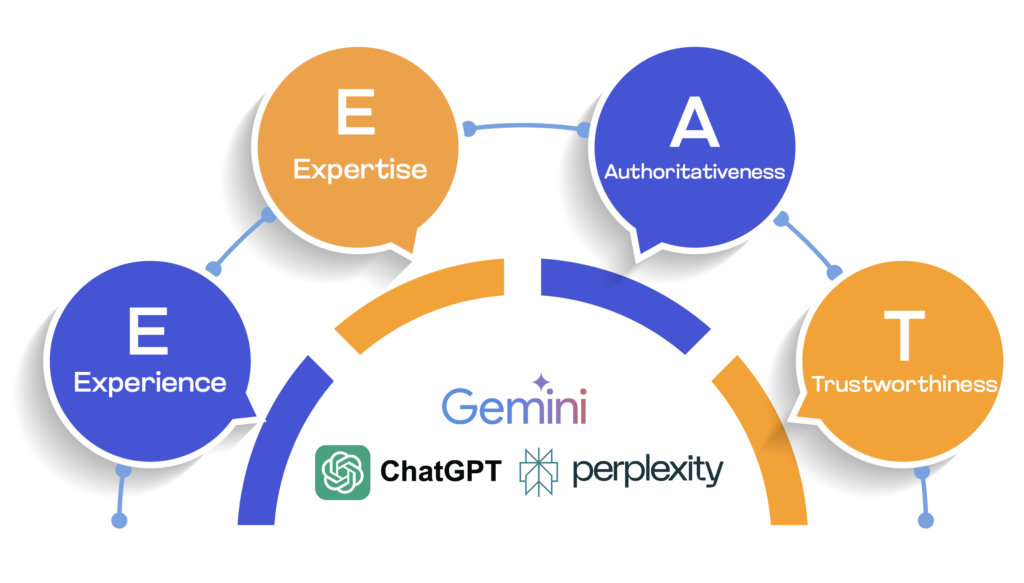
Search rankings no longer respond to thin content and keyword tricks. Google’s quality algorithms now put experience, expertise, authoritativeness, and trustworthiness—collectively known as E-E-A-T—at the center of every evaluation. AI EEAT optimization is the systematic application of artificial intelligence to strengthen these signals across your digital footprint. It moves beyond basic on-page tweaks and helps brands build sustainable authority without exhausting manual resources. This guide breaks down exactly how AI reshapes E-E-A-T, where the technology excels, and the precise steps to implement a strategy that Google trusts and users lean into.
What Is AI EEAT Optimization?

AI EEAT optimization refers to the use of artificial intelligence tools and models to audit, generate, monitor, and elevate the experience, expertise, authoritativeness, and trustworthiness signals a website sends to both search engines and real people. It automates high-effort tasks such as entity extraction, content gap analysis based on real expert sources, author credibility scoring, and review sentiment pattern detection. Instead of replacing human expertise, the most effective applications of AI EEAT optimization layer machine speed over human insight—surfacing exactly where trust gaps exist and proposing concrete fixes backed by data.
The concept grew out of the collision between Google’s increasing emphasis on content quality metrics and the pressure on CMS-driven sites to scale trustworthy content. AI EEAT optimization does not fabricate authority; it identifies real credentials, structures them for search engines, and validates that every piece of content passes a stringent quality filter before publication. The result is a site architecture that naturally aligns with the intricacies of Google’s Search Quality Evaluator Guidelines without guesswork.
The Core Components of E-E-A-T in an AI Context
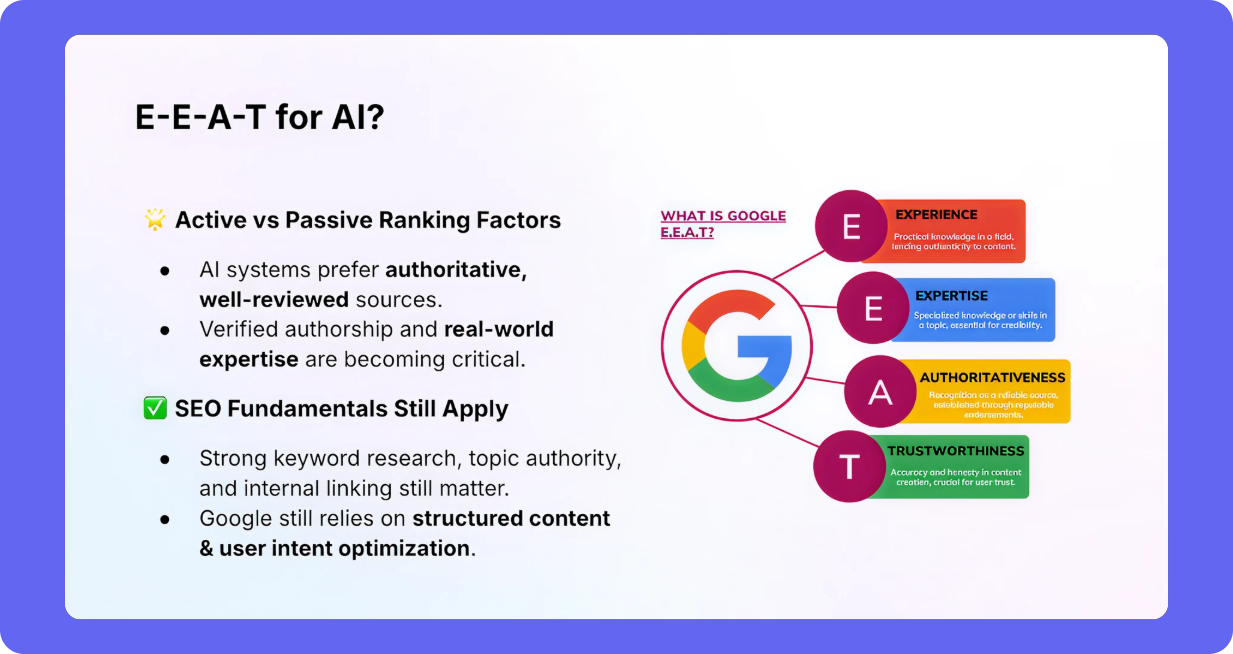
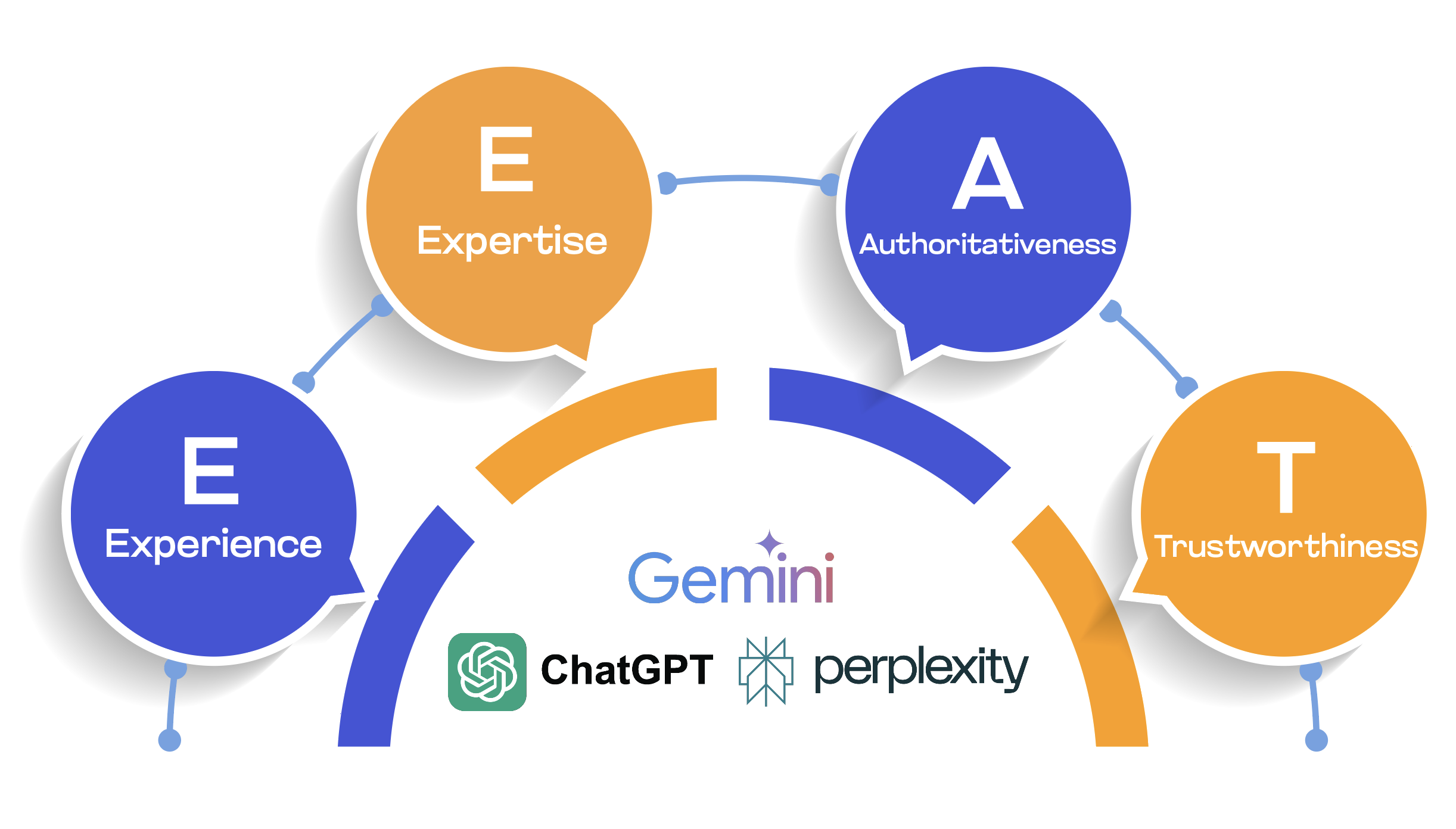
To optimize with AI, you first need to understand what the algorithm sees. E-E-A-T breaks down into four pillars, and each one interacts differently with machine intelligence.
Experience
Experience measures whether the creator has actual first-hand, real-world interaction with the topic. An AI cannot personally use a product or recover from an injury, so raw AI-generated content often flunks this criterion. AI EEAT optimization handles experience by scanning for unique experiential data points—like original photographs, specific step-by-step procedures, or verified purchase signals—and then ensuring these elements are surfaced prominently in the HTML, structured data, and visual summaries. Tools powered by computer vision and natural language processing can flag when a page lacks demonstrable first-hand engagement and suggest where to inject user-generated content, case studies, or on-site testing results to close the gap.
Expertise
Expertise demands depth of knowledge. AI EEAT optimization shines here by cross-referencing your content against authoritative knowledge bases, research papers, and competitor deep dives. An advanced language model can identify missing subtopics that a true subject-matter expert would cover, highlight inconsistencies in technical descriptions, and even recommend citation sources that solidify factual credibility. The crucial layer is human review, but the AI dramatically shortens the research-to-publish cycle and prevents omission errors that weaken perceived expertise.
Authoritativeness
Authoritativeness goes beyond the page to the entity behind it—the author, the brand, the organization. AI EEAT optimization automates author entity building: aggregating credentials, published works, external mentions, and social validation into a knowledge graph-ready format. It can audit the semantic relationship between your brand and authority hubs, detect missing backlinks from niche-recognized domains, and structure Author Schema so search engines instantly connect a human expert to the content they produce. Artificial intelligence also monitors the web for emerging authority signals, alerting you when a team member earns a new certification or publishes research that can be claimed and showcased.
Trustworthiness
Trust sits at the foundation. AI EEAT optimization addresses trust through security analysis, transparency scoring, and sentiment mining. Crawlers can verify HTTPS implementation, privacy policy completeness, and contact transparency at scale. Sentiment analysis on third-party reviews, forum discussions, and social chatter feeds into a trust health dashboard, flagging reputational risks before they escalate. Additionally, AI checks that factual claims inside your content align with trusted datasets, reducing the risk of publishing misleading information that would erode user confidence and search standing.
How AI Transforms Each Pillar of E-E-A-T
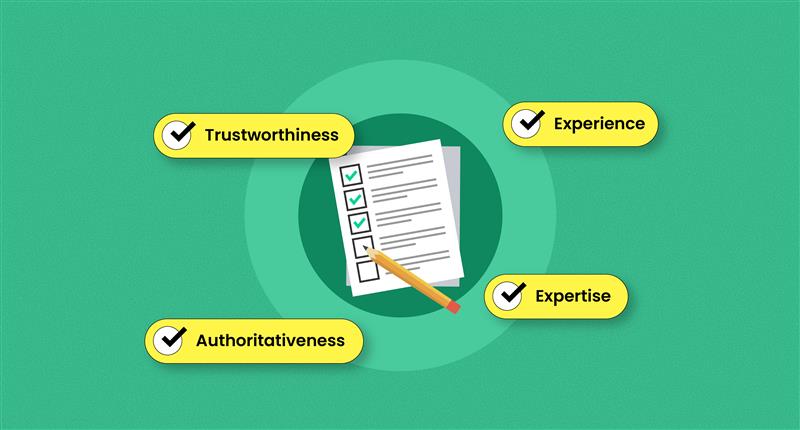
The real power emerges when AI acts as a continuous improvement engine, not a one-time generator. For experience, AI can parse thousands of support tickets and product feedback snippets to draft FAQ sections that mirror genuine user challenges—content that screams lived-in expertise. In expertise optimization, semantic analysis models compare your topical coverage against industry-recognized syllabi and trending queries, ensuring your resource center becomes the definitive source. For authoritativeness, machine learning identifies journalists, analysts, and institutions that have already cited your brand, surfacing unlinked mentions that can be converted into trust-boosting backlinks through strategic outreach.
Trustworthy signals multiply when AI monitors real-time changes to Google’s help content guidelines, detects outdated claims in legacy posts, and triggers revision workflows. The technology can also automate ClaimReview schema integration for fact-checked articles and validate medical or financial content against regulatory standards—a non-negotiable necessity for YMYL (Your Money or Your Life) sites.
Benefits and Limitations of AI EEAT Optimization
Benefits
- Scalable quality control: Maintain uniform E-E-A-T standards across thousands of URLs without a proportional expansion of human editors.
- Entity consistency: Ensure author names, logos, and affiliation data remain perfectly synchronized across the site, structured data, and third-party profiles.
- Proactive trust monitoring: Catch negative sentiment bursts or outdated information before Google reevaluates page quality.
- Data-driven content mapping: Pinpoint exact subtopics and citations that high-authority competitors feature, then close the gap with precision.
- Faster response to algorithm shifts: AI models can be retrained on new quality signals much faster than human teams can re-read updated guidelines.
- Zero genuine experience: AI cannot taste food, test a product, or offer real-life anecdotes. Over-reliance fabricates a hollow depth that sophisticated quality raters detect.
- Knowledge cutoff constraints: Static models lose temporal relevance on fast-moving topics unless frequently updated, risking factual drift on medical or legal content.
- Nuance blindness: Sentiment algorithms can misunderstand sarcasm, cultural context, or subtle professional disagreements, misclassifying trust signals.
- Compliance gaps: AI may suggest structures that violate privacy regulations or industry-specific advertising rules without human legal oversight.
- Initial integration cost: Building a robust AI EEAT optimization stack requires clean data pipelines, API access, and a team that understands both SEO and machine learning outputs.
- Publishing AI content without human experience injection: AI can write about a medical procedure but cannot provide patient testimony. Make it mandatory that every page includes at least one original experiential element—a quote from a practitioner, a verified patient review, or a photo from a real clinic.
- Fabricating author credentials: AI tools that auto-generate “Dr. X” with invented degrees destroy trust. Always verify credentials against third-party databases and use structured data only for real humans or legitimate organizations.
- Ignoring negative user signals: An AI EEAT optimization stack that focuses solely on on-page factors misses critical behavioral metrics. Combine your approach with user engagement analysis—pogo-sticking rates, rapid back-button exits—to refine content quality.
- Over-optimizing schema without user value: Stuffing FAQ schema with AI-generated questions that nobody asks triggers spam signals. Base schema on actual customer service queries and forum threads to reflect real informational demand.
- Setting and forgetting trust monitoring: Sentiment analysis models degrade over time as language evolves. Retrain them quarterly with fresh labeled data representative of your industry’s vernacular.
Limitations
AI EEAT Optimization vs. Traditional Manual Approaches: A Comparison
Understanding where AI fits best helps allocate resources wisely. The table below contrasts the two approaches across practical dimensions.
| Aspect | Manual E-E-A-T Optimization | AI EEAT Optimization |
|---|---|---|
| Speed | Slow; requires expert calls, manual fact-checking, and biography updates | Immediate data gathering; automated analysis in hours across thousands of pages |
| Consistency | Variable; quality depends on individual editor’s domain knowledge | High; uniform application of trust and expertise checks at scale |
| Depth of Research | Deep when performed by subject-matter experts; expensive and unscalable | Broad; combines multiple sources but may miss niche practitioner insights without human curation |
| Authenticity of Experience | Strong when author has real-world involvement | Weak if content relies solely on AI generation; requires human injection of unique data points |
| Reputation Management | Reactive; often discovers reviews or mentions too late | Proactive; 24/7 sentiment monitoring and alerting for brand mentions |
| Cost Effectiveness at Scale | Poor; expert hours multiply linearly with content volume | Excellent; fixed tooling costs with near-zero marginal increase per page |
A hybrid model consistently delivers the strongest results. AI EEAT optimization handles audit, monitoring, and structural integrity while human experts inject experiential authenticity, nuanced opinions, and final sign-off on high-stakes pages.
A Step-by-Step Guide to Implementing AI EEAT Optimization
Moving from theory to execution requires a phased approach that respects both search engine expectations and your team’s operational maturity.
Step 1: Perform an AI-Powered E-E-A-T Content Audit
Feed your site’s top-performing and most vulnerable pages into an AI content auditor trained on quality rater guidelines. The tool should output an E-E-A-T score per page—flagging missing author bios, thin experiential evidence, and factual claims lacking authoritative citations. Set up a dashboard that prioritizes YMYL pages (health, finance, legal) and pages with recent traffic drops. The output becomes your roadmap for the next steps.
Step 2: Build and Validate Author Entity Profiles
Aggregate each author’s real-world credentials—degrees, certifications, industry speaking engagements, published research—using AI-powered entity reconciliation. Link those credentials to personal author pages, embed Author schema that includes sameAs references to LinkedIn and Google Scholar, and automatically audit that every article displays a robust bio snippet. For brands, extend the same principle to Organization schema with verified logos, official name, and contact points.
Step 3: Strengthen Content with Experience-First Signals
Use computer vision APIs to identify whether your pages include original images, proprietary data charts, or screenshots that prove hands-on engagement. AI can suggest spots where a unique case study, original survey result, or behind-the-scenes process photo would convert a generic post into experience-rich content. Replace stock imagery with real, watermarked photos where possible; the AI pipeline can auto-optimize alt text and geo-tag for authenticity.
Step 4: Fact-Check and Deepen Expertise
Connect your content to a fact-verification engine that cross-references medical guidelines, legal statutes, or financial regulations in real time. The AI flags any statement that drifts from the consensus of high-authority sources, recommending revised language and direct citation links. Simultaneously, run a topical gap analysis: compare your page against the combined coverage of the top three organic competitors and instruct your editors to fill identified gaps with expert commentary.
Step 5: Automate Trust Signal Monitoring
Integrate review platform APIs, social listening tools, and security scanners into a unified AI monitoring layer. Set thresholds for negative sentiment spikes, SSL certificate expiration, and broken contact methods. When the system detects a trust risk, it automatically opens a task for the crisis team and temporarily pulls affected pages from discovery via a noindex tag if the issue is severe enough. Regularly publish trust transparency pages that highlight your satisfaction guarantees, real customer stories, and compliance certifications—content the AI updates dynamically as new ratings come in.
Step 6: Deploy Intelligent Structured Data at Scale
AI excels at generating and validating schema types that reinforce E-E-A-T—ClaimReview for fact-checked claims, HowTo for experiential step-by-step guides, Product with aggregated ratings, and FAQ built from genuine user queries. An AI schema validator continuously checks your deployment against Google’s rich result requirements and alerts on errors before they trigger manual action warnings.
Common Mistakes in AI EEAT Optimization and How to Avoid Them
Even well-intentioned implementations can backfire if teams ignore certain pitfalls.
Important Notes for Long-Term Success
AI EEAT optimization operates best as a continuous feedback loop, not a campaign. Google’s quality raters are trained to interrogate whether a site demonstrates genuine care for users. The moment your E-E-A-T strategy becomes performative, it collapses. Sustainable success requires a few non-negotiable principles.
First, AI must always be a tool in the hands of skilled editors. The person who reviews AI-generated insights should have subject-matter authority capable of overruling a machine recommendation. Second, prioritize transparency. When AI assists in research, disclose that fact on editorial pages—modern audiences and search engines reward honesty. Third, invest in proprietary data. First-party research, original surveys, and unique product tests are impossible for AI to replicate and form the highest form of experience signal. Fourth, align AI EEAT optimization with your brand’s real-world reputation. Optimize what you actually do, not what you wish you were; consistency across online and offline presence is the golden thread of trust.
Frequently Asked Questions About AI EEAT Optimization
What is AI EEAT optimization?
AI EEAT optimization is the use of artificial intelligence technologies to improve a website’s experience, expertise, authoritativeness, and trustworthiness signals. It combines entity analysis, content quality auditing, schema automation, sentiment tracking, and expert credential validation to help sites align with Google’s quality guidelines at scale.
How does AI help improve E-E-A-T in SEO?
AI speeds up E-E-A-T improvements by automatically identifying missing author bios, fact-checking content against authoritative sources, monitoring brand reputation across the web, generating structured data that clarifies entity relationships, and surfacing content gaps that prevent a page from being recognized as a comprehensive resource.
Can AI-generated content hurt E-E-A-T?
Yes. Purely AI-generated content that lacks original experience, verifiable citations, and human editorial review can seriously damage E-E-A-T. Google’s systems evaluate whether content demonstrates first-hand knowledge. Without genuine experiential inputs such as original data, case studies, or expert commentary, AI text alone appears shallow and may be classified as low quality.
How can I use AI to build author authority?
AI can aggregate an author’s external credentials—professional licenses, publications, speaking roles—from verified web sources and structure them into Author schema. It can also audit that content attributed to an author matches their real expertise, while continuously monitoring for new accomplishments that can be added to the author page to strengthen perceived authority.
What tools support AI EEAT optimization?
A complete stack typically includes large language models for content gap and factuality analysis, entity extraction APIs for building knowledge graphs, sentiment analysis platforms for review monitoring, computer vision tools for experiential image assessment, and schema validators that automate structured data. Many enterprise SEO suites now integrate these capabilities into a unified E-E-A-T workflow.
Is AI EEAT optimization against Google’s guidelines?
No, not inherently. Google’s guidelines discourage automation that creates low-quality, unoriginal content at scale. AI EEAT optimization focuses on helping human editors identify and fix trust gaps, enrich content with real expertise, and ensure technical accuracy. When the technology supports, rather than replaces, human oversight, it aligns fully with Google’s emphasis on people-first content.
Bringing It All Together
The future of organic visibility belongs to sites that can prove their worth beyond raw keyword density. AI EEAT optimization provides the engine to demonstrate that proof consistently across thousands of touchpoints, without sacrificing the human touch that ultimately earns trust. By combining machine-driven audits, entity intelligence, and sentiment awareness with relentless editorial integrity, you build a digital presence that search engines classify not just as a source of information, but as an authoritative destination worth ranking at the very top. The technology is ready—the competitive advantage goes to the brands that deploy it with authenticity first.
Xem thêm:
- AI SEO SEO Automation System: The Complete Guide to Scaling Organic Growth in 2025
- AI SEO Make Automation: The Complete Guide to Scaling Organic Growth in 2025
- WP Trove AI Copywriting: The Complete Guide to Smarter Content Creation
- AI White Hat SEO: Mastering Ethical Search Optimization in the Age of Artificial Intelligence
- Generative Engine Optimization: The Ultimate Guide to Winning AI-Powered Search
Bài viết cùng chủ đề:

AI SEO SEO Automation with Make: The Complete Workflow Guide

AI SEO SEO Automation with Zapier: The Complete Workflow Guide

AI SEO SEO Automation with n8n: The Complete Workflow Guide
AI SEO SEO Automation with Gemini: The Complete Guide to Scaling Organic Growth

AI SEO SEO Automation with Claude: The Complete Guide to Scaling Content in 2025

AI SEO SEO Automation with ChatGPT: The Complete Playbook for 2025

AI SEO & SEO Automation for Affiliate Sites: The 2025 Playbook for Passive Income Growth
AI SEO & SEO Automation for Bloggers: The Complete Guide to Scaling Your Content

AI SEO & SEO Automation for Agencies: The Complete 2025 Playbook

AI SEO and SEO Automation for Ecommerce: The Complete Playbook for 2025

AI SEO & SEO Automation for WordPress: The Complete Playbook for 2025
AI SEO SEO Automation Strategy: The Complete Playbook for 2025

Mastering the AI SEO SEO Automation Process: A Complete Guide to Scaling Organic Growth
AI SEO SEO Automation System: The Complete Guide to Scaling Organic Growth in 2025
AI SEO SEO Automation Platform: The Complete Guide to Scaling Organic Growth in 2025
AI SEO SEO Automation Software: The Complete Guide to Scaling Organic Growth in 2025















