No products in the cart.
AI SEO SEO Automation with Claude: The Complete Guide to Scaling Content in 2025

10
Aug
Aug
AI SEO SEO automation with Claude is transforming how digital marketing teams produce, optimize, and scale their organic search presence. As search engines increasingly reward genuinely helpful content, leveraging Anthropic’s Claude models for SEO workflows has moved from experimental to essential. This guide explores how to build robust automation pipelines using Claude’s API, natural language processing capabilities, and long-context understanding to outperform traditional content mills while maintaining editorial quality. You will learn concrete strategies, technical implementations, and practical workflows that combine human oversight with machine efficiency.
Understanding AI SEO SEO Automation with Claude
AI SEO SEO automation with Claude refers to the systematic use of Anthropic’s large language models to execute repetitive, data-intensive, and creative SEO tasks without manual intervention. Unlike basic AI writing tools, Claude excels at understanding complex instructions, maintaining brand voice across long documents, and processing massive datasets—making it ideal for enterprise-level content operations.
The core value proposition lies in the intersection of three capabilities: Claude’s 200k token context window (allowing analysis of entire websites or competitor clusters), its nuanced instruction-following (enabling precise formatting and tone control), and its tool-use functionality (permitting direct API calls to search engines or databases). This combination allows marketers to automate keyword clustering, content brief generation, on-page optimization, and even technical SEO audits.
The Evolution from Manual SEO to AI-Driven Workflows
Traditional SEO relied on spreadsheets, manual content briefs, and human writers producing 1,000-word articles over several days. The modern approach using Claude shifts this paradigm. A single prompt can generate a comprehensive content brief with semantic keyword variations, competitor gap analysis, and internal linking suggestions in under 60 seconds. This speed does not sacrifice depth—Claude’s training data includes extensive SEO best practices, and its ability to reason through multi-step problems allows for sophisticated strategic planning.
For example, a digital agency managing 50 client websites can use Claude to draft unique meta descriptions for every page, generate FAQ schemas based on search query mining, and rewrite thin content—all within a single afternoon. The automation layer handles the repetitive lifting, while human strategists focus on high-level decisions like topic selection and brand positioning.
Core Components of an AI SEO Automation Stack
Building a successful AI SEO SEO automation with Claude requires understanding the key technical components that work together. These elements form the foundation of any scalable system.
1. Claude API Integration Layer
The API serves as the engine room. You can access Claude via the Anthropic API (models like Claude 3.5 Sonnet or Claude 3 Opus) or through platforms like Amazon Bedrock and Google Vertex AI. The integration layer handles authentication, request throttling, and response parsing. For high-volume operations, batch processing via asynchronous requests is essential to manage rate limits effectively.
Key parameters to configure include temperature (set between 0.2 and 0.5 for consistent SEO output), max tokens (adjust based on task complexity), and system prompts that define the assistant’s role as an SEO specialist. A well-crafted system prompt dramatically improves output relevance, reducing the need for post-editing.
2. Data Pipeline and Storage
Automation requires structured data inputs. Your pipeline should collect search volume data (from tools like Ahrefs or Semrush), existing site crawl data (via Screaming Frog or custom crawlers), and competitor content. This data feeds into Claude as context, enabling the model to generate insights grounded in real metrics rather than generic advice.
Storage solutions like PostgreSQL or cloud-based data warehouses store the outputs—content drafts, keyword maps, and audit reports—for downstream publishing systems. Version control is critical here, as iterative prompt refinement often requires comparing historical outputs.
3. Orchestration and Workflow Management
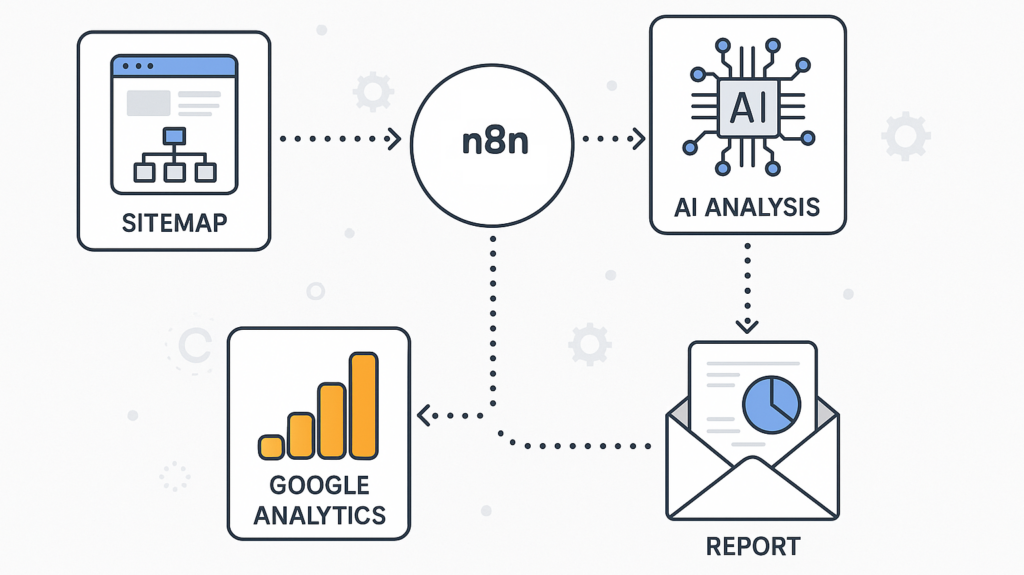
Tools like Zapier, Make (formerly Integromat), or custom Python scripts orchestrate the sequence of tasks. A typical workflow might be: trigger on new keyword list → send to Claude for clustering → receive cluster output → generate content briefs → send briefs to human approval → upon approval, generate full drafts → push to CMS via WordPress API. This orchestration layer ensures that automation runs reliably without constant human monitoring.
Practical Applications: Where Claude Excels in SEO
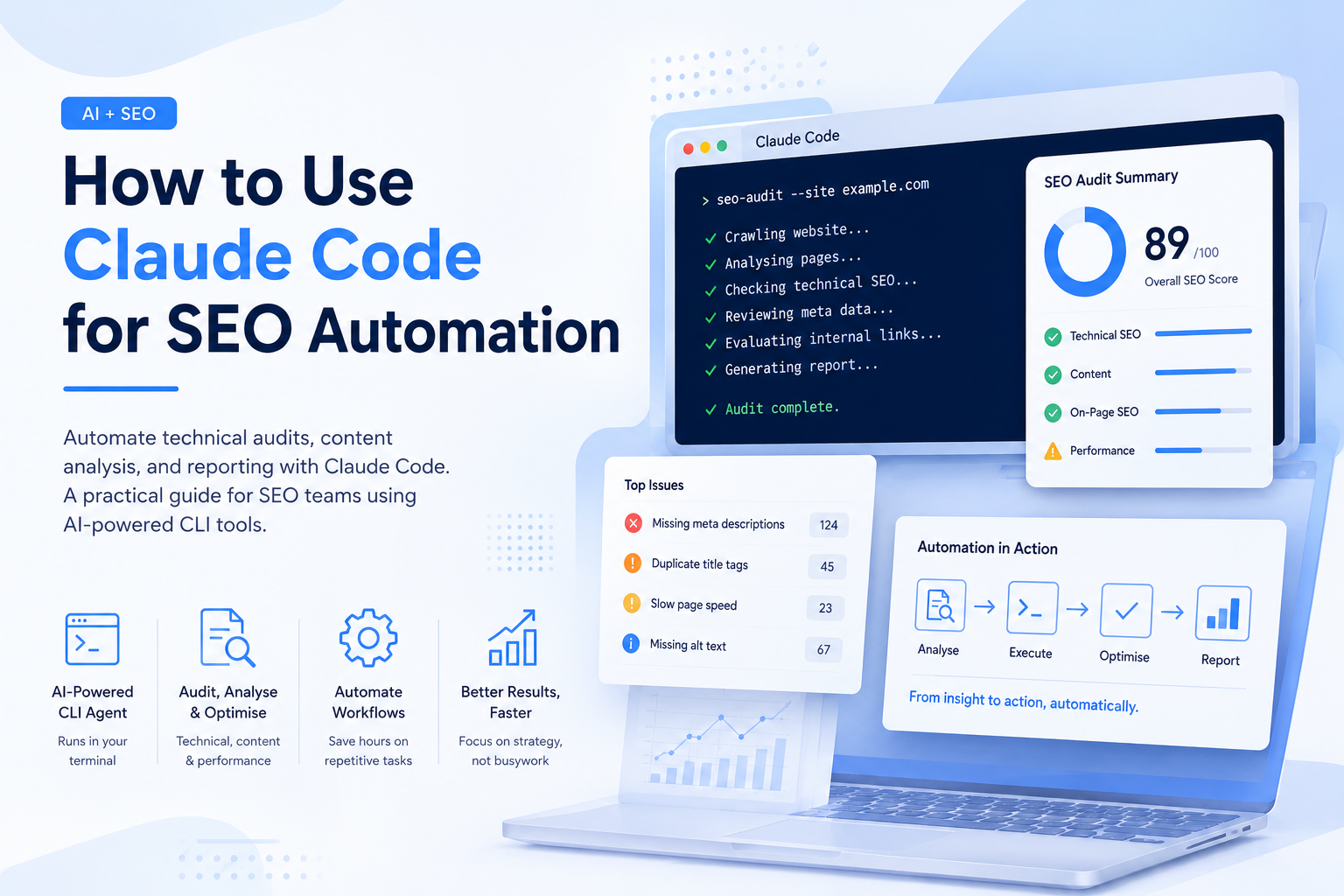
AI SEO SEO automation with Claude is not a single use case but a suite of applications. Understanding where the model provides the highest ROI helps prioritize implementation efforts.
Automated Keyword Clustering and Topic Modeling
Manual keyword clustering is tedious and often inconsistent. Claude can process thousands of keywords, analyze search intent signals (informational, transactional, navigational), and group them into semantically related topics. The model understands nuances like synonymy and co-occurrence patterns, producing clusters that align with Google’s understanding of entity relationships.
For instance, given 500 keywords related to “project management software,” Claude can separate them into clusters for “best tools,” “pricing comparisons,” “implementation guides,” and “team collaboration features.” Each cluster then informs a distinct content pillar, ensuring comprehensive topical coverage without cannibalization.
Dynamic Content Brief Generation
Content briefs generated by Claude go beyond simple outlines. By feeding the model competitor URLs, search engine results page (SERP) features, and user intent data, Claude produces briefs that specify: target word count, required H2/H3 structure, semantic LSI keywords to include, questions to answer (pulled from “People Also Ask”), and internal linking opportunities. These briefs serve as blueprints for human writers or as direct prompts for AI writing tools.
The quality of these briefs often surpasses manually created ones because Claude synthesizes data from multiple sources simultaneously. It can read a top-ranking article, extract its core arguments, identify content gaps, and propose a superior structure—all in one pass.
On-Page Optimization at Scale
For existing websites with hundreds of pages, Claude can automate title tag rewrites, meta description generation, header tag optimization, and image alt text creation. The model maintains brand consistency by referencing a style guide provided in the system prompt. This scalability is impossible with human copywriters alone, especially for e-commerce sites with thousands of product pages.
Claude also excels at internal linking suggestions. By analyzing the semantic relationship between pages, it can recommend anchor text and placement that improves crawlability and distributes link equity more effectively than simple “related posts” plugins.
Benefits and Limitations of Claude-Based SEO Automation
Adopting AI SEO SEO automation with Claude brings significant advantages, but a realistic assessment of its constraints is necessary for successful implementation.
Key Benefits
- Unmatched Speed: Tasks that take days manually are completed in minutes, enabling real-time content updates and rapid response to algorithm changes.
- Consistency: Claude applies the same standards to every page, eliminating the variability inherent in human writers.
- Cost Efficiency: While API costs exist, they are a fraction of the cost of hiring additional content strategists or agencies.
- Data Synthesis: The ability to process large datasets (competitor analyses, search trend reports) provides strategic insights that are difficult to derive manually.
- Scalability: Workflows can handle 10 pages or 10,000 pages with the same infrastructure, making growth predictable.
- Hallucination Risk: Claude can generate plausible but incorrect facts, especially for niche topics. Human fact-checking remains mandatory for YMYL (Your Money or Your Life) content.
- Lack of Real-Time Data: The model’s training data has a cutoff date. It cannot know the latest algorithm updates or breaking industry news without external data injection.
- Brand Voice Nuance: While Claude mimics tone well, deeply idiosyncratic brand voices may require extensive prompt engineering and iterative refinement.
- Dependency on Input Quality: Garbage in, garbage out. Poor keyword data or flawed competitor analysis leads to suboptimal outputs.
Critical Limitations
Comparison: Claude vs. Other AI SEO Tools
Understanding how Claude stacks up against alternatives helps justify its adoption in your tech stack. The following table compares key differentiators.
| Feature | Claude (Anthropic) | ChatGPT (OpenAI) | Jasper AI | Surfer SEO |
|---|---|---|---|---|
| Context Window | Up to 200k tokens | Up to 128k tokens (GPT-4) | Limited (varies) | N/A (not a language model) |
| Primary Use Case | Complex reasoning, long-form content, data analysis | General writing, coding, brainstorming | Marketing copy, brand voice | On-page optimization scoring |
| API Flexibility | High, with tool use and vision | High, with plugins | Medium, SaaS-focused | Limited, specific to SEO |
| Cost per 1M tokens (input) | $3 (Sonnet) to $15 (Opus) | $5 (GPT-4o mini) to $30 (GPT-4) | Subscription-based | Subscription-based |
| Best For | Custom automation pipelines | General AI tasks | Non-technical marketers | Content optimization scoring |
Claude’s advantage lies in its balance of reasoning capability and cost. For high-volume automation where you need the model to follow complex, multi-step instructions reliably, Claude often outperforms more expensive models. Its safety training also reduces the risk of generating harmful or biased content, which is crucial for brand reputation.
Step-by-Step Guide to Implementing Claude Automation
Implementing AI SEO SEO automation with Claude requires a structured approach. Follow these steps to move from concept to production.
Step 1: Define Your Automation Goals
Start with a specific, measurable objective. Do you want to reduce content production time by 50%? Increase the number of optimized pages per month from 20 to 200? Improve organic click-through rates through better meta descriptions? Clear goals determine which workflows to build first and how to measure success.
Step 2: Set Up Your Development Environment
Create an Anthropic account and obtain your API key. Install the official Python SDK or use REST API calls. For non-developers, platforms like Relevance AI or Gumloop offer no-code interfaces to connect Claude to your existing tools. Ensure you have a test environment to experiment with prompts without affecting production data.
Step 3: Engineer Your Core Prompts
Prompt engineering is the most critical skill. A high-performing SEO prompt includes: a clear role definition (“You are a senior SEO strategist”), the specific task (“Generate a content brief for the keyword ‘best CRM for small business‘”), input data (competitor URLs, SERP features), output format (JSON or markdown), and constraints (word count, tone, target audience). Iterate on prompts using a small sample of data before scaling.
Step 4: Build the Data Pipeline
Connect your SEO tools. Use APIs from Ahrefs, Semrush, or Google Search Console to pull keyword data and performance metrics. Store this data in a structured format (CSV, JSON) that Claude can ingest. For technical SEO audits, export crawl data from Screaming Frog and feed it to Claude for analysis and recommendations.
Step 5: Create the Orchestration Workflow
Use Python scripts or automation platforms to chain tasks. A simple workflow for meta description generation might be: read URL list from Google Sheets → for each URL, fetch page content → send to Claude with prompt → receive description → write back to Sheets. Add error handling and logging to monitor failures.
Step 6: Implement Human-in-the-Loop Review
Automation does not mean removing humans. Establish a review queue where generated content or recommendations are checked by an editor before publishing. This is especially important for factual claims, statistics, and legal or medical topics. Use project management tools like Asana or Trello to manage the review workflow.
Step 7: Monitor, Measure, and Iterate
Track key performance indicators (KPIs) such as organic traffic, keyword rankings, and conversion rates. Compare automated content performance against manually created baselines. Use this data to refine prompts, adjust workflows, and identify new automation opportunities. Continuous improvement is the hallmark of successful AI integration.
Common Mistakes and How to Avoid Them
Many teams fail to realize the full potential of AI SEO SEO automation with Claude due to avoidable errors. Recognizing these pitfalls is the first step to mitigating them.
Mistake 1: Over-Reliance on Unedited AI Output
Publishing raw Claude output without review leads to generic, low-value content that fails to rank. Search engines detect AI-generated patterns, and users bounce quickly. The solution is to treat Claude as a first draft generator, not a final author. Inject human expertise, personal experience, and unique data points to elevate the content.
Mistake 2: Ignoring Search Intent Nuances
Claude can generate content that matches keywords but misses the underlying user intent. For example, a keyword like “coffee” could mean “how to brew coffee,” “best coffee beans,” or “coffee near me.” Failing to specify intent in your prompts results in irrelevant content. Always provide intent context in your prompts and validate outputs against actual SERP results.
Mistake 3: Neglecting Prompt Updates
SEO is dynamic. What works today may not work tomorrow. Teams that set prompts once and forget them see performance degrade over time. Regularly review and update prompts based on algorithm changes, new competitor strategies, and performance data. Treat prompts as living documents.
Mistake 4: Scaling Poor-Quality Data
Automating a flawed process simply produces flawed results faster. If your keyword research is outdated or your competitor analysis is superficial, Claude will amplify these errors. Invest time in data quality before scaling automation.
Mistake 5: Lack of Clear Brand Guidelines
Claude needs explicit instructions on brand voice, prohibited words, and stylistic preferences. Without these, outputs will be generic and inconsistent. Develop a comprehensive brand style guide and integrate it into your system prompts.
Important Notes for Responsible Implementation
Using Claude for SEO automation carries responsibilities beyond technical execution. Adhering to ethical and practical guidelines ensures long-term success.
First, always disclose AI assistance where required by platform policies or legal regulations. Transparency builds trust with your audience and protects your brand from potential penalties. Second, prioritize user value over search engine manipulation. Google’s helpful content system rewards content that genuinely answers user queries, regardless of how it was produced. Use Claude to enhance helpfulness, not to spam low-quality pages.
Third, maintain data privacy. When sending data to the Claude API, ensure you are not transmitting sensitive customer information or proprietary business secrets without proper safeguards. Review Anthropic’s data usage policies and consider using enterprise-grade API endpoints with data isolation guarantees.
Finally, stay updated on model capabilities. Anthropic regularly releases new versions with improved reasoning, longer context, and better instruction following. Periodically test new models to see if they offer performance gains for your specific workflows.
Frequently Asked Questions
Is AI SEO SEO automation with Claude suitable for small businesses?
Yes, small businesses can benefit significantly. The API’s pay-as-you-go pricing means you only pay for what you use. Starting with simple tasks like meta description generation or blog post outlines requires minimal technical expertise, especially with no-code platforms. The key is to start small, measure results, and expand gradually.
What is the cost of using Claude for SEO automation?
Costs vary based on model choice and usage volume. Claude 3.5 Sonnet costs $3 per million input tokens and $15 per million output tokens. Generating a 1,500-word article might cost between $0.10 and $0.30 depending on prompt complexity. For a small business producing 20 articles per month, this is a negligible expense compared to hiring writers.
Can Claude replace human SEO specialists?
No, Claude cannot replace human strategic thinking, industry experience, or relationship building. It excels at execution and analysis but lacks the intuition to navigate ambiguous business situations. The most effective approach is a hybrid model where Claude handles repetitive tasks and humans focus on strategy, creative direction, and final quality control.
How does Claude handle local SEO tasks?
Claude can generate localized content, such as city-specific landing pages, by incorporating location data into prompts. It can also analyze local search results and suggest optimizations for Google Business Profile listings. However, it cannot directly manage your Google Business Profile or respond to reviews, which requires dedicated tools.
What are the risks of using AI for SEO content?
The primary risks include producing low-quality or duplicate content that triggers algorithmic penalties, losing brand authenticity, and potential copyright issues if the model reproduces copyrighted text. Mitigate these risks by implementing rigorous human review, using plagiarism checkers, and ensuring your prompts emphasize originality and factual accuracy.
Conclusion
AI SEO SEO automation with Claude represents a paradigm shift in how digital marketing teams operate. The ability to automate complex, data-driven tasks at scale—from keyword clustering to content brief generation to technical audits—provides a competitive edge that manual processes cannot match. However, the technology is a tool, not a replacement for strategic thinking. The most successful implementations combine Claude’s computational power with human editorial judgment, ethical practices, and a relentless focus on user value.
Start by identifying one repetitive SEO task that consumes significant team time. Build a simple automation using Claude, measure the time saved and quality impact, and iterate. As you gain confidence, expand to more complex workflows. The future of SEO belongs to those who can harness AI’s capabilities while maintaining the human touch that builds trust and authority. The time to start is now, and the tools are readily available.
Xem thêm:
- AI SEO Extensions: The Smart Way to Automate and Supercharge Your Search Rankings
- AI SEO Trends 2027: The Complete Blueprint for Search Dominance
- AI SEO Image Optimization: The Complete Guide to Boosting Rankings in 2025
- AI Editorial Calendar: Revolutionize Your Content Planning with Smart Automation
- AI SEO Automation: The Complete Guide to Ranking Smarter, Not Harder
Bài viết cùng chủ đề:

AI SEO SEO Automation with Make: The Complete Workflow Guide

AI SEO SEO Automation with Zapier: The Complete Workflow Guide

AI SEO SEO Automation with n8n: The Complete Workflow Guide
AI SEO SEO Automation with Gemini: The Complete Guide to Scaling Organic Growth

AI SEO SEO Automation with ChatGPT: The Complete Playbook for 2025

AI SEO & SEO Automation for Affiliate Sites: The 2025 Playbook for Passive Income Growth
AI SEO & SEO Automation for Bloggers: The Complete Guide to Scaling Your Content

AI SEO & SEO Automation for Agencies: The Complete 2025 Playbook

AI SEO and SEO Automation for Ecommerce: The Complete Playbook for 2025

AI SEO & SEO Automation for WordPress: The Complete Playbook for 2025
AI SEO SEO Automation Strategy: The Complete Playbook for 2025

Mastering the AI SEO SEO Automation Process: A Complete Guide to Scaling Organic Growth
AI SEO SEO Automation System: The Complete Guide to Scaling Organic Growth in 2025
AI SEO SEO Automation Platform: The Complete Guide to Scaling Organic Growth in 2025
AI SEO SEO Automation Software: The Complete Guide to Scaling Organic Growth in 2025
AI SEO SEO Automation Workflow: The Complete Guide to Scaling Organic Growth in 2025