No products in the cart.
AI SEO SEO Automation with Make: The Complete Workflow Guide

10
Aug
Aug
AI SEO SEO automation with Make is transforming how digital marketers handle repetitive search optimization tasks. By connecting artificial intelligence tools like ChatGPT or Claude with the Make automation platform, teams can streamline keyword research, content generation, internal linking, and rank tracking without manual intervention. This guide breaks down the exact workflows, practical examples, and strategic considerations for implementing AI-driven SEO automation using Make, helping you reclaim hours of productive time while improving your search visibility.
What Is AI SEO Automation with Make?
AI SEO automation with Make refers to the process of using Make (formerly Integromat) as a central hub to connect AI language models, SEO tools, and data sources into automated scenarios. These scenarios trigger specific actions—like generating meta descriptions or analyzing competitor pages—whenever a defined event occurs, such as a new blog post being published or a keyword dropping in rankings.
Make operates on a visual canvas where you build workflows by dragging and dropping modules. Each module represents an app or service, and you connect them with routes and filters. When combined with AI, Make becomes a powerful engine that can write, optimize, and audit content at scale, all while following your predefined rules and brand guidelines.
The Core Components of an AI SEO Automation Stack
To build effective automation, you need three primary layers. The first layer is the trigger source, which could be a Google Sheet, RSS feed, WordPress post, or a scheduled time. The second layer is the AI processing unit, typically an API connection to OpenAI, Anthropic, or Google Gemini. The third layer is the output destination, such as your CMS, Google Search Console, or an analytics dashboard.
For example, a simple scenario might watch a Google Sheet for new keyword ideas. When a new row appears, Make sends that keyword to ChatGPT with a prompt asking for a title tag and meta description. The AI returns the text, and Make pushes it into a WordPress draft. This entire process takes about 30 seconds, compared to the 10 minutes it would take manually.
Why Use Make for AI SEO Automation Instead of Other Tools?
Make stands out among automation platforms like Zapier or n8n for several reasons specific to SEO workflows. First, Make offers granular data manipulation through its built-in text parser, router, and aggregator modules. You can split a long article into paragraphs, send each chunk to an AI for rewriting, and then recombine them—something that is clunky in other tools.
Second, Make’s pricing model is based on operations, not tasks. For SEO agencies handling thousands of URLs, this often proves more cost-effective. Third, Make provides robust error handling and rollback features, which is critical when you are pushing AI-generated content directly to a live website.
Comparing Make with Zapier for SEO Tasks
| Feature | Make | Zapier |
|---|---|---|
| Data transformation | Advanced (text aggregators, arrays, JSON) | Basic (limited to simple formatting) |
| AI integration depth | Custom API calls with full prompt control | Pre-built actions with limited parameters |
| Error handling | Rollback, partial execution, detailed logs | Simple retry logic |
| Pricing for high volume | Operations-based, often cheaper | Task-based, can get expensive |
| Visual debugging | Real-time data flow inspection | Limited to input/output views |
For SEO professionals who need to manipulate large datasets, extract structured data from HTML, or build complex conditional logic, Make is the superior choice. Zapier works fine for simple one-to-one automations, but it struggles when you need to loop through multiple pages or parse JSON responses from AI APIs.
Practical AI SEO Workflows You Can Build in Make
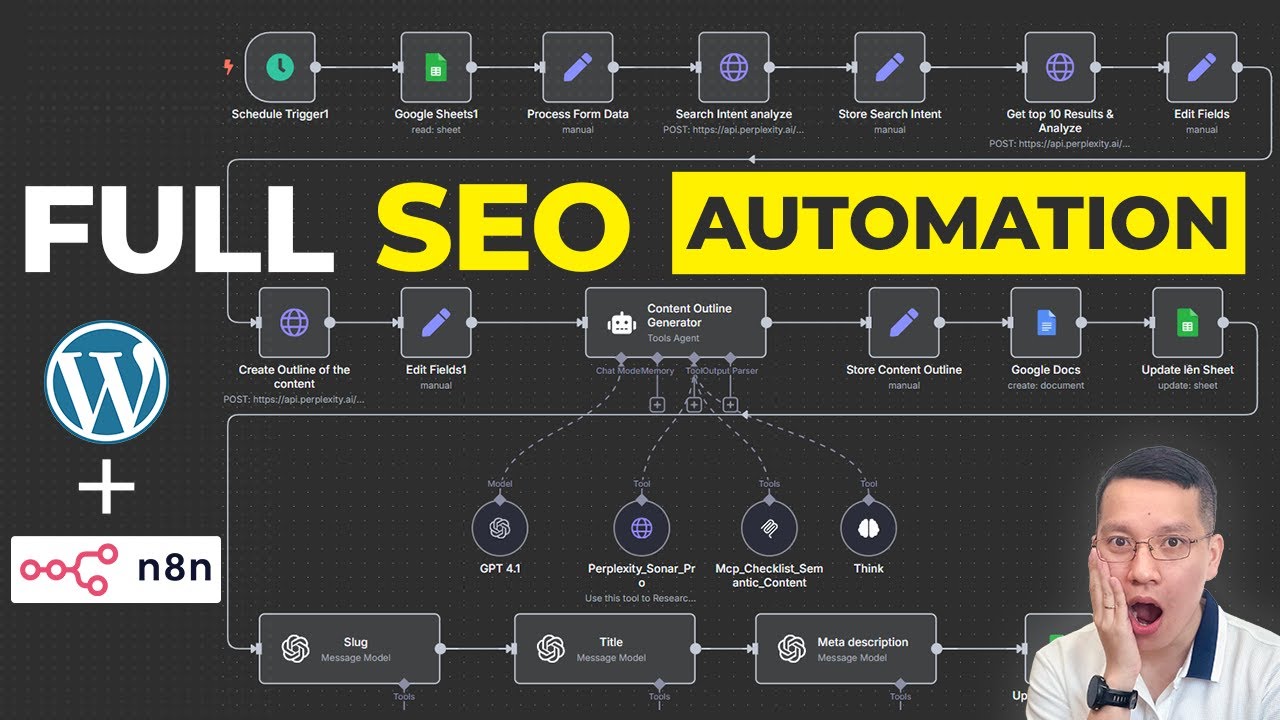
The possibilities are vast, but several high-impact workflows deliver immediate ROI. Below are the most effective automation scenarios that combine AI with Make for SEO purposes.
Automated Keyword Clustering and Content Brief Generation
Start with a list of 100 keywords in a Google Sheet. Make reads each keyword, sends it to an AI model with a prompt like “Group this keyword with similar intent keywords and suggest a primary topic.” The AI returns a cluster label. Make then aggregates all keywords by that label and creates a new sheet with content briefs, including suggested headings, search intent, and related questions.
This workflow eliminates the manual spreadsheet work that typically takes a full day. The AI provides the semantic understanding, while Make handles the data organization and deduplication.
Automated Meta Description Writing and A/B Testing
Connect Make to your CMS database. For every page that lacks a meta description, Make extracts the page title and first 150 words of content. It sends this to an AI with instructions to write three different meta descriptions, each under 155 characters, with a call-to-action. Make then pushes these variations to a testing tool like Google Optimize or stores them in a spreadsheet for manual review.
The key advantage You can generate meta descriptions for 500 pages in under an hour, something that would take a team of writers several days.
Automated Internal Link Suggestions
Internal linking is a tedious but crucial SEO task. Make can automate the discovery process by fetching all your published posts from WordPress, extracting the main topic of each post using AI, and then comparing those topics against a list of your pillar pages. When a match is found, Make generates a suggested anchor text and creates a task in your project management tool for a human to approve and insert the link.
This workflow ensures you never miss an internal linking opportunity, and it scales effortlessly as you publish more content.
Automated Rank Tracking and Alert System
Use Make to connect to Google Search Console’s API on a daily schedule. The scenario pulls your top 50 pages and their average positions. It sends this data to an AI model that identifies pages with significant drops or gains. The AI writes a brief analysis of why the change might have occurred, based on recent content updates or algorithm shifts. Make then sends this report to your Slack channel or email.
This gives you a daily executive summary without needing to log into multiple dashboards.
Step-by-Step Guide: Building Your First AI SEO Automation
Let’s walk through a concrete example: automating the creation of FAQ schema markup for your blog posts. This is a practical, high-value workflow that demonstrates the core principles of AI SEO automation with Make.
Step 1: Set Up the Trigger
Create a new scenario in Make. Choose the “Watch Published Posts” trigger from the WordPress module. This will fire every time you publish a new post. If you don’t use WordPress, you can use an RSS feed or a Google Sheets row as your trigger.
Step 2: Extract Content
Add a “Get a Post” module to retrieve the full content of the newly published post. Make will output the HTML content, title, and URL. You need to clean this HTML to plain text. Use the built-in “Text Parser” module with a regex pattern to strip out all tags.
Step 3: Send to AI for FAQ Generation
Add an HTTP module that makes a POST request to the OpenAI API. In the request body, include a prompt like: “Based on the following article, generate 5 frequently asked questions with concise answers. Format the output as JSON with keys ‘question’ and ‘answer’.” Paste the cleaned article text into the prompt.
Make will receive the JSON response. Use the “Parse JSON” module to extract the array of questions and answers.
Step 4: Create Schema Markup
Use a “Text Aggregator” module to loop through each question-answer pair and build the FAQPage schema in JSON-LD format. The aggregator combines all items into a single JSON object.
Step 5: Insert Schema into the Page
Finally, use the WordPress “Update a Post” module to append the generated schema markup to the post’s custom fields or header code area. Make can also send the schema to Google Tag Manager if you prefer that route.
This entire scenario runs in under two minutes after each post is published, ensuring your FAQ schema is always up to date without any manual coding.
Benefits of AI SEO Automation with Make

The advantages extend beyond simple time savings. Automation introduces consistency and scale that manual processes cannot match.
- Consistent output: AI follows the same prompt every time, so your meta descriptions or title tags maintain a uniform style and length.
- Scalability: Whether you have 50 pages or 50,000, the automation handles the volume without additional headcount.
- Faster iteration: You can test different AI prompts and see results in days, not weeks.
- Data-driven decisions: Automation logs every action, giving you a complete audit trail of what was changed and when.
- Reduced human error: No more forgetting to add alt text or missing a keyword in a title tag.
Limitations and Risks to Consider
AI SEO automation is not a silver bullet. There are significant limitations that you must manage carefully to avoid harming your rankings.
Quality Control Issues
AI models can produce fluent but factually incorrect content. If you automate the creation of on-page copy, you risk publishing misinformation. Always set up a human review step for any content that will be publicly visible. Use automation for drafts, suggestions, and repetitive metadata, but keep a human editor in the loop for final approval.
Prompt Dependency
The quality of your AI output is entirely dependent on your prompt engineering. A vague prompt like “write a meta description” will yield poor results. You need to invest time in crafting detailed prompts that include your brand voice, target audience, and specific SEO constraints.
API Costs
Every AI call costs money. If you are processing thousands of pages, the API fees can add up quickly. Monitor your usage and consider using cheaper models like GPT-3.5 Turbo for simple tasks and reserving GPT-4 for complex content generation.
Algorithm Changes
Search engines are increasingly sophisticated at detecting AI-generated content. While using AI for metadata is generally safe, using it to generate entire articles without human editing can trigger spam penalties. Use automation to assist, not replace, your content creation process.
Common Mistakes and How to Avoid Them
Many teams jump into AI SEO automation and immediately encounter problems. Here are the most frequent pitfalls and the strategies to avoid them.
Mistake 1: Automating Without a Clear Goal
Building a complex scenario just because you can is a waste of time. Before you start, define the exact problem you are solving. Are you trying to reduce time spent on meta descriptions? Increase internal links? Improve indexation? Start with one specific, measurable goal.
Mistake 2: Ignoring Data Privacy
When you send content to an AI API, you are sending it to a third-party server. If you are processing unpublished drafts or client data, this could be a breach of confidentiality. Check your AI provider’s data retention policy and consider using enterprise agreements that guarantee zero retention.
Mistake 3: Not Adding Error Handling
APIs fail, timeouts happen, and data formats change. If your Make scenario does not have error handling routes, a single failure can stop the entire workflow. Add error branches that send alerts to Slack or email, and set up automatic retries for transient failures.
Mistake 4: Over-Automating Content Creation
Publishing fully AI-written articles without human review is a fast track to losing your search rankings. Google’s helpful content system explicitly targets low-value, automated content. Use AI to generate outlines, drafts, and research, but always have a subject matter expert rewrite and fact-check before publishing.
Important Notes for Successful Implementation
To get the most out of AI SEO automation with Make, keep these strategic considerations in mind.
First, start small. Pick one workflow, like meta description generation, and run it for two weeks. Measure the click-through rate changes and the time saved. Once you have proven the value, expand to other areas.
Second, document your prompts. Create a prompt library in a shared document. This ensures that if a team member leaves, their knowledge is not lost. It also allows you to iterate on prompts systematically.
Third, monitor your automation logs weekly. Make provides detailed execution logs. Review them to identify bottlenecks, failed operations, and opportunities for optimization. You might find that a particular AI model is returning errors, or that your data source has changed its format.
Fourth, combine automation with human creativity. The best SEO strategies come from human insight into user behavior, market trends, and brand positioning. Use automation to handle the repetitive tasks, freeing up your team to focus on strategy and analysis.
Frequently Asked Questions
What is the difference between AI SEO automation and traditional SEO tools?
Traditional SEO tools like Ahrefs or SEMrush provide data and suggestions, but they require manual action to implement changes. AI SEO automation with Make goes a step further by automatically executing those changes. For example, a traditional tool might tell you that a page has a missing meta description. Automation would generate that description and publish it to your site without you touching the CMS.
Do I need coding skills to use Make for AI SEO?
No, Make is a no-code platform. You build workflows using a visual interface with drag-and-drop modules. However, some basic understanding of APIs, JSON, and webhooks is helpful for advanced scenarios, especially when you need to make custom HTTP requests to AI models.
Which AI models work best with Make for SEO tasks?
OpenAI’s GPT-4 and GPT-3.5 Turbo are the most common choices due to their strong language understanding and API reliability. Anthropic’s Claude models are also excellent for longer content analysis. For budget-conscious projects, Google’s Gemini Flash offers a lower cost per token. The best model depends on your specific task, volume, and quality requirements.
Can AI SEO automation replace human SEO specialists?
No, automation replaces tasks, not strategic thinking. AI can generate content and analyze data, but it cannot understand your brand’s unique voice, build relationships with other websites for link building, or make judgment calls about complex algorithm updates. The role of the SEO specialist shifts from doing manual work to overseeing and refining the automated systems.
How much does it cost to run AI SEO automation with Make?
Costs vary based on volume. Make’s paid plans start around $9 per month for 1,000 operations. AI API costs depend on the model and the number of tokens processed. For a small blog processing 100 pages a month, you might spend $20 to $50 total. For a large agency handling millions of URLs, costs can reach thousands of dollars per month.
Is AI-generated content penalized by Google?
Google’s official stance is that it penalizes spammy, low-quality content regardless of whether it is written by a human or AI. Content that is helpful, original, and demonstrates E-E-A-T (Experience, Expertise, Authoritativeness, Trustworthiness) will rank well. If you use AI to generate content, you must ensure it is factually accurate, well-researched, and edited by a human expert.
Conclusion
AI SEO automation with Make represents a significant shift in how digital marketing teams operate. By leveraging the power of large language models and the flexibility of Make’s automation canvas, you can eliminate hours of repetitive work, improve consistency across your web properties, and scale your SEO efforts without proportional increases in headcount or budget.
The key to success lies in thoughtful implementation. Start with a single, well-defined workflow. Invest time in crafting precise prompts. Always maintain human oversight for quality and strategic direction. Monitor your results, iterate on your processes, and gradually expand your automation footprint as you gain confidence.
The future of SEO is not about choosing between human intelligence and artificial intelligence. It is about combining the two. Make provides the connective tissue that allows AI to work alongside your team, handling the heavy lifting while your experts focus on the creative and analytical work that truly moves the needle. Those who embrace this hybrid approach now will have a significant competitive advantage as search engines continue to evolve.
Xem thêm:
- AI SEO Updates: Navigating the New Era of Search Engine Optimization
- AI SEO GEO Strategy: The Complete Guide to Generative Engine Optimization in 2025
- AI SEO LLM Brand Visibility: The Complete Playbook for the Generative Search Era
- AI SEO Claude Projects: The Complete Guide to Automating Search Rankings in 2025
- How to Scale SEO with AI: The Ultimate Guide to Automating Organic Growth
Bài viết cùng chủ đề:

AI SEO SEO Automation with Zapier: The Complete Workflow Guide

AI SEO SEO Automation with n8n: The Complete Workflow Guide

AI SEO SEO Automation with Gemini: The Complete Guide to Scaling Organic Growth

AI SEO SEO Automation with Claude: The Complete Guide to Scaling Content in 2025

AI SEO SEO Automation with ChatGPT: The Complete Playbook for 2025

AI SEO & SEO Automation for Affiliate Sites: The 2025 Playbook for Passive Income Growth
AI SEO & SEO Automation for Bloggers: The Complete Guide to Scaling Your Content

AI SEO & SEO Automation for Agencies: The Complete 2025 Playbook

AI SEO and SEO Automation for Ecommerce: The Complete Playbook for 2025

AI SEO & SEO Automation for WordPress: The Complete Playbook for 2025
AI SEO SEO Automation Strategy: The Complete Playbook for 2025

Mastering the AI SEO SEO Automation Process: A Complete Guide to Scaling Organic Growth
AI SEO SEO Automation System: The Complete Guide to Scaling Organic Growth in 2025
AI SEO SEO Automation Platform: The Complete Guide to Scaling Organic Growth in 2025
AI SEO SEO Automation Software: The Complete Guide to Scaling Organic Growth in 2025
AI SEO SEO Automation Workflow: The Complete Guide to Scaling Organic Growth in 2025