
No products in the cart.
AI Content Pruning: The Complete Strategy to Remove Weak Pages and Skyrocket SEO Performance

29
Jul
Jul
The web is cluttered with outdated blog posts, thin product descriptions, and pages that haven’t earned a single visitor in months. AI content pruning is the systematic process of identifying and removing or consolidating such underperforming content using artificial intelligence to supercharge a website’s authority and crawl efficiency. Instead of guessing which articles should stay, you rely on machine learning models that analyze traffic patterns, user engagement signals, keyword gaps, and content quality at scale. This approach turns a tedious audit into a data‑driven growth lever, and it is rapidly becoming a non‑negotiable practice for SEO teams who manage thousands of URLs.
In the following guide, every aspect of AI content pruning is unpacked—from the core technology that powers it to a repeatable workflow you can implement within days. You will discover how to tell the difference between a page that needs a rewrite and one that deserves deletion, the exact metrics AI considers, and the hidden risks that cause rankings to drop when pruning is done poorly. All information is grounded in real‑world application, with no vague theory.
What Is AI Content Pruning?

AI content pruning is the practice of auditing a website’s existing content inventory with the help of artificial intelligence and then systematically cutting, merging, or noindexing pages that fail to meet quality and performance thresholds. The “pruning” analogy is deliberate: just as a gardener removes dead branches so the healthy ones can flourish, website owners clear out content bloat so search engines concentrate ranking signals on the pages that actually deliver value.
Unlike traditional manual audits, AI-powered pruning uses natural language processing (NLP) to measure topical depth, semantic relevance, and readability. It also ingests log file data, click‑through rates, and conversion metrics to judge whether a URL helps the site or hurts it. The output is a prioritized list of pages to keep as they are, refresh with updated information, merge with similar articles, or eliminate entirely. This method transforms what was once a gut‑feel exercise into a repeatable, objective, and extremely fast quality control system.
The Core Technology That Powers AI Content Pruning
Understanding the machine beneath the hood removes the mystery and helps you trust the recommendations. AI content pruning tools are built on several interconnected layers of analysis that evaluate content from three angles: performance, substance, and structure.
Traffic and Engagement Signal Extraction
The first layer pulls data from Google Search Console, Google Analytics, and server logs. AI models do not just look at current organic traffic; they examine twelve‑month trends, seasonal fluctuations, and the ratio of entrances to exits. A page that once attracted thousands of visitors but has been declining steadily for six quarters may be flagged as a candidate for refresh or retirement. Meanwhile, pages with zero clicks but strong backlinks are treated differently—pruning must account for link equity.
Content Quality Scoring via NLP
Advanced models like BERT and proprietary scoring systems read the actual text. They assess whether the content comprehensively covers the topic by comparing it against top‑ranking competitors. Thin pages—those with fewer than 300 words of shallow information—are easily spotted. The AI also detects duplicate content, outdated statistics, and missing entities that modern searchers expect. This quality score becomes one of the main pillars for the keep‑or‑delete decision.
Topical Overlap and Cannibalization Detection
AI content pruning examines semantic relationships across your entire site. When two or more pages target essentially the same keyword cluster but split the authority, the tool flags a cannibalization risk. It then suggests the best course of action: either choose the strongest page and 301‑redirect the others, or merge the content into a single definitive resource. Without AI, spotting these overlaps inside a site of 5,000 URLs is practically impossible.
Predictive Ranking Impact Models
The most sophisticated platforms simulate what happens to your overall organic visibility after specific URLs are pruned. By training on historical indexation changes and ranking shifts, the AI can warn you if removing a seemingly useless page might cause a drop in a neighboring cluster. This prediction layer is what separates blunt‑force deletion from surgical pruning.
Why AI Content Pruning Has Become Essential for Modern SEO
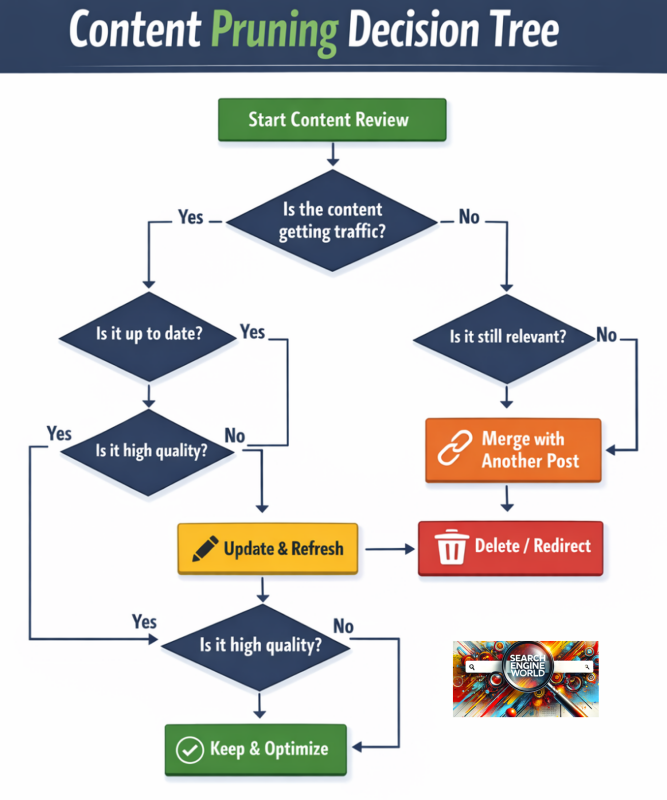
Google’s algorithms continuously refine how they allocate crawl budget and how they evaluate a domain’s overall quality. Having hundreds of low‑value pages is no longer a neutral factor—it actively drags down the entire site. Several concrete shifts have made AI content pruning a core tactic rather than an optional cleanup:
- Crawl budget efficiency: Googlebot has a finite resource allocated to each site. If it wastes time crawling thin tag pages, empty category archives, or multiple near‑duplicate blog posts, it may miss new, important content. Pruning guides the crawler toward pages that matter.
- Helpful content signals: Since the rollout of the helpful content system, sites with a high proportion of unsatisfying content see their entire rankings suppressed. AI content pruning directly improves the ratio of helpful to unhelpful pages.
- Core Web Vitals and page experience: Many old pages are built on heavy templates or contain bloated code. Removing them lightens the overall site structure, which can indirectly improve performance metrics across the remaining URLs.
- Authority consolidation: When you merge three weaker posts into one powerful guide, all incoming internal and external links point to a single URL, amplifying its ability to compete for competitive terms.
- Keep: High‑performing, quality content that needs no immediate change.
- Refresh: Decent page with outdated information or a declining traffic curve.
- Merge: Content overlapping with a stronger peer; move unique insights and then redirect.
- Noindex: Page that serves internal users but has no search value (e.g., filtered search results).
- Delete (410 or 301): Zero traffic, no backlinks, thin content with no salvageable pieces.
- Stronger topical authority: A domain with 200 tightly focused, high‑value pieces is seen as more expert than one with 2,000 pieces of mixed quality. AI pruning intensifies your authority in your niche.
- Improved internal linking structure: When thin pages vanish, link equity redistributes. AI can even suggest new internal links to strengthen the refreshed content, based on the pruned pages’ former connections.
- Faster content production cycles: Teams stop wasting time creating yet another blog post that competes with existing pages. Instead, they spend energy improving and consolidating.
- Higher user satisfaction metrics: Visitors land on complete, up‑to‑date resources. Bounce rates drop, time on page increases, and these engagement signals feed back into rankings.
- Context blindness: AI might see a page with low traffic and thin text as useless, but that page could serve as legal documentation, a required disclosure, or a support article that solves a critical customer issue offline. Human review must override for business‑essential pages.
- Backlink oversight: Some tools undervalue external links pointing to a page. Deleting a URL that holds even a handful of authoritative backlinks, without a proper redirect, erases hard‑earned equity. Always manually inspect the backlink profile of prune candidates.
- Threshold tunneling: Setting rigid cut‑offs—for instance, delete everything with fewer than 100 pageviews—ignores seasonal content and newly published articles still gaining traction. AI models need to incorporate freshness and trend data to avoid premature culling.
- Historical data gaps: If a site recently migrated tracking codes or lost analytics data, the AI won’t have an accurate picture. Validate data integrity before initiating any large‑scale pruning.
- SEO crawlers with analytical layers: Screaming Frog’s custom extraction and API connections can feed data into your own machine learning models. For teams with data science skills, this approach offers maximum control.
- Content optimization suites: Platforms like MarketMuse, Clearscope, or Surfer SEO analyze content quality and topical completeness. They are excellent at identifying thin pages and content gaps, though they often need pairing with traffic data.
- All‑in‑one AI content pruning tools: Emerging dedicated tools handle the entire process from crawl to action recommendation. Evaluate them based on the transparency of their scoring algorithms and the flexibility of their output formats.
- Custom Google Sheets + GPT models: Many smaller teams combine Google Analytics data with the OpenAI API to batch‑score content quality and semantic overlap. While more hands‑on, this method is affordable and fully customizable.
Step-by-Step AI Content Pruning Process
Executing a successful pruning project requires discipline, not just a tool. Follow this framework to ensure you cut what needs cutting and preserve what still holds value.
1. Crawl and Inventory Every Indexable URL
Begin with a full site crawl using a tool like Screaming Frog or Sitebulb, exporting all HTML pages that return a 200 status code. Supplement this with an export from your XML sitemap and Google Search Console’s index coverage report. The goal is to build a single master inventory containing every page that Google can see.
2. Enrich the Data with Performance Metrics
Connect the URL list to Google Analytics and Search Console via API or manual export. For each URL, collect: 12-month organic clicks, impressions, average click‑through rate, bounce rate, conversion completions, number of backlinks (pulled from Ahrefs or Majestic), and last modified date. AI content pruning tools automate this stitching, but you can do it with spreadsheets if the domain is small.
3. Run AI Quality Evaluation
Feed the content body (or the URL) into your chosen AI writing assistant or dedicated pruning platform. The system will return scores for word count, uniqueness, topic coverage, readability, and entity richness. Set threshold values: for example, pages with a quality score below 40 out of 100 and fewer than 10 organic clicks in the last year become automatic prune candidates.
4. Detect Cannibalization and Overlap
Let the AI cluster URLs by primary keyword or topic. Pages with a similarity score above 80% are reviewed. Determine the canonical version—usually the one with the most backlinks and highest organic traffic—and plan to merge the rest into it or redirect them. Remove the weaker pages only after the merge content is live.
5. Assign Custom Actions for Each URL
Every page in the inventory receives one of five actions:
6. Implement, Monitor, and Iterate
Apply the changes during a low‑traffic period if possible. Set up 301 redirects from deleted pages to relevant live pages—never to the homepage unless absolutely necessary. After implementation, watch the index status in Search Console for two weeks, then shift to monthly monitoring of organic impressions and average position for the remaining pages. The AI model can be rerun quarterly to catch new bloat before it accumulates.
AI Content Pruning vs Manual Content Pruning
While a skilled SEO professional can manually audit a few hundred URLs, the sheer scale of modern websites makes manual work unsustainable. The table below highlights the key differences.
| Factor | Manual Content Pruning | AI Content Pruning |
|---|---|---|
| Speed for 1,000 URLs | 40–60 hours of repetitive work | Less than 2 hours for analysis, plus implementation time |
| Content quality assessment | Human reads samples; subjective and inconsistent | NLP scores each page against objective criteria; consistent benchmarks |
| Cannibalization detection | Requires manual tagging and keyword mapping; easy to miss overlaps | Semantic clustering automatically surfaces duplicate intent pages |
| Cost at scale | Linear increase with more pages; becomes prohibitive | Flat fee or monthly subscription; marginal cost per URL near zero |
| Predictive insight | Based on practitioner’s experience; prone to oversight | Algorithmic simulation of ranking movements before any change |
Critical Benefits of AI Content Pruning (Beyond Crawl Budget)
The most obvious win is a cleaner site, but the ripple effects run deeper.
Limitations and Risks to Recognize
No technology is flawless, and blind trust in AI can cause serious SEO damage. Acknowledge these constraints before you start.
Common Mistakes When Pruning Content with AI
Even experienced teams fall into the traps below. Knowing them in advance keeps your project disaster‑free.
Deleting pages without setting up 301 redirects. Any URL that has ever been indexed or linked to internally must be redirected to the next most relevant page. A 404 is a dead end for users and link equity. For pages that truly have no redeeming value and no links, a 410 Gone response is cleaner, but only after verifying there are zero external backlinks.
Treating all thin pages equally. A thin product description with a unique SKU but low word count might still be the only page ranking for a niche long‑tail query. Compare the keyword footprint before removal. AI classification helps, but a manual sanity check on keyword rankings prevents accidentally killing money pages.
Pruning too aggressively in one push. Removing 30% of a site’s pages overnight can shock search engines. Stagger the implementation over multiple weeks, monitoring the index coverage report for sudden spikes in errors. This gives you time to revert if a cluster behaves unexpectedly.
Ignoring content refresh opportunities. Many pages flagged as “prune” are simply outdated, not worthless. Refreshing a post with current data, updating the publish date, and improving its internal links often revives traffic within weeks, saving the URL from deletion.
Choosing the Right Tools for AI Content Pruning
No single platform does everything, but a combination of specialized software covers the full workflow. While the AI landscape changes rapidly, the categories remain stable.
Important Notes for Long‑Term Success
AI content pruning is not a one‑time cleanup. Build it into your editorial calendar. Set quarterly audits, and immediately after any major site migration, run the analysis again. Keep meticulous records of every deleted or redirected URL, along with the rationale, in a changelog. This documentation proves invaluable when diagnosing a ranking drop months later.
Before any pruning action, take a full backup of the site—both files and database—and export the complete URL inventory with metrics. If you must roll back, you can restore the content and its historical tracking data. Also, communicate with other departments, especially customer support and legal, to confirm that no page flagged for deletion carries regulatory information or internal training value.
Finally, view AI recommendations as an informed colleague, not an infallible dictator. The strongest results come when a seasoned SEO strategist reviews the AI’s list, applying context and long‑term brand knowledge to every final decision.
Frequently Asked Questions
What exactly does AI content pruning involve?
AI content pruning involves using artificial intelligence to audit all pages on a website, assign quality and performance scores, and then recommend which pages should be kept, refreshed, merged, or removed. The AI analyzes traffic, backlinks, content depth, and cannibalization to make data‑driven pruning decisions.
How does AI content pruning improve SEO?
It improves SEO by consolidating ranking signals onto fewer, higher‑quality pages, making better use of crawl budget, and increasing the overall ratio of helpful content on the site. This leads to higher domain authority, better user engagement metrics, and fewer instances of keyword cannibalization.
Can AI content pruning hurt my rankings?
Yes, if done incorrectly. Deleting pages with strong backlinks without proper 301 redirects, removing content that still ranks for valuable long‑tail queries, or pruning too aggressively without monitoring can cause ranking drops. Always combine AI insights with human oversight and a thorough backlink check.
How often should I perform AI content pruning?
A full content pruning audit is recommended every three to six months, depending on how quickly you publish. Sites that produce daily content or user‑generated content may need quarterly reviews, while smaller static sites may only require an annual check.
Which metrics matter most for AI content pruning?
The most important metrics are organic traffic over the past twelve months, the number of unique backlinks, conversion rate (if applicable), content quality score, and whether the page causes keyword cannibalization. AI combines these weighted signals to suggest an action.
Conclusion
AI content pruning transforms the messy, often emotional process of deleting web pages into a disciplined, evidence‑based system. By letting algorithms sift through thousands of URLs, you liberate your team to focus on creating content that actually performs, while the site compacts its authority on fewer, stronger pages. The result is not just a cleaner sitemap—it is a measurable lift in rankings, a better experience for visitors, and a defense against the algorithmic penalties that haunt cluttered domains. Start small, verify each recommendation, and soon you will wonder why this wasn’t a standard part of your SEO routine years ago.
Xem thêm:
- AI SEO Schema Markup Generator: The Complete Guide to Automated Structured Data
- WP Trove AI Prompts: The Complete Guide to Unlocking WordPress Automation
- AI SEO for Digital Agencies: The Complete Playbook for Scaling Client Results
- AI SEO AI Agents: The Complete Guide to Autonomous Search Optimization in 2025
- WP Trove Content AI Review: The Ultimate WordPress Content Creation Tool in 2025
Bài viết cùng chủ đề:

AI SEO SEO Automation with Make: The Complete Workflow Guide

AI SEO SEO Automation with Zapier: The Complete Workflow Guide

AI SEO SEO Automation with n8n: The Complete Workflow Guide
AI SEO SEO Automation with Gemini: The Complete Guide to Scaling Organic Growth

AI SEO SEO Automation with Claude: The Complete Guide to Scaling Content in 2025

AI SEO SEO Automation with ChatGPT: The Complete Playbook for 2025

AI SEO & SEO Automation for Affiliate Sites: The 2025 Playbook for Passive Income Growth
AI SEO & SEO Automation for Bloggers: The Complete Guide to Scaling Your Content

AI SEO & SEO Automation for Agencies: The Complete 2025 Playbook

AI SEO and SEO Automation for Ecommerce: The Complete Playbook for 2025

AI SEO & SEO Automation for WordPress: The Complete Playbook for 2025
AI SEO SEO Automation Strategy: The Complete Playbook for 2025

Mastering the AI SEO SEO Automation Process: A Complete Guide to Scaling Organic Growth
AI SEO SEO Automation System: The Complete Guide to Scaling Organic Growth in 2025
AI SEO SEO Automation Platform: The Complete Guide to Scaling Organic Growth in 2025
AI SEO SEO Automation Software: The Complete Guide to Scaling Organic Growth in 2025















