
No products in the cart.
AI Link Building: The Definitive Guide to Smart Backlink Strategies in 2025
29
Jul
Jul
Securing high-quality backlinks remains one of the most influential ranking signals in search engine algorithms. Yet the traditional methods of link building are manual, time-consuming, and often hit-or-miss. AI link building changes this equation by integrating machine learning, natural language processing, and predictive analytics into every phase of the outreach and acquisition process. In this guide, you will discover how artificial intelligence transforms prospecting, personalization, content creation, and monitoring, allowing businesses to build authoritative backlink profiles faster and smarter than ever before.
What Is AI Link Building?
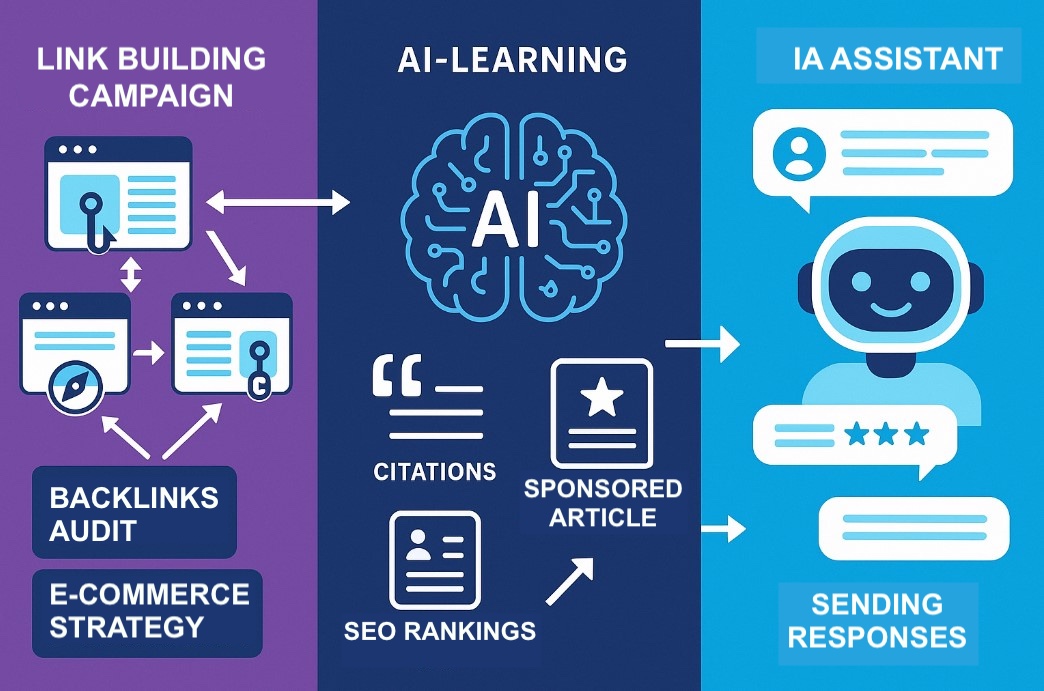
AI link building refers to the use of artificial intelligence technologies to streamline, automate, and enhance the process of acquiring backlinks from external websites. Unlike conventional link building that relies heavily on manual research and generic email templates, AI-driven approaches leverage algorithms to identify high-value prospects, craft highly personalized outreach messages, and predict which sites are most likely to link back. The result is a far more efficient pipeline that prioritises relevance and link quality over volume.
At its core, AI link building does not replace human strategy but amplifies it. Smart marketers now combine AI tools with editorial judgement to scale efforts without sacrificing authenticity. The technology can analyse millions of data points—from a domain’s authority and traffic trends to the topical relevance of its content—within seconds, tasks that would take a human team days or weeks to complete manually. This allows link builders to focus on relationship nurturing while the AI handles the heavy lifting of data sorting and pattern recognition.
The Technology Stack Behind Intelligent Link Building
Modern AI link building draws on several interconnected technologies. Understanding these components helps marketers choose the right tools and build robust workflows.
Natural Language Processing (NLP)
NLP enables machines to understand context, sentiment, and semantic meaning in text. For link building, NLP powers content gap analysis, email personalisation that mirrors human tone, and the detection of link-worthy topics. Tools use NLP to scan a prospect’s articles and suggest anchor text that flows naturally within their existing content structure. This avoids the unnatural feel of keyword-stuffed requests that editors quickly reject.
Machine Learning for Prospect Scoring
Machine learning models are trained on historical link building data to predict a website’s likelihood of accepting a guest post, resource link, or collaboration. Factors such as the site’s link-out frequency, domain rating trends, author engagement, and social signals combine into a dynamic score. Over time, the model learns which patterns indicate a high-conversion prospect, continuously refining its recommendations and reducing wasted outreach.
Predictive Analytics and SERP Analysis
Predictive engines analyse search engine results pages to identify domains that consistently secure links for a given topic. They then reverse-engineer those sites’ link profiles, unveiling patterns a competitor’s link builder might have exploited. With this intelligence, marketers can proactively target similar authoritative sources before their rivals do, turning reactive link building into a proactive strategy.
Generative AI for Content and Outreach
Large language models—trained on vast corpora—can generate initial drafts of guest post pitches, article outlines, and even full-length content that meets editorial standards. In link building, generative AI creates tailored email sequences, follow-ups, and social media messages that adapt to each recipient’s unique publishing style and recent content. The key is a strong review layer; human oversight ensures brand voice consistency and factual accuracy.
The AI Link Building Process: A Step-by-Step Breakdown
Implementing AI link building involves an interconnected series of stages, each enhanced by intelligent automation.
1. Intelligent Prospecting
Instead of manually searching for “write for us” pages or scraping blogs, AI tools ingest seed keywords and instantly return a curated list of prospect domains. The system evaluates SEO metrics such as Domain Authority, organic traffic, spam score, and topical relevance. It can also filter by link type—guest post, resource page, broken link, or unlinked brand mentions. Some platforms apply lookalike modelling: if a competitor earned a link from a particular site, the AI identifies dozens of similar domains ready to be pitched.
2. Data-Driven Personalization at Scale
Generic “Dear Webmaster” emails have single-digit response rates. AI changes this by scraping the prospect’s social bios, recent articles, and public interviews. It then generates an email opening that references a specific post, a shared professional interest, or a statistic the author used. The message feels hand-crafted because the AI has done the research a human would normally spend 10 minutes on. Marketers can review and tweak before sending, maintaining authenticity while dramatically increasing reply rates.
3. Content Ideation and Creation
AI analyses trending topics within a niche and identifies content formats that historically attract backlinks—such as original research, infographics, definitive guides, and interactive tools. It then creates structured briefs or full drafts. During outreach, AI-generated article outlines can be shared with prospects who prefer to see a detailed angle before committing. This drastically shortens the negotiation cycle because site owners see immediate value and minimal editing work.
4. Automated Follow-Up Sequences
Persistence matters in link building, but manual follow-ups often slip through the cracks. AI-driven CRM systems schedule follow-up emails based on recipient behaviour—whether they opened, clicked, or replied. The sequence adapts: if a prospect asked for more details, the AI sends a tailored response; if there was no engagement, it tries a different subject line or angle. This dynamic nurturing reduces forgetfulness and improves conversion without human micromanagement.
5. Link Monitoring and Performance Analysis
Once links are live, AI monitors them for status changes—nofollow additions, removal, or page deindexing. It also evaluates the actual SEO impact by correlating new backlinks with organic traffic shifts, keyword ranking improvements, and referral traffic. Advanced tools use attribution models to assign value to each acquired link, helping teams understand true ROI and reallocate budget toward the most effective tactics.
Benefits of AI Link Building
Adopting AI in your link building strategy delivers quantifiable advantages that go far beyond saving time. Here are the most important benefits SEO teams report after implementation.
- Unmatched efficiency: AI reduces prospecting time by up to 80%. A campaign that once required 40 hours of manual list building can be done in a morning, freeing strategists for relationship-building and content quality control.
- Higher conversion rates: Personalization driven by real data lifts email response rates from the typical 2–5% into the 15–25% range. When editors receive a message that clearly demonstrates familiarity with their work, they trust the sender more.
- Better link quality: AI’s scoring models filter out low-authority, spam-ridden domains automatically. The result is a cleaner backlink profile that withstands Google algorithm updates.
- Scalability without dilution: Traditional agencies hit a ceiling where scaling meant hiring more junior staff and quality declined. AI allows the same experienced team to manage multiple campaigns simultaneously while maintaining high personalization and editorial standards.
- Data-informed decisions: Instead of guessing which content type will earn links, AI provides predictive analytics that guide investment toward topics and formats with a proven backlink history in your niche.
- Quality control remains human-dependent: Generative AI can produce factually incorrect or bland content if not carefully reviewed. Publishing AI-written guest posts without expert editing risks damaging both the linking domain’s credibility and your own brand reputation.
- Over-automation can trigger red flags: Mass email platforms that send poorly targeted AI-generated pitches at scale may be flagged as spam by email service providers. Additionally, Google’s algorithms are adept at spotting unnatural link patterns, especially if AI is used to acquire links from irrelevant or low-quality sites at high velocity.
- Contextual nuance is sometimes missed: AI may misclassify a site’s niche or fail to detect subtle brand misalignments. A high-tech B2B company accidentally landing a link on a consumer gossip blog, even one with reasonable metrics, dilutes topical authority.
- Transparency and ethics: Some AI tools scrape personal data to craft hyper-personalized pitches that feel invasive. Brands must set clear ethical boundaries and comply with data privacy regulations like GDPR.
- Relying entirely on AI for prospecting without manual verification. AI might include sites that look authoritative on paper but have disengaged audiences or poor user experience. Always manually check a sample of prospects before loading them into an outreach sequence.
- Ignoring link relevance in pursuit of high metrics. A high Domain Authority score means little if the linking page is about cryptocurrency and your site sells organic baby food. AI tools can over-prioritise general authority. Fine-tune filters to prioritise topical relevancy above all else.
- Using generative AI to mass-produce guest posts. Publishers are increasingly wary of AI-written content. Submitting an obviously AI-generated article damages your relationship and can get you banned from the site. Instead, use AI for research and outlines, then let human writers develop the final piece.
- Neglecting relationship building. AI can draft charming emails, but it cannot attend an industry conference for you or hop on a quick call. The best link builders blend AI efficiency with genuine human networking. A warm introduction still outperforms the most optimised cold pitch.
- Not staying current with search engine guidelines. Google’s helpful content system and link spam updates evolve. AI models trained on old data may suggest tactics that are now risky, such as exact-match anchor text overuse. Always align your AI strategy with the latest webmaster guidelines.
Limitations and Risks to Consider

Despite its power, AI link building is not flawless. Understanding its boundaries prevents costly missteps and protects your site from penalties.
Traditional Link Building vs. AI Link Building: A Side-by-Side Comparison
| Aspect | Traditional Link Building | AI Link Building |
|---|---|---|
| Prospecting speed | Manual Google searches, hours per campaign | Algorithmic discovery, seconds to minutes |
| Personalization depth | Generic merge tags, low effort | Deep personalization based on journalistic analysis |
| Scale | Limited by team bandwidth | Virtually unlimited, maintains quality with guardrails |
| Response rate | 2–5% typical | 15–25% with AI-driven customization |
| Quality filtering | Manual metric checks, prone to error | Automated scoring using dozens of trust signals |
| ROI measurement | Largely anecdotal | Precise attribution linking backlinks to traffic and rankings |
How to Integrate AI into Your Link Building Workflow
Practical application separates theory from results. Follow these steps to embed AI without losing the human touch that editors and readers value.
Start with a strategy workshop. Define your target keywords, linkable assets, and ideal publisher profiles before touching any tool. AI is a force multiplier, not a replacement for a clear content marketing strategy. Map out which stages—prospecting, email drafting, content creation, or monitoring—will benefit most from automation based on your current pain points.
Choose the right AI toolkit. The market offers specialised platforms for different link building tasks. SEMrush and Ahrefs incorporate AI for backlink gap analysis and competitor research. BuzzStream and Pitchbox now embed machine learning for prospect scoring and automated follow-ups. Tools like Jasper and ChatGPT assist with email copy and content ideation, but always with a human-in-the-loop. Avoid black-box “fully automated” link building services that promise thousands of links per month; these are often spam networks that will harm your site.
Build a data feedback loop. AI models learn from outcomes. Tag which prospects converted, which email templates performed best, and which content topics attracted the most organic links. Feed that data back into your tools. Over several cycles, your predictive models become significantly more accurate, mirroring your unique niche’s behaviour.
Maintain editorial rigour. Every AI-generated email and guest post outline must pass through an experienced human editor. This editor checks for brand tone, factual correctness, and emotional resonance. Remember that the end recipient is a busy editor or site owner who values genuine connection—no algorithm can fully replicate that trust.
Audit regularly for link health. Use AI monitoring to detect and disavow toxic links early. A monthly review catches unnatural patterns before they trigger manual actions. Set up alerts for any newly discovered link from a domain with a significantly low trust score or unrelated topic cluster.
Common Mistakes in AI Link Building and How to Avoid Them
Even with advanced tools, teams fall into predictable traps. Awareness is the first line of defence.
Important Notes for a Sustainable AI Link Building Strategy
Google’s stance on AI-generated content for link building is nuanced. The search engine does not penalise AI content outright, but it prioritises “people-first” content that demonstrates experience, expertise, authoritativeness, and trustworthiness (E-E-A-T). If AI assists in creating linkable assets, those assets must still pass a human quality check for originality and value. Guest posts created solely by AI and placed for the purpose of manipulating rankings are considered link spam under Google’s policies.
Anchor text diversity remains critical. AI tools can help by suggesting natural variations and mapping anchor text to the linked page’s context. Avoid stuffing the same keyword-rich phrase across every acquired link. Analyse the top-ranking pages for your target terms; they typically have a healthy mix of branded, naked URL, generic, and partial-match anchors. Let AI model that natural distribution.
Ethical data usage cannot be overstated. Scraping personal emails or using AI to generate pitches that mimic a known colleague crosses an ethical line and may breach anti-spam laws. Use only publicly available business information and honour opt-out requests immediately. A reputation for spammy outreach is near impossible to undo.
Frequently Asked Questions About AI Link Building
Does AI link building violate Google’s guidelines?
Not inherently. Google’s guidelines prohibit manipulative link schemes, regardless of whether AI is involved. If you use AI to identify relevant, high-quality sites and craft genuine, helpful outreach, you are operating within the rules. The moment AI is used to generate mass spam, buy links, or participate in link networks, it violates the guidelines. Always assess the intent behind each link—are you earning it because your content merits the reference? That remains the gold standard.
Can AI completely replace human link builders?
No. AI excels at data processing, pattern recognition, and generating first drafts. However, building real editorial relationships, negotiating placement terms, understanding nuanced brand values, and creating truly captivating content still require human empathy and strategic thinking. The most effective teams treat AI as an augmentation layer that handles repetitive tasks, leaving humans free for the high-impact creative and relational work.
What types of links can AI help acquire?
AI can assist with nearly every legitimate link type: guest posts, resource page inclusions, broken link building, HARO/journalist queries, unlinked brand mentions, digital PR placements, and even competitor link reclamation. The common thread is that AI improves the targeting and personalization for each approach. For example, in broken link building, AI rapidly scans a site for dead outbound links and matches them with your live replacement content, then drafts a polite notification email.
How do I measure the success of an AI link building campaign?
Move beyond simple link count. Track metrics such as the Domain Rating or Authority of linking domains, organic traffic lift to linked pages, referral traffic volume, conversion rates from referral visitors, and the velocity of new referring domains over time. AI dashboards can correlate these signals, showing you a clear cost-per-quality-link. Additionally, monitor your brand’s visibility for non-branded key phrases, because a strong link profile typically correlates with broader keyword footprint growth.
The Future of Link Acquisition Relies on Intelligent Assistance
AI link building is no longer a fringe experiment—it is rapidly becoming the standard operating procedure for competitive SEO teams. The technology compresses months of manual labour into days while increasing the precision and relevance of every outreach touchpoint. By combining machine intelligence with authentic human judgement, marketers can build resilient backlink profiles that not only boost rankings but also attract genuine traffic and brand authority.
Success with AI link building requires a disciplined approach: invest in reliable tools, establish strict editorial checkpoints, and never sacrifice relationship quality for volume. When implemented thoughtfully, AI becomes the engine that powers a link building strategy capable of outpacing competitors, adapting to algorithm shifts, and earning the only currency that truly matters in search—trust.
Xem thêm:
- AI Copywriting Tools: The Complete Guide to Automating High-Converting Content in 2025
- AI SEO Citation Building: The Complete Guide to Automated Local Search Dominance
- AI Translation SEO: Mastering Multilingual Content for Global Search Dominance
- AI SEO for Influencers: The Complete Guide to Ranking and Growing in 2025
- AI SEO Review Content: The Complete Guide to Automated Reviews That Rank
Bài viết cùng chủ đề:

AI SEO SEO Automation with Make: The Complete Workflow Guide

AI SEO SEO Automation with Zapier: The Complete Workflow Guide

AI SEO SEO Automation with n8n: The Complete Workflow Guide
AI SEO SEO Automation with Gemini: The Complete Guide to Scaling Organic Growth

AI SEO SEO Automation with Claude: The Complete Guide to Scaling Content in 2025

AI SEO SEO Automation with ChatGPT: The Complete Playbook for 2025

AI SEO & SEO Automation for Affiliate Sites: The 2025 Playbook for Passive Income Growth
AI SEO & SEO Automation for Bloggers: The Complete Guide to Scaling Your Content

AI SEO & SEO Automation for Agencies: The Complete 2025 Playbook

AI SEO and SEO Automation for Ecommerce: The Complete Playbook for 2025

AI SEO & SEO Automation for WordPress: The Complete Playbook for 2025
AI SEO SEO Automation Strategy: The Complete Playbook for 2025

Mastering the AI SEO SEO Automation Process: A Complete Guide to Scaling Organic Growth
AI SEO SEO Automation System: The Complete Guide to Scaling Organic Growth in 2025
AI SEO SEO Automation Platform: The Complete Guide to Scaling Organic Growth in 2025
AI SEO SEO Automation Software: The Complete Guide to Scaling Organic Growth in 2025















