
No products in the cart.
AI SEO AI Search Rankings: The Complete Guide to Winning in 2025
10
Aug
Aug
The digital landscape has shifted dramatically. Traditional SEO tactics that worked a decade ago are losing their edge. The rise of generative engines and machine learning algorithms has created a new paradigm where AI SEO AI Search Rankings determine online visibility. Businesses and content creators must adapt to how artificial intelligence interprets, ranks, and displays information. This guide breaks down the mechanics of AI-driven search, offering a clear roadmap to maintain and improve your position in this new era.
Understanding the Shift: What is AI SEO AI Search Rankings?
AI SEO refers to the practice of optimizing content for search engines that use artificial intelligence to understand queries and rank results. AI Search Rankings are the positions your content holds in these AI-driven systems. Unlike traditional search engines that rely heavily on exact keyword matching and backlinks, AI models focus on semantic meaning, user intent, and contextual relevance.
Search engines like Google use systems such as RankBrain and BERT to process natural language. These systems analyze the relationship between words in a query, not just the words themselves. This means your content must answer questions comprehensively rather than simply repeating a phrase. The goal is to create material that satisfies the searcher’s underlying need, which AI algorithms are increasingly adept at identifying.
The Core Components of AI-Driven Search Algorithms
To rank well, you must understand the pillars that support AI search systems. These components work together to evaluate the quality and relevance of your content.
Natural Language Processing (NLP)
NLP allows search engines to understand the nuance of human language. It identifies entities, relationships, and sentiment within your text. For AI SEO, this means writing in a conversational tone that mirrors how people actually speak and ask questions. Avoid robotic phrasing and focus on covering topics with depth and clarity.
Machine Learning (ML) Ranking Models
Machine learning models are trained on vast datasets of human behavior. They learn which results satisfy users based on click-through rates, dwell time, and bounce rates. These models are constantly updating. Your strategy must focus on user engagement metrics. If users quickly return to the search results to try another link, the algorithm interprets your page as low-quality.
Entity Recognition and Knowledge Graphs
AI systems build knowledge graphs to connect entities (people, places, things) and their relationships. Content that clearly establishes what your brand is, who it serves, and how it relates to other industry players helps the AI place you in context. Structured data markup is critical here, as it explicitly tells the AI what your content means.
How AI Search Engines Differ from Traditional SEO
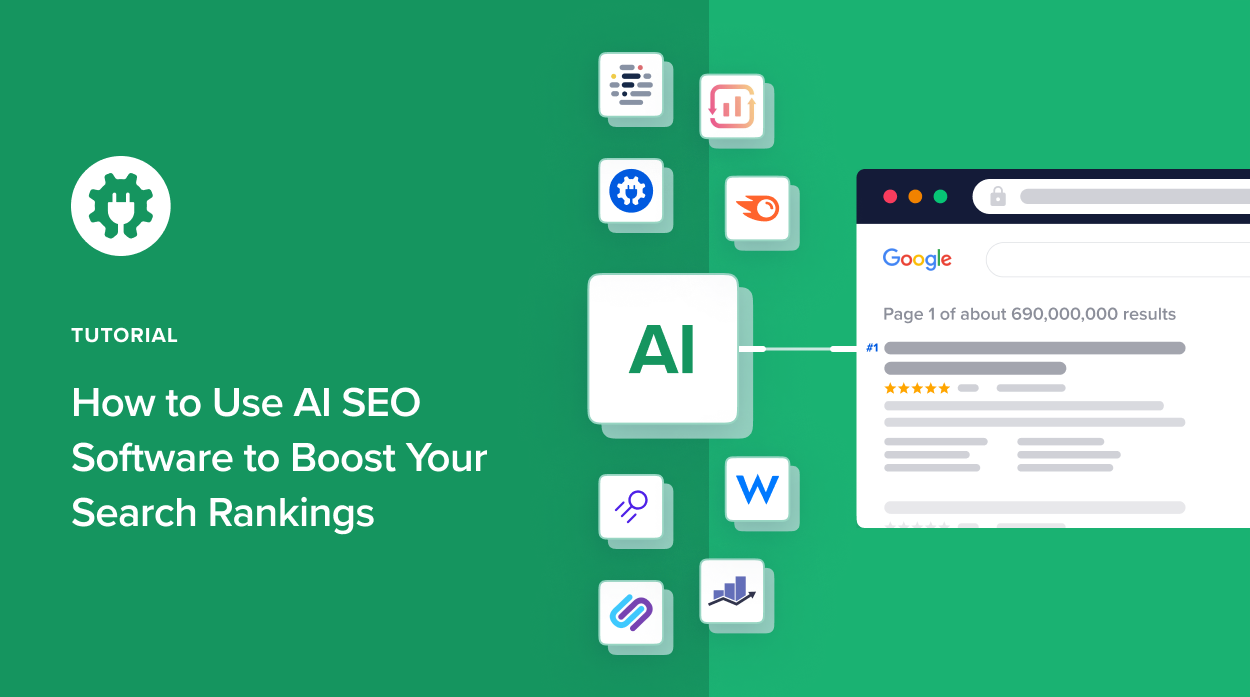
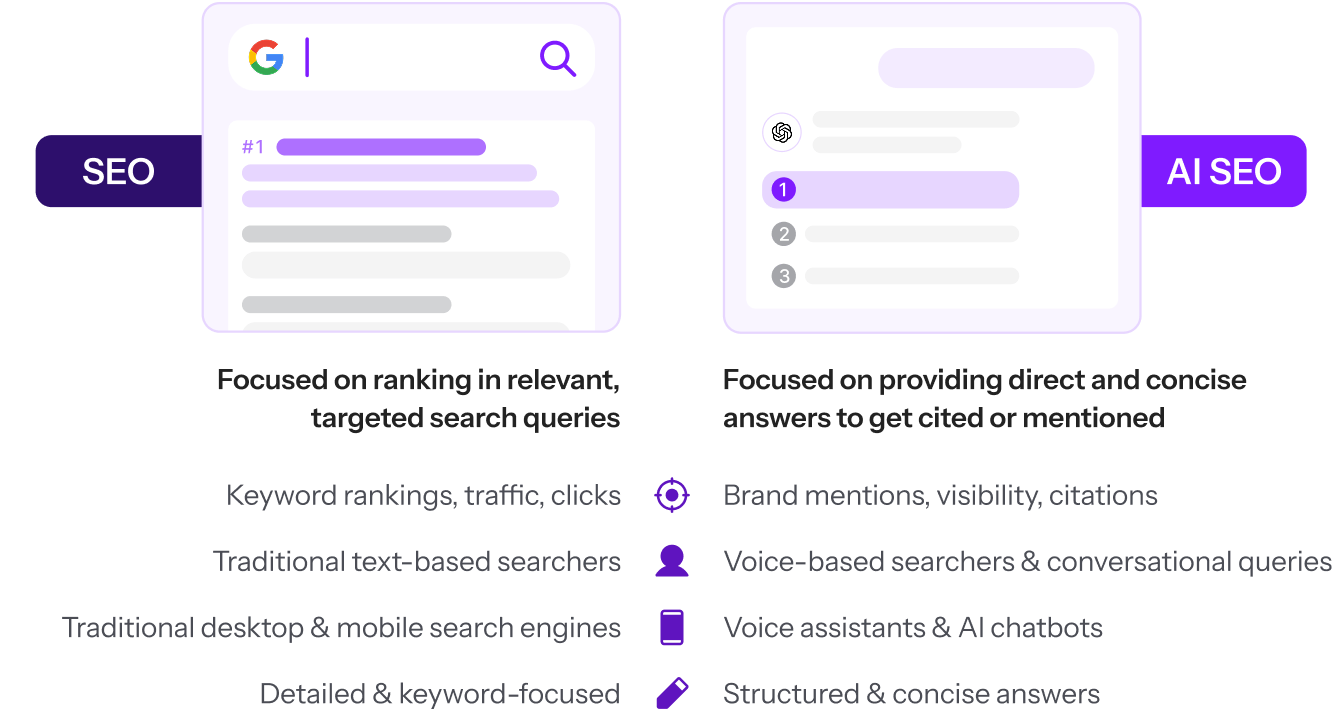
The transition from keyword-based to intent-based search requires a fundamental change in approach. The table below highlights the key differences.
| Aspect | Traditional SEO | AI SEO |
|---|---|---|
| Primary Focus | Exact keywords and backlinks | User intent and semantic relevance |
| Content Style | Short, keyword-dense articles | Comprehensive, authoritative guides |
| Query Understanding | Literal word matching | Contextual and conversational understanding |
| Ranking Signals | Domain authority, link quantity | Engagement, topical authority, clarity |
| Algorithm Updates | Periodic, manual refreshes | Continuous, real-time learning |
Traditional SEO often involved creating multiple pages targeting slight variations of a keyword. AI SEO rewards creating one definitive resource that covers a topic thoroughly. This shift reduces content duplication and pushes creators toward higher quality standards.
Optimizing Content for AI Search Rankings
Implementing AI SEO requires a structured approach to content creation and technical setup. Here are the actionable steps to improve your visibility.
1. Focus on Topical Authority
Search engines now favor websites that demonstrate expertise across a full subject area. Instead of writing one article about “best running shoes,” create a cluster of content covering shoe types, materials, fitting guides, and maintenance. This builds a semantic web that AI algorithms recognize as authoritative.
- Create a pillar page that covers the core topic broadly.
- Link to detailed cluster pages that address specific subtopics.
- Use consistent terminology and vocabulary across all related posts.
- Higher Quality Traffic: By matching user intent, you attract visitors who are more likely to convert into customers or subscribers.
- Long-Term Stability: Content built on semantic relevance is less susceptible to minor algorithm fluctuations.
- Improved Brand Authority: Being recognized as a topical expert by AI systems builds trust with your audience.
- Better User Satisfaction: Providing clear, direct answers improves the overall experience on your site.
- Lack of Transparency: The exact ranking factors are hidden, making it difficult to diagnose sudden drops in traffic.
- High Content Standards: Producing comprehensive, expert-level content requires significant time and resources.
- Data Privacy Concerns: AI systems rely on user data, and privacy regulations can impact how this data is used for personalization.
- Potential for Bias: AI models can inherit biases from their training data, which may affect how certain topics are ranked.
- Audit Your Current Content: Use analytics tools to identify pages with high impressions but low click-through rates. These pages likely have a title or meta description that does not match user intent.
- Map Search Intent: For your primary keywords, categorize the intent behind them. Is the user looking for information, a product, or a specific website? Tailor your content to match that intent.
- Rewrite for Clarity: Break down complex paragraphs into shorter, digestible chunks. Use bullet points and tables to present data clearly. Ensure your main keyword appears in the first 100 words and in at least one H2 heading.
- Build Internal Links: Connect related articles using descriptive anchor text. This helps AI understand the relationship between your pages and distributes ranking authority.
- Monitor Engagement Metrics: Track dwell time and bounce rate in your analytics. If users are leaving quickly, revise the introduction to better set expectations.
2. Optimize for Conversational Queries
Voice search and AI assistants have made conversational queries the norm. People ask full questions like “What is the best way to train for a marathon?” Your content should include direct answers to these questions, often in a dedicated FAQ section or a highlighted summary box. Use natural language that includes transition words and varied sentence structure.
3. Implement Structured Data
Schema markup is the language that AI search engines understand best. It provides explicit clues about the type of content you have, whether it is a product, article, review, or event. Implementing schema helps the AI display your content as a rich snippet, which significantly increases click-through rates.
4. Prioritize User Experience (UX)
AI models track how users interact with your site. A page that loads slowly, has intrusive pop-ups, or is difficult to navigate will be penalized. Ensure your site is mobile-friendly, uses clear headings, and has a logical internal linking structure. The goal is to keep the user on the page and engaged with the content.
Benefits of AI SEO for Your Business
Adopting an AI-focused strategy offers several advantages that go beyond simple rankings.
Limitations and Challenges of AI Search
While AI SEO is powerful, it is not without its challenges. Understanding these limitations helps you set realistic expectations.
Practical Application: A Step-by-Step Guide to AI SEO
Common Mistakes in AI SEO and How to Avoid Them
Many website owners make critical errors when trying to optimize for AI search. Recognizing these pitfalls is the first step to avoiding them.
Keyword Stuffing in Disguise
Some try to trick AI by inserting the keyword unnaturally into every paragraph. This backfires. AI detects unnatural language patterns and will rank the content lower. Write for humans first, and ensure the keyword flows naturally within the context.
Ignoring Search Intent
Creating content that does not answer the user’s question is the fastest way to fail. If someone searches for “how to bake a cake,” they do not want a history of cake baking. They want a recipe. Always align your content with the specific need behind the query.
Neglecting Content Updates
AI models favor fresh information. A page that was accurate in 2020 may be outdated in 2025. Regularly review your top-performing pages and update statistics, examples, and best practices to maintain relevance.
Overlooking Technical SEO
AI cannot rank what it cannot crawl. Ensure your robots.txt file is not blocking important pages, your XML sitemap is up to date, and your site has no broken links. Technical health is the foundation upon which all other SEO efforts are built.
Important Notes for Long-Term Success
AI SEO is not a one-time project but an ongoing process. The algorithms are constantly learning from user behavior. What works today may need adjustment tomorrow. Stay informed about updates in the search industry and be willing to pivot your strategy.
Focus on building a brand that people trust. AI search engines are designed to promote content that is helpful, reliable, and people-first. If you prioritize the user experience and provide genuine value, the rankings will follow. Avoid shortcuts and black-hat tactics, as AI systems are highly effective at detecting and penalizing manipulation.
Frequently Asked Questions
What is the main difference between AI SEO and traditional SEO?
The main difference lies in how the search engine processes queries. Traditional SEO relies on exact keyword matching and backlink profiles. AI SEO uses machine learning to understand the context and intent behind a search, prioritizing comprehensive, semantically relevant content over keyword density.
How do I find the right keywords for AI search rankings?
Instead of focusing on short, high-volume keywords, look for long-tail phrases and full questions. Use tools that show “People Also Ask” data and analyze the autocomplete suggestions in search engines. These provide insight into the conversational queries your audience is using.
Does AI SEO require technical coding skills?
Basic technical skills are helpful, particularly for implementing structured data (schema markup). However, many content management systems offer plugins that handle this automatically. The core of AI SEO is content strategy and writing quality, which does not require coding knowledge.
How long does it take to see results from AI SEO?
Unlike traditional SEO, which might show results in a few weeks, AI SEO often takes longer. The AI needs time to crawl, index, and understand your content’s relationship to other entities. Typically, you can expect to see significant movement in 3 to 6 months, provided you consistently publish high-quality content.
Is backlinking still important for AI search rankings?
Yes, backlinks remain a strong signal of authority. However, the quality of the link matters more than the quantity. A few links from highly relevant, authoritative sites in your niche are more valuable than hundreds of links from low-quality directories. AI evaluates the context of the link to determine its relevance.
Conclusion
The era of AI SEO AI Search Rankings is here to stay. The shift from keyword matching to semantic understanding requires a new mindset. Success depends on your ability to create content that serves the user’s intent, demonstrates topical authority, and provides a seamless experience. By focusing on clarity, structure, and genuine value, you align your strategy with the goals of AI algorithms. This approach not only improves your rankings but also builds a stronger, more trusted brand. The future of search is intelligent, and your content strategy must be equally smart to thrive in it.
Xem thêm:
- AI SEO Ecommerce Content Generator: The Complete Guide to Scaling Product Pages in 2025
- AI SEO Keyword Expansion: The Complete Guide to Scaling Your Content Strategy
- How to Build AI Content Systems: A Complete Guide to Scalable, Intelligent Content Operations
- AI SEO AI Citation Building: The Complete Guide to Automated Local Search Dominance
- AI SEO Brand Mentions: The Complete Guide to Digital PR in the Age of Algorithms
Bài viết cùng chủ đề:

AI SEO SEO Automation with Make: The Complete Workflow Guide

AI SEO SEO Automation with Zapier: The Complete Workflow Guide

AI SEO SEO Automation with n8n: The Complete Workflow Guide
AI SEO SEO Automation with Gemini: The Complete Guide to Scaling Organic Growth

AI SEO SEO Automation with Claude: The Complete Guide to Scaling Content in 2025

AI SEO SEO Automation with ChatGPT: The Complete Playbook for 2025

AI SEO & SEO Automation for Affiliate Sites: The 2025 Playbook for Passive Income Growth
AI SEO & SEO Automation for Bloggers: The Complete Guide to Scaling Your Content

AI SEO & SEO Automation for Agencies: The Complete 2025 Playbook

AI SEO and SEO Automation for Ecommerce: The Complete Playbook for 2025

AI SEO & SEO Automation for WordPress: The Complete Playbook for 2025
AI SEO SEO Automation Strategy: The Complete Playbook for 2025

Mastering the AI SEO SEO Automation Process: A Complete Guide to Scaling Organic Growth
AI SEO SEO Automation System: The Complete Guide to Scaling Organic Growth in 2025
AI SEO SEO Automation Platform: The Complete Guide to Scaling Organic Growth in 2025
AI SEO SEO Automation Software: The Complete Guide to Scaling Organic Growth in 2025















