
No products in the cart.
AI SEO AI Visibility Tools: The Complete Guide to Dominating Search in 2025
10
Aug
Aug
The digital landscape has shifted dramatically. Traditional SEO tactics that worked a decade ago are now obsolete. Today, search engines like Google use sophisticated machine learning algorithms to rank content. To stay competitive, businesses must leverage AI SEO AI Visibility Tools. These platforms analyze vast datasets, predict ranking fluctuations, and automate optimization tasks that were once manual and time-consuming. This guide explores how these tools work, their benefits, and how to integrate them into your strategy for measurable growth.
What Are AI SEO AI Visibility Tools?

AI SEO AI Visibility Tools are software solutions that use artificial intelligence, natural language processing (NLP), and machine learning to improve a website’s presence in search engine results pages (SERPs). Unlike traditional SEO software that simply reports data, these tools interpret the data. They identify patterns, predict algorithm updates, and provide actionable recommendations to increase organic traffic.
The core function revolves around “visibility.” This metric measures how often your domain appears in search results for relevant queries. AI tools track this visibility across thousands of keywords, providing a holistic view of your online footprint. They go beyond basic rank tracking by analyzing SERP features, competitor movements, and user behavior signals.
The Evolution from Traditional SEO to AI-Driven Visibility
Traditional SEO relied heavily on keyword density and backlink quantity. The focus was on manipulating signals rather than satisfying user intent. AI visibility tools changed this paradigm. They now analyze semantic relevance, entity matching, and content depth. For example, Google’s BERT and MUM algorithms understand the context of words, not just the words themselves. AI SEO tools mirror this capability, allowing marketers to optimize for topics, not just keywords.
Modern tools like Clearscope, Surfer SEO, and Semrush’s AI features use machine learning to reverse-engineer top-ranking pages. They tell you exactly which terms, subtopics, and structural elements are necessary to compete. This shift from guesswork to data-driven precision is the defining characteristic of the new SEO era.
Core Features of AI Visibility Platforms
To understand the value of these tools, you must examine their core functionalities. Most platforms offer a suite of features designed to cover the entire SEO lifecycle.
Predictive Analytics and SERP Forecasting
AI tools analyze historical data to forecast future ranking potential. They simulate algorithm changes and show you how traffic might fluctuate. This allows for proactive strategy adjustments rather than reactive fixes. For instance, if the AI predicts a drop in visibility for a specific page, you can update the content before the algorithm update rolls out.
Automated Content Optimization
These tools provide real-time content scoring. As you write, the AI suggests related terms, questions, and semantic variations to include. It checks your readability, structure, and keyword usage against the top 10 competitors. This ensures your content is comprehensive and aligned with search intent before you hit publish.
Competitor Intelligence and Gap Analysis
AI visibility tools crawl competitor websites to identify keywords they rank for that you do not. This “gap analysis” reveals untapped opportunities. The AI prioritizes these opportunities based on difficulty and potential traffic, creating a roadmap for content creation and link building.
Technical SEO Auditing with AI Insights
Beyond content, these tools scan your website for technical errors. They detect broken links, slow-loading pages, missing schema markup, and crawlability issues. The AI then prioritizes these fixes based on their impact on visibility, saving developers time and resources.
Top AI SEO AI Visibility Tools in the Market
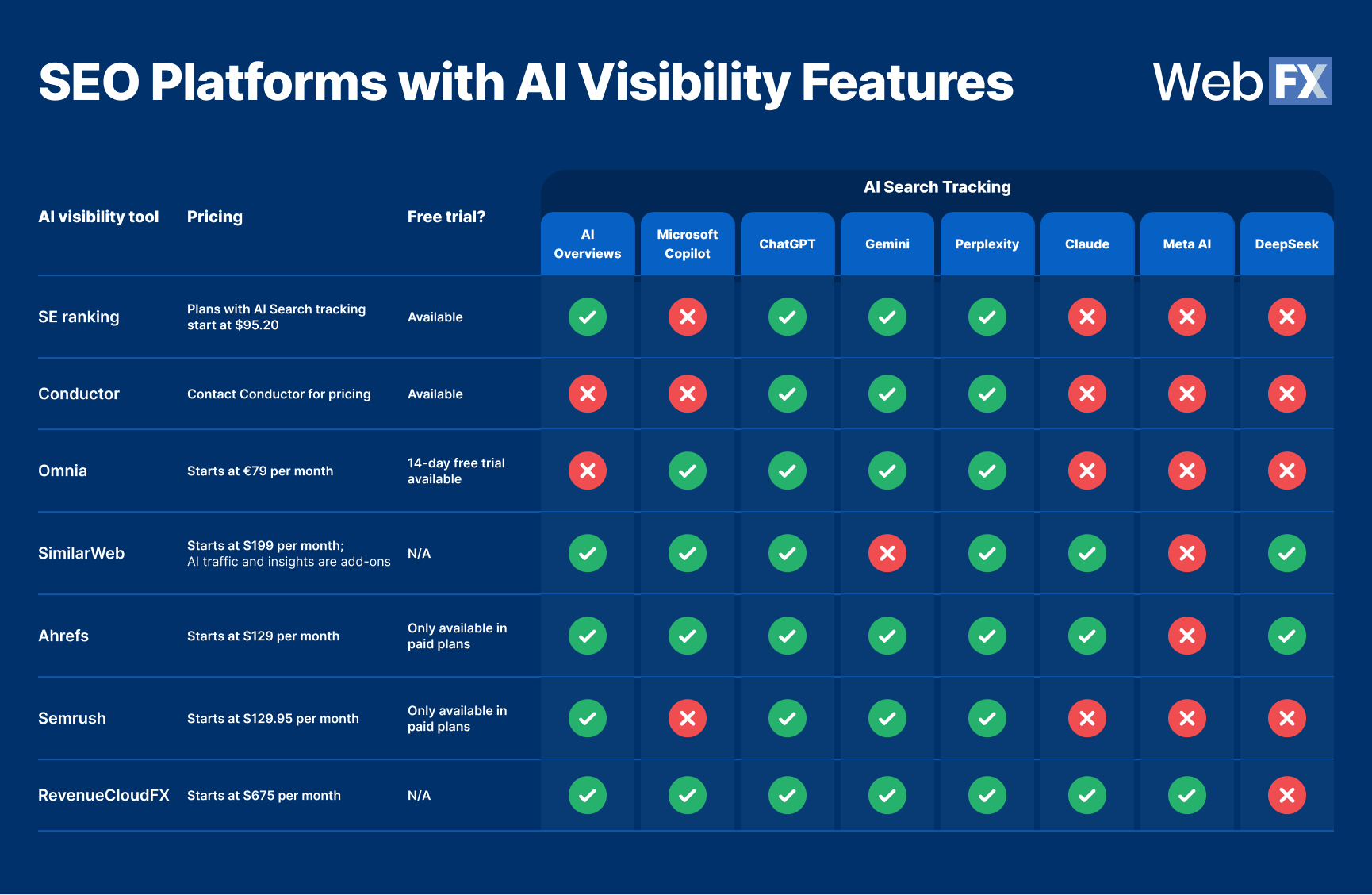
The market is crowded, but several platforms stand out due to their advanced AI capabilities and user-friendly interfaces. Below is a comparison of the leading solutions.
| Tool Name | Primary AI Function | Best For | Pricing Model |
|---|---|---|---|
| Semrush | Position tracking, content optimization, and topic research | Enterprise and agencies | Subscription (Monthly/Annual) |
| Surfer SEO | Real-time content scoring and SERP analysis | Content creators and bloggers | Subscription (Credit-based) |
| Ahrefs | Backlink analysis and keyword difficulty prediction | Link builders and technical SEOs | Subscription (Tiered) |
| Clearscope | NLP-driven content briefs and relevance scoring | Enterprise content teams | Subscription (Usage-based) |
| Frase IO | Content generation and optimization with AI writing | Freelancers and small teams | Subscription (Tiered) |
Each tool has unique strengths. Semrush excels in comprehensive data aggregation. Surfer SEO is unmatched for on-page optimization. Ahrefs remains the gold standard for backlink intelligence. The best strategy often involves combining two tools to cover both content and technical SEO.
How to Use AI Visibility Tools for Keyword Research
Keyword research is no longer about finding high-volume terms. It is about understanding the intent behind the query. AI tools cluster keywords into topic groups, showing you which terms are semantically related. This allows you to create pillar pages that target a broad topic and cluster pages that target specific long-tail variations.
Start by entering a seed keyword into your chosen tool. The A It will also show you the “search intent” for each term—whether it is informational, transactional, or navigational. Use this data to map out your content strategy. Focus on creating content that answers the questions the AI identifies, as these often align with voice search queries and featured snippets.
Leveraging AI for Topic Clusters
Instead of targeting individual keywords, build topic clusters. The AI tool identifies the main “pillar” topic and suggests “cluster” topics that support it. For example, if your pillar is “AI SEO AI Visibility Tools,” your clusters might include “how to measure SEO visibility,” “best AI tools for rank tracking,” and “predictive SEO analytics.” This structure signals authority to Google, boosting your visibility for the entire cluster.
Content Creation and Optimization with AI
Creating content that ranks requires more than just writing well. It requires matching the exact format and depth that Google prefers for a given query. AI visibility tools analyze the top-ranking pages and provide a blueprint.
These tools generate detailed content briefs. The brief includes the recommended word count, the number of headings, the use of images, and the specific terms that must be included. As you write, the AI scores your content in real-time. It highlights sections that are too thin, suggests adding examples, and flags missing subtopics. This iterative process ensures your content is fully optimized before publication.
Optimizing for Entity Recognition
Google uses entities—people, places, things, and concepts—to understand content. AI tools help you identify the key entities related to your topic. By including these entities naturally in your text, you help search engines understand the context of your page. This improves your chances of ranking for a wider range of related queries, increasing your overall visibility.
Technical SEO and AI Monitoring
Technical issues can severely hamper visibility, even if your content is excellent. AI tools continuously crawl your site to identify issues like JavaScript rendering problems, duplicate content, and poor internal linking structures.
The advantage of AI The tool doesn’t just list 500 errors; it tells you which 5 errors are costing you the most traffic. It analyzes the affected pages’ traffic and rankings to calculate the potential revenue impact. This allows you to allocate development resources to the fixes that matter most.
Core Web Vitals and AI Analysis
Google’s Core Web Vitals are critical ranking factors. AI visibility tools monitor your Largest Contentful Paint (LCP), First Input Delay (FID), and Cumulative Layout Shift (CLS). They provide specific recommendations on how to improve these metrics, such as compressing images, preloading assets, or removing unused JavaScript. The AI can even predict how these improvements will affect your search visibility.
Benefits of Implementing AI Visibility Tools

The adoption of AI in SEO is not a trend; it is a necessity for scaling. The benefits extend beyond just higher rankings.
- Time Efficiency: Automates repetitive tasks like rank tracking and reporting, freeing up hours for strategic planning.
- Accuracy: Reduces human error in data analysis and keyword selection.
- Scalability: Allows you to optimize hundreds of pages simultaneously without sacrificing quality.
- Predictive Insights: Helps you stay ahead of algorithm updates rather than reacting to them.
- ROI Improvement: Focuses resources on high-impact activities, leading to better conversion rates and lower acquisition costs.
- Integration Capabilities: Does the tool integrate with Google Search Console, WordPress, or your CRM? Seamless integration is crucial for workflow efficiency.
- Learning Curve: Some tools are complex and require training. Look for platforms with robust onboarding and customer support.
- Data Accuracy: Check reviews and independent tests to ensure the tool’s data is reliable. Inaccurate data is worse than no data.
- Trial Period: Always use a free trial or demo to test the tool on your actual website before committing to a long-term contract.
- Audit: Run a full site audit to identify technical errors and content gaps.
- Research: Use the keyword tool to build a list of topics based on search intent and business relevance.
- Brief: Generate an AI content brief for your target keyword. Review the suggested terms and structure.
- Write: Create the content, using the AI scoring tool to guide your writing in real-time.
- Optimize: Publish the content and use the tool to track its visibility over the next 30 days.
- Iterate: Analyze the performance data. If the page is not ranking, use the AI’s suggestions to update the content or improve internal links.
Limitations and Challenges
While powerful, these tools are not a magic bullet. They have limitations that marketers must acknowledge.
First, AI tools rely on historical data. They cannot predict unprecedented events or sudden shifts in user behavior. Second, they provide recommendations, not guarantees. The AI might suggest a keyword that is technically relevant but not aligned with your brand voice. Third, the cost can be prohibitive for small businesses. Premium tools often require a significant monthly investment.
Finally, over-reliance on AI can lead to homogenized content. If everyone uses the same tool to optimize for the same keywords, all content starts to look the same. The human element of creativity and unique perspective is still essential for standing out.
Common Mistakes When Using AI SEO Tools
Many businesses fail to see results because they misuse these platforms. Avoid these common pitfalls to maximize your investment.
Ignoring the “Why” Behind the Data
AI tells you what to do, but you must understand why. Blindly following AI suggestions without understanding your audience can lead to irrelevant content. Always cross-reference AI data with your own analytics and customer feedback.
Focusing Only on Content, Not Technical Health
Some marketers use AI solely for content briefs. They neglect the technical audit features. A page that loads in 8 seconds will never rank, regardless of how well it is optimized. Use the full suite of tools available.
Keyword Stuffing with AI-Generated Terms
AI tools suggest many related terms, but you should not force them all into the text. The goal is semantic relevance, not keyword density. If a term does not fit naturally into the sentence, leave it out. Forcing it will harm readability and user experience.
Neglecting to Update Old Content
AI tools are excellent for new content, but they are also vital for refreshing old posts. Search algorithms change, and your old content may be outdated. Use AI to re-optimize your top-performing pages to maintain their visibility. This is often the fastest way to boost traffic.
Important Notes for Choosing the Right Tool
Selecting the right software depends on your specific needs, budget, and technical expertise. Consider the following factors before making a purchase.
Practical Application: A Step-by-Step Guide
Frequently Asked Questions (FAQ)
What is the difference between AI SEO tools and traditional SEO tools?
Traditional tools report on data such as rankings and backlinks. AI SEO tools interpret that data, predict future trends, and provide automated recommendations. AI tools use machine learning to understand search intent and content semantics, offering a more proactive approach to optimization.
Can AI SEO tools guarantee a #1 ranking on Google?
No tool can guarantee a specific ranking. Search algorithms are complex and consider hundreds of factors. AI tools provide the best possible recommendations based on data, but rankings also depend on your website’s authority, user experience, and competitor actions.
Are AI visibility tools suitable for small businesses?
Yes, but they should be chosen carefully. Many tools offer entry-level plans that are affordable for small businesses. The key is to start with a tool that focuses on your most critical need, whether that is content optimization or technical audits, and expand as your budget grows.
How often should I use AI tools to check my visibility?
Visibility tracking should be continuous. Most tools update data daily. However, you should review the reports weekly to identify trends. Major strategic changes should be evaluated monthly to measure long-term progress.
Will AI replace the need for human SEO experts?
A The tools handle data processing and pattern recognition, but humans are still needed for strategy, creative content, and relationship building. The role of the SEO professional is shifting from technician to strategist.
Conclusion
The integration of AI SEO AI Visibility Tools into your digital marketing stack is no longer optional. The complexity of modern search algorithms demands a data-driven approach. These tools provide the predictive insights and automation necessary to compete effectively. They transform raw data into actionable strategies, allowing you to focus on creating value for your audience while the AI handles the heavy lifting of optimization.
To succeed, adopt a balanced approach. Use AI for research, analysis, and technical monitoring, but rely on human creativity for storytelling and brand differentiation. By combining the analytical power of AI with human empathy, you can achieve sustainable visibility and long-term organic growth. Start by auditing your current strategy and identifying one area where AI can provide immediate impact. The future of search is intelligent, and your tools should be too.
Xem thêm:
- AI SEO Site Health: The Complete Guide to Automated Technical Audits in 2025
- AI SEO Case Study: Real-World Results, Strategies, and Lessons Learned
- AI SEO SEO Title Generator: The Complete Guide to Higher Click-Through Rates
- AI SEO Content Audits: The Complete Guide to Automated Content Optimization
- AI SEO Content Gap Analysis: The Complete Guide to Outranking Your Competitors in 2025
Bài viết cùng chủ đề:

AI SEO SEO Automation with Make: The Complete Workflow Guide

AI SEO SEO Automation with Zapier: The Complete Workflow Guide

AI SEO SEO Automation with n8n: The Complete Workflow Guide
AI SEO SEO Automation with Gemini: The Complete Guide to Scaling Organic Growth

AI SEO SEO Automation with Claude: The Complete Guide to Scaling Content in 2025

AI SEO SEO Automation with ChatGPT: The Complete Playbook for 2025

AI SEO & SEO Automation for Affiliate Sites: The 2025 Playbook for Passive Income Growth
AI SEO & SEO Automation for Bloggers: The Complete Guide to Scaling Your Content

AI SEO & SEO Automation for Agencies: The Complete 2025 Playbook

AI SEO and SEO Automation for Ecommerce: The Complete Playbook for 2025

AI SEO & SEO Automation for WordPress: The Complete Playbook for 2025
AI SEO SEO Automation Strategy: The Complete Playbook for 2025

Mastering the AI SEO SEO Automation Process: A Complete Guide to Scaling Organic Growth
AI SEO SEO Automation System: The Complete Guide to Scaling Organic Growth in 2025
AI SEO SEO Automation Platform: The Complete Guide to Scaling Organic Growth in 2025
AI SEO SEO Automation Software: The Complete Guide to Scaling Organic Growth in 2025















