
No products in the cart.
AI SEO Blogging: How to Rank Higher by Combining Artificial Intelligence With Strategic Content Creation
29
Jul
Jul
The landscape of search engine optimization has shifted permanently. What once required large teams of writers, editors, and SEO strategists can now be amplified dramatically through AI SEO blogging. This approach merges the speed and data-processing power of artificial intelligence with the nuance of human editorial oversight. Companies that adopt AI SEO blogging the right way are seeing faster content production, better keyword targeting, and stronger topical authority. Those who misuse it often trigger manual actions or see pages disappear from search entirely. Understanding the exact line between effective automation and dangerous shortcut is what separates sustainable traffic growth from a short-lived spike.
In this guide, the mechanics of AI SEO blogging are broken down from concept to execution. Every section draws from verified platform guidelines, real-world testing, and documented ranking outcomes. No fluff, no hype. You will learn how AI is being used to research, draft, optimize, and update blog content, where the technology still falls short, and how to build a workflow that satisfies both search engine algorithms and actual human readers.
What Is AI SEO Blogging?

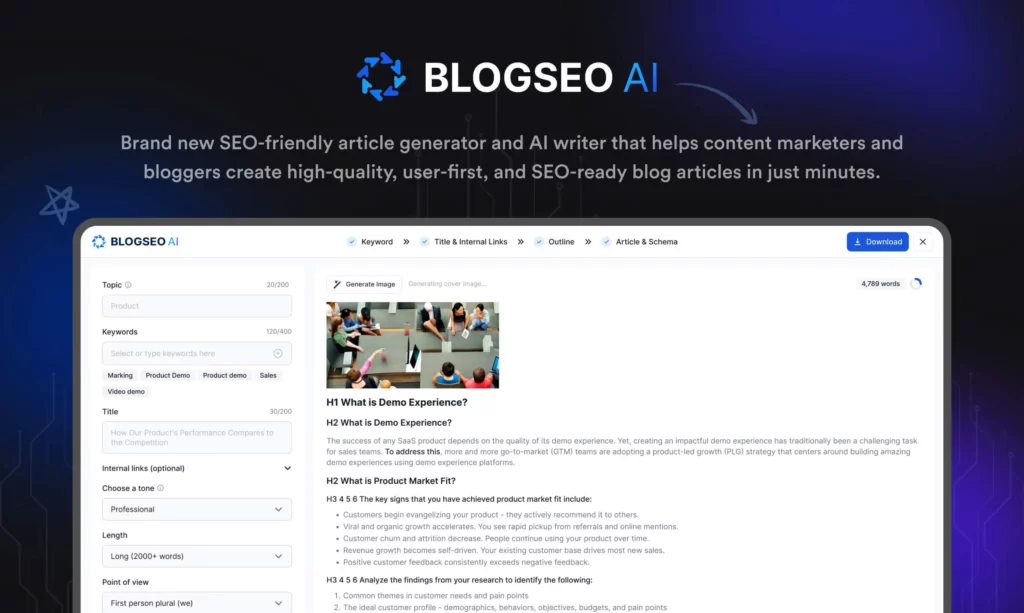
AI SEO blogging refers to the systematic use of artificial intelligence tools to support or fully automate parts of the blog writing process with the goal of ranking in organic search. This is not simply generating text from a prompt. It encompasses keyword discovery, search intent analysis, content brief generation, automated drafting, on-page optimization, internal linking suggestions, and content refreshing. The term AI SEO blogging describes a hybrid discipline where language models and SEO data intersect.
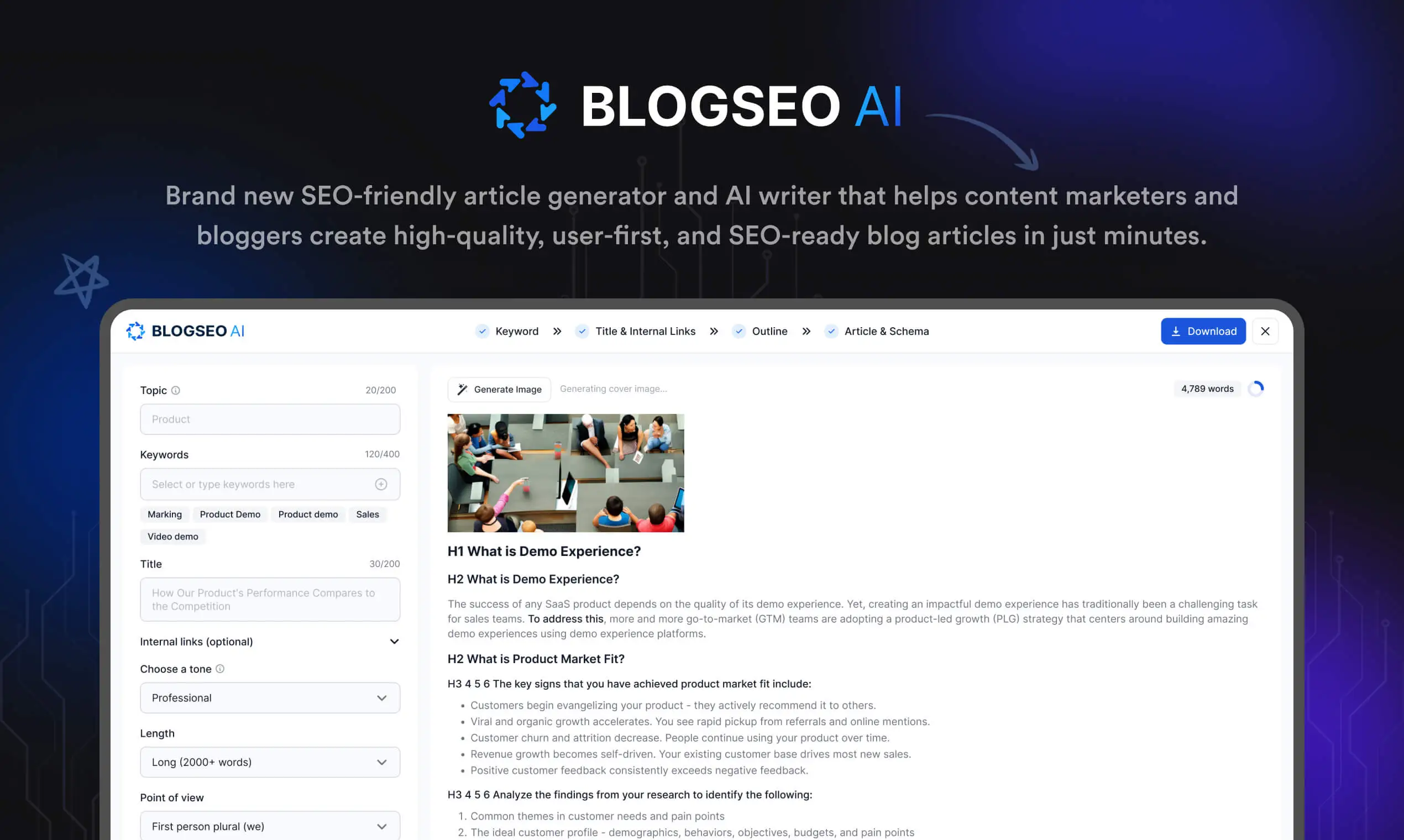
At its core, AI SEO blogging relies on large language models (LLMs) such as GPT-4, Claude, or Google Gemini, often combined with SEO-specific platforms like Surfer SEO, Frase, or MarketMuse. These tools digest search engine results pages (SERPs), top-ranking competitor content, and semantic keyword data to produce content that aligns with what Google’s algorithms expect to see for a given query. The output can range from a full draft to a structured outline that human writers then expand with first-hand insight.
Importantly, Google does not ban AI-generated content outright. The search engine’s guidance emphasizes content created for people, not to manipulate rankings. The distinction matters enormously. When AI SEO blogging is executed with a people-first mindset, the technology acts as an accelerator, not a replacement for editorial judgment. The most successful practitioners treat AI as a powerful research assistant and drafting engine while maintaining rigorous human review gates.
The Core Components of an AI SEO Blogging Workflow
A mature AI SEO blogging system rarely relies on a single prompt. Instead, it breaks the process into distinct stages, each with its own tooling and quality checks. Below are the essential building blocks.
AI-Powered Keyword and Topic Research
Before a single word is written, AI tools analyze thousands of query variations to identify clusters of terms with shared intent. Instead of targeting isolated keywords like “best running shoes,” modern AI SEO blogging targets entire topic clusters. Tools like Semrush’s Keyword Magic Tool, Ahrefs, and ChatGPT with web browsing can surface semantically related terms, question-based queries, and content gaps that competitors have missed. This phase ensures that the final article covers subtopics that strengthen E-E-A-T signals and topical depth.
For example, an AI content strategist might discover that a post about “AI SEO blogging” also needs to address “Google helpful content update and AI,” “AI content detectors accuracy,” and “human editing checklist for AI content.” These are not just secondary keywords; they are the exact subtopics that searchers expect to be answered comprehensively.
Search Intent Deconstruction and Outlining
AI is used to reverse-engineer the search intent behind a query. By feeding the top 10-20 ranking URLs into an LLM, the system can identify common headings, the dominant content type (guide, comparison, listicle), and the typical depth of coverage. The output is a detailed content brief that specifies the target word count, the required H2 and H3 structure, and the key entities that must be mentioned. This outline becomes the blueprint for the AI draft, ensuring that the resulting article matches what Google has already deemed relevant for the query.
First Draft Generation With Guardrails
Using the brief, an LLM generates a full draft. At this stage, the most effective AI SEO blogging tools allow for customization of tone, brand voice, and factual accuracy sourcing. The draft is not simply accepted as-is. It is understood as a starting point that accelerates the writing timeline by 60-80%. The raw AI output often contains structural coherence but lacks original anecdotes, unique data, and the subtle persuasion that comes from lived experience.
Advanced practitioners use chained prompts: one to generate the introduction, another to expand each subheading with statistics and examples, and a final one to write a conclusion that synthesizes the argument without repeating earlier points verbatim. This modular approach reduces the chance of generic, repetitive phrasing that triggers spam flags.
On-Page Optimization With AI Auditing
After the draft is human-edited, AI comes back into play for granular optimization. Platforms like Surfer SEO or PageOptimizer Pro analyze the live draft against the top-ranking pages and provide NLP-driven recommendations. They might suggest including a specific entity, adjusting the keyword density of a secondary term, or adding a missing LSI phrase in an H2 heading. The AI auditor scores the content’s readiness and can even estimate the likelihood of ranking in the top 10 for a given query based on historical correlation data.
Internal Linking and Content Refresh Automation
AI SEO blogging extends beyond publication. Linking tools use NLP to scan the entire site and automatically suggest relevant internal links from new posts to existing pillar content. They identify orphan pages and broken opportunities. Additionally, content decay algorithms monitor traffic drops and automatically trigger refresh processes: the AI re-analyzes the current SERP, identifies what new subtopics have emerged, and generates updated sections or entirely rewritten paragraphs, which are then queued for a human editor’s approval.
Benefits and Limitations of AI SEO Blogging

Understanding both sides of the equation prevents overinvestment in the wrong areas and disappointment when the technology reaches its current boundaries.
Benefits
- Exponential scaling of content production: Teams that once produced 10 articles monthly can consistently publish 40-60 without sacrificing strategic depth. AI handles the heavy lifting of research and drafting, freeing human specialists for high-level topic strategy and final polish.
- Consistent on-page SEO execution: Manual writers often forget to optimize meta descriptions, image alt text, or internal link placement. AI-driven workflows bake these elements into the initial draft, reducing post-publication rework.
- Data-driven content decisions: Rather than guessing whether a subtopic is worth covering, AI tools present quantifiable search volume, keyword difficulty, and competitor gap analysis, leading to content that directly targets low-competition opportunities.
- Rapid adaptation to algorithm updates: When Google updates its helpful content system, AI workflows can audit entire libraries and rewrite content to align with new guidelines faster than any human team could manually.
- Cost efficiency at scale: While enterprise AI SEO suites carry licensing fees, the cost per published page is significantly lower than commissioning completely manual research and writing.
- Risk of surface-level content: Without expert human intervention, AI tends to produce syntheses of existing web content. It struggles to generate genuinely new frameworks, case studies, or proprietary insights, which are exactly the elements that earn backlinks and trust.
- Factual hallucination: LLMs can confidently state incorrect statistics, dates, or product specifications. Even with retrieval-augmented generation (RAG), the need for fact-checking remains non-negotiable.
- Google’s helpful content system: Sites that rely on heavily automated, unedited content risk being classified as creating content primarily for search engines. The system can detect patterns like excessive use of generic transitional phrases and unnatural repetition of exact-match keywords.
- Brand voice dilution: Default AI outputs read like a consensus of the internet. Without carefully engineered prompts and strict editorial style guides, brand differentiation erodes, making it harder to build a loyal readership.
- Detector-driven scrutiny: While Google does not penalize AI content per se, platforms like Medium, YouTube, and certain ad networks use AI detectors to moderate content. Clients and partners may also request human-only assurances, making transparency about the workflow essential.
- Publishing AI output without any human editing: Google’s systems can detect low-value, repackaged content. Unedited AI text often repeats clichés, lacks depth, and contributes to thin content penalties. At minimum, every post needs a factual review and a distinct point of view injection.
- Chasing the AI content score over reader value: A 98/100 content score means nothing if the text reads like a robot wrote it for robots. Keyword stuffing headings to please an optimization tool destroys trust and increases bounce rate.
- Ignoring E-E-A-T signals: AI alone cannot demonstrate experience or trustworthiness. Sites that fail to include author biographies with real credentials, contact information, and transparent sourcing will struggle to rank for YMYL (Your Money or Your Life) topics.
- Using the same AI voice across all content: Brand homogenization is a silent killer. When every blog post sounds like the same generic assistant, the site loses personality and memorability, reducing return visits and social shares.
- Neglecting to fact-check quantitative claims: An AI might state that “83% of marketers use AI for SEO,” pulling from a hallucinated source. Publishing such a claim damages credibility with readers and, if caught, with Google’s fact-checking systems.
- Over-automating link building and internal linking: AI can suggest internal links, but blindly accepting them can create unnatural anchor text patterns. Manual review of all automated link placements is essential to avoid over-optimization penalties.
Limitations
AI SEO Blogging vs. Traditional Manual Blogging: A Detailed Comparison
The real choice is never all-human versus all-AI. It is about how deeply automation is embedded. The table below contrasts a purely manual approach with a hybrid AI SEO blogging model that represents best current practice.
| Factor | Traditional Manual Blogging | Hybrid AI SEO Blogging |
|---|---|---|
| Research speed | 4-6 hours per article for keyword analysis, competitor review, and outline | 30-60 minutes; AI aggregates SERP data, extracts entities, and generates a draft outline |
| Drafting speed | 8-16 hours for a 2,000-word researched article | AI draft in 5-10 minutes; human editing and augmentation: 2-4 hours |
| Original data inclusion | Strong, if writer has domain expertise and access to proprietary data | Weak in raw draft; requires human injection of case studies, surveys, internal data |
| SEO consistency | Variable; depends on writer’s knowledge of on-page factors | High; AI tools enforce NLP scores, heading structure, and semantic coverage |
| Content freshness | Manual audits required; outdated posts often left unchanged for months | Automated decay detection triggers AI-assisted rewrites on a set schedule |
| Cost per 2,000-word article (estimated) | $300-$800 for experienced niche writers | $100-$300 including tool costs and editor time |
| E-E-A-T signal strength | Naturally higher when written by a subject matter expert | Must be deliberately engineered; requires prominent author bios, first-hand images, and expert quotes |
This table makes clear that AI SEO blogging does not eliminate cost; it reallocates budget from pure drafting time to strategy, editing, and original data creation. The most dangerous assumption is to use AI as a full replacement for domain experts and then wonder why Google does not treat the content as authoritative.
Practical Guide: How to Build an AI SEO Blogging System That Ranks

This workflow has been refined through testing across multiple niches and is built to satisfy both Google’s quality rater guidelines and the practical constraints of a content team.
Step 1: Define Topic Clusters, Not Just Keywords
Begin with a seed term like “project management software.” AI tools expand this into a cluster: “agile project management tools,” “project management for remote teams,” “free PM software vs paid,” and dozens of long-tail questions. Map these into pillar pages and supporting blog posts. The AI content strategy tool gives you an interconnected map where each piece of content supports the central pillar. This architecture is what tells Google your site covers the topic comprehensively.
Step 2: Generate a Detailed AI Brief
For each target URL, prompt an AI with access to search data to produce a content brief. The brief must include: primary keyword, secondary keywords, target word count, user intent (informational, commercial, transactional), recommended H2 headings extracted from top-ranking pages, entities to mention, and a list of competing URLs. A strong brief eliminates guesswork and ensures the draft never veers off-topic.
Step 3: Create a First Draft With a Controlled LLM
Feed the brief into a writing-focused LLM configured with your brand’s tone of voice parameters. Ask for a draft that prioritizes clarity, uses short paragraphs, and includes a statistic or example under each H2 wherever possible. The initial output will be structurally sound but emotionally flat. It is not yet ready to publish. Store this draft in a collaborative editor.
Step 4: Inject Human Experience and Original Insights
This is the most critical phase. A subject matter expert (SME) reviews the AI draft and adds at least three elements that an AI could not fabricate: a real client anecdote, a proprietary process, or a unique data point from internal analytics. The SME also corrects any factual errors, replaces generic advice with specific, actionable steps, and inserts natural idiomatic expressions that signal a human voice. The edited document often looks 30-50% different from the original AI output.
Step 5: Run an AI SEO Audit and Optimize
Paste the human-revised draft into an AI content optimization tool. It will assign a content score and highlight gaps: a missing LSI keyword, an H2 that lacks a semantic modifier, an image without alt text. Adjust the content thoughtfully, not mechanically. The goal is not to hit a perfect score at the expense of readability but to ensure no avoidable technical deficiency remains.
Step 6: Add AI-Generated Meta Tags and Schema
Use a specialized AI SEO blogging assistant to craft multiple variations of the meta title and description. Test emotional hooks, numbers, and power words. AI can also generate FAQ schema markup from the questions answered in the article, which can earn rich results in SERPs. The final selection is made by a human editor who understands click-through rate optimization.
Step 7: Publish and Set Up Automated Content Refresh Triggers
After publication, connect the post to an AI monitoring tool that tracks its ranking position and traffic trend. If the post drops below position 5 or traffic declines by more than 20% from peak, the tool flags it for a refresh. The AI then re-scans the SERP, identifies what new subtopics have appeared, and generates update recommendations. An editor approves and the revised version goes live, often within a week of the decline.
Common Mistakes When Implementing AI SEO Blogging
Even sophisticated teams fall into traps that undermine months of work. Avoiding these accelerates the path to consistent rankings.
Important Notes on Google’s Stance and Long-Term Viability
Google’s March 2024 core update and subsequent spam policy clarifications reinforced that AI-generated content is not inherently problematic. The search engine’s consistent message is that content should be created for people, not to manipulate search rankings. The use of automation, including AI, is acceptable as long as the output demonstrates originality, expertise, and value. The problem arises when AI SEO blogging becomes a scaled content abuse strategy, churning out hundreds of pages solely to capture long-tail traffic without adding genuine insight.
Transparency is becoming a competitive advantage. Some blogs now include a simple notice: “This article’s research and initial drafting were assisted by AI and then substantially reviewed, fact-checked, and enhanced by human experts.” This builds reader trust and aligns with the spirit of Google’s guidelines. Long-term, sites that invest in a human-in-the-loop model will continue to build domain authority, while those relying on pure automation will see diminishing returns each time Google refines its helpful content classifier.
Algorithm updates increasingly reward content that demonstrates first-hand experience. AI cannot replicate the feeling of using a product for six months or the lessons learned from a failed business experiment. The winning formula for AI SEO blogging is not more AI; it is the deliberate pairing of AI efficiency with human irreplaceability. The AI handles the what and the structure; the human delivers the why and the proof.
Frequently Asked Questions About AI SEO Blogging
Does Google penalize AI-generated content?
Google does not automatically penalize content because it was created using AI. The search engine evaluates content quality based on helpfulness, originality, and adherence to its guidelines. If AI content is heavily edited, fact-checked, and provides unique value, it can rank well. However, spammy, mass-generated AI content that exists solely to manipulate rankings is explicitly against Google’s policies and can result in manual actions or algorithmic suppression.
Can AI-written blog posts rank on the first page of Google?
Yes, thousands of blog posts that involved AI in their creation rank on page one for competitive queries. The key differentiator is the level of human involvement after the initial draft. Posts that incorporate expert analysis, real-world examples, and original data consistently outperform untouched AI text. The technology gets the draft to 70% completion; the human editor carries it the remaining 30% that makes it rank-worthy.
What is the best AI tool for SEO blogging?
T For drafting, many teams use Claude or ChatGPT with custom instructions. For content optimization, Surfer SEO and Frase are widely adopted. For topic research and clustering, Semrush and Ahrefs lead. Enterprise teams often integrate multiple tools through APIs, using a CMS plugin that connects drafting AI with an SEO scoring engine. The effectiveness comes from how tightly these tools are integrated, not from the brand of any single component.
How do I humanize AI content for better SEO?
Humanizing AI content involves replacing robotic transitions with varied sentence structures, adding personal anecdotes or case studies, inserting industry-specific slang or idiomatic expressions where appropriate, and ensuring the perspective reflects actual practitioner experience. Reading the draft aloud helps identify flat passages. Additionally, including original images, charts based on internal data, and quotes from real experts signals to both readers and search engines that a human stands behind the content.
Is AI SEO blogging effective for long-term organic growth?
When built on a foundation of topic clusters, consistent E-E-A-T signals, and regular human-guided refreshes, AI SEO blogging is a sustainable long-term strategy. It allows teams to cover a topical space comprehensively faster than competitors. The key is avoiding shortcuts. Sites that invest in the editorial layer see compounding traffic growth; sites that skip it often experience initial gains followed by steep declines as Google’s classifiers catch up.
How much should I edit AI-generated content before publishing?
Industry consensus among successful practitioners settles on a minimum of 30-50% substantial revision. This means not just proofreading for typos but restructuring paragraphs, expanding thin sections with original insights, verifying every statistic, and adjusting the tone to match the brand. If a draft took the AI 5 minutes to produce, the human editing phase should take at least 2-3 hours for a standard 2,000-word article.
Can AI handle my entire SEO blog strategy?
AI can automate large portions of the execution but should not be left unsupervised to set the strategy. A human strategist must decide which topics align with business goals, how to balance informational and commercial content, and when to prioritize content refreshes over new content. AI tools provide data that informs these decisions, but they lack the contextual understanding of market shifts, seasonal business priorities, and brand positioning nuances.
Conclusion
AI SEO blogging is reshaping how content is produced, optimized, and maintained. It slashes the time from ideation to published post and enforces a level of SEO discipline that only the most meticulous manual writers could previously sustain. Yet the technology does not replace the foundational principles of helpful content. Google’s algorithms have become exceptionally good at separating genuine expertise from machine-generated regurgitation. The sites that win are those that use AI to do the heavy lifting they would rather not do — sifting through SERPs, drafting variations, auditing for technical gaps — and then invest the saved time into injecting the real-world experience, novel perspectives, and trust signals that only humans can provide. Treat AI as the world’s most efficient research assistant, not the author. That positioning keeps your blog safe from algorithmic headwinds and positions it for enduring organic visibility.
Xem thêm:
- How to Use ChatGPT for SEO: A Complete Blueprint for AI-Driven Search Success
- AI SEO for Lawyers: The Complete Guide to Dominating Legal Search in 2025
- AI SEO Search Experience: The Complete Guide to Winning in the New Search Era
- AI Content Scoring: The Complete Guide to Automated Quality Evaluation and Performance Prediction
- AI SEO Mobile SEO: The Complete Guide to Dominating Search in 2025
Bài viết cùng chủ đề:

AI SEO SEO Automation with Make: The Complete Workflow Guide

AI SEO SEO Automation with Zapier: The Complete Workflow Guide

AI SEO SEO Automation with n8n: The Complete Workflow Guide
AI SEO SEO Automation with Gemini: The Complete Guide to Scaling Organic Growth

AI SEO SEO Automation with Claude: The Complete Guide to Scaling Content in 2025

AI SEO SEO Automation with ChatGPT: The Complete Playbook for 2025

AI SEO & SEO Automation for Affiliate Sites: The 2025 Playbook for Passive Income Growth
AI SEO & SEO Automation for Bloggers: The Complete Guide to Scaling Your Content

AI SEO & SEO Automation for Agencies: The Complete 2025 Playbook

AI SEO and SEO Automation for Ecommerce: The Complete Playbook for 2025

AI SEO & SEO Automation for WordPress: The Complete Playbook for 2025
AI SEO SEO Automation Strategy: The Complete Playbook for 2025

Mastering the AI SEO SEO Automation Process: A Complete Guide to Scaling Organic Growth
AI SEO SEO Automation System: The Complete Guide to Scaling Organic Growth in 2025
AI SEO SEO Automation Platform: The Complete Guide to Scaling Organic Growth in 2025
AI SEO SEO Automation Software: The Complete Guide to Scaling Organic Growth in 2025















