
No products in the cart.
AI Content Scoring: The Complete Guide to Automated Quality Evaluation and Performance Prediction
29
Jul
Jul
Every minute, millions of blog posts, social media updates, product descriptions, and ad copies flood the internet. Separating high-performing content from mediocre filler has become one of the most pressing challenges for marketers, editors, and SEO professionals. This is where AI content scoring enters the picture—a technology that uses machine learning and natural language processing to assign a quality score to any piece of text. Rather than relying on gut feeling or time-consuming manual reviews, teams now use AI to instantly gauge readability, SEO potential, tone consistency, and even predicted engagement. The goal is simple: publish content that works, and fix what doesn’t, before it goes live.
While the term sounds technical, the core idea is straightforward. AI content scoring platforms analyze text against dozens of parameters and return a single score or a multidimensional breakdown. The score might reflect how likely the article is to rank in search engines, how clear it is for a target audience, or how closely it matches brand voice guidelines. What makes this technology indispensable is its speed and scalability. A human editor can review perhaps five to ten articles a day; an AI scoring engine can process thousands in seconds while applying the same criteria consistently.
In this guide, we explore every angle of AI content scoring—from the underlying technology and key evaluation metrics to practical workflows and common pitfalls. You will discover how scoring models are built, which tools lead the market, and how you can integrate automated content evaluation into your daily operations without losing the creative spark that makes great writing human.
What Is AI Content Scoring and How Does It Work?
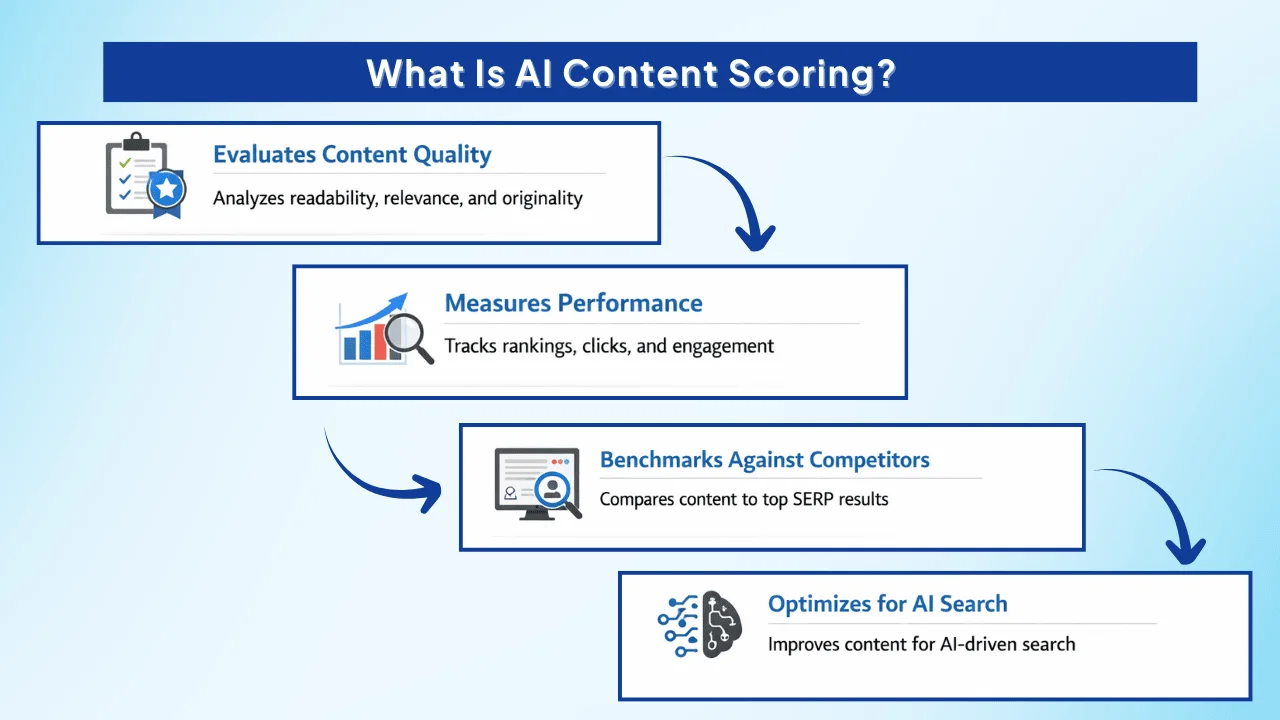
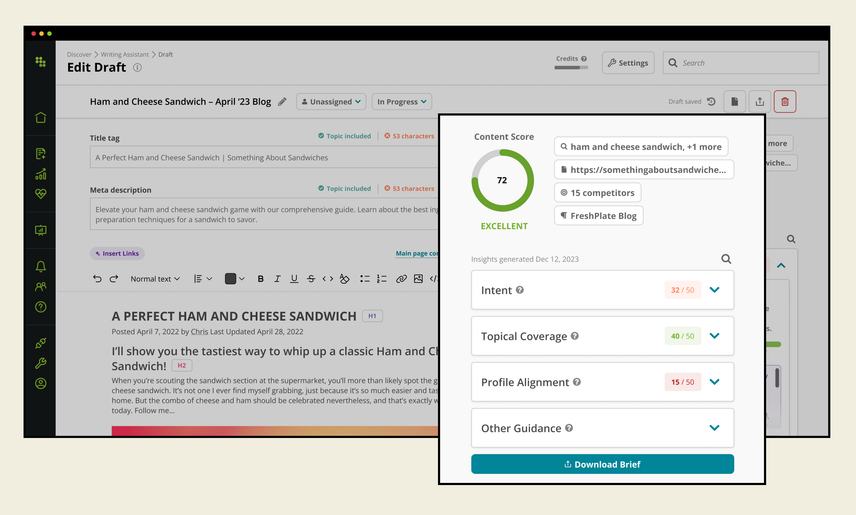
At its core, AI content scoring is the process of using artificial intelligence to assign a quantitative or qualitative value to a piece of content based on predefined quality criteria. The AI model examines linguistic features, structural elements, keyword usage, sentiment, grammar, and much more, then produces a score—often on a scale from 0 to 100. Some systems return a letter grade, a star rating, or a simple pass/fail indicator tied to a specific threshold.
The engine behind these scores typically combines several AI disciplines. Natural language processing breaks down sentences, identifies parts of speech, and extracts meaning. Machine learning models, often trained on thousands of examples of human-scored content, learn to map text characteristics to performance outcomes. More advanced solutions use deep learning and transformer architectures to understand context and nuance far beyond simple keyword matching.
A typical scoring pipeline follows four stages. First, the text is cleaned and tokenized—split into words, phrases, and sentences. Second, feature extraction pulls out everything from average sentence length and passive voice ratio to sentiment polarity and entity density. Third, the model compares these features against its training data to produce sub-scores for different dimensions. Finally, those sub-scores are aggregated into an overall content quality score, often weighted according to the user’s priorities.
For example, an AI content scoring tool designed for SEO might weigh keyword placement, heading structure, and internal linking heavily, while a tool built for educational content would prioritize readability grade level and conceptual clarity. The flexibility to tailor scoring rubrics is what makes the technology so versatile across industries.
Why AI Content Scoring Matters for Modern Content Teams
The explosion of content marketing has created a paradox: more content is produced than ever, yet the pressure to maintain quality and consistency is relentless. Editors burn out, brand voice drifts, and conversion rates suffer when subpar material slips through. AI content scoring addresses these pain points by acting as an always-on quality gate.
Consistency across large teams is one of the most immediate benefits. When a company employs dozens of freelance writers or multiple in-house content creators, maintaining a uniform tone and quality standard becomes nearly impossible through manual oversight alone. An AI scoring model can ingest brand guidelines and flag deviations automatically, ensuring that every article, email, and social post feels like it came from the same source.
Speed is another critical factor. In fast-moving industries like e-commerce and news publishing, the window for content relevance can be measured in hours. AI content scoring returns detailed feedback in real time, allowing writers to make adjustments on the fly instead of waiting for a human editor’s availability. Teams that adopt automated scoring consistently report shorter editorial cycles and faster time-to-publish without sacrificing quality.
Data-driven optimization also becomes possible. When every piece of content receives a numeric score, teams can correlate those scores with actual performance metrics—organic traffic, time on page, conversion rate, bounce rate. Over time, this reveals which scoring dimensions genuinely predict success, allowing the model to be refined and content standards to become more precise. The result is a continuous improvement loop where AI content scoring not only evaluates but actively elevates the quality of future output.
Key Dimensions and Metrics in AI Content Scoring Models
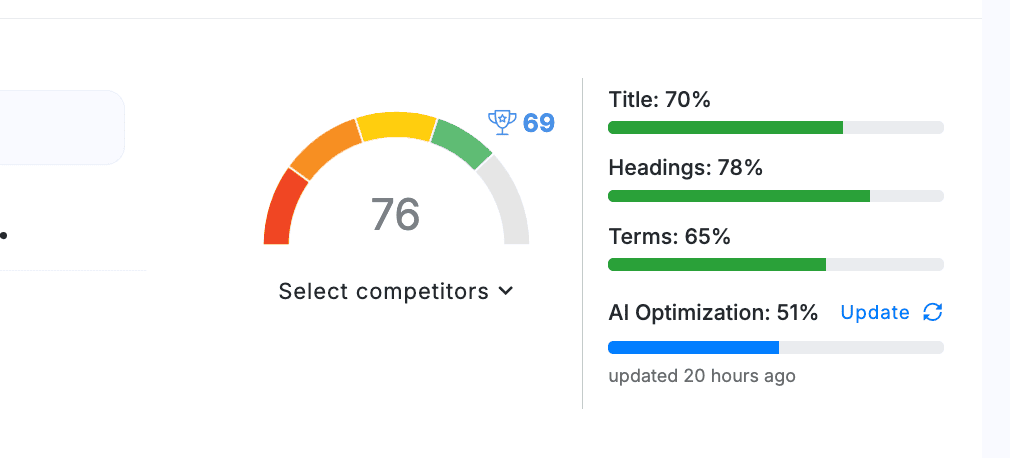
Not all content scores are created equal. A robust AI content scoring system evaluates text across multiple dimensions, each contributing to a holistic view of quality. Understanding these dimensions helps you choose the right tool and interpret scores intelligently.
Readability and Clarity
Readability metrics like Flesch-Kincaid Grade Level, Gunning Fog Index, and SMOG have been used for decades. AI content scoring tools automate these calculations and combine them with more sophisticated analysis, such as sentence length variation, transition word frequency, and active versus passive voice ratios. A high readability sub-score indicates that the content is accessible to the intended audience, whether they are fifth-graders or PhDs.
SEO and Search Engine Alignment
Content scoring platforms with an SEO focus examine keyword density, LSI keyword presence, title tag optimization, meta description length, header hierarchy, image alt text, and internal linking structure. Some even evaluate topic coverage by comparing the text against top-ranking pages for the target query. The AI identifies missing subtopics and semantic gaps that could prevent the content from ranking well.
Grammar, Spelling, and Mechanics
While basic spell-checking is decades old, modern AI content scoring goes deeper. It detects subject-verb agreement errors, misplaced modifiers, incorrect preposition usage, and inconsistent tense. More importantly, it does so with an understanding of context, reducing false positives that plague old rule-based grammar checkers. Grammarly’s AI engine, for instance, powers scoring features that evaluate correctness and clarity simultaneously.
Tone, Voice, and Brand Consistency
Maintaining a consistent brand voice across thousands of content assets is challenging. AI tools now measure tone—whether the text is formal, conversational, enthusiastic, empathetic—and compare it to a defined brand profile. They flag sections that sound off-brand or shift tone unexpectedly, giving editors the chance to harmonize the voice before publication.
Engagement and Persuasion Potential
Advanced scoring models incorporate psychological and linguistic principles of persuasion. They evaluate the presence of emotional triggers, storytelling elements, call-to-action clarity, and even power word usage. For sales copy and email marketing, such a score predicts how likely a reader is to take the desired action, making AI content scoring a bridge between creative writing and conversion science.
Common AI Content Scoring Tools and Platforms
The market offers dozens of tools, each with its own strengths. Understanding the landscape helps you match the tool to your specific use case.
| Tool | Primary Scoring Focus | Best For | Unique Feature |
|---|---|---|---|
| Clearscope | Content relevance and SEO comprehensiveness | SEO-driven blog and website content | Real-time Google SERP analysis for topic coverage grading |
| MarketMuse | Content depth, topic authority, and competitive gaps | Long-form pillar pages and knowledge bases | Personalized content score against top 20 competitors |
| Grammarly Business | Correctness, clarity, engagement, and delivery | Business communication, emails, and documents | Tone detection and brand voice customization |
| Frase | Content optimization and question-answering score | Blog posts targeting featured snippets | SERP-based content briefs with opportunity scoring |
| Writer.com | Style guide compliance, inclusive language, voice | Enterprise content teams with strict brand standards | Custom terminology management and multi-dimensional scoring |
| Copywritely | SEO content analysis, uniqueness, and readability | Small teams and solo bloggers | All-in-one score combining plagiarism, SEO, and readability |
Choosing a tool depends heavily on your content goals. If you run a blog competing for organic traffic, an SEO-focused scorer like Clearscope or Frase will deliver the most actionable feedback. For an enterprise team prioritizing brand consistency, Writer.com’s style-guide-driven scoring is invaluable. The key is to avoid looking for a single magic number; instead, use AI content scoring as a diagnostic framework that highlights specific areas for improvement.
How to Implement AI Content Scoring in Your Workflow
Introducing automated scoring into an existing content operation requires more than turning on a tool. Without a thoughtful implementation, scores become either ignored numbers or tyrannical gatekeepers that frustrate writers. The following process ensures adoption and real quality gains.
Define Your Quality Rubric First
Before evaluating any tool, sit down with your editorial team and articulate what “good content” means for your brand. Is it short, punchy paragraphs and a casual tone? Is it deep, research-backed, academic-level thoroughness? List the top five qualities and weight them. This rubric becomes the North Star against which any AI score is calibrated.
Select a Tool That Matches the Rubric
Not every AI content scoring engine measures the same things. Pilot two or three tools with a batch of 20 pieces of content that range from excellent to poor according to your manual judgment. Compare the AI scores to your internal ratings. Choose the tool whose scores correlate most closely with your human evaluation. This validation step prevents blind faith in a black-box algorithm.
Train Your Team on Score Interpretation
A score of 85 means nothing unless everyone knows what components it comprises and what actions to take. Hold workshops where editors walk through scored content samples and discuss what fixed the score. Emphasize that the AI score is a compass, not a verdict—writers should understand the reasoning behind the score and feel empowered to challenge it when the algorithm misreads creative intent.
Set Thresholds, Not Hard Gates
Rather than blocking publication for any article scoring below 70, set advisory thresholds. For instance, a score under 60 triggers an automatic editorial review, while a score above 80 allows fast-track publishing. This preserves editorial judgment while using AI content scoring to prioritize human attention where it is needed most.
Establish Feedback Loops From Performance Data
The true power of scoring emerges when you close the loop. Match content scores with actual metrics 30, 60, and 90 days after publication. Does a high readability score correlate with lower bounce rate? Does a high SEO score correlate with rankings? Feed these learnings back to adjust the rubric and scoring weights. Over time, your scoring model becomes a predictive engine tuned to your specific audience and business goals.
Limitations and Potential Pitfalls of AI Content Scoring
Despite impressive advances, AI content scoring is not without blind spots. Understanding its limitations prevents over-reliance and poor editorial decisions.
The most significant limitation is context blindness. An AI can score the sentence “The product failed spectacularly” as negative sentiment, but not understand that it is part of a before-and-after transformation story where the eventual solution triumphed. Similarly, satire, humor, and literary devices routinely confuse scoring models trained on straightforward informational text. Scores for such creative content should be taken with a large grain of salt.
Another trap is optimization for scores rather than for humans. When writers chase the algorithm—stuffing keywords to hit a target density, shortening every sentence mechanically, or stripping out personality to avoid tone flags—the result can be technically high-scoring content that reads like a soulless robot wrote it. This phenomenon, sometimes called “score hacking,” undermines the very engagement the team sought to improve.
Bias in training data also affects AI content scoring. If the model was trained predominantly on content from Western, English-speaking, male-dominated industries, it may penalize writing styles, examples, or perspectives common in other cultures. Scrutinize the training corpus and bias mitigation efforts of any tool you adopt, especially if you serve a diverse global audience.
Finally, content scoring models struggle with truly novel ideas. They are trained on patterns from existing content, so a groundbreaking perspective or unconventional structure may receive a low score simply because it doesn’t resemble anything the model has seen. Editors must recognize when high-scoring sameness is the enemy of differentiation.
AI Content Scoring vs. Manual Editorial Evaluation: A Comparison
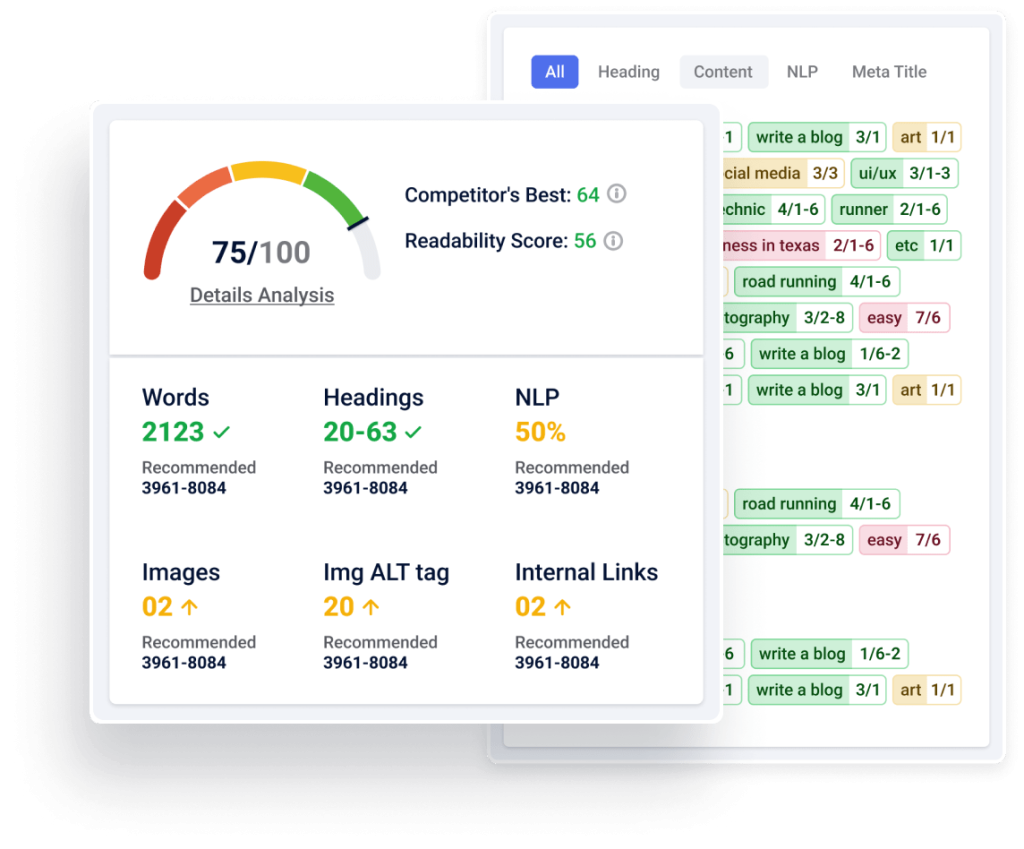
Rather than framing this as a competition, smart teams use a hybrid approach. The table below highlights the strengths of each method.
| Aspect | AI Content Scoring | Manual Editorial Evaluation |
|---|---|---|
| Speed | Seconds per article, scalable to thousands | 30-90 minutes per article, limited by human bandwidth |
| Consistency | Identical criteria applied every time | Varies by editor, mood, fatigue, and interpretation |
| Contextual Understanding | Limited; struggles with nuance, humor, and layered meaning | Deep; understands intent, voice, and cultural references |
| Objectivity on Mechanics | Excellent; catches every grammar slip and formatting issue | Imperfect; human eyes miss errors, especially under time pressure |
| Creative Judgment | Poor; cannot appreciate originality or emotional resonance | Superior; can champion bold, rule-breaking content |
| Feedback Detail | Data-rich, specific, actionable at scale | Qualitative, narrative, may omit granular data points |
| Cost | Monthly subscription, per-word cost decreases with volume | Salary or per-piece cost, increases linearly with volume |
The most effective content operations use AI content scoring for the heavy lifting—catching errors, measuring readability, checking on-page SEO elements—while reserving human editors for final judgment on voice, creative angles, and emotional connection. A score might tell you that a draft is mechanically sound, but only a human can tell you if it’s a compelling read.
Real-World Use Cases and Industry Applications
AI content scoring is not confined to blog writing. Industries across the board are adapting the technology to their unique needs.
E-commerce: Large retailers use scoring to evaluate product descriptions at scale. An AI checks whether each description includes key features, benefits, and SEO keywords while maintaining a consistent voice across thousands of SKUs. Descriptions that score low are automatically flagged for rewriting, protecting brand integrity and conversion rates.
Higher Education: Content scoring tools help universities maintain quality across countless program pages, news articles, and alumni stories. They also assist students by providing instant feedback on essay clarity, structure, and grammar before submission, functioning as a tireless writing coach.
News Media: Digital publishers deploy AI content scoring to uphold editorial standards under breaking-news pressure. The system scans for readability, factual consistency flags, and style guide adherence, allowing editors to focus on verifying facts and shaping the narrative arc.
Healthcare: Patient education materials demand both accuracy and accessibility. AI scoring ensures that medical information is written at an appropriate reading level, free of jargon where unnecessary, and aligned with health literacy best practices. Some hospitals automatically route content that scores below the required reading grade for revision.
Legal and Compliance: Contracts, terms of service, and policy documents must be unambiguous. AI scoring tools specialized for legal language evaluate clarity, potential interpretive risk, and adherence to plain language mandates, reducing the likelihood of disputes arising from poorly drafted clauses.
Common Mistakes When Using AI Content Scoring and How to Avoid Them
Even well-intentioned teams stumble when first adopting automated scoring. Here are the most frequent missteps and practical remedies.
- Treating the score as an absolute truth. An AI score is a signal, not a scoreboard. Avoid publishing decisions based solely on a single number. Always apply human judgment to the final output, especially for creative or opinion-driven pieces.
- Ignoring the sub-scores. An overall score of 82 might hide a readability crisis. Drill down into the component scores. A piece with perfect SEO but poor clarity will still fail to engage readers.
- Using a single scoring model for all content types. A tool optimized for SEO blogs will penalize a video script or social media post that intentionally uses short, fragmented sentences. Tailor the scoring rubric to the content format.
- Failing to update the scoring rubric over time. Search algorithms, audience preferences, and brand voice evolve. A scoring calibration done 18 months ago may now be encouraging outdated practices. Review and refresh weights quarterly.
- Punishing writers for low scores. When writers fear negative consequences, they write for the algorithm instead of the reader. Use scores as coaching tools, not performance metrics for individual blame.
- Overlooking technical setup. Some tools require API connections, custom dictionaries, or whitelisted terms to function properly. A poorly configured tool will produce misleading scores, eroding trust in the entire system.
Important Notes When Leveraging AI Content Scoring
Beyond avoiding mistakes, a proactive stance on several fronts maximizes the return on investment in automated scoring technology.
First, data privacy and security deserve careful attention. Many AI content scoring tools process text in the cloud. If you handle sensitive or proprietary content—unreleased product specs, internal strategy documents, confidential client communications—verify that the vendor offers enterprise-grade encryption and data isolation. Never feed trade secrets into a free or consumer-grade tool without understanding where that data goes and whether it is used to train future models.
Second, model transparency matters. When a tool reduces a 2,000-word article to a score of 73, you should be able to see exactly why. Demand explainable AI features that show which sections triggered deductions and what specific improvements would raise the score. A black box score is useless for learning and improvement; an interpretable score is worth its weight in editorial training hours.
Third, cultural and linguistic inclusivity must not be sacrificed. If your audience spans multiple English-speaking regions, evaluate how the scoring model handles British versus American spellings, regional idioms, or non-native sentence structures. A rigid model that penalizes legitimate variation will alienate both writers and readers. Where necessary, augment generic scoring with human review for international content.
Finally, cost-to-value analysis is essential. AI content scoring tools range from free browser extensions to enterprise platforms costing thousands per month. Calculate the hours of editorial time saved and the performance uplift (higher traffic, lower bounce rates, better conversion) that can be attributed to scored-and-improved content. In many cases, the break-even point justifies the investment, but only if the team actively uses the insights.
Frequently Asked Questions About AI Content Scoring
What exactly does an AI content score measure?
An AI content score typically measures a combination of readability, grammar accuracy, SEO optimization, tone consistency, and sometimes predicted engagement. The exact composition depends on the tool and the rubric configured by the user, but the score is always a composite of multiple linguistic and structural factors rather than a single aspect.
Can AI content scoring replace human editors?
No. AI content scoring accelerates the editing process and catches objective errors and omissions at scale, but human editors remain irreplaceable for nuanced judgment, creative direction, and understanding contextual meaning that machines cannot grasp. The best results come from pairing AI efficiency with human insight.
Is AI content scoring only useful for SEO writing?
While SEO is a popular application, AI content scoring is used in academia, legal drafting, healthcare communication, e-commerce product copy, brand messaging, and internal corporate communications. Any scenario that demands consistent, clear, and effective writing at scale can benefit from automated evaluation.
How accurate are AI content scoring tools?
Accuracy varies widely based on the training data, the sophistication of the language model, and the specific use case. For well-defined tasks like grammar checking and readability assessment, leading tools achieve very high accuracy with over 90% agreement with human judgment. For subjective dimensions like tone or engagement potential, accuracy is lower and context-dependent. Always validate a tool against your own content and audience before relying on it heavily.
Do AI content scores affect my search engine rankings directly?
No, search engines do not use third-party content scores as a ranking factor. However, if an AI content scoring tool helps you improve readability, keyword relevance, topic depth, and user engagement signals (such as dwell time), those factors indirectly contribute to better rankings. The score itself is a diagnostic aid, not a direct ranking signal.
Can I train an AI content scoring model on my own brand guidelines?
Yes, several enterprise-grade platforms like Writer.com and Acrolinx allow you to upload custom style guides, terminology lists, and brand voice examples. The model then scores content against your specific standards, not just general best practices. This customization is essential for organizations with strict or unique content requirements.
The Future of AI Content Scoring
The technology behind AI content scoring is evolving rapidly. Large language models capable of understanding generation intent, multimodal inputs, and audience simulation are pushing scoring far beyond mechanical checks. Soon, scoring engines will not just tell you that your content is readable but predict how specific persona segments will react to different sections—emotional response, cognitive load, and likelihood to convert.
Integration with content management systems and generative AI writing assistants will create a continuous loop: write, score, revise, re-score, all within the same interface. This will collapse the edit cycle from hours to minutes while raising the average quality floor across the web. Yet as the tools grow more powerful, the responsibility to use them ethically and to preserve authentic human voice will become even more critical.
Conclusion
AI content scoring represents a fundamental shift in how we produce, evaluate, and optimize written material. By turning subjective quality judgments into objective, data-backed insights, it empowers teams to scale content without sacrificing standards. The key to success lies not in obsessing over any single number, but in using AI scores as one input into a broader editorial process that values clarity, originality, and genuine human connection. When implemented thoughtfully, AI content scoring transforms the age-old question of “is this good?” into a precise, improvable, and auditable answer—freeing your best creative minds to focus on what only humans can do: tell stories that truly resonate.
Xem thêm:
- Agency AI SEO: The Complete Guide to Scaling Client Results with Artificial Intelligence
- AI SEO Keyword Database: The Complete Guide to Smarter Search Rankings
- AI SEO NLP Keyword Analysis: The Complete Guide to Smarter Search Rankings
- AI SEO Log File Analysis: The Complete Guide to Unlocking Crawl Insights
- AI SEO Rendering: The Complete Guide to Modern Search Visibility
Bài viết cùng chủ đề:

AI SEO SEO Automation with Make: The Complete Workflow Guide

AI SEO SEO Automation with Zapier: The Complete Workflow Guide

AI SEO SEO Automation with n8n: The Complete Workflow Guide
AI SEO SEO Automation with Gemini: The Complete Guide to Scaling Organic Growth

AI SEO SEO Automation with Claude: The Complete Guide to Scaling Content in 2025

AI SEO SEO Automation with ChatGPT: The Complete Playbook for 2025

AI SEO & SEO Automation for Affiliate Sites: The 2025 Playbook for Passive Income Growth
AI SEO & SEO Automation for Bloggers: The Complete Guide to Scaling Your Content

AI SEO & SEO Automation for Agencies: The Complete 2025 Playbook

AI SEO and SEO Automation for Ecommerce: The Complete Playbook for 2025

AI SEO & SEO Automation for WordPress: The Complete Playbook for 2025
AI SEO SEO Automation Strategy: The Complete Playbook for 2025

Mastering the AI SEO SEO Automation Process: A Complete Guide to Scaling Organic Growth
AI SEO SEO Automation System: The Complete Guide to Scaling Organic Growth in 2025
AI SEO SEO Automation Platform: The Complete Guide to Scaling Organic Growth in 2025
AI SEO SEO Automation Software: The Complete Guide to Scaling Organic Growth in 2025















