
No products in the cart.
How to Use ChatGPT for SEO: A Complete Blueprint for AI-Driven Search Success
29
Jul
Jul
The rise of generative AI has turned ChatGPT into a multipurpose assistant that SEO professionals can no longer ignore. Mastering how to use ChatGPT for SEO means accelerating keyword research, refreshing content strategies, and tightening on‑page elements without burning endless hours. This guide walks through every practical angle—from prompt crafting to avoiding costly mistakes—so you can integrate the tool while preserving originality, expertise, and trust.
Understanding ChatGPT’s Role in Modern SEO
ChatGPT is a large language model trained on a vast corpus of internet text. It excels at generating coherent, context‑aware text that mimics human writing. For SEO, this capability translates into summarizing data, drafting outlines, writing meta tags, and even producing full articles when guided properly. However, the tool does not browse the live web, analyze real‑time metrics, or understand search engine algorithms natively. It works with patterns it learned up to its training cutoff, which means outputs must be verified and tailored with current data and human judgment.
Because search engines value unique, helpful content that demonstrates real‑world experience, ChatGPT becomes a productivity lever—not a replacement for an SEO expert. It shines brightest when you supply detailed prompts, feed it fresh information, and refine its output with your own insight. When used correctly, it reduces the time‑to‑first‑draft dramatically and helps you explore keyword clusters, topical angles, and technical markup that might otherwise be overlooked.
Key Areas Where ChatGPT Elevates SEO Workflows
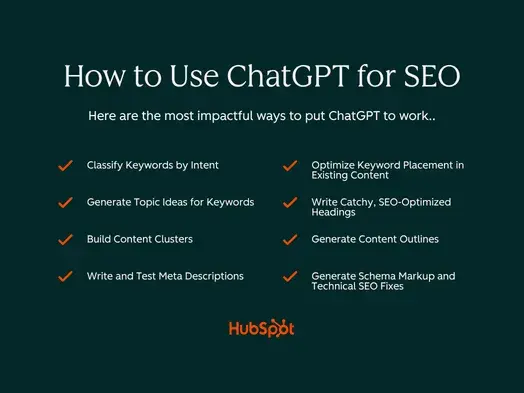
ChatPT can be woven into almost every pillar of an SEO strategy. The following categories highlight where its generative abilities create the most immediate impact.
Keyword Research and Topic Clustering
Generating relevant keyword ideas and grouping them is often a manual, time‑intensive task. ChatGPT can rapidly produce lists of long‑tail keywords, semantic variations, and question‑based queries around a seed topic. By prompting it to act as a search intent analyst, you can uncover content gaps and cluster keywords into pillar pages and supporting articles. While it cannot show search volume or difficulty, pairing its output with tools like Ahrefs or Google Keyword Planner fills those gaps.
Content Strategy and Outline Creation
Structuring a blog post or landing page around user intent is central to SEO. ChatGPT drafts comprehensive outlines that mirror the People Also Ask sections, related searches, and subtopics needed to fully cover a subject. These outlines serve as blueprints, ensuring you address all relevant concepts while maintaining a logical flow. The AI can also suggest internal linking opportunities within a site’s existing content when you provide a list of published URLs.
On‑Page SEO Elements
Title tags, meta descriptions, and header tags are the first touchpoints for both users and crawlers. ChatGPT writes multiple compelling variations that incorporate primary and secondary keywords naturally. It can generate schema markup snippets for FAQs, articles, local businesses, and products, which helps earn rich results without manual coding. Additionally, it can optimize image alt text when you describe the image content.
Technical SEO Assistance
While ChatGPT cannot audit your website, it can help interpret technical issues. You can feed it a snippet of robots.txt,.htaccess directives, or a list of crawl errors, and it will explain what the rules mean and suggest corrections. Generating regex patterns for redirects, crafting XML sitemap outlines, or drafting structured data in JSON‑LD are all within its reach. These outputs save developers and SEOs hours of troubleshooting.
Local SEO and Citation Building
For brick‑and‑mortar businesses, ChatGPT drafts consistent NAP (Name, Address, Phone) information, writes location‑specific landing page copy, and suggests localized content ideas. When provided with a business category and location, it can produce a list of relevant directories for citation building and even template outreach emails for local partnerships.
Benefits and Limitations of Using ChatGPT for SEO
Adopting ChatGPT into your SEO toolkit comes with clear advantages, but its boundaries must be respected. Understanding both sides prevents misuse and ensures outputs uphold quality standards.
Key Benefits
- Speed and scalability: Drafts that previously took hours can be produced in minutes, allowing teams to scale content production and idea generation significantly.
- Idea diversity: The model surfaces angles and keyword variations that even experienced strategists might not consider, enriching content plans.
- Consistency: It maintains a uniform tone across pages and reduces the risk of oversight in technical elements like schema markup.
- Cost efficiency: For small businesses or solo marketers, it reduces reliance on multiple expensive tools for basic outlining and drafting tasks.
- No real‑time data: ChatGPT lacks current search volume, trends, or competitor rankings; its knowledge freezes at a certain point, so fact‑checking is mandatory.
- Potential inaccuracies: The model may generate plausible‑sounding but incorrect information, especially for niche or emerging topics without widespread web coverage.
- Generic output: Without highly specific prompts, the writing can feel bland or formulaic, lacking the unique perspective Google’s helpful content system rewards.
- No genuine experience: Authentic case studies, personal anecdotes, and original data must come from a human expert; ChatGPT cannot fabricate them credibly.
- Publishing raw output without editing: ChatGPT’s drafts are a starting point. Without human fact‑checking, tone refinement, and addition of original insights, content risks being generic and algorithmically flagged as low value.
- Neglecting E‑E‑A‑T signals: Google heavily weighs experience, expertise, authoritativeness, and trustworthiness. AI‑generated text alone does not demonstrate firsthand experience. Always infuse articles with author bios, credentials, quotes from experts, and real case studies.
- Keyword stuffing prompted by over‑optimization: When ChatGPT is instructed to “include keyword X exactly Y times,” it may produce unnatural repetition. Focus on topic coverage and semantic relevance instead of rigid keyword density.
- Ignoring prompt specificity: Vague requests yield vague results. Failing to define audience, intent, format, and desired outcome leads to content that misses the mark.
- Relying on ChatGPT for data‑driven decisions: Never use it for search volume estimates, trend forecasting, or live SERP analysis. Always combine its output with concrete data from analytics and SEO tools.
- Using it as a mass content factory: Publishing dozens of AI‑only pages quickly can trigger manual reviews or algorithmic downgrades if the content lacks substantive value. Scale thoughtfully.
- Treat ChatGPT as an assistant, not the author. Every piece of content should pass through a human editor who adds expertise, fact‑checks statements, and aligns the message with brand values.
- Train the model with your own data when possible. Provide examples of your best‑performing content, style guides, and brand terminology so ChatGPT assimilates your voice more accurately.
- Document your usage. Some teams find it useful to log which drafts originated from AI and how they were modified, demonstrating a clear human‑in‑the‑loop process if ever questioned.
- Blend AI efficiency with original research. Use ChatGPT to handle repetitive tasks so you can invest time in conducting surveys, interviews, or data studies—exactly the type of content that builds authority.
- Regularly audit AI‑assisted pages. Monitor rankings, engagement metrics, and user feedback to see if AI‑generated sections are underperforming and need a human rewrite.
Notable Limitations
Comparing ChatGPT with Dedicated SEO Platforms
ChatGPT complements rather than replaces specialized SEO tools. The table below clarifies where it adds value and where purpose‑built software still dominates.
| SEO Function | ChatGPT Capability | Dedicated Tool (e.g., Ahrefs, Semrush) |
|---|---|---|
| Keyword volume and difficulty | Cannot provide; only offers suggestions based on patterns | Real‑time metrics with competitive analysis |
| Content drafting | Excellent for outlines, blog posts, and meta tags | Limited to content templates or AI add‑ons |
| Technical site audit | Can explain errors if you supply data, but cannot crawl | Full crawl, issue severity, and fix recommendations |
| Backlink analysis | No access to link profiles | Comprehensive link index and gap analysis |
| Schema markup generation | Quickly writes JSON‑LD code from text instructions | Often requires manual input or built‑in generators |
| Rank tracking | Not possible | Daily position monitoring across locations |
The most effective SEO workflow combines the creative, generative muscle of ChatGPT with the data horsepower of professional SEO suites. ChatGPT takes over the ideation, drafting, and basic optimization tasks, while traditional tools handle measurement, auditing, and competitive intelligence.
Step‑by‑Step: How to Use ChatGPT for SEO with Proven Prompts
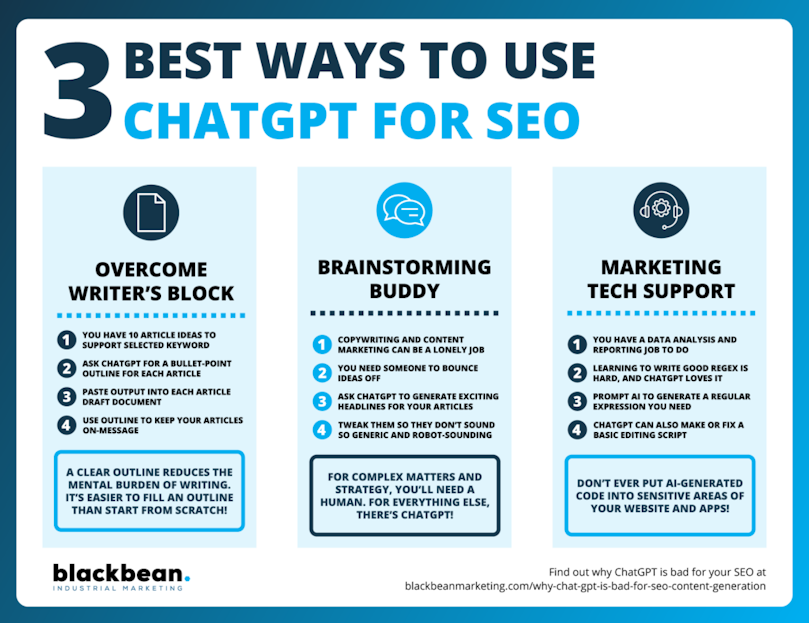
Moving from theory to execution requires concrete prompts and clear processes. The following steps illustrate exactly how to integrate ChatGPT into daily SEO tasks. Each prompt is designed to be copied, refined, and extended based on your specific niche.
1. Seed Keyword Expansion
Start by feeding ChatGPT a primary keyword along with a description of your target audience. Prompt: “Act as an SEO keyword strategist. Generate 30 long‑tail keyword variations for the topic ‘vegan protein powder’ suitable for health‑conscious beginners. Include informational, commercial, and transactional intent keywords. Present them in a table with columns: keyword, intent, and estimated competition range (low/medium/high) based on your understanding.” The output jump‑starts your keyword list, which you then validate with a tool like Google Keyword Planner.
2. Building a Content Outline that Matches Search Intent
Once a target keyword is chosen, have ChatGPT build a detailed outline. Prompt: “Create a comprehensive blog post outline for the keyword ‘how to use ChatGPT for SEO’. The audience is intermediate SEO practitioners. Include H2 and H3 subheadings that cover practical applications, benefits, limitations, prompts, and common mistakes. Ensure the outline follows a logical, educational flow and resembles what would rank in the top 3 results.” This produces a skeleton you can enrich with original data and examples.
3. Writing Meta Titles and Descriptions
For a specific URL, you can request multiple variations. Prompt: “You are an SEO copywriter. Write five SEO‑optimized title tags (under 60 characters) and five meta descriptions (under 155 characters) for a page about ‘how to use ChatGPT for SEO’. Include primary keyword and one secondary keyword naturally. Make them compelling and click‑worthy.” Review the options, pick the best, and fine‑tune for brand voice.
4. Generating FAQ Section Content
FAQ sections win rich snippets and improve user experience. Prompt: “Based on the main topic ‘how to use ChatGPT for SEO’, list the top 10 most frequently asked questions people search for on Google. Provide a concise, accurate answer for each in 2‑3 sentences, written in a helpful tone.” The resulting Q&A can be directly placed on the page with proper FAQ schema markup.
5. Creating Schema Markup in JSON‑LD
Implementing structured data manually is error‑prone. Prompt: “Generate FAQPage JSON‑LD schema markup for the following questions and answers: [paste your Q&A]. Include mainEntity array with correct @type and properties. Output only valid JSON.” The model produces clean code that you can validate in Google’s Rich Results Test. Extend this to Article, LocalBusiness, or Product schema as needed.
6. Competitor Content Gap Analysis (Manual Input Required)
While ChatGPT cannot analyze live URLs, you can paste competitor headings to find gaps. Prompt: “Here are the H2 subheadings from three competitor articles about ‘how to use ChatGPT for SEO’. Analyze them and suggest five subtopics they all missed that would strengthen a comprehensive guide.” This exercise uncovers unique angles that differentiate your content.
7. Local SEO Landing Page Content
For multi‑location businesses, scaling local pages is tedious. Prompt: “Write a 200‑word introductory section for a service page targeting ‘emergency plumber in Austin, TX’. Naturally incorporate the keywords ‘24/7 plumber Austin’, ‘Austin emergency plumbing’, and ‘licensed plumber near me’. Mention local landmarks or neighborhoods to show local relevance.” Edit the draft to insert real photos, reviews, and precise location details to achieve strong local ranking signals.
8. Internal Linking Suggestions
Provide a list of existing pages and ask for linking opportunities. Prompt: “ For a new article titled ‘how to use ChatGPT for SEO’, recommend five internal links from the new article to existing content with relevant anchor text. Also suggest two existing pages that could link back to the new article.” This strengthens site architecture and distributes link equity.
Common Mistakes When Using ChatGPT for SEO
Even seasoned marketers slip into habits that undermine the value of AI‑assisted SEO. Avoiding these missteps protects site authority and ranking stability.
Important Notes for Sustainable SEO with ChatGPT
Google’s stance on AI content has evolved. The search engine does not penalize AI‑generated content outright; it penalizes unhelpful, unoriginal content regardless of how it is produced. This means the benchmark is quality, not the tool. To operate safely and effectively:
Frequently Asked Questions
Can ChatGPT replace an SEO specialist?
No. ChatGPT automates parts of the workflow, but an SEO specialist provides strategic direction, interprets data, makes judgment calls, and ensures content meets quality standards that AI alone cannot guarantee.
Is ChatGPT good for SEO content writing?
Yes, when used responsibly. It excels at drafting outlines, introductions, and repetitive copy. For content to rank well, human oversight is essential to add originality, factual accuracy, and engaging storytelling.
How do I write effective SEO prompts for ChatGPT?
Effective prompts are clear about role, audience, format, and goal. Include the primary keyword, specify word count or structure, and provide examples of the desired output. Iterating with follow‑up prompts refines the result.
Does Google penalize AI‑generated content?
Google focuses on content quality and helpfulness. AI‑generated material that is thin, inaccurate, or spammy may be penalized under existing guidelines. High‑value content that serves user intent, regardless of how it was created, can rank well.
How can I use ChatGPT for local SEO?
ChatGPT helps by drafting location‑specific service pages, generating local business schema, creating consistent NAP information, and suggesting hyperlocal content ideas. Always verify all business details and integrate real customer reviews to build trust.
What are the best ChatGPT SEO prompts for on‑page optimization?
The best prompts ask for title tag variations, meta description drafts, header tag suggestions, image alt text, and internal linking anchor text. Pair these with current keyword data and a deep understanding of the page’s target intent.
Can ChatGPT generate schema markup for SEO?
Yes. By providing the content details, you can prompt ChatGPT to produce JSON‑LD for FAQ, Article, Product, or LocalBusiness schema. Always validate the output with Google’s Rich Results Test before deployment.
How do I avoid bland content when using ChatGPT?
Inject your brand voice, specific data points, and personal stories into the draft. Use prompt instructions like “write in a conversational yet authoritative tone” and refine with follow‑up edits. The final polish must come from a human editor.
Conclusion
Knowing how to use ChatGPT for SEO is no longer a speculative skill—it is a practical, everyday advantage for those willing to blend AI speed with human judgment. From brainstorming keyword clusters and outlining pillar content to crafting precise meta tags and schema markup, the tool fits into a modern SEO stack seamlessly. Yet its real power unlocks only when the output is scrutinized, enriched, and validated against live data and real‑world experience. The SEOs who thrive in this landscape will be the ones who treat ChatGPT as a tireless junior researcher while reserving the strategic thinking, creativity, and quality control for themselves. Start with small, well‑defined tasks, iterate your prompts, and let every piece of content carry your unique fingerprint of expertise.
Xem thêm:
- AI SEO Content Intelligence: The Complete Guide to Data-Driven Content That Ranks
- AI Programmatic SEO: The Ultimate Guide to Automated Content Generation at Scale
- AI SEO Resource Page Links: The Complete Guide to Building High-Quality Backlinks in 2025
- AI SEO Alt Text Generator: The Complete Guide to Automated Image Optimization
- AI SEO Writing: The Complete Guide to Ranking Smarter with Machine Assistance
Bài viết cùng chủ đề:

AI SEO SEO Automation with Make: The Complete Workflow Guide

AI SEO SEO Automation with Zapier: The Complete Workflow Guide

AI SEO SEO Automation with n8n: The Complete Workflow Guide
AI SEO SEO Automation with Gemini: The Complete Guide to Scaling Organic Growth

AI SEO SEO Automation with Claude: The Complete Guide to Scaling Content in 2025

AI SEO SEO Automation with ChatGPT: The Complete Playbook for 2025

AI SEO & SEO Automation for Affiliate Sites: The 2025 Playbook for Passive Income Growth
AI SEO & SEO Automation for Bloggers: The Complete Guide to Scaling Your Content

AI SEO & SEO Automation for Agencies: The Complete 2025 Playbook

AI SEO and SEO Automation for Ecommerce: The Complete Playbook for 2025

AI SEO & SEO Automation for WordPress: The Complete Playbook for 2025
AI SEO SEO Automation Strategy: The Complete Playbook for 2025

Mastering the AI SEO SEO Automation Process: A Complete Guide to Scaling Organic Growth
AI SEO SEO Automation System: The Complete Guide to Scaling Organic Growth in 2025
AI SEO SEO Automation Platform: The Complete Guide to Scaling Organic Growth in 2025
AI SEO SEO Automation Software: The Complete Guide to Scaling Organic Growth in 2025















