No products in the cart.
AI SEO Cannibalization: The Hidden Threat to Your Organic Traffic and How to Fix It
31
Jul
Jul
AI SEO cannibalization is rapidly becoming one of the most expensive silent killers of organic growth. As search engines increasingly rely on machine learning to interpret content, the risk of your own pages competing against each other for the same query has intensified. When your website publishes multiple articles targeting the same keyword or user intent, you force Google to choose a winner, often resulting in both pages ranking lower than they should. This comprehensive guide explains what AI SEO cannibalization is, why it happens, how to detect it, and the exact steps to resolve it before your traffic bleeds out.
What Is AI SEO Cannibalization?
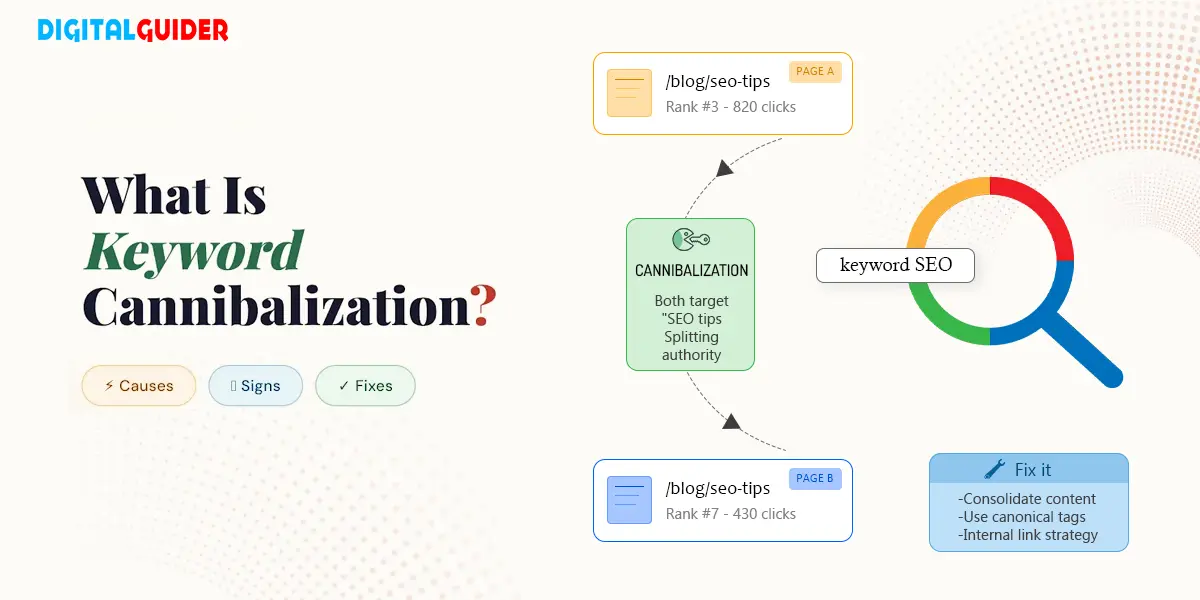
Keyword cannibalization occurs when two or more URLs on the same domain target the same keyword or search intent. The term “AI SEO cannibalization” specifically refers to the modern context where artificial intelligence systems, like Google’s RankBrain and BERT, evaluate semantic relevance. These AI algorithms do not simply look at exact keyword matches; they analyze the entire context, entities, and user intent behind a query. When you have multiple pages that AI perceives as equally relevant to a single query, the algorithm struggles to determine which page deserves the top position.
This confusion leads to a scenario where neither page ranks as highly as it could. Instead of consolidating authority, you split it across multiple URLs. The AI system may even alternate which page it shows in search results, causing erratic ranking fluctuations. Unlike traditional keyword stuffing issues, AI-driven cannibalization is more subtle because the pages might not share the exact keyword phrase but still compete for the same semantic intent.
How AI Algorithms Detect Cannibalization
Modern search engines use neural networks to map out the relationship between queries and content. These systems evaluate the topical authority of a domain by looking at how many pages cover the same entity. If your site has three articles about “best running shoes,” the AI notes that you have high topical coverage but also detects redundancy. The algorithm then applies a filter to prevent the same domain from occupying multiple top slots for one query. This filter, often called “site clustering,” means Google will typically show only one or two of your pages per search result page.
The AI also uses user interaction signals to determine which page is the “best” answer. If users click on Page A but quickly bounce back to search results and then click on Page B, the algorithm interprets this as neither page fully satisfying the query. This negative feedback loop further depresses your rankings for both URLs.
Why AI SEO Cannibalization Is More Dangerous Now Than Ever
In the past, keyword cannibalization was a manageable issue. You could simply check your keyword rankings and merge duplicate pages. However, the rise of AI-generated content has exponentially increased the risk. Many websites now use AI writing tools to produce large volumes of articles quickly. These tools often generate multiple pieces covering the same topic with slight variations, inadvertently creating cannibalization at scale.
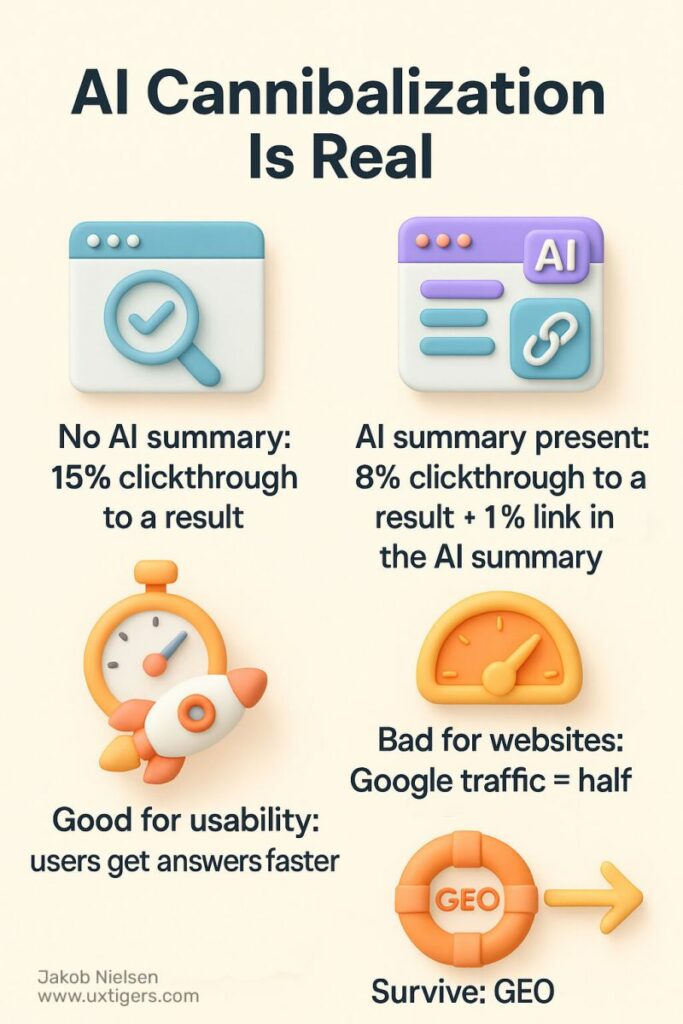
Furthermore, Google’s Helpful Content Update and the introduction of AI Overviews have changed how search results are displayed. With AI Overviews taking up prime real estate at the top of the page, organic listings have less space. If your site has multiple competing pages, you are far less likely to secure one of the few remaining spots. The cost of cannibalization is no longer just a small ranking drop; it can mean complete invisibility for your target keywords.
The Financial Impact of Cannibalized Keywords
Consider a scenario where you run an e-commerce site selling fitness equipment. You publish a blog post titled “Best Treadmills for Home” and a product category page also optimized for “best treadmills.” Both pages have backlinks and authority. Instead of one page ranking in position 3 and the other in position 15, you might see both stuck at positions 8 and 12. The combined click-through rate for those positions is significantly lower than what a single page at position 3 would receive. This directly translates to lost revenue, wasted content production costs, and diluted link equity.
Common Causes of AI SEO Cannibalization

Understanding the root causes is essential for prevention. Here are the most frequent scenarios that trigger AI SEO cannibalization:
- Overlapping Blog Posts: Writing multiple articles on the same topic with slightly different angles, such as “What is SEO” and “SEO Explained for Beginners.”
- Similar Product or Category Pages: Having separate pages for “Men’s Running Shoes” and “Running Shoes for Men” that target the same audience.
- Tag and Category Archives: WordPress sites often create archive pages that compete with the main content pages for the same keywords.
- AI-Generated Content Sprawl: Using AI tools to generate dozens of articles without a proper content clustering strategy, leading to massive semantic overlap.
- International or Regional Pages: Creating pages for different locations that accidentally target the same keyword without proper hreflang implementation.
- Pagination Issues: When paginated lists (e.g., page 2, page 3 of a category) are not properly tagged with rel=”canonical” or rel=”prev/next”.
- Which page has the most backlinks?
- Which page has the highest organic traffic?
- Which page has the highest conversion rate?
- Which page is most aligned with the user’s search intent?
- Deleting Pages Without Redirects: If you delete a page without a 301 redirect, you lose all its link equity and potentially cause 404 errors.
- Redirecting to the Wrong Page: Always redirect to the page that best matches the original content’s intent. Redirecting a “how-to” article to a product page will confuse users and hurt rankings.
- Ignoring International Cannibalization: If you have pages for different countries, ensure you use hreflang tags correctly. Otherwise, Google may show the wrong country’s page to users.
- Using Noindex Instead of Redirects: Noindexing a page removes it from the index but does not pass link equity to the preferred page. Use 301 redirects instead.
- Fixing Only One Instance: Cannibalization often occurs in clusters. If you fix one pair of pages but ignore another pair targeting the same topic, you will not see significant improvements.
How to Detect AI SEO Cannibalization
Detection requires a combination of manual analysis and specialized tools. You cannot rely solely on your intuition because AI-driven cannibalization often hides behind different keyword variations.
Manual Search Audit
Go to Google and search for your target keyword using the “site:” operator. For example, type site:yourdomain.com “best running shoes”. If you see more than one URL from your site ranking for that exact phrase, you have a cannibalization issue. Also, check for variations like “best running shoes for men” and “top running shoes” to identify semantic overlap.
Using Google Search Console
Navigate to the Performance report in Google Search Console. Filter by a specific query and look at the “Pages” tab. If you see multiple pages receiving impressions for the same query, that is a clear signal of cannibalization. Pay attention to pages that have high impressions but low click-through rates, as this often indicates that Google is showing your pages but users are choosing competitors.
Advanced SEO Tools
Tools like Ahrefs, Semrush, and Screaming Frog can help you identify cannibalization at scale. In Ahrefs, use the “Organic Keywords” report and filter for keywords where two or more pages rank in the top 100. Semrush has a dedicated “Cannibalization” feature in its Position Tracking tool. Screaming Frog allows you to crawl your site and compare title tags and meta descriptions to spot duplicates.
Step-by-Step Guide to Fixing AI SEO Cannibalization
Once you have identified the competing pages, you need to take decisive action. The solution depends on the value and authority of each page.
Step 1: Audit and Classify the Competing Pages
Create a spreadsheet listing all the cannibalized keywords and the URLs that compete for them. For each set of pages, evaluate the following criteria:
This analysis will tell you which page is the “primary” page that deserves to rank.
Step 2: Choose a Strategy: Merge, Redirect, or Differentiate
There are three main strategies to eliminate cannibalization. The choice depends on the quality and purpose of the pages.
| Strategy | When to Use | Implementation |
|---|---|---|
| 301 Redirect | When one page is clearly inferior, has no unique value, or is an old duplicate. | Redirect the weaker page to the stronger page. Ensure the redirect is a 301 (permanent) and update internal links pointing to the old URL. |
| Merge Content | When both pages have valuable information that can be combined into a single, comprehensive resource. | Create a new “ultimate guide” page that incorporates the best elements of both. Then 301 redirect both old pages to the new one. |
| Differentiate Intent | When both pages serve different user intents (e.g., informational vs. transactional) but target similar keywords. | Rewrite each page to target a distinct long-tail keyword and modify the content to match the specific intent. Update title tags and meta descriptions to reflect the new focus. |
Step 3: Implement Canonical Tags Correctly
If you have pages that are similar but you want to keep them live (e.g., product variations), use the rel=”canonical” tag to point to the preferred version. This tells the AI algorithms which URL should be indexed and ranked. However, be careful: canonical tags are a signal, not a directive. If the content is too different, Google may ignore the tag.
Step 4: Consolidate Internal Linking
Internal links are a powerful way to signal relevance and authority. When you have multiple pages targeting the same topic, ensure that all internal links point to the primary page. Remove or update links that point to the secondary pages. This consolidates link equity and helps the AI understand which page is the authoritative source.
Step 5: Update and Refresh the Winning Page
After you have redirected or merged the competing pages, focus on making the surviving page the best possible resource. Add new sections, update statistics, include FAQs, and improve the user experience. This signals to Google that the page is fresh and deserves to rank higher.
How to Prevent AI SEO Cannibalization in the Future
Prevention is far easier than fixing the damage. Implementing a robust content governance strategy is essential, especially if you rely on AI writing tools.
Create a Content Cluster Strategy
Before writing any new article, map out your content clusters. A pillar page should target the broad, high-volume keyword, while cluster pages should target specific long-tail variations. For example, a pillar page on “Email Marketing” can have cluster pages on “Email Marketing for E-commerce” and “Email Automation Workflows.” This structure ensures that no two pages compete for the same primary keyword.
Maintain a Keyword-to-URL Mapping Document
Keep a live spreadsheet that tracks every target keyword and the exact URL assigned to it. Before publishing new content, check this document to ensure you are not targeting a keyword that is already assigned to another page. This is a simple but highly effective control mechanism.
Set Clear Guidelines for AI Content Generation
If you use AI tools to generate content, you must provide strict prompts that specify the target keyword, the user intent, and the unique angle. Instruct the AI to avoid covering subtopics that belong to other pages in your cluster. Review all AI-generated content for semantic overlap before publishing.
Regular Audits with AI-Powered SEO Tools
Schedule a quarterly audit using tools that leverage AI to detect semantic similarity. Tools like MarketMuse and Clearscope can analyze your existing content and flag pages that are too similar. These tools use natural language processing to understand the topical overlap, which is more accurate than manual keyword checking.
Common Mistakes When Dealing with Cannibalization
Many website owners make the situation worse when trying to fix cannibalization. Avoid these common pitfalls.
Important Notes on AI and Search Engine Behavior
It is critical to understand that Google’s AI is constantly evolving. What works today may not work tomorrow. The algorithms are becoming better at understanding user satisfaction, not just keyword matching. Therefore, the ultimate defense against AI SEO cannibalization is to create content that is genuinely unique and valuable. If two pages on your site provide different answers to the same question, you are still at risk. The goal is to have one definitive, comprehensive answer per query.
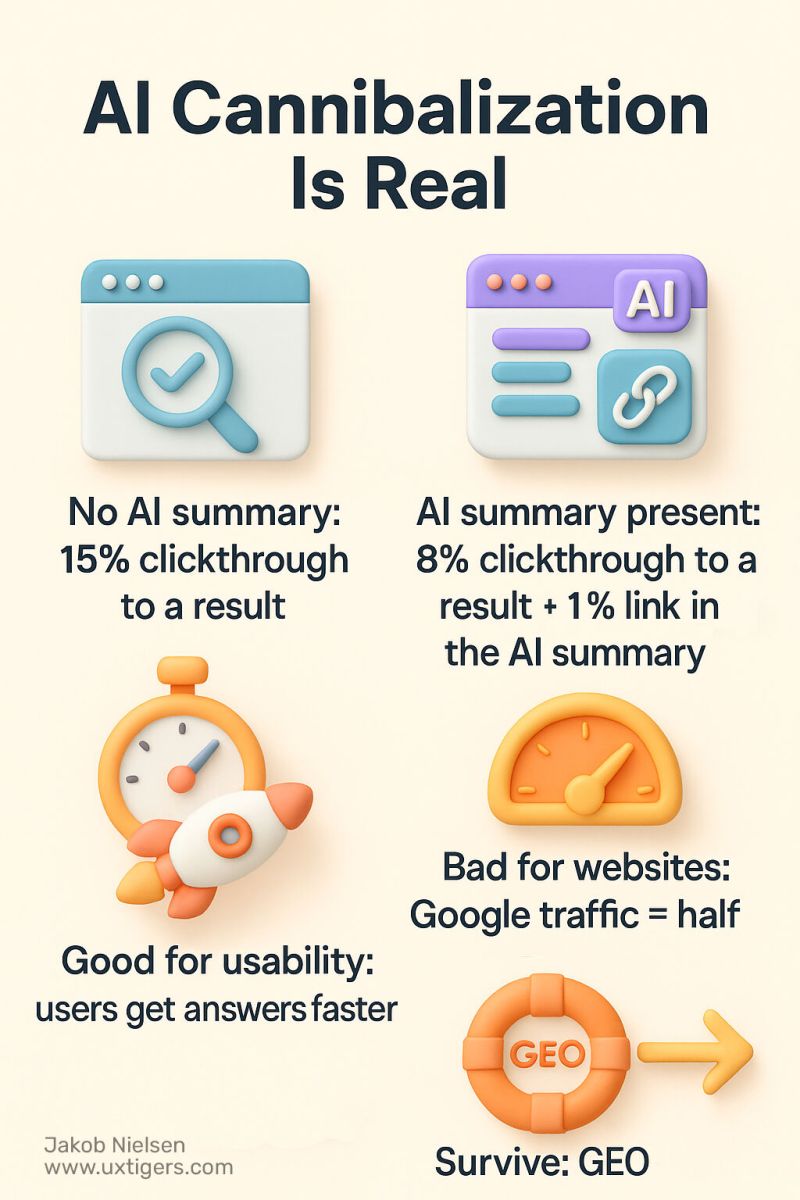
Also, note that AI Overviews (formerly known as Search Generative Experience) can change the game entirely. These overviews often pull information from multiple sources, but they typically cite only one page from a single domain. If your site has cannibalized pages, the AI may struggle to choose which one to cite, leading to your brand being excluded entirely from the AI-generated answer.
Frequently Asked Questions (FAQ)
What is the difference between keyword cannibalization and AI SEO cannibalization?
Traditional keyword cannibalization refers to multiple pages targeting the exact same keyword phrase. AI SEO cannibalization is broader and includes pages that target different keywords but share the same semantic intent or topic. AI algorithms can detect this overlap even when the exact keywords differ, making it harder to identify manually.
How long does it take to recover from AI SEO cannibalization?
Recovery time varies depending on the authority of your domain and the speed of Google’s recrawl. In most cases, you can see improvements within 2 to 4 weeks after implementing 301 redirects and consolidating content. However, for large sites with thousands of pages, it may take several months to see the full impact.
Can AI SEO cannibalization affect my paid search campaigns?
No, cannibalization primarily affects organic search results. However, if your organic pages are cannibalized, your quality score for paid ads might indirectly suffer if users land on a weak page and bounce back. It is best to fix organic cannibalization to improve overall user experience.
Should I use a 301 redirect or a canonical tag to fix cannibalization?
Use a 301 redirect when you want to permanently merge two pages into one. Use a canonical tag when you have similar pages that must remain live, such as product variations with different tracking parameters. A 301 redirect passes more link equity than a canonical tag.
How do I know if my AI-generated content is causing cannibalization?
Run a semantic similarity analysis using tools like MarketMuse or use Google Search Console to check for multiple pages ranking for the same query. If you notice that your AI-generated articles are getting impressions but no clicks, they are likely competing with each other.
Conclusion
AI SEO cannibalization is a complex problem that requires a strategic, data-driven approach. The rise of AI in search algorithms and content creation has made this issue more prevalent and more damaging. By understanding how AI perceives your content, conducting regular audits, and implementing a clear content hierarchy, you can eliminate cannibalization and unlock your true organic potential. The key is to treat every page on your site as part of a cohesive ecosystem, not as isolated pieces of content. Consolidate your authority, differentiate your intent, and let the AI algorithms see exactly which page deserves to win. Your rankings, traffic, and revenue will thank you.
Xem thêm:
- AI SEO Strategy: The Complete Guide to Ranking with Artificial Intelligence in 2025
- AI SEO Product Schema: The Complete Guide to Structured Data That Ranks
- AI SEO AI Search Traffic: The Complete Guide to Winning Generative Engine Rankings
- AI Blogging Tools: The Complete Guide to Automating Content Creation Without Losing Your Voice
- AI SEO Product Reviews: The Complete Guide to Smarter Buying Decisions
Bài viết cùng chủ đề:

AI SEO SEO Automation with Make: The Complete Workflow Guide

AI SEO SEO Automation with Zapier: The Complete Workflow Guide

AI SEO SEO Automation with n8n: The Complete Workflow Guide
AI SEO SEO Automation with Gemini: The Complete Guide to Scaling Organic Growth

AI SEO SEO Automation with Claude: The Complete Guide to Scaling Content in 2025

AI SEO SEO Automation with ChatGPT: The Complete Playbook for 2025

AI SEO & SEO Automation for Affiliate Sites: The 2025 Playbook for Passive Income Growth
AI SEO & SEO Automation for Bloggers: The Complete Guide to Scaling Your Content

AI SEO & SEO Automation for Agencies: The Complete 2025 Playbook

AI SEO and SEO Automation for Ecommerce: The Complete Playbook for 2025

AI SEO & SEO Automation for WordPress: The Complete Playbook for 2025
AI SEO SEO Automation Strategy: The Complete Playbook for 2025

Mastering the AI SEO SEO Automation Process: A Complete Guide to Scaling Organic Growth
AI SEO SEO Automation System: The Complete Guide to Scaling Organic Growth in 2025
AI SEO SEO Automation Platform: The Complete Guide to Scaling Organic Growth in 2025
AI SEO SEO Automation Software: The Complete Guide to Scaling Organic Growth in 2025