
No products in the cart.
AI SEO Community: The Ultimate Hub for Modern Search Professionals
29
Jul
Jul
The digital marketing landscape has undergone a seismic shift with the rise of artificial intelligence. At the heart of this transformation is the AI SEO community, a growing network of forward-thinking marketers, developers, and search experts who leverage machine learning to dominate search rankings. These communities are not just discussion boards; they are incubators of innovation where members share real-world prompts, case studies, and tool stacks that are reshaping how websites are optimized. For anyone serious about staying competitive, tapping into an active AI SEO community is no longer optional—it is the fastest path to mastering search in the age of large language models.
Within these spaces, you will find a relentless focus on practical execution. From automating technical audits to predicting algorithm updates before they happen, the collective intelligence of an AI SEO community compresses years of trial and error into actionable daily insights. This article serves as your comprehensive guide to understanding, joining, and thriving in these specialized groups, covering everything from the available platforms to the subtle cultural norms that separate successful members from the rest.
What Exactly Is an AI SEO Community?
An AI SEO community is a collaborative ecosystem where professionals converge to discuss the intersection of search engine optimization and artificial intelligence. Unlike traditional SEO forums that focus solely on backlinks or keyword density, these communities explore how natural language processing, predictive analytics, and generative AI can automate and enhance ranking strategies. They are typically hosted on platforms like Slack, Discord, Reddit, or dedicated membership sites, and they often attract a mix of data scientists, content strategists, and agency owners.
The core identity of these groups revolves around three pillars: tool experimentation, workflow automation, and algorithmic interpretation. Members dissect the outputs of large language models to understand entity recognition, share prompt libraries for generating content briefs, and debate the increasingly blurred line between Google’s ranking systems and AI-driven content. In essence, an AI SEO community functions as a real-time brain trust for anyone trying to decode the black box of modern search engines.
The Evolution from Traditional SEO to AI-Infused Communities
Before the explosion of generative AI, SEO communities focused primarily on manual grind: link-building matrices, manual keyword mapping, and reverse-engineering minor Google updates. The shift toward AI SEO communities began in earnest with the release of advanced language models, which forced a rethinking of what signals search engines value. Suddenly, topics shifted from “How to build a PBN” to “How to use semantic clustering APIs to structure topical authority.” This evolution represented a fundamental change in required expertise, prompting a new wave of communities that demanded technical literacy alongside marketing intuition.
Today’s AI SEO community bridges the gap between machine efficiency and human strategy. Where an older forum might have a thread about meta description length, these modern groups discuss embedding vectors, retrieval-augmented generation for content freshness, and the statistical probability of ranking factors. This higher-level discourse attracts a more analytically minded crowd, creating a positive feedback loop of increasingly sophisticated knowledge sharing.
Why Joining an AI SEO Community Accelerates Growth
The solo practitioner trying to keep pace with Google’s 5,000-plus yearly algorithm changes while simultaneously mastering Midjourney for image alt optimization and Python for log file analysis faces an impossible task. An AI SEO community demolishes this learning curve by distributing the cognitive load. Instead of testing every new tool yourself, you can rely on the vetted experiences of hundreds of peers who have already done the heavy lifting.
Beyond knowledge aggregation, these communities provide a powerful competitive moat. Members often gain early access to beta tools, undisclosed prompting techniques that bypass generic AI outputs, and critical intelligence about search engine behavior that never reaches public blogs. The shared struggle against confirmation bias also serves as a reality check; rigorous peer review within an AI SEO community prevents the adoption of flashy but ineffective “shiny object” technologies that waste budget and sandbox sites.
Networking and Career Velocity
A hidden advantage of active participation is career acceleration. Recruiters and agency owners increasingly lurk in these spaces, hunting for talent who can speak fluently about vector databases and content refreshing workflows. It is not unusual to see job offers posted directly in a specialized AI SEO community, bypassing traditional hiring platforms entirely because the employer knows the baseline competence of members is already higher than the general applicant pool.
Types of AI SEO Community Platforms
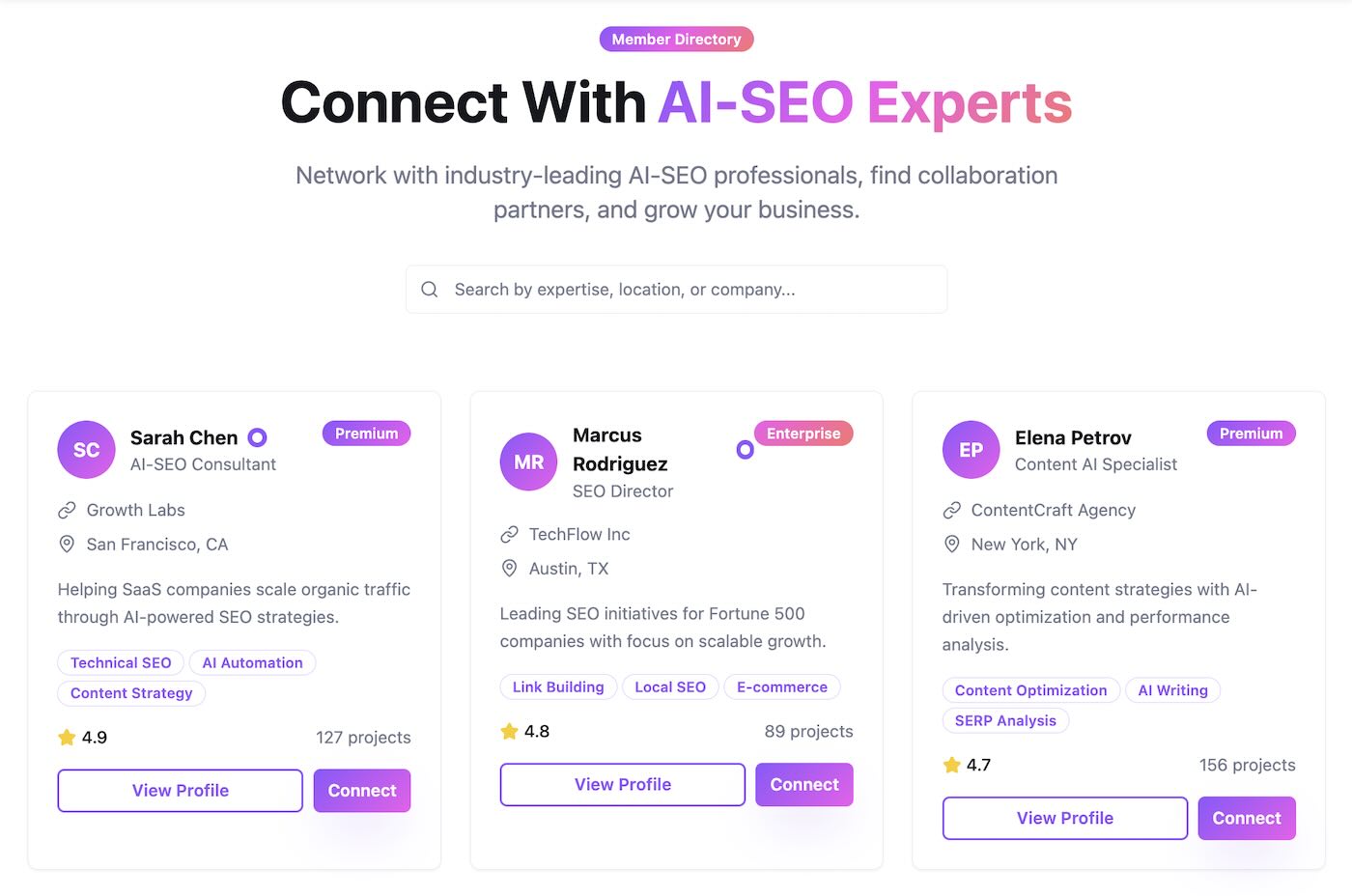
Not all groups operate the same way. The platform a community chooses often dictates the depth and style of interaction. Understanding these formats helps you find an AI SEO community that matches your communication preferences and learning goals.
- Slack and Discord Groups: These real-time chat platforms are the operational hubs of the AI SEO world. They are fast, noisy, and ideal for immediate troubleshooting. Channels are usually segmented into specific topics like #prompt-engineering, #python-scripts, or #ranking-news. The barrier to entry is often higher here, requiring an invitation or a paid membership.
- Subreddits and Online Forums: Reddit communities such as r/seo and more niche AI-focused subreddits offer a slower, more archival style of discussion. They are public, easily searchable via Google, and excellent for long-form debate. However, they sometimes lack the proprietary nuance that private, paid AI SEO community groups protect fiercely.
- LinkedIn and X (Twitter) Communities: These platforms serve as the public-facing layer. Thought leaders often test concepts here before moving deeper discussion into closed environments. While not purely an AI SEO community in the gated sense, the LinkedIn collaborative articles and X Spaces provide a funnel into the private ecosystem.
- Skool and Circle Communities: These structured learning platforms have become popular for cohort-based courses. They blend a forum layout with video content and gamification. An AI SEO community built on Skool usually centers around a single instructor’s methodology, providing a unified framework that reduces cognitive dissonance for beginners.
- Excessive Hype Without Data: If every post promises “100% traffic increase with zero effort,” the group lacks scientific rigor.
- Outdated Focus on Volume: A community still centered solely on keyword density or article count, rather than entity optimization and information gain, is stuck in 2018.
- Secrecy About Failures: Groups that delete threads about indexing bugs or deindexing penalties are curating an unrealistic picture of AI search.
Comparing Open-Source Intelligence vs. Gated AI SEO Groups
T The table below highlights the core differences to help you allocate resources effectively.
| Aspect | Open-Source AI SEO Community (Reddit, X) | Gated AI SEO Community (Paid Slack, Skool) |
|---|---|---|
| Information Depth | Broad, varying quality; often surface-level | Deep, data-backed, proprietary method sharing |
| Noise Level | High; many beginners asking repetitive questions | Low to moderate; self-selected for professionalism |
| Tool Exposure | Mainly mainstream tools | Custom scripts, private betas, custom GPTs |
| Networking Value | Low; anonymous interactions dominate | High; real identities and business partnerships form |
| Cost | Free | $50–$500 per month or one-time premium fees |
Many professionals adopt a hybrid model. They use the public open-source AI SEO community layer to scout for talent and monitor broad trends, while relying on one or two tightly gated groups for their actual operational edge. The cost of a premium group is negligible compared to the wasted budget of executing an AI strategy that a smarter community could have debunked in minutes.
How to Evaluate and Choose the Right AI SEO Community
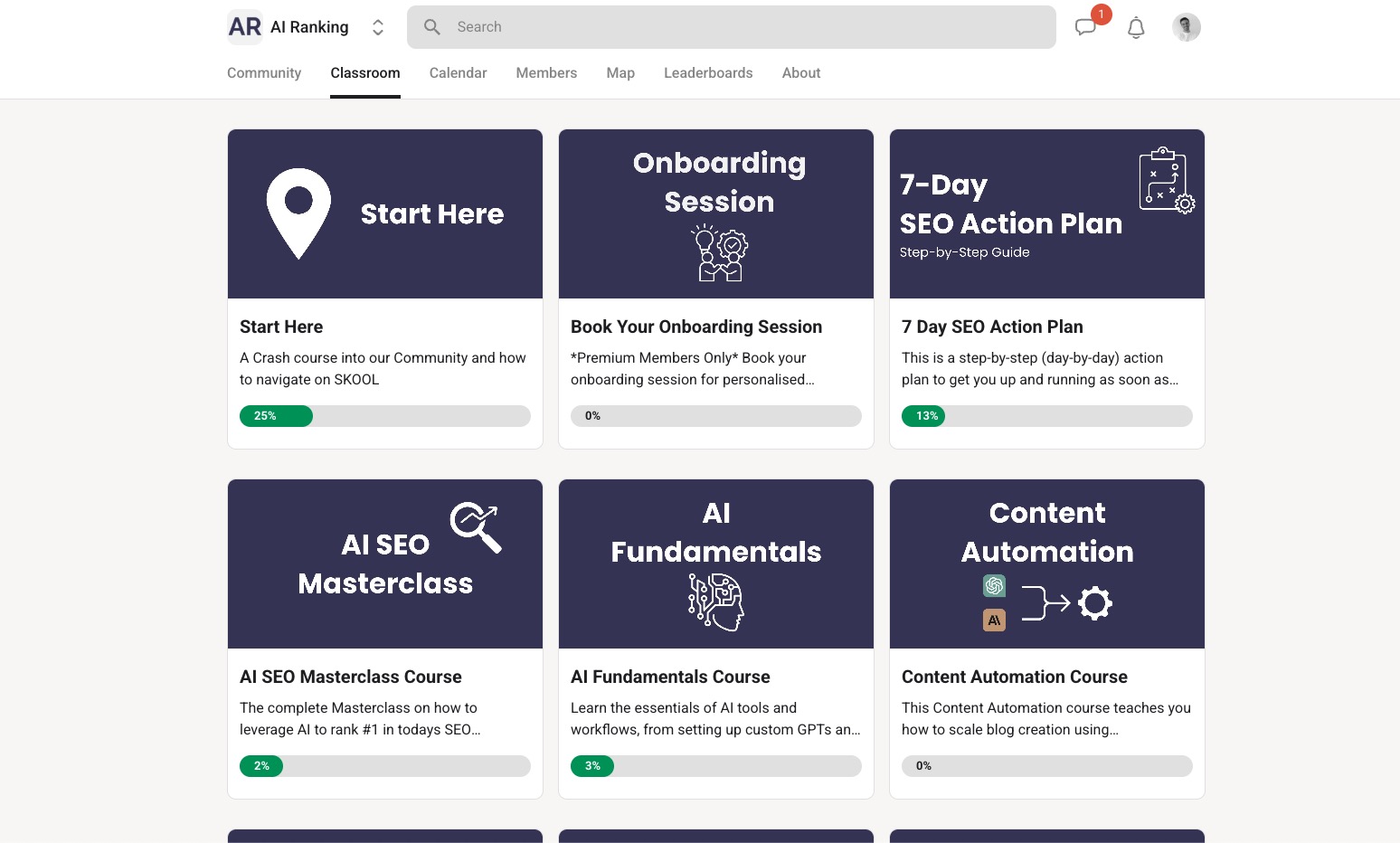
With dozens of groups vying for attention, joining the wrong community can be a drain on time and a source of inaccurate information. Vetting an AI SEO community requires looking beyond the marketing hype and focusing on the signal-to-noise ratio of its members.
Start by examining the leadership. Are the founders actively shipping AI agents, publishing research, or managing large-scale SEO operations? Or are they primarily course sellers who haven’t executed a real campaign in years? The former builds a community of practice; the latter often builds an echo chamber of theory. Additionally, check if the community publicly shares its case studies. A confident AI SEO community is transparent about its wins, but more importantly, its losses, because debugging failures in AI-driven indexing is where the real learning occurs.
Red Flags in AI SEO Communities
Practical Applications: What Gets Shared Daily
When you log into a vibrant AI SEO community in the morning, the content is far from abstract fluff. The daily feed is a workflow engine. You will often see members sharing precise Python scripts that connect to the OpenAI API to classify search intent at scale, or configuration files for Screaming Frog that detect AI-generated spam footprints on client sites.
Another major area of sharing involves content refreshing. Members post detailed prompts that instruct AI to compare a declining page against the new top-ranking competitors, extract the information gain gaps, and rewrite the content to satisfy the user’s updated query semantics. This is not generic “write a blog post” prompting; it is a surgical calibration of on-page signals. In a robust AI SEO community, you also get precise guidance on structuring JSON-LD schema for rich results that generative engines are actively crawling to populate AI overviews.
Building Topical Maps with AI Collaboration
One of the most valuable group activities in an AI SEO community is the collaborative construction of topical maps. Members feed seed domains into clustering tools and GPT-4, then cross-reference the entity outputs with Google Knowledge Graph data. The community debates whether the AI’s suggestion of a subtopic is a true user need or a statistical hallucination, refining a semantic core that a single practitioner could not have perfected alone.
Common Mistakes When Navigating an AI SEO Community
Newcomers often enter these groups with a take-only mindset, asking for ChatGPT prompts and leaving without sharing their own data. This behavior is quickly ignored. An AI SEO community operates on a gift economy of expertise. Failing to contribute your own experimental results, even small ones, marks you as a leech rather than a peer.
Another mistake is treating AI-generated advice from the community as gospel without local validation. Just because a member’s custom Python script doubled their traffic in the travel niche does not mean it will survive a YMYL (Your Money or Your Life) review in finance. The smartest members use the AI SEO community as a starting hypothesis generation engine, not a replacement for their own testing suites. Finally, avoid the temptation to automate authenticity entirely. Communities quickly call out members who post comments or responses entirely written by GPT without personal insight; it signals that you have nothing to add beyond what the model already provided.
Over-Fragmentation of Tools
The sheer volume of “next big tool” alerts in an AI SEO community can lead to tool obsession. Jumping from one beta to another every three days prevents mastery. Successful members stick to a core stack (such as Ahrefs/BigQuery for data, OpenAI/Claude for generation, and Make/Zapier for integration) and only adopt new entries when the community provides overwhelming, repeated evidence of a superior capability.
Important Notes for Ethical and White-Hat AI SEO
As Google and other search engines refine their AI detection and policy enforcement, an AI SEO community must foster ethical standards. The best groups explicitly prohibit or condemn pure mass-generative “publish and pray” strategies. The conversation has shifted toward “assisted quality”: using AI to make a human writer 10 times faster while maintaining factual verification and unique expert insights.
It is critical to align with communities that emphasize E-E-A-T (Experience, Expertise, Authoritativeness, Trustworthiness). A responsible AI SEO community discusses how to use language models to format source citations automatically, fact-check statistical claims, and insert first-hand case study data that an AI cannot fabricate. This ensures that the output is not just ranking today but is resilient against future algorithm updates targeting unverified content at scale.
Frequently Asked Questions About the AI SEO Community
What is an AI SEO community and how does it differ from standard marketing groups?
An AI SEO community focuses specifically on blending machine learning, natural language processing, and generative content models with search engine ranking strategies. Standard marketing groups usually cover broader brand and paid media topics, while an AI SEO community dives deep into prompt engineering, automated entity extraction, and AI-driven technical audits.
Do I need to know Python to participate in an AI SEO community?
Not necessarily, but basic technical literacy helps. Many AI SEO community subgroups welcome non-coders who focus on content strategy and prompt crafting. However, to fully leverage shared scripts and API workflows, learning Python fundamentals will dramatically increase your return on community membership.
How can I avoid getting scammed by fake AI SEO gurus in these communities?
Look for members who share server logs, Google Search Console snapshots, and real traffic charts—not just sleek dashboards. A trustworthy AI SEO community encourages live screen-sharing sessions and open-source collaboration. Avoid any group that relies on FOMO (fear of missing out) without transparent data backing.
Are free AI SEO communities on Reddit valuable enough?
The free AI SEO community on Reddit, such as the active threads in r/seo or r/artificial, serves as a good entry point for news and trend spotting. However, for advanced technical execution like building custom GPT-based content agents, the paid gated communities almost always provide higher signal quality and less noise.
How is the AI SEO community adapting to Google’s latest helpful content update?
Members are shifting from generating full articles to generating “content skeletons and outlines,” which are then heavily rewritten with proprietary data and expert analysis. The AI SEO community now emphasizes using AI for the “heavy lifting” of data processing and trend analysis, not for outsourcing judgment.
Conclusion: The Unstoppable Rise of Collective Intelligence in Search
The AI SEO community represents the new frontier of professional digital marketing. It is a dynamic, self-correcting ecosystem that pushes the boundaries of what is possible in organic search. No single conference, online course, or newsletter can match the 24/7 iterative learning that happens in a well-managed group of dedicated practitioners. The synthesis of human strategy and machine speed is not a solo endeavor; it requires the cross-pollination of ideas found only in these specialized networks.
Your next step is to identify a community that matches your ethical stance and technical depth. Invest the effort to contribute genuine value, and you will find that the collective brainpower of an AI SEO community can compress years of solo effort into months of explosive growth. The future of search belongs to those who build it together, one shared prompt and one data-backed insight at a time.
Xem thêm:
- AI SEO HTTPS Optimization: The Complete Guide to Securing Higher Rankings in 2025
- AI SEO AI Workflows: The Complete Guide to Automating Your Search Rankings
- AI SEO Microsoft Clarity: The Complete Guide to Smarter User Behavior Analysis
- AI SEO Strategy: The Complete Guide to Ranking with Artificial Intelligence in 2025
- AI SEO for Enterprises: The Complete Guide to Scaling Organic Growth in 2025
Bài viết cùng chủ đề:

AI SEO SEO Automation with Make: The Complete Workflow Guide

AI SEO SEO Automation with Zapier: The Complete Workflow Guide

AI SEO SEO Automation with n8n: The Complete Workflow Guide
AI SEO SEO Automation with Gemini: The Complete Guide to Scaling Organic Growth

AI SEO SEO Automation with Claude: The Complete Guide to Scaling Content in 2025

AI SEO SEO Automation with ChatGPT: The Complete Playbook for 2025

AI SEO & SEO Automation for Affiliate Sites: The 2025 Playbook for Passive Income Growth
AI SEO & SEO Automation for Bloggers: The Complete Guide to Scaling Your Content

AI SEO & SEO Automation for Agencies: The Complete 2025 Playbook

AI SEO and SEO Automation for Ecommerce: The Complete Playbook for 2025

AI SEO & SEO Automation for WordPress: The Complete Playbook for 2025
AI SEO SEO Automation Strategy: The Complete Playbook for 2025

Mastering the AI SEO SEO Automation Process: A Complete Guide to Scaling Organic Growth
AI SEO SEO Automation System: The Complete Guide to Scaling Organic Growth in 2025
AI SEO SEO Automation Platform: The Complete Guide to Scaling Organic Growth in 2025
AI SEO SEO Automation Software: The Complete Guide to Scaling Organic Growth in 2025















