
No products in the cart.
AI SEO Dwell Time: The 2025 Playbook for Boosting Rankings with Machine Learning
31
Jul
Jul
Search engines have evolved far beyond simple keyword matching. Today, algorithms like Google’s RankBrain and BERT use artificial intelligence to interpret user behavior, and one metric stands out as a critical signal: AI SEO dwell time. This refers to how long a visitor stays on your page after clicking from the search results before returning to the SERP. In the era of machine learning, dwell time is not just a passive statistic; it is a direct feedback loop that tells AI systems whether your content satisfies the user’s query. Understanding and optimizing this metric is now a cornerstone of technical and content-driven SEO strategies.
What Exactly is Dwell Time in the Context of AI Search?
Dwell time measures the duration between a user clicking your search result and navigating back to the search engine results page (SERP). It is often confused with “time on page,” but t Time on page can be inflated by a user leaving the tab open in the background. Dwell time, however, is specifically tied to the session where the user returns to the search engine. If a user clicks your link, reads for three minutes, and then clicks the “back” button to try another result, that is a three-minute dwell time.
In the context of AI SEO, dwell time is a proxy for relevance and satisfaction. Machine learning models are trained on massive datasets of user interactions. When millions of users consistently spend a long time on a page for a specific query, the AI learns that this page is a high-quality answer. Conversely, if users click and immediately bounce back to the SERP (a “pogo-sticking” behavior), the AI interprets this as a poor match, leading to a drop in rankings.
The Difference Between Dwell Time, Bounce Rate, and Pogo-sticking
These three metrics are often lumped together, but they tell different stories to the AI algorithms.
- Dwell Time: The total time spent on a page before returning to the SERP. This is the primary engagement signal.
- Bounce Rate: The percentage of single-page sessions where the user leaves without interacting. A high bounce rate is not always bad; a user who finds a phone number and calls it has “bounced” but had a successful session.
- Pogo-sticking: This is the negative signal. It occurs when a user clicks your result, quickly realizes it is irrelevant, and clicks back to the SERP to click another result. High pogo-sticking rates are devastating for rankings.
AI systems specifically look for the ratio of long dwell times to pogo-sticking. If your page has a high dwell time, the AI assumes your content is comprehensive. If you have high pogo-sticking, the AI assumes your title tag or meta description is misleading.
How AI Algorithms Use Dwell Time to Rank Content
Google’s algorithms do not use dwell time as a direct, singular ranking factor in the way they use backlinks. Instead, they use it as a training signal for machine learning models. The process is nuanced and involves several layers of neural networks.
First, the AI analyzes the query’s intent. For a transactional query like “buy running shoes,” a short dwell time might be acceptable if the user finds the product immediately and makes a purchase. For an informational query like “how to fix a leaky faucet,” the AI expects a longer dwell time because the user needs to read instructions, watch a video, or study diagrams.
Second, the AI compares your dwell time against the average for the top 10 results. If your page consistently holds users for 4 minutes while the average is 2 minutes, the A This is a relative metric, not an absolute one. The algorithm is constantly recalibrating what “good” looks like for each specific keyword cluster.
The Role of Machine Learning in Predicting User Satisfaction
Modern AI models, such as the Multitask Unified Model (MUM), are designed to predict user satisfaction before the user even clicks. They use historical dwell time data to create a “satisfaction score” for each URL. When a new query comes in, the AI predicts which page will have the highest dwell time based on past user behavior patterns. This means that if your page has a history of long dwell times, the A
This creates a virtuous cycle. High dwell time leads to better rankings, which leads to more clicks, which leads to more dwell time data. The challenge for SEO professionals is to break into this cycle initially, often by improving content depth and user experience to generate that first wave of positive signals.
Key Factors That Influence AI SEO Dwell Time
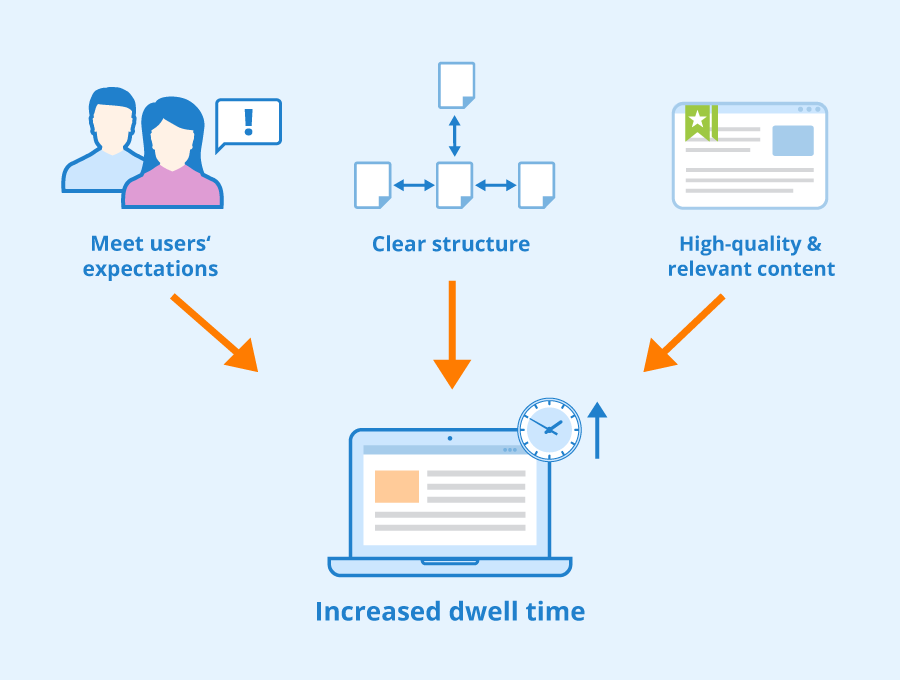
Several on-page and off-page elements directly influence how long a user stays. These are the levers you can pull to improve your AI SEO dwell time.
Content Readability and Structure
Users do not read; they scan. If your content is a wall of text, they will leave within seconds. AI algorithms are trained to recognize well-structured content that uses headings, bullet points, and short paragraphs. This structure not only helps the user navigate but also helps the AI parse the semantic meaning of your content. Using clear H2 and H3 tags, as discussed in this article, signals to the AI that your content is organized and covers multiple subtopics.
Multimedia Integration
Videos and images are powerful dwell time extenders. A user who watches a 3-minute video on your page is spending 3 minutes of dwell time. AI systems can detect if a video is playing and whether the user is actively engaged. Embedding relevant videos, infographics, and interactive charts can dramatically increase the time a user spends consuming your content. This is particularly effective for tutorials and product reviews.
Internal Linking Strategy
Internal links are the pathways that keep users on your site. If a user finishes reading your article and clicks a link to a related article, the dwell time for the first page ends, but the session continues. From the AI’s perspective, this is a positive signal because it indicates the user is engaged with your domain as a whole. Strategically placing contextual internal links within the body of your content can reduce pogo-sticking and increase overall session duration.
Practical Strategies to Increase Dwell Time Using AI Tools
You can leverage AI-powered SEO tools to analyze and improve your dwell time. These tools can predict what content will perform well and identify areas where users are dropping off.
Using AI for Content Gap Analysis
AI tools like Surfer SEO or Frase can analyze the top-ranking pages for your target keyword. They look at the word count, the number of images, the use of specific LSI keywords, and the estimated reading time. By comparing your content against these benchmarks, you can identify gaps. If the top pages have a 2,000-word count and you only have 800 words, your dwell time will likely suffer because you are not covering the topic comprehensively.
Predictive Analysis for User Intent
AI can help you understand the “why” behind a search query. Instead of just targeting the keyword “AI SEO dwell time,” you can use AI to analyze the related questions users ask. Tools like AnswerThePublic or Google’s “People Also Ask” can be fed into AI models to generate content that answers these tangential questions. When a user finds all their questions answered on one page, they have no reason to return to the SERP, thus increasing dwell time.
Heatmap and Session Recording Analysis
Tools like Microsoft Clarity or Hotjar use AI to analyze user behavior on your site. They can show you where users scroll, where they stop, and where they click. If you see a high drop-off rate at a specific section, you know that section is causing users to leave. You can then rewrite that section, add a visual, or break it into smaller chunks to keep the user engaged.
Common Mistakes That Destroy Dwell Time

Even with great content, certain technical and design flaws can kill your dwell time. Avoiding these mistakes is crucial for AI SEO success.
Misleading Meta Descriptions and Title Tags
Clickbait is the enemy of dwell time. If your title promises “10 Secrets” but your article only lists 5, the user will feel cheated and leave immediately. The A Your title and meta description must accurately reflect the content on the page. The goal is to attract the right visitor, not just any visitor.
Slow Page Speed and Layout Shift
If your page takes 5 seconds to load, the user will likely hit the back button before the content even appears. This results in a dwell time of zero. Similarly, if the page layout shifts while loading (Cumulative Layout Shift), causing the user to click the wrong button, they will get frustrated and leave. Optimizing images, using a content delivery network, and ensuring stable layouts are non-negotiable for dwell time optimization.
Ignoring Mobile User Experience
Over 60% of searches happen on mobile devices. If your desktop site is beautiful but your mobile site is cluttered with pop-ups and tiny text, mobile users will have a very short dwell time. Google uses mobile-first indexing, meaning the AI primarily looks at the mobile version of your site for ranking. Ensure that your font sizes are legible, buttons are clickable, and pop-ups are minimized on mobile.
Comparing Dwell Time Optimization: Traditional SEO vs. AI-Driven SEO
The shift from traditional SEO to AI-driven SEO changes how we approach dwell time. The table below illustrates the key differences in strategy.
| Aspect | Traditional SEO Approach | AI-Driven SEO Approach |
|---|---|---|
| Keyword Focus | Exact match keywords and density | Semantic relevance and entity-based optimization |
| Content Length | Longer is always better | Length is determined by user intent and competition |
| User Signals | Bounce rate is a primary KPI | Dwell time and pogo-sticking are the primary KPIs |
| Optimization Method | Manual A/B testing | Predictive analytics and machine learning models |
| Content Updates | Periodic refreshes | Real-time updates based on user behavior data |
Traditional SEO focused on getting the user to the page. AI-driven SEO focuses on keeping the user on the page. The metrics have shifted from acquisition to retention, and dwell time is the ultimate retention metric.
Important Notes on Data Privacy and Dwell Time

With the rise of privacy regulations like GDPR and the phasing out of third-party cookies, the way AI measures dwell time is changing. Search engines are increasingly relying on “on-device” processing and aggregated, anonymized data. This means that dwell time is becoming a more generalized signal rather than a precise tracking metric.
For SEO professionals, this means you should focus on creating genuinely engaging content rather than trying to “game” the metric. The AI is getting smarter at detecting fake engagement, such as auto-scrolling bots. Authentic user satisfaction is the only sustainable way to improve dwell time in the long run.
Frequently Asked Questions About AI SEO Dwell Time
Is dwell time a confirmed Google ranking factor?
Google has stated that dwell time is not a direct ranking factor in their core algorithm. However, it is a significant signal used in their machine learning models to assess content quality. The correlation between high dwell time and high rankings is strong, making it a critical metric to monitor.
What is a good dwell time for a blog post?
A good dwell time varies by industry and intent. For informational blog posts, a dwell time of 2-3 minutes is considered average, while 4-5 minutes is excellent. For transactional pages, such as product pages, a dwell time of 30-60 seconds can be perfectly healthy if the user converts.
How can I check my dwell time in Google Analytics?
Google Analytics does not directly report “dwell time.” The closest metric is “Average Session Duration” or “Average Time on Page.” However, these are not the same as dwell time. To get a true dwell time, you need to track return visits to the SERP, which requires advanced event tracking or using specialized SEO tools that integrate with Search Console data.
Does video content always increase dwell time?
Not always. If the video is irrelevant, too long, or has poor audio quality, users will close the tab. However, a high-quality, relevant video that is embedded at the top of the page can significantly increase dwell time. The key is to ensure the video complements the text and provides additional value.
Can I improve dwell time by adding more images?
Adding images can help, but only if they are relevant and add context. Stock photos that are generic and unrelated to the text can actually decrease dwell time because they distract the user. Use custom screenshots, diagrams, and data visualizations that help explain the concepts in your text.
Conclusion: The Future of Dwell Time in AI Search
AI SEO dwell time is not a fleeting trend; it is the new currency of search engine rankings. As AI models become more sophisticated, they will rely even more heavily on behavioral signals to determine content quality. The days of stuffing keywords and hoping for the best are over. The future belongs to those who create immersive, valuable, and user-centric experiences.
To succeed, you must treat dwell time as a core KPI in your SEO strategy. This means investing in deep research, creating multimedia-rich content, and continuously analyzing user behavior to refine your pages. By aligning your content with the expectations of both the user and the AI algorithms, you will not only improve your dwell time but also build a loyal audience that trusts your brand. The algorithms are watching, and they reward those who keep users engaged.
Xem thêm:
- AI SEO Content Scaling: The Complete Playbook for 2025 and Beyond
- AI SEO SEO Automation with Make: The Complete Workflow Guide
- AI SEO Search Entity Optimization: The Complete Guide to Future-Proof Rankings
- WP Trove AI Articles: The Complete Guide to Automated Content Creation
- AI SEO Entity Recognition: The Complete Guide to Mastering Semantic Search
Bài viết cùng chủ đề:

AI SEO SEO Automation with Make: The Complete Workflow Guide

AI SEO SEO Automation with Zapier: The Complete Workflow Guide

AI SEO SEO Automation with n8n: The Complete Workflow Guide
AI SEO SEO Automation with Gemini: The Complete Guide to Scaling Organic Growth

AI SEO SEO Automation with Claude: The Complete Guide to Scaling Content in 2025

AI SEO SEO Automation with ChatGPT: The Complete Playbook for 2025

AI SEO & SEO Automation for Affiliate Sites: The 2025 Playbook for Passive Income Growth
AI SEO & SEO Automation for Bloggers: The Complete Guide to Scaling Your Content

AI SEO & SEO Automation for Agencies: The Complete 2025 Playbook

AI SEO and SEO Automation for Ecommerce: The Complete Playbook for 2025

AI SEO & SEO Automation for WordPress: The Complete Playbook for 2025
AI SEO SEO Automation Strategy: The Complete Playbook for 2025

Mastering the AI SEO SEO Automation Process: A Complete Guide to Scaling Organic Growth
AI SEO SEO Automation System: The Complete Guide to Scaling Organic Growth in 2025
AI SEO SEO Automation Platform: The Complete Guide to Scaling Organic Growth in 2025
AI SEO SEO Automation Software: The Complete Guide to Scaling Organic Growth in 2025















