
No products in the cart.
AI SEO Entity Recognition: The Complete Guide to Mastering Semantic Search
10
Aug
Aug
AI SEO Entity Recognition has fundamentally changed how search engines interpret content. Gone are the days when keyword density ruled the rankings. Modern algorithms like Google’s RankBrain and MUM rely on entities—people, places, concepts, and things—to understand context and user intent. For digital marketers, mastering this shift is no longer optional. This guide breaks down what entity recognition means for your SEO strategy, how it works, and exactly how to optimize your content to gain a competitive edge in 2025.
What is AI SEO Entity Recognition?
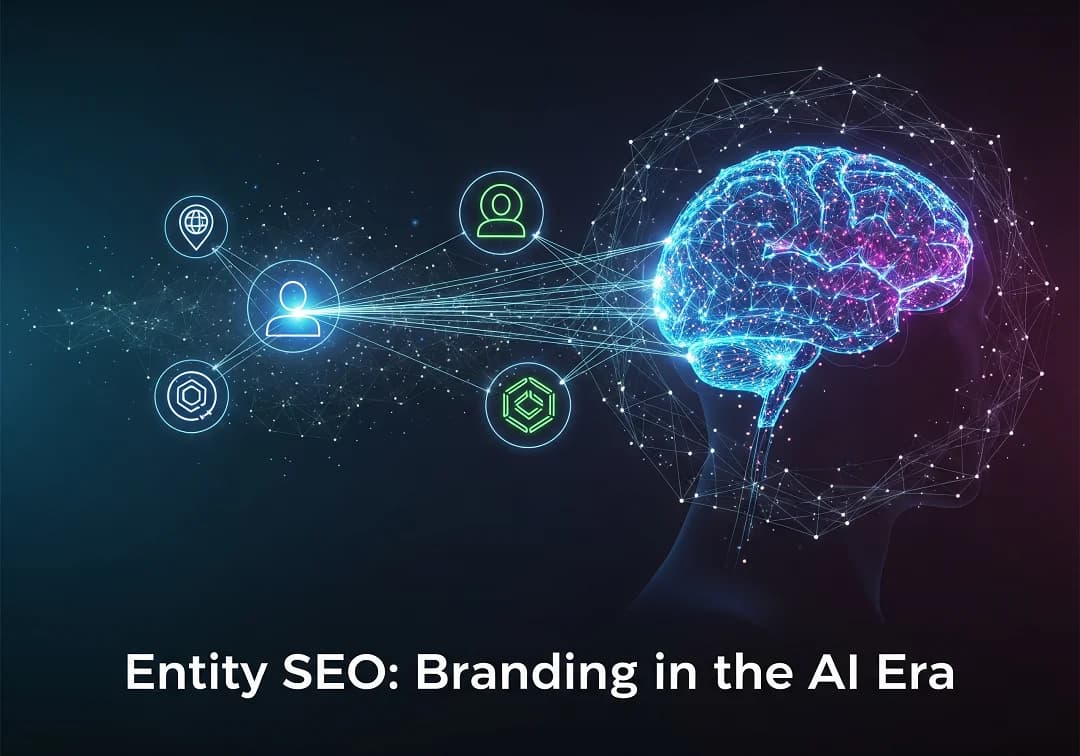
AI SEO Entity Recognition refers to the process where machine learning algorithms identify and categorize named entities within a piece of content. An entity is a distinct object or concept that can be uniquely identified, such as “Apple” (the company), “Tim Cook” (the person), or “iPhone 15” (the product). Search engines use Natural Language Processing (NLP) to map these entities and understand the relationships between them.
This technology moves beyond simple keyword matching. Instead of just looking for the phrase “best running shoes,” the AI recognizes the entities “running,” “shoes,” and “comfort” as related concepts. It then evaluates how well your content covers the entire topic ecosystem. The result is a more nuanced understanding of relevance, which directly impacts your search rankings.
The Difference Between Keywords and Entities
Keywords are literal strings of text. Entities are semantic representations of real-world objects. For example, the keyword “Jaguar” could refer to the animal or the car brand. Entity recognition uses context to determine which one you mean. If your page mentions “engine,” “dealership,” and “luxury,” the AI understands you are discussing the vehicle, not the wild cat.
This distinction is critical. Optimizing for entities means you are building topical authority. You are telling the search engine that your content is a comprehensive resource about a specific subject, not just a page stuffed with variations of a phrase.
How Does AI Entity Recognition Work in Search Engines?
Search engines process content through several stages to build an entity-based knowledge graph. Understanding this pipeline helps you create content that aligns with algorithmic expectations.
1. Text Parsing and Tokenization
The AI breaks down your content into individual tokens (words and punctuation). It then analyzes the grammatical structure to identify the subject, object, and verbs in each sentence.
2. Named Entity Identification
The system flags proper nouns and specific terms. This includes names of people, organizations, locations, dates, and numerical values. For instance, in the sentence “Elon Musk founded SpaceX in 2002,” the AI identifies “Elon Musk” as a person, “SpaceX” as an organization, and “2002” as a date.
3. Entity Disambiguation
This is where the AI resolves ambiguity. If your text mentions “Mercury,” the algorithm checks surrounding words to decide if it refers to the planet, the element, or the car brand. This step relies heavily on the context provided by your other sentences.
4. Relationship Mapping
Once entities are identified, the AI determines how they relate to each other. It builds a knowledge graph. For example, it connects “Google” to “Sundar Pichai” with the relationship “CEO of.” This graph allows the search engine to understand the broader context of your content.
Why AI SEO Entity Recognition Matters for Rankings
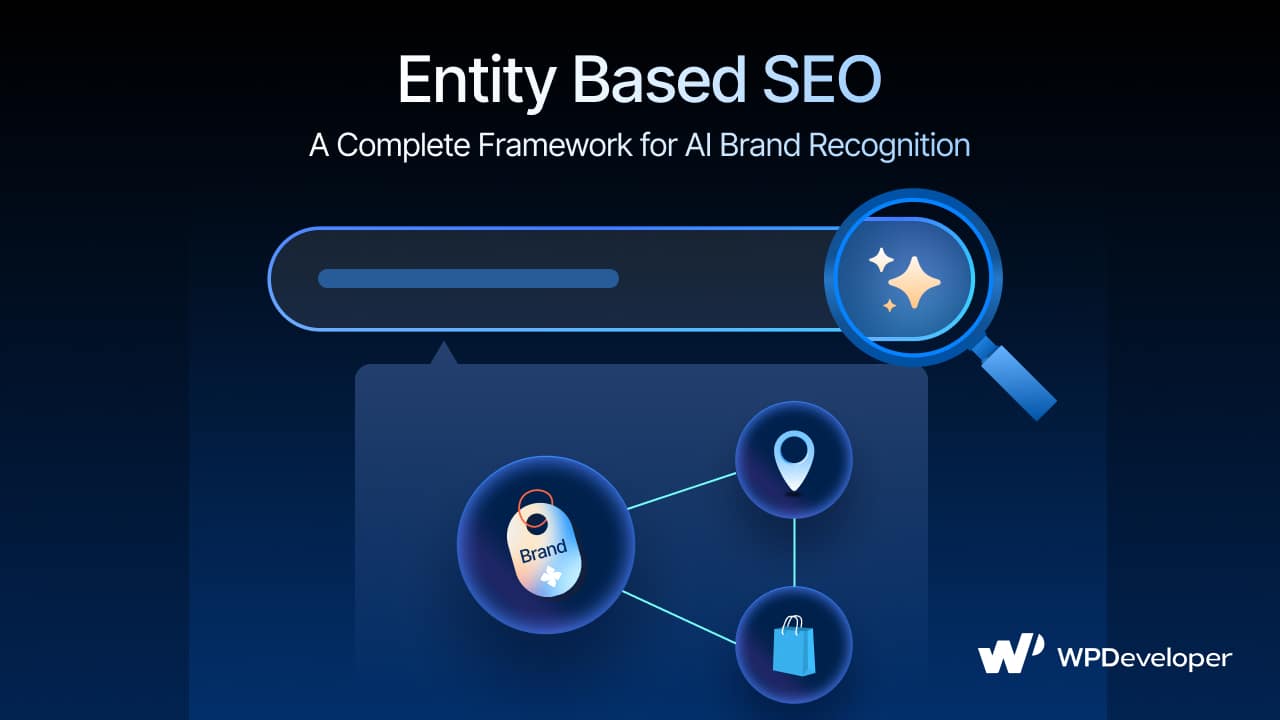
Google’s shift to entity-based indexing means that pages with clear entity signals often outperform those with only keyword optimization. Here are the primary reasons why this matters for your bottom line.
Improved Search Intent Matching
Entity recognition helps search engines match your content to queries that do not contain your exact keywords. If someone searches “how to fix a leaky faucet,” the AI looks for pages that discuss “plumbing,” “water pressure,” and “wrench.” If your content covers these related entities, it can rank even without the exact phrase.
Enhanced Featured Snippet Opportunities
Google prefers to pull featured snippets from content that clearly defines entities. When you explicitly state what something is, who it is for, and how it works, the AI can easily extract that information for a snippet. This increases your visibility and click-through rate.
Stronger Topical Authority
Websites that consistently cover a specific domain with interconnected entities are seen as authorities. For example, a health site that discusses “diabetes,” “insulin,” “blood sugar,” and “endocrinologist” in a structured way builds a strong entity profile. This authority helps all your related pages rank higher.
Key Components of an Entity-Based SEO Strategy
To leverage AI SEO Entity Recognition, you need to adjust your content creation workflow. The focus shifts from individual pages to the entire semantic ecosystem of your website.
1. Build a Comprehensive Entity Map
Before writing, list all the entities relevant to your topic. Use tools like Google’s Knowledge Graph API or text analysis platforms to identify related concepts. For a page about “electric vehicles,” your entity map should include “battery,” “charging station,” “Tesla,” “range anxiety,” and “regenerative braking.”
2. Use Structured Data Markup
Schema.org vocabulary helps search engines identify entities explicitly. Use Person, Organization, Product, and FAQPage schemas. This markup acts as a direct signal to the AI, confirming what your content is about. JSON-LD format is the recommended implementation.
3. Create In-Depth, Interlinked Content
Entity recognition thrives on context. Write longer, detailed articles that naturally mention related entities. Internal linking is crucial. When you link from a page about “SEO” to a page about “backlinks,” you are helping the AI understand the relationship between those two entities.
4. Optimize for Semantic Relevance
Use LSI (Latent Semantic Indexing) keywords naturally. These are terms that frequently appear together with your main topic. For “AI SEO Entity Recognition,” related terms include “knowledge graph,” “natural language processing,” “semantic search,” and “machine learning.” Include these in your headings and body text.
Practical Guide: How to Optimize Content for Entity Recognition
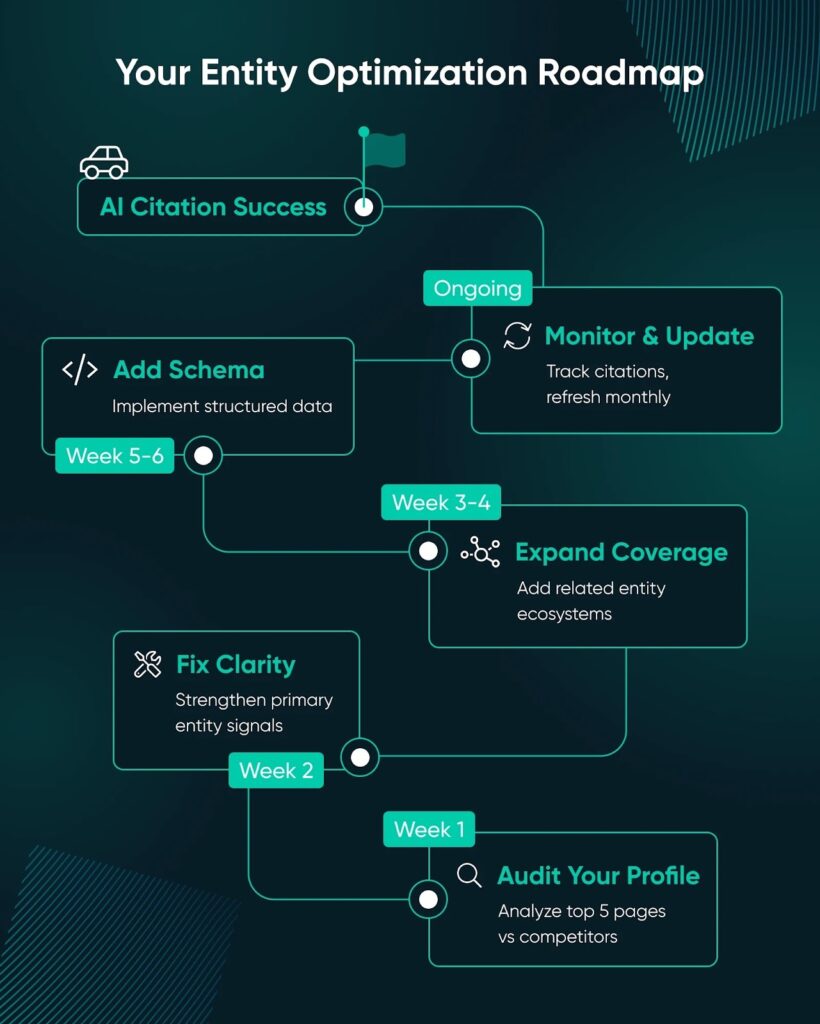
Implementing entity optimization requires a step-by-step approach. Follow this process for every new piece of content you create.
Step 1: Conduct Entity Research
Start by searching your target keyword in Google. Look at the “People Also Ask” box and the “Related Searches” section. These are goldmines for entity discovery. Also, analyze the top-ranking pages to see which entities they mention consistently.
Step 2: Structure Your Content Logically
Use clear H2 and H3 headings that describe specific aspects of the topic. Each section should focus on one primary entity. This helps the AI parse your content structure and understand the hierarchy of information.
Step 3: Write Naturally and Explicitly
Avoid vague pronouns. Instead of saying “It is important,” say “Entity recognition is important.” Explicitly naming the entity in each paragraph reinforces the semantic signal. Use synonyms and related terms, but always keep the core entity clearly defined.
Step 4: Implement Schema Markup
Add the appropriate schema types to your HTML. For a blog post, use Article schema. For a product page, use Product schema. Include properties like author, datePublished, and about to provide explicit entity data.
Step 5: Build Contextual Internal Links
Link to your other relevant pages using descriptive anchor text. The anchor text should contain the entity name. For example, link to your “semantic search guide” using the phrase “semantic search guide” rather than “click here.”
Benefits and Limitations of AI Entity Recognition in SEO
Understanding the pros and cons of this technology helps set realistic expectations for your strategy.
| Benefits | Limitations |
|---|---|
| Higher relevance for long-tail queries | Requires more research and content depth |
| Better resistance to algorithm updates | Harder to measure direct ROI |
| Improved voice search optimization | Risk of over-optimization if forced |
| Stronger brand visibility in Knowledge Panels | Dependent on consistent NAP (Name, Address, Phone) data |
| Enhanced user experience through context | Time-consuming to map entities for large sites |
Common Mistakes to Avoid with Entity Optimization
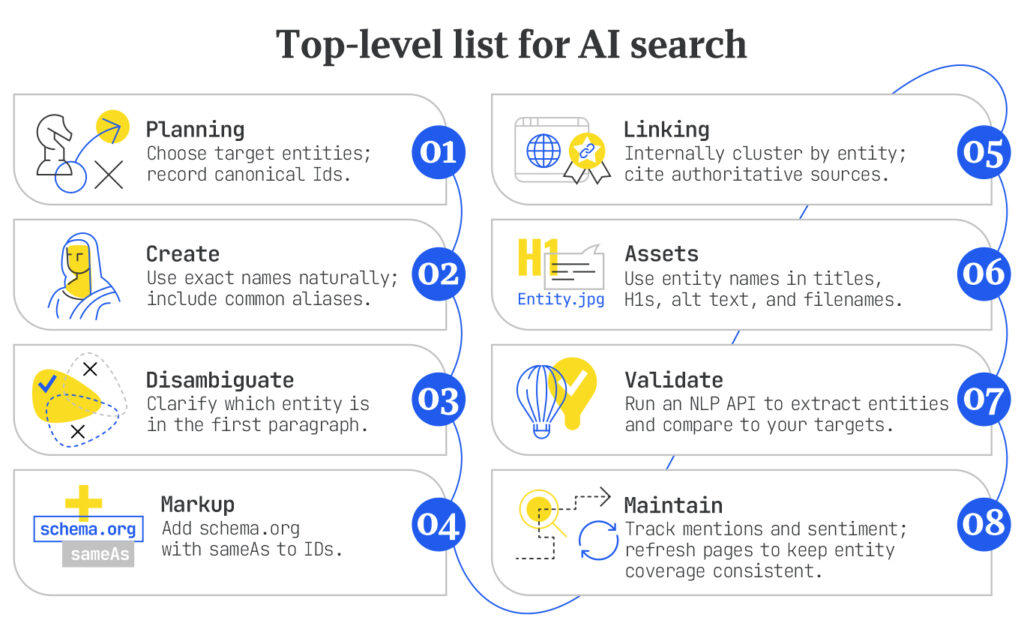
Many marketers try to game entity recognition and end up hurting their rankings. Avoid these frequent pitfalls.
1. Keyword Stuffing with Related Terms
Do not force LSI keywords into every sentence. The AI detects unnatural language patterns. Write for humans first. If a related term fits naturally, use it. If not, skip it.
2. Ignoring Entity Disambiguation
If your topic has multiple meanings, clarify it immediately. For example, if you are writing about “Java,” state in the first paragraph whether you mean the programming language or the island. Failure to disambiguate confuses the AI.
3. Neglecting Off-Page Entity Signals
Entity recognition is not just about on-page content. Your brand mentions on other websites, social media profiles, and business directories all contribute to your entity profile. Ensure your brand name and details are consistent across the web.
4. Focusing Only on Google
Bing and other search engines also use entity recognition. While Google is the priority, a solid entity strategy will improve your visibility across all platforms, including AI-powered assistants like Siri and Alexa.
Tools to Enhance Your Entity Recognition Strategy
Several tools can help you identify and optimize for entities. These are essential for scaling your efforts.
- Google Natural Language API: This free tool analyzes text and identifies entities, sentiment, and syntax. It is excellent for auditing your existing content.
- TextRazor: A powerful NLP API that provides detailed entity extraction and relationship analysis.
- MarketMuse: This content optimization platform uses AI to compare your content against top-ranking pages and suggests related entities to include.
- Surfer SEO: Provides content scoring based on entity usage and semantic relevance.
- Schema.org Validator: Use this to test your structured data markup and ensure it is correctly implemented.
Important Notes for Long-Term Success
Entity optimization is not a one-time task. It requires continuous monitoring and updating. Search engines are constantly refining their algorithms. What works today may need adjustment tomorrow.
Focus on building a knowledge graph for your website. Every new piece of content should add a new node to this graph. Over time, this creates a dense network of interconnected entities that signals deep expertise to search engines. Consistency is more important than perfection. Update old content to include new entities as your industry evolves.
Also, pay attention to user engagement metrics. If users spend more time on your page and interact with it, the AI interprets this as a sign of high-quality, entity-rich content. Optimize for readability, use multimedia, and break up text with bullet points and tables to keep users engaged.
Frequently Asked Questions (FAQ)
What is the difference between AI SEO Entity Recognition and traditional keyword optimization?
Traditional keyword optimization focuses on matching exact phrases in the query to the text on the page. AI SEO Entity Recognition goes deeper by understanding the meaning behind those phrases. It identifies the real-world objects and concepts mentioned and evaluates how well they relate to the user’s intent. This allows search engines to rank content that covers a topic comprehensively, even if it does not contain the exact keyword string.
How do I find entities for my niche?
Start by analyzing the top 10 ranking pages for your target keyword. Use a tool like Google Natural Language API to extract the entities from those pages. Look at Wikipedia for your topic to identify key related concepts. Also, review your customer support questions and forum discussions to see what terms your audience uses. Compile these into a list and use them as a checklist for your content.
Does entity recognition affect local SEO?
Yes, significantly. Local SEO relies heavily on entities like your business name, address, phone number, and service area. Search engines use entity recognition to connect your business to local search queries. Ensuring your NAP data is consistent across all directories and using LocalBusiness schema markup are critical steps for local entity optimization.
Can I use AI tools to write content optimized for entity recognition?
AI writing tools can assist, but they cannot replace human oversight. Use them to generate drafts that include related entities, but you must manually verify the accuracy and context. The AI may hallucinate facts or use entities incorrectly. Always edit the output to ensure it aligns with your brand voice and provides genuine value to the reader.
How long does it take to see results from entity-based SEO?
Entity optimization is a long-term strategy. Unlike quick keyword tweaks, building topical authority takes time. You may start seeing improvements in 4 to 6 weeks for specific pages, but significant gains in domain-wide authority typically take 3 to 6 months. The key is consistency and creating high-quality content that genuinely covers the entity ecosystem.
Conclusion
AI SEO Entity Recognition represents the current frontier of search engine optimization. By shifting your focus from isolated keywords to interconnected concepts, you align your content with how modern algorithms actually process information. This approach not only improves your rankings but also enhances the user experience by providing more relevant, comprehensive answers.
The transition requires effort. You must research entities, structure your content logically, and implement structured data. However, the payoff is substantial. Websites that master entity optimization are more resilient to algorithm updates, capture more featured snippets, and build lasting topical authority. Start by auditing your top pages with an NLP tool, identify the missing entities, and update your content accordingly. The future of search is semantic, and the time to adapt is now.
Xem thêm:
- AI SEO Content Creation: The Complete Playbook for Ranking in 2025
- AI SEO Future: How Intelligent Algorithms Are Reshaping Search Rankings in 2025 and Beyond
- Startup AI SEO: The Complete Playbook for Scaling Organic Growth in 2025
- AI SEO Content Repurposing: The Complete Strategy Guide for 2025
- AI Introduction Generator: Write Perfect Openings Effortlessly With Smart Technology
Bài viết cùng chủ đề:

AI SEO SEO Automation with Make: The Complete Workflow Guide

AI SEO SEO Automation with Zapier: The Complete Workflow Guide

AI SEO SEO Automation with n8n: The Complete Workflow Guide
AI SEO SEO Automation with Gemini: The Complete Guide to Scaling Organic Growth

AI SEO SEO Automation with Claude: The Complete Guide to Scaling Content in 2025

AI SEO SEO Automation with ChatGPT: The Complete Playbook for 2025

AI SEO & SEO Automation for Affiliate Sites: The 2025 Playbook for Passive Income Growth
AI SEO & SEO Automation for Bloggers: The Complete Guide to Scaling Your Content

AI SEO & SEO Automation for Agencies: The Complete 2025 Playbook

AI SEO and SEO Automation for Ecommerce: The Complete Playbook for 2025

AI SEO & SEO Automation for WordPress: The Complete Playbook for 2025
AI SEO SEO Automation Strategy: The Complete Playbook for 2025

Mastering the AI SEO SEO Automation Process: A Complete Guide to Scaling Organic Growth
AI SEO SEO Automation System: The Complete Guide to Scaling Organic Growth in 2025
AI SEO SEO Automation Platform: The Complete Guide to Scaling Organic Growth in 2025
AI SEO SEO Automation Software: The Complete Guide to Scaling Organic Growth in 2025















