
No products in the cart.
AI SEO for Shopify: Transform Your Store Traffic With Intelligent Automation
29
Jul
Jul
Running a Shopify store means juggling inventory, customer service, and marketing simultaneously. Among these, search engine optimization often becomes the bottleneck. AI SEO for Shopify changes that equation by automating repetitive tasks, uncovering hidden keyword opportunities, and optimizing product pages at a scale no human team can match. Instead of spending hours tweaking meta tags or researching long-tail phrases, store owners can now rely on machine learning models trained on mountains of search data. This article breaks down exactly how AI-powered SEO works for Shopify, the tools worth investing in, and a step-by-step roadmap to implement it without hurting your rankings.
What Is AI SEO for Shopify?
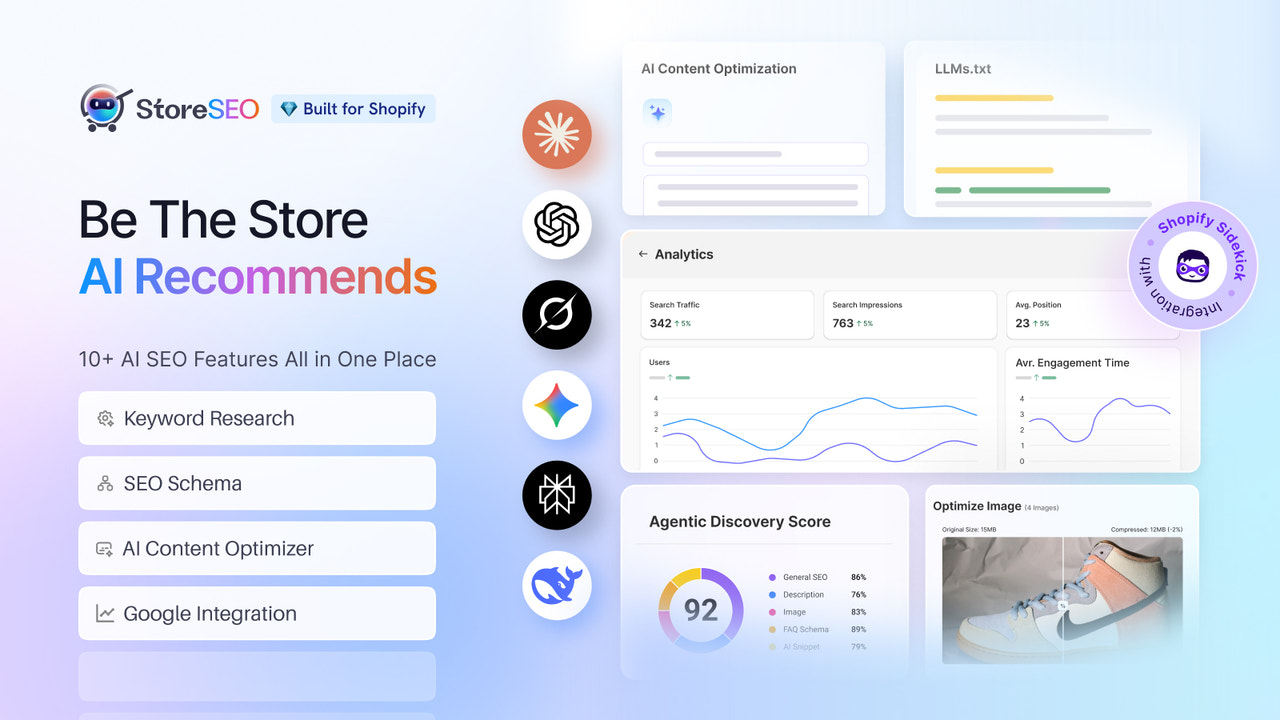
AI SEO for Shopify refers to using artificial intelligence and machine learning algorithms to improve a Shopify store’s visibility in search engine results. Unlike traditional SEO that depends entirely on manual audits, keyword research, and content writing, AI-driven tools analyze thousands of data points in seconds. They can generate product descriptions, suggest relevant internal links, optimize image alt attributes, and even predict which content will perform best over time.
At its core, AI SEO marries natural language processing with the technical demands of Shopify’s architecture. For example, an AI tool might scan your entire catalog, identify thin-content product pages, and rewrite them with semantically rich terms—all while preserving your brand voice. It can read your liquid theme files to flag missing structured data or slow-loading assets, then prioritize fixes based on impact. The technology is not a magic wand; it’s a force multiplier that makes every SEO action smarter and faster.
How AI SEO Tools Process a Shopify Store
Most AI SEO tools for Shopify follow a predictable analysis pipeline. Understanding this process helps you trust the recommendations and catch any blind spots early.
1. Crawling and Indexing Simulation
The AI first mimics the behaviour of Googlebot by crawling your store. It evaluates URL structure, canonical tags, robots.txt rules, and internal linking depth. Tools like Sitebulb or the built-in crawler in SEO apps construct a visual map of your store’s architecture, revealing orphan pages or broken links.
2. Data Ingestion from Google Search Console and Analytics
By connecting to Google Search Console and Google Analytics, AI models can correlate page performance with actual queries. They identify pages sitting on page two of the SERPs and suggest minor tweaks—like adjusting a title tag by a few words—that could push them into the top ten. This is real-time pattern recognition, not guesswork.
3. Content and On-Page Element Analysis
Natural language processing scans your product titles, descriptions, and collection pages for keyword density, readability, and entity relevance. Some advanced models check whether you’ve included supporting terms buyers might search for, such as “vegan leather backpack” instead of just “backpack.” The AI then recommends edits or automatically generates optimized drafts.
4. Technical Health Audits
AI tools diagnose page speed issues, mobile usability errors, missing structured data, and duplicate content. They often assign priority scores so you tackle high-impact problems first. For Shopify stores, common technical fixes involve compressing images, deferring JavaScript, and implementing JSON-LD schema for products.
Key Areas Where AI SEO Delivers Results for Shopify
AI-driven SEO is not a single feature; it touches every layer of your store. Below are the core areas where automation makes a measurable difference.
Product Page Optimization at Scale
Stores with hundreds or thousands of SKUs cannot manually write unique meta descriptions for each item. AI tools generate SEO-friendly meta titles and descriptions that include primary keywords while staying under character limits. They also ensure alt text for all product images carries descriptive, keyword-relevant phrases, boosting image search traffic.
Keyword Research Reinvented
Traditional keyword tools output a list of seed terms. AI-powered research goes further. It clusters keywords by intent, spots question-based queries that fit your blog or FAQ sections, and reveals emerging trends before they become competitive. For example, an AI might detect a rising search volume for “plastic-free kitchen storage” and alert a home goods store to create a dedicated collection page.
Automated Internal Linking
Link equity distribution is tedious to manage manually. AI can scan your blog content and product pages, suggesting where to insert contextual links with optimal anchor text. This strengthens topic clusters and helps Google understand your site’s hierarchy. Some Shopify apps let you define rules and have the AI insert links automatically as new content gets published.
Predictive Ranking and A/B Testing for SEO
A few premium AI platforms simulate how changes to a page’s title, heading structure, or content length might affect its ranking. They draw from hundreds of ranking signals and historical data from similar stores. While not infallible, these predictions help you prioritize edits with the highest potential ROI.
Content Generation for Blogs and Collection Pages
Writing SEO-optimized blog posts and collection descriptions is resource-intensive. AI content creation tools, when supervised by a human editor, can produce first drafts that cover subtopics, include target keywords naturally, and match search intent. This is particularly useful for stores investing in content marketing as a traffic channel.
Benefits and Limitations of AI SEO for Shopify
No technology is without trade-offs. Understanding both sides ensures you deploy AI sensibly.
Benefits
- Time efficiency: Routine tasks like meta tag writing and image optimization are reduced from hours to minutes.
- Data-driven decisions: Algorithms process vast amounts of performance data, removing personal bias from optimization choices.
- Scalability: A 5,000-product store gets the same level of SEO attention as a 50-product store, without line-item manual effort.
- Continuous monitoring: AI tools can detect sudden traffic drops, indexing issues, or keyword ranking changes and alert you instantly.
- Improved search intent matching: Advanced models analyze top-ranking pages to reverse-engineer what Google finds valuable, then tailor your content structure accordingly.
- Generic output risk: AI-generated text can feel templated if not edited by a human who understands the brand’s voice.
- Over-optimization danger: Blindly following AI suggestions can lead to keyword stuffing or unnatural phrasing that hurts readability.
- Limited creative insight: AI misses cultural nuances, storytelling angles, and deep emotional triggers that connect with customers.
- Technical blind spots: AI may overlook Shopify-specific issues like app script conflicts that drag down speed, which require a developer’s eye.
- Blindly trusting AI copy: Search engines value originality and helpfulness. Mass-publishing unedited AI content can trigger quality flags, especially after Google’s updates targeting thin AI-generated pages.
- Ignoring page speed while chasing on-page tweaks: AI might suggest extensive content additions on a page that already loads in 5 seconds. Content improvement matters little if customers bounce due to slow load times.
- Over-optimizing anchor text for internal links: Using exact-match anchors everywhere looks unnatural. AI can still produce spammy patterns if not set with variation rules.
- Skipping mobile audit: Shopify themes often look great on desktop but have mobile UX issues. AI tools may mark mobile speed as acceptable when real users experience layout shifts. Always validate on actual devices.
- Neglecting local SEO signals: If your store has a physical presence, AI SEO tools may not automatically optimize Google Business Profile or local schema. You must manually bridge that gap.
Limitations
Manual SEO vs. AI-Driven SEO for Shopify: A Comparison
| Aspect | Manual SEO | AI SEO for Shopify |
|---|---|---|
| Speed of execution | Slow; requires dedicated staff | Near-instant for bulk tasks |
| Keyword discovery | Relies on brainstorming and limited tool searches | Mines suggestion databases, competitor gaps, and semantic clusters automatically |
| Content writing | Human-created, carries unique voice | AI drafts need human refinement to avoid blandness |
| Technical audits | Often infrequent and resource-heavy | Continuous scanning with prioritized recommendations |
| Adaptability | Slow to react to algorithm changes | Can retrain models on new ranking patterns faster |
| Cost | High (salary or agency fees) | Monthly subscription, typically much lower |
Practical Guide: Implementing AI SEO on Your Shopify Store
Adopting AI SEO does not require a developer background. Follow this step-by-step workflow to integrate intelligent automation while retaining oversight.
Step 1: Choose a Reliable Shopify SEO App with AI Capabilities
Start with an all-in-one SEO app that incorporates AI. Popular options include Plug in SEO, Avada SEO Suite, and SEOAnt. These apps scan your store, flag issues, and provide AI-generated fixes for meta tags, alt text, and structured data directly inside the Shopify admin. Install the app, grant necessary permissions, and run an initial audit.
Step 2: Connect Google Search Console and Analytics
Feed your AI tool real performance data. Most advanced apps and standalone platforms (like Semrush or Ahrefs with their AI features) integrate with Google Search Console. This unlocks query-based recommendations: the AI sees which keywords generate impressions but few clicks and suggests title tag rewrites to improve click-through rate.
Step 3: Automate Technical On-Page Elements
Focus first on low-hanging technical fixes. Let the AI detect missing H1 tags, duplicate title tags, and pages lacking meta descriptions. Enable auto-generation for missing elements, but always review a sample batch to confirm the tone is consistent. For images, use AI to generate alt text from the product name and a brief description, then spot-check for accuracy.
Step 4: Use AI-Powered Keyword Research to Build a Content Roadmap
Employ tools like Surfer SEO, Frase, or even ChatGPT with browsing capabilities to identify long-tail queries your store can answer. Map each keyword cluster to a specific page: product pages for transactional intent, blog posts for informational, collection pages for commercial investigation. Let AI outline the post structure based on top-ranking competitors, then write the content manually or with AI assistance.
Step 5: Optimize Product Pages With AI-Generated Copy
For large catalogs, select a batch of low-performing product pages. Use an AI copywriting tool to rewrite descriptions, headings, and bullet points with relevant keywords and benefit-driven language. Compare the AI versions against your original pages. Import only the variants that match your brand and offer clear SEO improvements.
Step 6: Deploy AI-Driven Internal Linking
Some Shopify SEO apps offer automatic internal linking rules. For instance, whenever you mention “yoga mats” in a blog post, the app can link to your Yoga Mats collection page. Set up context-aware rules. If you prefer more control, use a site audit tool that suggests links and implement them manually in batches.
Step 7: Monitor Performance and Iterate
AI SEO is not a one-time setup. Schedule weekly checks of the AI dashboard to review new issues and opportunities. Watch for sudden ranking drops—AI often catches these before they snowball. Compare organic traffic month over month. If certain automated meta descriptions underperform, tweak the templating rules.
Common Mistakes When Using AI SEO for Shopify
Automation can backfire when handled carelessly. Avoid these frequent pitfalls to protect your search visibility.
Important Notes for Long-Term Success
AI SEO tools evolve rapidly, but the fundamentals of search remain. Maintain these habits to get the most from your investment.
Keep a human in the loop. Train a team member or freelancer to review AI-generated content, meta tags, and structural recommendations. The combination of machine efficiency and human judgment consistently outperforms pure automation.
Stay updated on Shopify platform changes. Liquid updates, theme modifications, and new app policies sometimes interfere with SEO app functionality. Subscribe to Shopify changelogs and your SEO tool’s update feed.
Diversify your SEO tool stack. Relying on a single AI app can create blind spots. Use a dedicated keyword research tool alongside your Shopify SEO app to cross-check keyword opportunities.
Prioritize E-E-A-T. Google’s quality rater guidelines emphasize experience, expertise, authoritativeness, and trustworthiness. AI cannot manufacture genuine experience. Add author bios, customer reviews, and detailed product guides that demonstrate real-world knowledge.
Respect data privacy. If your AI tool uses customer data to personalize shopping experiences, ensure compliance with GDPR/Opt-in requirements. Reassure visitors via your privacy policy.
Frequently Asked Questions About AI SEO for Shopify
Can AI SEO completely replace a human SEO specialist for Shopify?
No. AI excels at automation, data analysis, and draft creation, but it cannot replace strategic planning, brand storytelling, or nuanced understanding of customer psychology. The most successful stores use AI as an assistant managed by an experienced marketer.
Which is the best AI SEO app for Shopify beginners?
Plug in SEO offers a user-friendly interface with automated fixes for meta tags, alt text, and structured data. It also includes a built-in keyword suggestion tool and broken link checker. Avada SEO Suite is another strong option with image optimization and speed analysis features.
How does AI improve Shopify product page rankings?
AI tools analyze top-ranking competitors and extract semantically related terms, optimal heading structures, and description lengths. They then apply those patterns to your product pages while keeping content unique. The AI also ensures technical elements like schema markup and image compression are in place, which collectively improve rank potential.
Is AI-generated content safe from Google penalties?
Google does not penalize AI content automatically. It penalizes low-quality, unhelpful content regardless of how it was created. As long as an editor reviews and enriches AI-generated text to meet user needs and demonstrate expertise, it is safe. Transparent, well-researched content that was initially drafted by AI can rank well.
Will AI SEO work for dropshipping stores with many products?
Yes, it is particularly beneficial. Dropshipping catalogs often contain generic manufacturer descriptions. AI can rewrite these into unique, keyword-optimized versions that reduce duplicate content issues. The automated alt text and meta tag generation also save enormous time across hundreds of listings.
How quickly can I see results after implementing AI SEO on Shopify?
Some technical fixes like correcting broken links or adding missing meta tags can bring improvements within a few days to weeks. Content and keyword strategy changes usually take 2–4 months to show significant ranking movement. AI speeds up the implementation, but SEO remains a long-term investment.
Conclusion
AI SEO for Shopify represents a fundamental shift in how store owners approach search visibility. It removes the manual grind from on-page optimization, surfaces data-driven insights impossible to spot by intuition alone, and scales across catalogs of any size. However, the technology is a powerful complement, not a substitute, for human creativity and strategic oversight. Stores that combine AI-driven automation with thoughtful content editing, solid technical foundations, and an understanding of user intent will continue to outrank those that treat automation as a set-it-and-forget-it button. Start with a reliable Shopify SEO app, build a review workflow, and let the machines handle the repetitive heavy lifting while you focus on growing your brand.
Xem thêm:
- AI SEO Retrieval Augmented Generation: The Complete Guide to Smarter Search Rankings
- How to Improve EEAT with AI: A Strategic Roadmap for Lasting Search Visibility
- WP Trove AI Assistant: The Complete Guide to Smarter WordPress Content Creation
- AI SEO Software: How Artificial Intelligence Is Redefining Search Optimization in 2025
- AI SEO BI Reports: The Complete Guide to Data-Driven Search Optimization
Bài viết cùng chủ đề:

AI SEO SEO Automation with Make: The Complete Workflow Guide

AI SEO SEO Automation with Zapier: The Complete Workflow Guide

AI SEO SEO Automation with n8n: The Complete Workflow Guide
AI SEO SEO Automation with Gemini: The Complete Guide to Scaling Organic Growth

AI SEO SEO Automation with Claude: The Complete Guide to Scaling Content in 2025

AI SEO SEO Automation with ChatGPT: The Complete Playbook for 2025

AI SEO & SEO Automation for Affiliate Sites: The 2025 Playbook for Passive Income Growth
AI SEO & SEO Automation for Bloggers: The Complete Guide to Scaling Your Content

AI SEO & SEO Automation for Agencies: The Complete 2025 Playbook

AI SEO and SEO Automation for Ecommerce: The Complete Playbook for 2025

AI SEO & SEO Automation for WordPress: The Complete Playbook for 2025
AI SEO SEO Automation Strategy: The Complete Playbook for 2025

Mastering the AI SEO SEO Automation Process: A Complete Guide to Scaling Organic Growth
AI SEO SEO Automation System: The Complete Guide to Scaling Organic Growth in 2025
AI SEO SEO Automation Platform: The Complete Guide to Scaling Organic Growth in 2025
AI SEO SEO Automation Software: The Complete Guide to Scaling Organic Growth in 2025















