
No products in the cart.
AI SEO Funnel Optimization: The Complete Guide to Converting Search Traffic
31
Jul
Jul
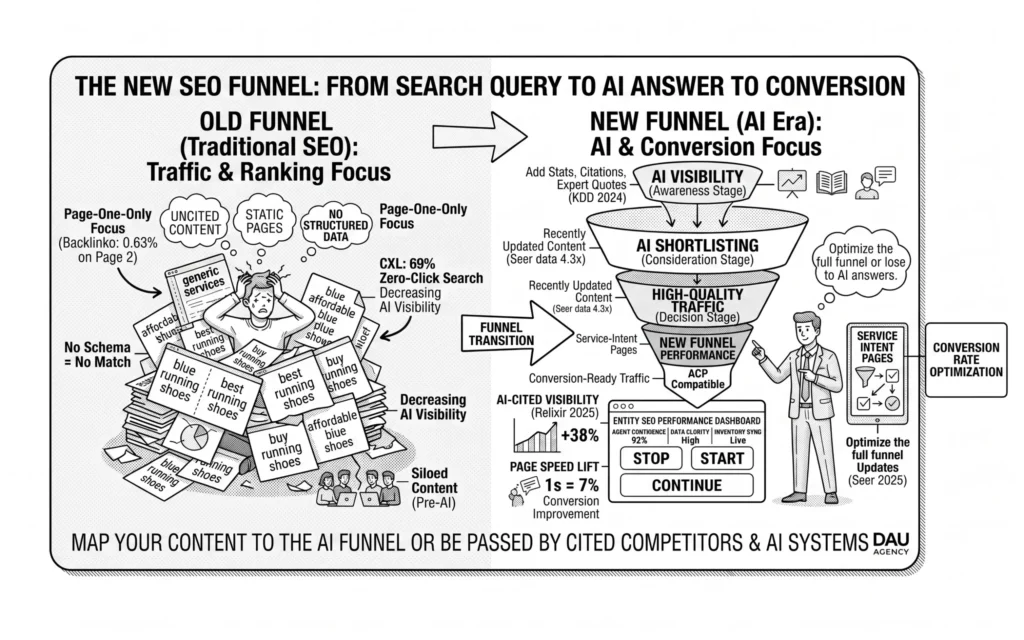
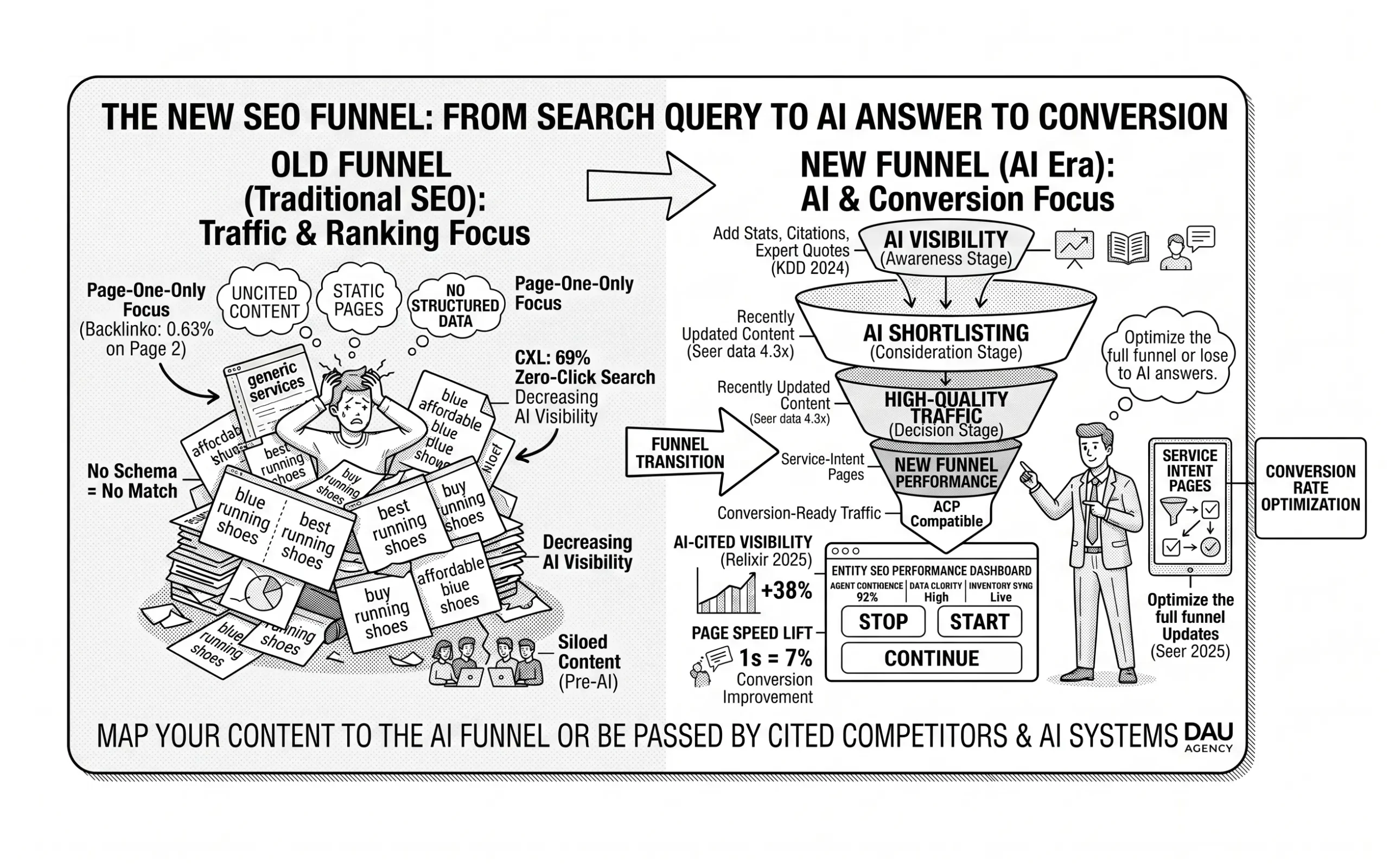
AI SEO funnel optimization is the process of using artificial intelligence to analyze, predict, and enhance every stage of the customer journey—from the moment a user enters a search query to the point of conversion. Unlike traditional SEO, which focuses primarily on rankings and traffic volume, AI-driven funnel optimization shifts the focus toward user intent, content relevance, and conversion probability at each specific stage. This approach leverages machine learning algorithms to identify patterns in search behavior, personalize content delivery, and automate technical optimizations that directly impact revenue. For businesses competing in saturated markets, mastering this discipline is no longer optional; it is the primary differentiator between brands that generate leads and those that merely generate clicks.
Understanding the Core Concept of AI SEO Funnel Optimization
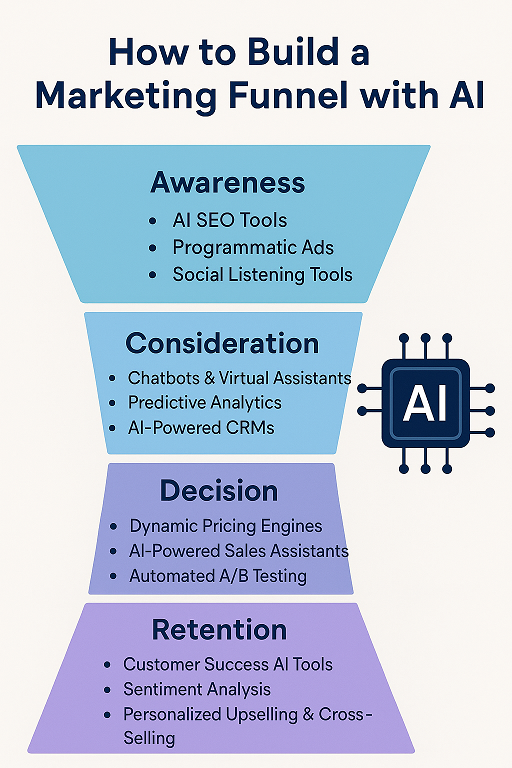
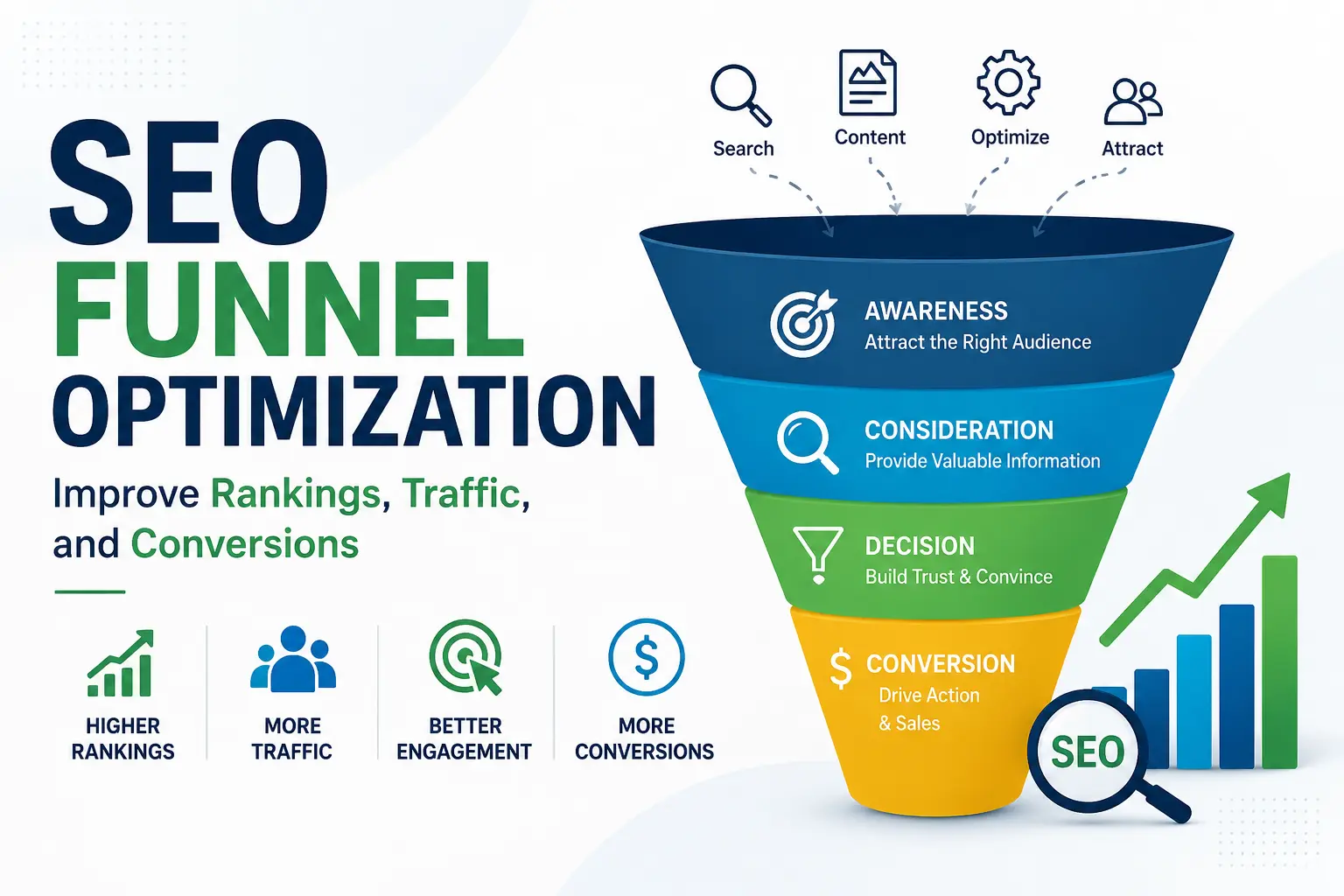
At its foundation, AI SEO funnel optimization merges two distinct disciplines: search engine optimization and conversion rate optimization. The traditional SEO funnel consists of four stages: awareness, consideration, conversion, and retention. Each stage requires different types of content, different keyword targeting, and different technical setups. AI enhances this framework by processing massive datasets that reveal exactly what users need at each stage, predicting which content formats will perform best, and automating the adjustments that keep the funnel efficient.
The key difference between standard SEO and AI-driven funnel optimization lies in the feedback loop. Standard SEO relies on historical data and manual analysis. AI SEO funnel optimization uses real-time behavioral signals, natural language processing, and predictive analytics to continuously refine the funnel. For example, an AI system can detect that users who search for “best project management software” are 70% more likely to convert when they see a comparison table rather than a listicle. The system then automatically adjusts content presentation for that specific segment.
The Role of Machine Learning in Funnel Analysis
Machine learning models, particularly those using supervised and unsupervised learning, are the engines behind AI SEO funnel optimization. These models analyze thousands of variables—click-through rates, dwell time, scroll depth, bounce rates, and conversion paths—to identify which combinations of keywords, meta descriptions, and on-page elements drive users to the next stage. Predictive lead scoring is a prime example. By training on historical conversion data, the AI can assign a probability score to each incoming visitor based on their search query and behavior, allowing marketers to prioritize high-intent traffic.
Natural language processing (NLP) plays an equally critical role. NLP algorithms understand semantic relationships between words, enabling the AI to match content not just to keywords but to the underlying intent. This means a single piece of content can be dynamically optimized for multiple intents. For instance, an article about “email marketing tools” can be segmented into sections that answer “what is email marketing” for top-funnel users and “best email marketing tools for agencies” for bottom-funnel users, all within the same page.
The Four Stages of the AI-Powered SEO Funnel
To implement AI SEO funnel optimization effectively, you must understand how each stage operates differently and what AI tools are best suited for each. The funnel is not a linear path but a dynamic ecosystem where users can enter and exit at various points.
Stage 1: Awareness – Capturing Broad Search Demand
At the awareness stage, users are identifying problems or exploring topics. They use informational queries like “how to increase website traffic” or “what is digital marketing.” AI tools here focus on topic clustering and content gap analysis. Instead of targeting individual keywords, the AI maps out entire topic clusters based on semantic search data. It identifies subtopics that competitors have missed, predicts which questions will gain search volume in the coming months, and recommends content formats that maximize visibility in AI-generated search results like Google’s Search Generative Experience (SGE).
For awareness-stage optimization, the primary metrics are impressions, new keyword rankings, and organic reach. The AI continuously monitors search engine results pages (SERPs) for shifts in featured snippets and “People Also Ask” boxes, adjusting content structure to capture these high-visibility positions. A practical application involves using AI tools like Clearscope or MarketMuse to generate comprehensive content briefs that cover every facet of a topic, ensuring the resulting article satisfies both users and search algorithms.
Stage 2: Consideration – Nurturing Qualified Leads
The consideration stage is where users compare options, read reviews, and evaluate solutions. Queries become more specific: “HubSpot vs Salesforce pricing,” “best SEO tools for small business,” or “does AI content rank on Google.” AI SEO funnel optimization at this stage involves dynamic content personalization. The AI analyzes the user’s search history, device type, and engagement patterns to present the most relevant case studies, comparison tables, or video testimonials.
Technical SEO also becomes crucial here. Page speed, mobile responsiveness, and structured data markup are heavily weighted by AI algorithms. The AI can automatically generate schema markup for product comparisons, reviews, and FAQs, making the content eligible for rich results that increase click-through rates. Furthermore, internal linking strategies are optimized by AI to guide users from informational posts to commercial pages, creating a natural navigation path that mirrors the user’s decision-making process.
Stage 3: Conversion – Optimizing for Action
Conversion-stage optimization is the most direct application of AI in the funnel. Here, the focus is on transactional keywords like “buy,” “discount,” “pricing,” and “free trial.” AI tools analyze landing page performance in real time, running continuous A/B tests on headlines, call-to-action buttons, and form lengths. Heatmaps generated by AI vision systems reveal where users click, how far they scroll, and which elements cause friction.
Predictive analytics also play a role in pricing and offer optimization. The AI can segment users based on their search intent and adjust the displayed offer accordingly. A user who searched for “cheap SEO tools” might see a discounted annual plan, while a user who searched for “enterprise SEO platform” sees a demo request form. This level of personalization, driven by AI SEO funnel optimization, significantly increases conversion rates compared to static landing pages.
Stage 4: Retention – Building Long-Term Value
Retention is often overlooked in SEO, but AI makes it measurable and actionable. After conversion, the AI tracks user behavior on the website, identifies patterns that lead to repeat purchases or subscription renewals, and creates content that addresses post-purchase questions. This includes “how-to” guides, troubleshooting articles, and advanced usage tips. The AI also identifies churn risk by analyzing engagement drops and triggers automated email sequences with relevant content.
From an SEO perspective, retention content targets long-tail keywords that existing customers search for. This creates a moat around your brand, as satisfied customers generate their own search demand for your product’s specific features. AI SEO funnel optimization ensures that this content is not only created but also ranked, by continuously updating it with new information and technical SEO improvements.
Key AI Tools and Technologies for Funnel Optimization
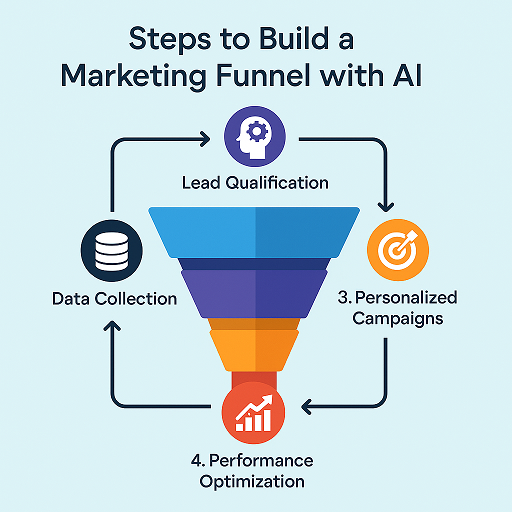
Implementing AI SEO funnel optimization requires a stack of specialized tools. While no single platform does everything, the following categories cover the essential functions.
| Tool Category | Primary Function | Example Use Case |
|---|---|---|
| NLP Content Optimization | Analyzes top-ranking content and provides semantic keyword recommendations | Generating a content brief for a commercial comparison article |
| Predictive Analytics | Forecasts keyword performance and traffic potential | Prioritizing content creation based on projected ROI |
| Automated Technical SEO | Identifies and fixes crawl errors, schema issues, and page speed problems | Automatically generating FAQ schema for all product pages |
| Personalization Engines | Delivers dynamic content based on user behavior and intent | Showing different CTAs to first-time visitors vs. returning users |
| Conversion Rate Optimization (CRO) AI | Runs A/B tests and analyzes user interaction heatmaps | Testing 10 different headline variations simultaneously |
When selecting tools, prioritize those that integrate with your existing analytics and CMS. The most effective AI SEO funnel optimization strategies rely on a unified data flow. If your SEO tool cannot share data with your CRM or email marketing platform, you will lose the ability to close the loop between search behavior and conversion outcomes.
Benefits of AI SEO Funnel Optimization
The advantages of this approach extend beyond simple efficiency gains. Businesses that adopt AI SEO funnel optimization report measurable improvements across multiple KPIs.
- Higher Conversion Rates: By targeting users with content that matches their exact stage in the buying journey, conversion rates typically increase by 20-40% compared to non-personalized approaches.
- Reduced Cost Per Acquisition: AI eliminates wasted spend on keywords that attract low-intent traffic. Marketing budgets are reallocated to high-probability segments, lowering overall CPA.
- Faster Time-to-Market: AI-generated content briefs and automated technical audits reduce the time required to publish optimized content from weeks to days.
- Scalability: Manual SEO processes do not scale beyond a certain point. AI can analyze thousands of keywords and pages simultaneously, making it possible to optimize large e-commerce catalogs or multi-location service businesses.
- Improved User Experience: AI-driven personalization ensures that users find the most relevant information quickly, reducing bounce rates and increasing dwell time—both of which are indirect ranking factors.
Limitations and Challenges to Consider
Despite its power, AI SEO funnel optimization is not a silver bullet. There are significant challenges that require human oversight and strategic thinking.
First, data quality is paramount. AI models are only as good as the data they are trained on. If your analytics tracking is broken, or if you have insufficient historical conversion data, the AI’s predictions will be inaccurate. Small businesses with low traffic volumes may struggle to generate enough data for meaningful machine learning.
Second, AI cannot replace human creativity and brand voice. While AI can generate content outlines and even full drafts, the resulting text often lacks the nuance, storytelling, and emotional connection that builds trust. Search engines are increasingly sophisticated at detecting purely AI-generated content that offers no unique perspective. The best approach is a hybrid model where AI handles data analysis and optimization, while human writers craft the final narrative.
Third, algorithmic volatility remains a risk. Google’s core updates can dramatically shift ranking factors overnight. An AI model trained on pre-update data may make incorrect recommendations. Continuous monitoring and model retraining are essential, which requires dedicated technical resources.
Practical Implementation: A Step-by-Step Guide
Implementing AI SEO funnel optimization requires a structured approach. The following steps provide a roadmap for businesses of any size.
Step 1: Audit Your Current Funnel with AI
Start by using AI-powered analytics tools like Google Analytics 4 with its machine learning insights, or specialized platforms like BrightEdge or Conductor. These tools will identify where users are dropping off in your funnel. Are you getting traffic but no conversions? The problem is likely in your consideration-stage content. Are you getting conversions but low traffic? The issue is in your awareness-stage keyword targeting. The A
Step 2: Map Keywords to Funnel Stages
Using an NLP tool, categorize your entire keyword portfolio into awareness, consideration, conversion, and retention buckets. Do not rely on manual categorization. AI can analyze search intent with over 90% accuracy by examining the language patterns in the top 10 results for each query. This mapping will reveal gaps—for example, you might have strong conversion-stage keywords but no awareness-stage content to feed the top of the funnel.
Step 3: Generate AI-Optimized Content Briefs
For each keyword cluster, use an AI content optimization tool to generate a comprehensive brief. The brief should include the primary keyword, related semantic terms, suggested headings, word count, and examples of current top-ranking content. The A
Step 4: Implement Dynamic Personalization
If you have a WordPress site, use plugins like OptinMonster or Personizely that leverage AI to deliver different content variations based on user behavior. For more advanced needs, consider a customer data platform (CDP) that unifies data from your CRM, email, and web analytics. The CDP feeds the personalization engine, which then adjusts headlines, images, and CTAs in real time. This is the core of AI SEO funnel optimization—delivering the right message to the right user at the right moment.
Step 5: Automate Technical SEO Audits
Set up weekly automated crawls using tools like Screaming Frog with AI add-ons, or use cloud-based platforms like Sitebulb. These tools will automatically detect broken links, missing meta descriptions, duplicate content, and schema errors. More importantly, they will prioritize these issues based on their impact on conversion. A broken link on a high-converting landing page is flagged as critical, while a missing alt tag on a blog image is marked as low priority.
Step 6: Close the Loop with Conversion Data
The final step is integrating your SEO data with your conversion data. Use Google Tag Manager to track micro-conversions—newsletter signups, video views, add-to-cart events—and feed this data back into your AI model. The A This continuous feedback loop is what separates true AI SEO funnel optimization from simple automation.
Common Mistakes and How to Avoid Them
Even experienced marketers make errors when implementing AI-driven strategies. Recognizing these pitfalls early can save significant time and budget.
Mistake 1: Over-Optimizing for Bots Instead of Users. Some AI tools generate content that is technically perfect for search engines but reads poorly for humans. This leads to high rankings but low engagement, which eventually causes rankings to drop. Avoid this by always having a human editor review AI-generated content for readability and value.
Mistake 2: Ignoring the Middle of the Funnel. Many businesses focus heavily on top-of-funnel blog content and bottom-of-funnel product pages, neglecting the consideration stage. This creates a leaky funnel where users have no path from awareness to conversion. Use AI to identify your most popular blog posts and automatically add internal links to relevant comparison guides or case studies.
Mistake 3: Relying on a Single AI Tool. No single platform can handle all aspects of AI SEO funnel optimization. Content generation tools do not understand technical SEO, and technical SEO tools do not understand copywriting. Build a stack of complementary tools and ensure they share data through APIs or integrations.
Mistake 4: Setting and Forgetting. AI models degrade over time as search algorithms and user behaviors change. Schedule monthly reviews of your AI model’s performance. If conversion rates are declining, retrain the model with fresh data or adjust your input parameters.
Important Notes for Long-Term Success
AI SEO funnel optimization is not a one-time project but an ongoing operational discipline. The most successful organizations treat it as a continuous improvement cycle. They allocate dedicated resources to monitor AI outputs, validate recommendations, and refine the underlying data models.
Ethical considerations also matter. Google’s guidelines prohibit manipulative tactics, and AI-generated spam is explicitly targeted by their spam policies. Ensure that your AI tools are used to enhance user experience, not to deceive search engines. Transparency with your audience about data collection and personalization practices builds trust, which is a core component of E-E-A-T (Experience, Expertise, Authoritativeness, Trustworthiness).
Finally, remember that AI is a tool for amplification, not replacement. The brands that win with AI SEO funnel optimization are those that combine machine intelligence with human empathy. They use AI to understand what users need, but they use human judgment to deliver it in a way that resonates emotionally and builds lasting relationships.
Frequently Asked Questions
What is the difference between traditional SEO and AI SEO funnel optimization?
Traditional SEO focuses on ranking for keywords and increasing organic traffic volume. AI SEO funnel optimization goes further by analyzing user intent at each stage of the buying journey and using machine learning to personalize content, predict conversion probability, and automate technical fixes. The primary goal is not just traffic but qualified traffic that converts into customers.
How does AI predict which keywords will convert?
AI models are trained on historical data that includes search queries, user engagement metrics, and final conversion outcomes. By identifying patterns—such as specific query modifiers like “best,” “cheap,” “vs,” or “review”—the AI can assign a conversion probability score to each keyword. It also analyzes the content of top-ranking pages to understand what type of information satisfies the user’s intent.
Can small businesses benefit from AI SEO funnel optimization?
Yes, but the implementation differs. Small businesses may not have enough data for complex machine learning models. However, they can still use AI-powered tools for keyword research, content briefs, and basic personalization. Many affordable SaaS tools offer AI features that are accessible to small teams. The key is to start with a narrow focus, such as optimizing one high-value landing page, before scaling up.
What are the best AI tools for SEO funnel optimization?
The best tools depend on your specific needs. For content optimization, Clearscope and Surfer SEO are popular. For predictive analytics, BrightEdge and Conductor offer enterprise-grade solutions. For personalization, tools like Optimizely and VWO use AI to run experiments. For technical SEO, Sitebulb and Lumar provide automated audits. A combination of these tools, integrated with your analytics platform, is the most effective approach.
How long does it take to see results from AI SEO funnel optimization?
Results vary based on the current state of your website and the competitiveness of your industry. Some technical fixes, like schema markup implementation, can show improvements in click-through rates within weeks. Content optimization and personalization typically take 2-3 months to show meaningful conversion improvements. Full-funnel optimization, including predictive modeling, may take 6-12 months to reach maturity.
Will AI replace SEO professionals?
A Routine tasks like keyword research, meta tag generation, and basic reporting will be automated. The human professional will focus on strategy, creative content, data interpretation, and ethical oversight. The demand for SEO experts who understand both AI capabilities and human psychology will increase significantly.
Conclusion
AI SEO funnel optimization represents the next evolution in digital marketing. It moves the industry beyond vanity metrics like page views and keyword rankings toward a holistic understanding of the customer journey. By leveraging machine learning, natural language processing, and predictive analytics, businesses can create a self-optimizing system that continuously improves conversion rates and reduces acquisition costs.
The implementation requires investment in the right tools, a willingness to embrace data-driven decision-making, and a commitment to maintaining human oversight. The rewards, however, are substantial. Companies that master this discipline will not only survive the increasing complexity of search algorithms but will thrive by delivering exactly what their customers need, precisely when they need it. The future of SEO is not about ranking—it is about relevance, and AI is the key to unlocking that relevance at scale.
Xem thêm:
- WP Trove Content AI Review: The Ultimate WordPress Content Creation Tool in 2025
- AI SEO Landing Pages: The Complete Guide to Automated Conversion Optimization
- WP Trove Content Generator: The Complete Guide to Automating Your WordPress Publishing
- The Ultimate AI SEO Roadmap: How to Rank in the Age of Intelligent Search
- AI SEO Competitor Research: The Complete Guide to Outranking Your Rivals in 2025
Bài viết cùng chủ đề:

AI SEO SEO Automation with Make: The Complete Workflow Guide

AI SEO SEO Automation with Zapier: The Complete Workflow Guide

AI SEO SEO Automation with n8n: The Complete Workflow Guide
AI SEO SEO Automation with Gemini: The Complete Guide to Scaling Organic Growth

AI SEO SEO Automation with Claude: The Complete Guide to Scaling Content in 2025

AI SEO SEO Automation with ChatGPT: The Complete Playbook for 2025

AI SEO & SEO Automation for Affiliate Sites: The 2025 Playbook for Passive Income Growth
AI SEO & SEO Automation for Bloggers: The Complete Guide to Scaling Your Content

AI SEO & SEO Automation for Agencies: The Complete 2025 Playbook

AI SEO and SEO Automation for Ecommerce: The Complete Playbook for 2025

AI SEO & SEO Automation for WordPress: The Complete Playbook for 2025
AI SEO SEO Automation Strategy: The Complete Playbook for 2025

Mastering the AI SEO SEO Automation Process: A Complete Guide to Scaling Organic Growth
AI SEO SEO Automation System: The Complete Guide to Scaling Organic Growth in 2025
AI SEO SEO Automation Platform: The Complete Guide to Scaling Organic Growth in 2025
AI SEO SEO Automation Software: The Complete Guide to Scaling Organic Growth in 2025















