
No products in the cart.
The Ultimate AI SEO Roadmap: How to Rank in the Age of Intelligent Search
29
Jul
Jul
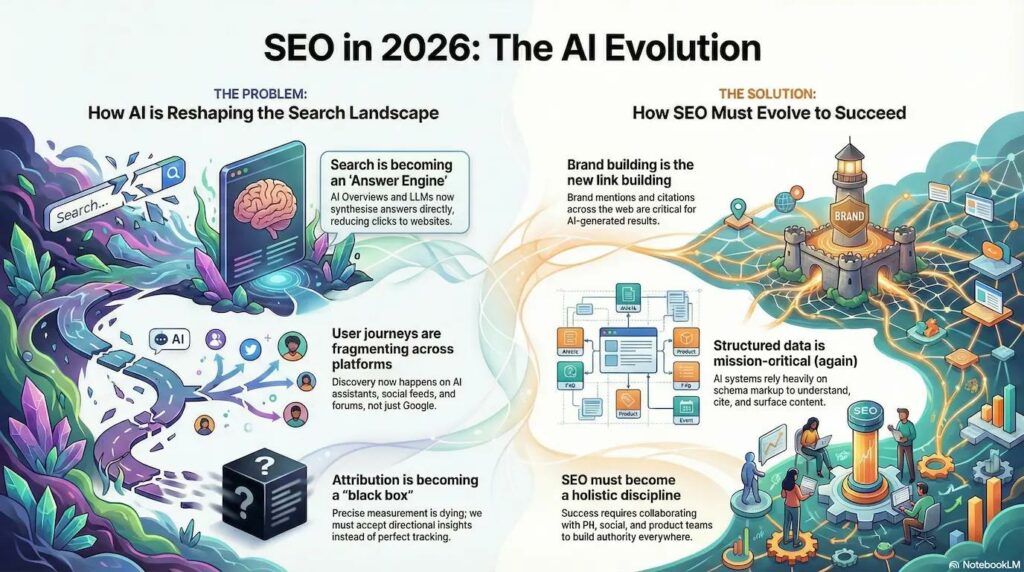
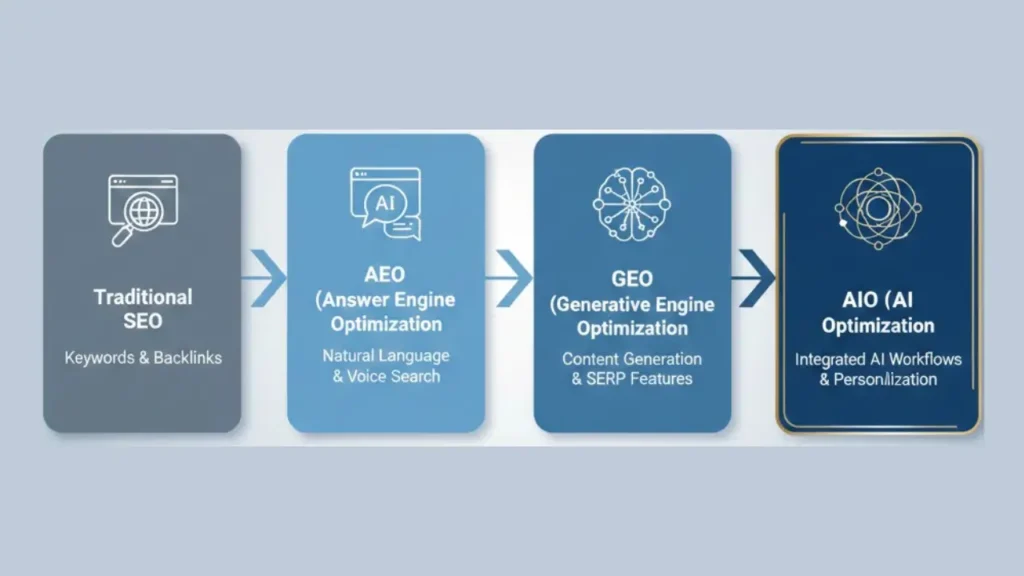
Search engine optimization has undergone a radical transformation. Traditional tactics like exact-match keyword stuffing and mass link building no longer guarantee visibility. Today, search engines use artificial intelligence to understand content, context, and user intent at an unprecedented level. An AI SEO Roadmap is your strategic guide to aligning every aspect of your digital presence with these intelligent systems. It blends data science, machine learning, and semantic content planning into a cohesive framework that drives sustainable organic growth.
The roadmap is not a one-time checklist. It’s a dynamic process that evolves with Google’s AI core updates, large language models, and generative search experiences. By following a structured AI SEO roadmap, marketers can move from reactive firefighting to proactive, insight-led optimization. This article unpacks every layer of the roadmap—from foundational concepts to advanced implementation—giving you the clarity to build a future-proof SEO machine.
What Is an AI SEO Roadmap?
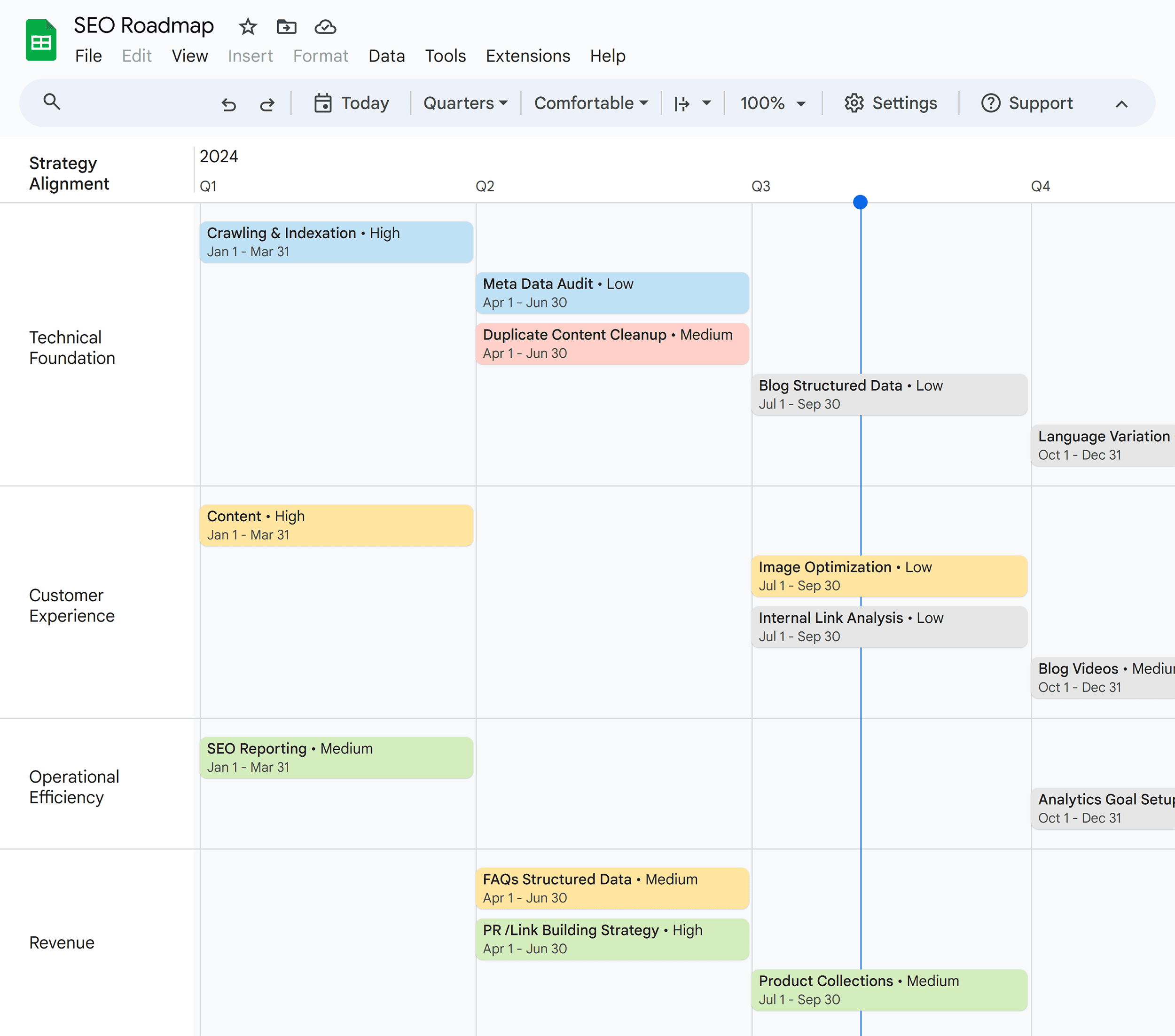
An AI SEO roadmap is a phased plan that uses machine learning, natural language processing, and predictive analytics to optimize every stage of the search journey. It goes beyond generic keyword research to map user intent, entity relationships, and content effectiveness against algorithms like Google’s RankBrain, BERT, and MUM. The roadmap integrates human creativity with AI’s ability to process vast datasets, identifying content gaps, technical flaws, and competitive opportunities faster than any person could alone.
At its core, this roadmap treats your website as a knowledge graph that must be easily consumable by both AI crawlers and human readers. It prioritizes semantic relevance, topic clusters, and user experience signals—metrics that modern AI-driven search engines rely on. Rather than guessing what might work, you implement data-backed strategies that continuously learn and adapt.
Why AI is Reshaping the SEO Landscape
The days of a static 10-blue-link search results page are over. Google now delivers direct answers, featured snippets, knowledge panels, and AI-generated overviews within search engine results pages. These changes stem from the integration of advanced AI systems that don’t just match keywords—they interpret meaning, sentiment, and even predict user satisfaction.
Natural language processing models like BERT enable Google to grasp the full context of a query by looking at the relationships between all words in a sentence. Multitask Unified Model (MUM) goes further, extracting insights across multiple formats—text, images, video—simultaneously. Meanwhile, the Search Generative Experience (SGE) uses generative AI to synthesize answers from multiple sources. An AI SEO roadmap aligns your assets to appear in these new AI-driven surfaces, not just in traditional organic listings.
Core Components of an AI SEO Roadmap
Building a successful roadmap requires a balanced focus across content, technical infrastructure, and performance analysis. Each component is interconnected, feeding data back into the system to refine future actions. Below are the fundamental pillars.
Semantic Content Strategy and Topic Clusters
AI algorithms interpret content based on entities and their relationships, not just keywords. Your roadmap must start with a semantic content model built around pillar pages and tightly connected cluster content. Use entity extraction tools to map the key topics, subtopics, and related concepts that form the knowledge universe around your core subject. This approach signals authority and depth, making it easier for AI to rank you as a comprehensive resource.
AI-Powered Search Intent Analysis
Understanding why a user is searching is the foundation of modern SEO. AI tools can classify millions of search queries into intent categories—informational, commercial, transactional, navigational—and uncover nuanced micro-intents. Your roadmap should include regular intent refinement using AI clustering techniques, ensuring every page you create matches the precise desire behind the query, including the need for visual, video, or local results.
Technical AI Compliance and Structured Data
Crawling and indexing are no longer enough. AI-enhanced search engines expect clean, context-rich technical frameworks. A robust AI SEO roadmap mandates structured data markup (Schema.org) for articles, FAQs, products, how-tos, and organization details. This enables rich results and AI-generated answers. It also means optimizing site architecture for natural language crawling, using clear internal linking, and maintaining lightning-fast core web vitals that reinforce a positive user experience score.
AI-Assisted Content Creation and Optimization
AI writing assistants help scale content production, but the roadmap must govern their use. Integrate tools that analyze top-performing pages for your target queries, suggesting optimal word count, semantic keywords, readability, and tone. Use AI to generate drafts that are then heavily reviewed, enriched, and verified by subject matter experts. Continually update existing content using AI-driven decay detection—identifying pages losing impressions and refreshing them with up-to-date data and entities.
Predictive Analytics and Proactive SEO
The most advanced AI SEO roadmaps incorporate predictive models. By analyzing historical data, seasonality, competitor movements, and search trend forecasting, you can identify topics that will spike in demand weeks or months before they peak. This lets you publish and index content ahead of the curve, capturing the initial traffic surge without battling saturated SERPs. Predictive analytics also flag pages at risk of declining, allowing preemptive optimization.
Automated Reporting and Insight Extraction
Manual report generation wastes time. Your roadmap should deploy AI reporting systems that monitor rankings, click-through rates, and conversions, then surface actionable insights in plain language. Instead of staring at charts, you receive alerts like “Your blog post on X dropped 5 positions due to new competitor content with more images—consider adding video and infographic.” This turns data into immediate tactical moves.
Step-by-Step Action Plan for Your AI SEO Roadmap
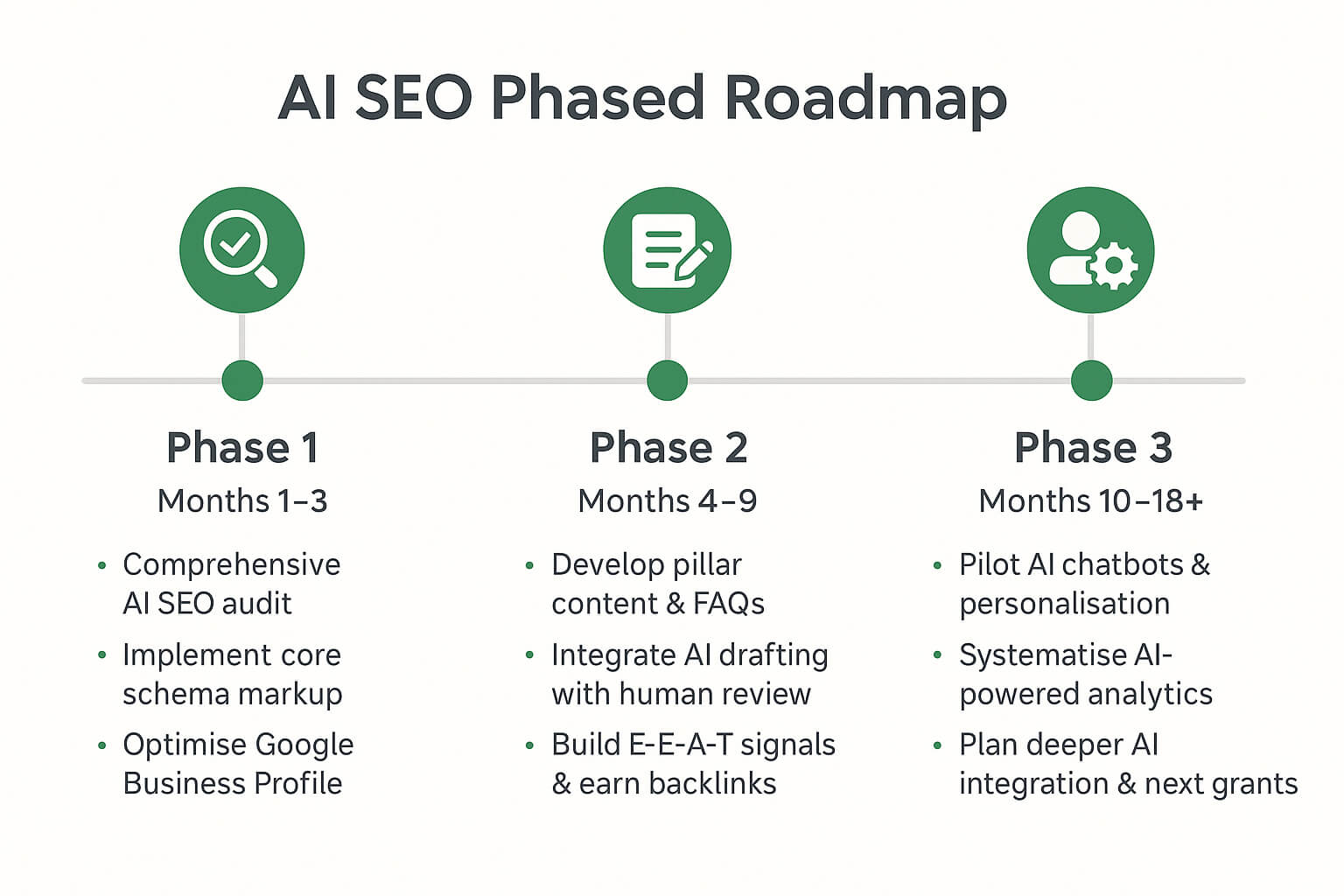
Transforming theory into practice demands a clear, phased execution. The following action plan breaks the journey into manageable stages that build upon each other.
Phase 1: Foundation and AI Audit
- Run a full technical crawl using AI-enhanced auditing tools to detect index bloat, broken entity connections, and schema gaps.
- Analyze current organic traffic patterns through an AI anomaly detection system to identify sudden drops or unexpected gains tied to algorithm updates.
- Map your existing content to a semantic knowledge graph, identifying orphaned pages and missing topic clusters.
- Define core entities (people, places, concepts, products) that your brand needs to be associated with and verify your site’s entity coverage.
- Use AI cluster analysis to redesign your site architecture, grouping content into authoritative pillar sections and supportive sub-pages.
- Rewrite or consolidate thin content that fails to meet comprehensive search intent, using AI-generated outlines as a starting point.
- Implement advanced content scoring—a composite metric blending readability, entity density, topical depth, and user engagement signals.
- Create AI-driven content calendars that prioritize high-opportunity queries where you can realistically compete within 6 months.
- Apply all relevant structured data types, test them in Google’s Rich Results Test, and monitor their appearance in AI overviews.
- Improve internal link signals using natural language anchor text that reinforces entity relationships, not repetitive money keywords.
- Optimize visual content—images and videos—with AI-generated alt text, transcripts, and file names that contribute to entity understanding.
- Strengthen E-E-A-T signals by clearly authoring industry experts, linking to credible references, and maintaining an up-to-date About page that aligns with your knowledge graph.
- Set up AI-powered alerts for shifts in Google’s Search Console data patterns, particularly when impressions deviate from forecasted ranges.
- Regularly retrain your predictive models with fresh data to improve topic forecasting accuracy.
- Perform monthly content decay audits, using AI to suggest update angles that will reclaim lost rankings.
- Monitor AI-generated search features (featured snippets, SGE carousels) specific to your industry and adapt your markup and content format accordingly.
- Semantic Content Optimizers: Platforms that compare your content against real-time search results, providing entity- and NLP-based recommendations for comprehensiveness.
- AI Content Generation Assistants: Large language models that help draft outlines, meta descriptions, and full articles when guided by expert strategy and strict editorial oversight.
- Technical AI Crawlers: Site audit tools that interpret JavaScript, detect structured data issues, and simulate how AI agents experience your pages.
- Predictive Keyword Intelligence: Solutions that forecast search volume trends, seasonality, and competitive difficulty using machine learning models trained on years of search data.
- Unified Data Analytics Suites: Integration platforms that merge rank tracking, web analytics, and conversion data, then use AI to attribute ROI to specific SEO initiatives.
- Scaled Topic Coverage: AI identifies hundreds of relevant subtopics you would miss manually, enabling you to build massive, authoritative content libraries without sacrificing quality.
- Higher SERP Feature Occupancy: By aligning with entity-based ranking, you increase the chances of winning featured snippets, People Also Ask boxes, and AI-generated overviews.
- Faster Reaction to Algorithm Updates: Anomaly detection pinpoints traffic changes in near real-time, slashing the diagnosis and recovery cycle from weeks to days.
- Precision Resource Allocation: Predictive models show exactly where to invest content and technical resources for maximum ROI, eliminating wasted effort on low-impact tasks.
- Enhanced User Experience: Intent-driven content and swift technical performance reduce bounce rates and increase dwell time, which reinforces your relevance signals to AI rankers.
- Quality Erosion: Relying entirely on AI-generated text without deep human editing leads to factually inaccurate, shallow content that erodes trust and triggers Google’s helpful content signals.
- Algorithmic Detection: Search engines continually improve their detection of machine-generated, low-value content. Massive AI-produced output without unique insight can attract manual actions or algorithmic suppression.
- Data Bias: AI models trained on historical data may reinforce existing biases, causing you to miss emerging niches or unconventional user needs that fall outside established patterns.
- Integration Complexity: Connecting multiple AI tools often requires technical expertise and rigorous validation. Misconfigured data pipelines can lead to incorrect recommendations that waste months of effort.
- Loss of Brand Voice: Homogenized AI content can strip away the authentic personality that differentiates a brand, making it indistinguishable from competitors who use the same generic patterns.
- Starting Without a Clean Data Foundation: Feeding AI systems messy, unconsolidated analytics leads to flawed predictions. Dedicate time to data hygiene, UTM normalization, and accurate conversion tracking before launching any AI initiative.
- Ignoring the Human Layer: Allowing AI to make final decisions without human oversight results in content that may be semantically correct but emotionally flat. Every AI output must pass through a subject matter expert review gate.
- Neglecting E-E-A-T Signals: AI can optimize for entities and comprehensiveness, but it cannot fabricate genuine experience and trust. A roadmap that overlooks author credentials, transparent about pages, and real customer proof will eventually hit a ceiling.
- Focusing on Quantity Over Depth: AI enables mass content production. Chasing quantity without strategic topic clustering creates content bloat that confuses crawlers and dilutes your thematic authority.
- Skipping Regular Roadmap Revisions: The AI SEO roadmap is not a static document. Treating it as such means missing new search features, model updates, or shifts in user behavior that render your plan obsolete.
- Put Experience and Expertise First: Always prioritize first-hand insights, case studies, and expert quotes that AI cannot fabricate. This aligns with Google’s E-E-A-T guidelines and ensures your content stands out in an AI-saturated web.
- Build for Humans, Optimize for Machines: Write clear, helpful content that satisfies the user’s unspoken question. Then use AI tools to fine-tune the structure, entities, and markup that make it machine-readable.
- Maintain a Continuous Feedback Loop: Connect your AI tools so that performance data flows back into your content and technical recommendations. A self-learning loop elevates your entire SEO strategy progressively.
- Embrace Experimentation: Devote a small percentage of your content effort to testing new AI-generated formats—interactive content, dynamic Q&A pages, AI-compatible video transcripts—and measure their impact on rich results.
- Never Outsource Strategic Thinking: AI informs decisions but should not make them. Your team’s unique understanding of the market, brand, and audience remains the ultimate differentiator.
Phase 2: Content and Intent Alignment
Phase 3: Technical AI Enhancements
Phase 4: Continuous Monitoring and Adaptation
AI SEO Tools and Technologies
The right technology stack accelerates roadmap execution without replacing human judgment. AI SEO platforms fall into distinct categories, each serving a specific segment of the roadmap.
Select tools that share data seamlessly, because isolated solutions create fragmented intelligence. A connected ecosystem allows your AI SEO roadmap to function as a single, self-improving system.
Benefits of an AI-Driven SEO Roadmap
Moving to an AI-centric approach yields advantages that compound over time. Early adopters often see a clear separation from competitors who still rely on intuition and manual processes.
Limitations and Risks of AI in SEO
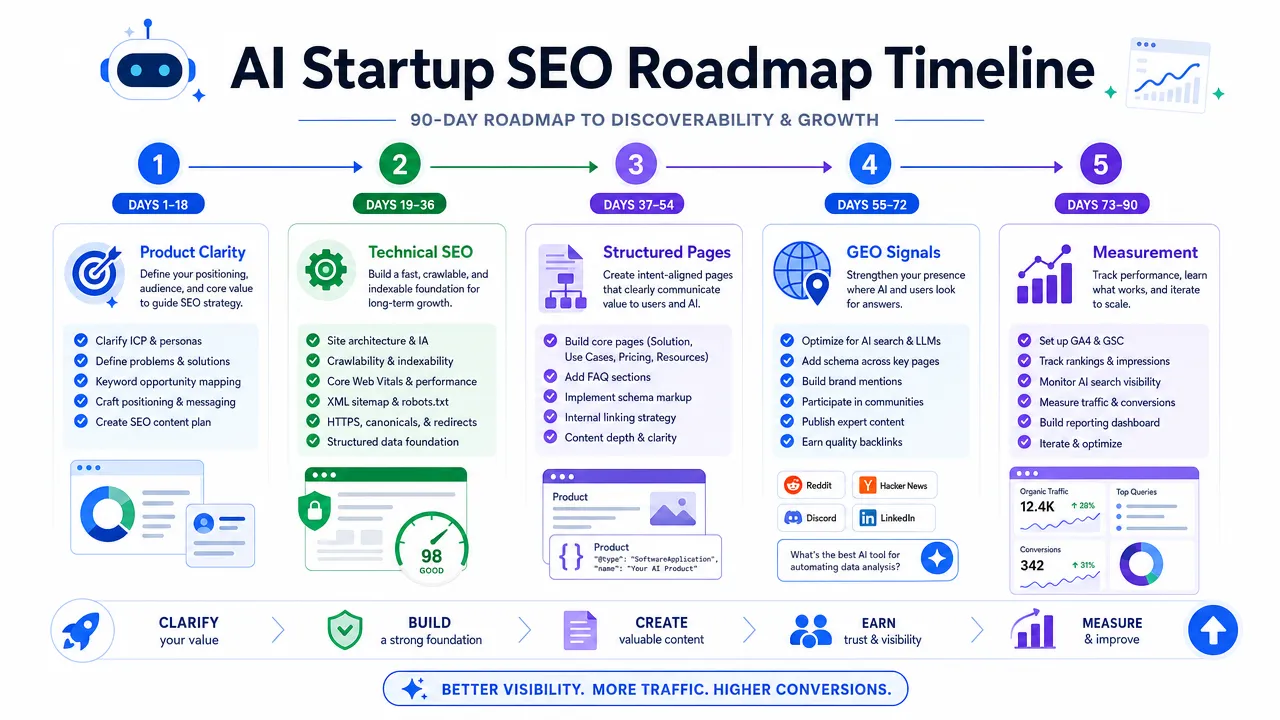
Overestimating AI can derail even the smartest roadmap. The technology is an amplifier, not a replacement for strategic thinking. Acknowledge these boundaries to maintain long-term performance.
AI SEO vs. Traditional SEO: A Detailed Comparison
The shift from manual to AI-powered SEO is not merely a tool upgrade—it’s a philosophical change. The following table highlights the key differences in approach, execution, and measurement.
| Aspect | Traditional SEO | AI SEO Roadmap |
|---|---|---|
| Keyword Research | Focus on individual keywords and search volume | Entity and topic cluster discovery using semantic analysis |
| Content Creation | Manual writing based on keyword density and competitor mimicry | Human-led creation augmented by AI outlines, entity gaps, and comprehensive intent coverage |
| Technical Focus | Basic crawlability, meta tags, site speed | Structured data, JavaScript rendering, natural language internal linking, core web vitals tied to AI signals |
| Performance Analysis | Manual rank tracking and periodic reporting | Continuous AI monitoring, anomaly detection, and predictive forecasting with automated narrative insights |
| Adaptation Speed | Reactive; weeks to respond to ranking changes | Proactive; real-time alerts and predictive content planning ahead of demand |
| Goal | Rankings and traffic volume | User intent satisfaction, entity authority, and sustainable presence in AI-generated search features |
Common Mistakes When Implementing an AI SEO Roadmap
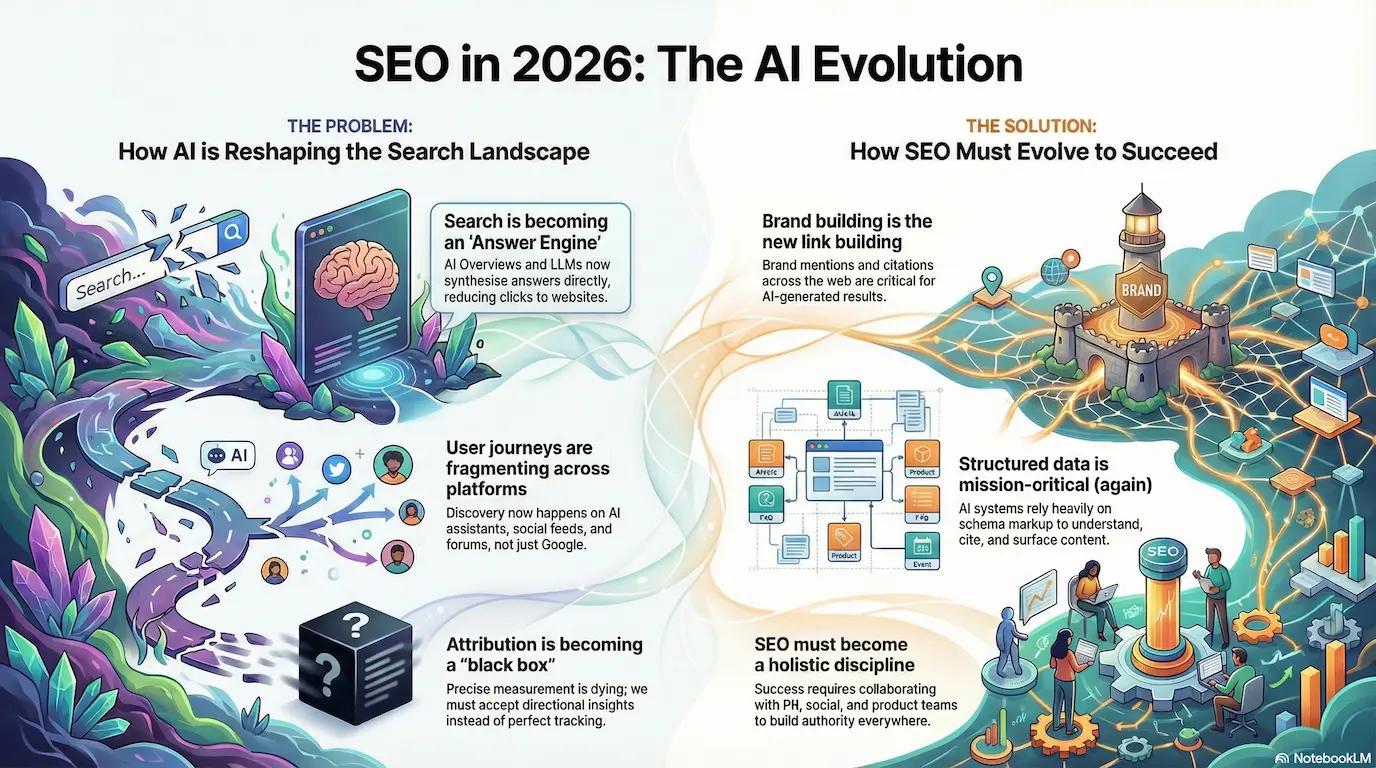
Even experienced teams fall into traps that undermine their roadmap’s effectiveness. Recognizing these pitfalls early prevents wasted resources and algorithm penalties.
Key Principles for Long-Term Success
A durable AI SEO roadmap rests on principles that outlast any single algorithm update. Internalize these to keep your strategy resilient.
Frequently Asked Questions
What exactly is an AI SEO roadmap?
An AI SEO roadmap is a structured strategic plan that uses artificial intelligence technologies—including machine learning, NLP, and predictive analytics—to guide all SEO activities. It maps out how to research intent, create entity-rich content, optimize technical infrastructure, and measure performance in a way that aligns with modern AI-powered search algorithms.
How does an AI SEO roadmap differ from a traditional SEO strategy?
Traditional SEO strategies center on manual keyword research, static content briefs, and periodic rank checks. An AI SEO roadmap continuously analyzes massive datasets to uncover semantic relationships, forecast trends, and automatically detect performance anomalies. It shifts the focus from chasing individual keywords to building comprehensive topic authority and appearing in AI-driven search features.
Do I need expensive AI tools to follow an AI SEO roadmap?
While advanced paid tools accelerate the process, a functional roadmap can start with accessible AI features in platforms you may already use, such as Google’s natural language API, basic predictive functions in analytics suites, and careful application of publicly available large language models for content research. The roadmap is more about mindset and process than any single tool.
Can AI-generated content rank well on Google?
AI-generated content can rank if it provides unique value, factual accuracy, and genuine insight beyond what the model was trained on. However, Google’s helpful content system prioritizes people-first content and may demote mass-produced AI text lacking original research or expert perspective. The most effective approach combines AI drafting with deep human enrichment.
How often should I update my AI SEO roadmap?
A full formal review every quarter is recommended, with monthly check-ins for critical components like content decay analysis, structured data compliance, and search intent shifts. Major Google algorithm updates or the introduction of new AI search features warrant an immediate tactical review of the roadmap’s priorities.
What are the first steps to building an AI SEO roadmap for a small business?
Begin with a thorough content audit using AI-powered crawling to identify your strongest entity clusters. Then define clear topic pillars and use free or low-cost AI tools to uncover intent gaps. Focus on creating deeply helpful, semantically structured pages around those clusters, applying basic schema markup, and setting up simple anomaly alerts to catch sudden traffic changes early.
Bringing Your AI SEO Roadmap to Life
The integration of artificial intelligence into search has permanently altered what it means to rank. An AI SEO roadmap provides the clarity to navigate this new reality without falling back on guesswork. It combines human expertise with intelligent automation, creating a system that not only reacts to changes but anticipates them.
Success depends on disciplined execution, continuous learning, and an unwavering commitment to serving genuine user needs. When the roadmap is treated as a living framework rather than a static document, it turns SEO from a cost center into a compounding growth engine. The future of search belongs to those who plan for it—start building your roadmap today.
Xem thêm:
- AI Meta Descriptions: The Complete Guide to Writing High-Converting Search Snippets With Artificial Intelligence
- AI SEO Content Quality: The Complete Guide to Publishing Content That Ranks in 2025
- AI SEO Table Generator: The Complete Guide to Smarter Content in 2025
- AI SEO User Signals: The Complete Guide to Ranking in the Age of Machine Learning
- Next-Generation AI SEO Workflow for Enterprises: A Blueprint for Scalable Organic Growth
Bài viết cùng chủ đề:

AI SEO SEO Automation with Make: The Complete Workflow Guide

AI SEO SEO Automation with Zapier: The Complete Workflow Guide

AI SEO SEO Automation with n8n: The Complete Workflow Guide
AI SEO SEO Automation with Gemini: The Complete Guide to Scaling Organic Growth

AI SEO SEO Automation with Claude: The Complete Guide to Scaling Content in 2025

AI SEO SEO Automation with ChatGPT: The Complete Playbook for 2025

AI SEO & SEO Automation for Affiliate Sites: The 2025 Playbook for Passive Income Growth
AI SEO & SEO Automation for Bloggers: The Complete Guide to Scaling Your Content

AI SEO & SEO Automation for Agencies: The Complete 2025 Playbook

AI SEO and SEO Automation for Ecommerce: The Complete Playbook for 2025

AI SEO & SEO Automation for WordPress: The Complete Playbook for 2025
AI SEO SEO Automation Strategy: The Complete Playbook for 2025

Mastering the AI SEO SEO Automation Process: A Complete Guide to Scaling Organic Growth
AI SEO SEO Automation System: The Complete Guide to Scaling Organic Growth in 2025
AI SEO SEO Automation Platform: The Complete Guide to Scaling Organic Growth in 2025
AI SEO SEO Automation Software: The Complete Guide to Scaling Organic Growth in 2025















