
No products in the cart.
AI SEO Keywords Everywhere: The Complete Guide to Smarter Keyword Research in 2025
31
Jul
Jul
The digital marketing landscape has shifted dramatically with the integration of artificial intelligence into everyday SEO workflows. AI SEO Keywords Everywhere represents a new paradigm where machine learning algorithms analyze search patterns, user intent, and content gaps at a scale impossible for manual research. This comprehensive guide explores how AI-powered keyword tools are transforming search engine optimization, what specific features matter most, and how to implement these technologies for measurable ranking improvements.
Understanding AI SEO Keywords Everywhere

AI SEO Keywords Everywhere refers to the pervasive integration of artificial intelligence across all stages of keyword research and content optimization. Unlike traditional keyword tools that rely on static databases and simple volume metrics, AI-powered systems continuously learn from search engine result pages, user behavior signals, and semantic relationships between concepts. These systems process billions of data points to identify emerging trends, predict search demand shifts, and uncover opportunities that human analysts would likely miss.
The core difference lies in the analytical depth. Traditional tools show you what people search for. AI tools explain why they search, what they expect to find, and how to structure content that satisfies both users and search algorithms. This shift from keyword matching to intent understanding represents the most significant evolution in SEO methodology since Google’s Hummingbird update.
How AI Keyword Research Works
AI-powered keyword research operates through several sophisticated mechanisms that work in concert to deliver actionable insights. Natural language processing algorithms break down search queries into their component parts, identifying entities, relationships, and contextual meaning. Machine learning models then cross-reference these queries against millions of indexed pages to determine which content types rank for specific terms and why.
Predictive analytics play a crucial role in modern AI keyword tools. These systems analyze historical search data, seasonal patterns, and current events to forecast future search volumes with remarkable accuracy. For example, an AI tool might detect rising interest in “electric vehicle charging stations” weeks before traditional keyword tools register significant volume changes, giving early adopters a competitive advantage.
Semantic Search and Entity Recognition
Modern search engines understand language the way humans do, not just as strings of characters but as interconnected concepts. AI SEO Keywords Everywhere tools leverage this semantic understanding to identify related terms, synonyms, and contextual variations that should appear naturally throughout your content. When you target “best running shoes,” the AI recognizes that “cushioning,” “arch support,” “heel drop,” and “pronation” are all semantically related concepts that strengthen topical authority.
Entity recognition takes this further by identifying specific people, places, organizations, and products mentioned in search queries. This allows content creators to build comprehensive resource pages that answer multiple related questions, increasing the likelihood of earning featured snippets and position zero results.
Key Features of AI Keyword Tools
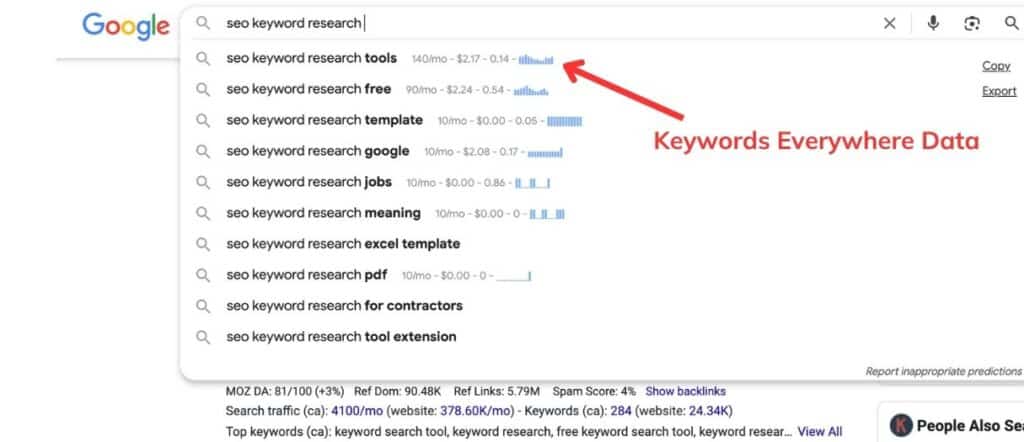
Modern AI SEO platforms offer a range of features designed to streamline the entire content creation process. Understanding these capabilities helps you select the right tools for your specific needs and budget constraints.
Real-Time Search Data Analysis
Traditional keyword tools update their databases monthly or quarterly. AI-powered systems analyze search data in real-time, detecting shifts in user behavior within hours rather than weeks. This immediacy proves invaluable for news sites, e-commerce businesses, and any organization operating in fast-moving industries where search trends change rapidly.
Content Gap Analysis
AI algorithms can compare your existing content against top-ranking pages for your target keywords, identifying specific subtopics, questions, and data points you have not covered. This gap analysis goes beyond simple keyword comparison to evaluate content depth, readability, and structural elements that influence search rankings.
Search Intent Classification
Every search query carries an underlying intent: informational, navigational, commercial, or transactional. AI tools classify keywords by intent automatically, helping you match your content format to user expectations. A query like “how to tie a tie” demands a step-by-step guide, while “best ties for weddings” requires a comparison article with product recommendations.
Benefits of AI-Powered Keyword Research
The advantages of integrating AI into your keyword research workflow extend far beyond time savings. These systems deliver measurable improvements across multiple SEO performance indicators.
- Increased Accuracy: AI algorithms eliminate human bias and guesswork, providing data-driven recommendations based on actual search behavior rather than assumptions.
- Scalability: Analyze thousands of keywords simultaneously, identifying patterns and opportunities that would take weeks to uncover manually.
- Competitive Intelligence: AI tools monitor competitor content strategies, alerting you to new keywords they target and content they publish.
- Predictive Insights: Forecast future search trends and position your content ahead of demand curves.
- Content Optimization: Receive real-time suggestions for improving on-page elements, from title tags to internal linking structures.
Limitations and Challenges

Despite their impressive capabilities, AI keyword tools have limitations that require human oversight and strategic thinking. Understanding these constraints prevents over-reliance on automated systems.
AI algorithms operate based on historical data patterns. When unprecedented events occur, such as a global pandemic or sudden market disruption, these systems may struggle to predict new search behaviors accurately. Human intuition and industry knowledge remain essential for navigating truly novel situations.
Cost presents another consideration. Premium AI SEO platforms charge substantial monthly fees, often ranging from $100 to $500 or more. Smaller businesses and individual content creators may find these prices prohibitive, though many tools offer limited free tiers or more affordable entry-level plans.
AI SEO Keywords Everywhere vs Traditional Keyword Tools
Comparing AI-powered solutions with traditional keyword research tools highlights the significant advantages of machine learning approaches while acknowledging where conventional methods still hold value.
| Feature | Traditional Tools | AI-Powered Tools |
|---|---|---|
| Data Update Frequency | Monthly or quarterly | Real-time or daily |
| Search Intent Analysis | Basic categorization | Deep semantic understanding |
| Content Recommendations | Keyword lists only | Full content outlines and briefs |
| Competitor Analysis | Manual comparison | Automated monitoring and alerts |
| Predictive Capabilities | Limited or none | Advanced trend forecasting |
| Cost | Generally lower | Higher, with premium features |
Practical Implementation Guide

Implementing AI SEO Keywords Everywhere requires a systematic approach that integrates these tools into your existing content workflow. The following steps outline a proven methodology for maximizing the value of AI-powered keyword research.
Step 1: Define Your Content Pillars
Start by identifying the core topics that define your business or website. These content pillars should represent broad subject areas where you want to establish authority. For a fitness website, pillars might include strength training, nutrition, recovery, and mental wellness. AI tools help validate these pillars by analyzing search demand and competition levels.
Step 2: Generate Keyword Clusters
Use AI tools to expand each content pillar into comprehensive keyword clusters. The AI identifies primary keywords, secondary terms, long-tail variations, and semantically related concepts. Organize these clusters by search intent and user journey stage, from awareness through consideration to decision.
Step 3: Analyze Search Intent Deeply
For each keyword cluster, examine the top-ranking pages to understand what content format and angle satisfies user intent. AI tools provide detailed SERP analysis, highlighting common elements across high-ranking pages such as word count, media types, and structural patterns. Use these insights to create content that matches or exceeds existing standards.
Step 4: Create Content Briefs
Generate comprehensive content briefs using AI assistance. These briefs should include target keywords, related terms to incorporate naturally, suggested headings and subheadings, questions to answer, and data points to include. The AI can also suggest internal linking opportunities to existing content on your site.
Step 5: Optimize and Monitor
After publishing, use AI tools to monitor keyword performance, track ranking changes, and identify opportunities for content updates. AI systems detect when competitors publish new content targeting your keywords, allowing you to respond quickly with enhanced or updated material.
Common Mistakes and How to Avoid Them
Even experienced SEO professionals make errors when adopting AI keyword tools. Recognizing these pitfalls helps you avoid wasting time and resources on ineffective strategies.
Mistake 1: Blindly Following AI Recommendations
AI tools provide data, not decisions. Always apply your industry knowledge and brand expertise when evaluating keyword suggestions. If an AI recommends targeting a keyword that does not align with your business goals or audience needs, skip it regardless of search volume.
Mistake 2: Ignoring Search Intent Nuances
AI classification of search intent is helpful but not infallible. Manually review keyword clusters to ensure you understand the specific user needs behind each query. A keyword classified as informational might actually have commercial intent when examined in context.
Mistake 3: Over-Optimizing for Keywords
AI tools make it easy to stuff content with target keywords and related terms. Search engines penalize unnatural keyword usage. Focus on creating genuinely helpful content that naturally incorporates relevant terms where they add value for readers.
Mistake 4: Neglecting Human Creativity
AI excels at analyzing existing data but cannot generate truly novel ideas or unique perspectives. Use AI for research and optimization, but rely on human creativity for content differentiation and brand voice development.
Important Notes for Success
Several factors determine whether your AI keyword strategy delivers meaningful results. Keep these considerations in mind as you develop your approach.
Quality remains the ultimate ranking factor. AI tools help you identify opportunities and optimize content, but they cannot compensate for thin, poorly written, or unhelpful material. Invest in skilled writers who can transform AI-generated briefs into compelling, authoritative content.
Algorithm updates constantly reshape the SEO landscape. AI tools that worked effectively last year may require adjustments as search engines evolve. Stay informed about industry changes and regularly reassess your tool stack to ensure it still meets your needs.
Data privacy and ethical considerations matter. Some AI tools collect and analyze user data in ways that raise privacy concerns. Choose reputable providers with transparent data practices and comply with applicable regulations in your jurisdiction.
Frequently Asked Questions
What exactly does AI SEO Keywords Everywhere mean?
AI SEO Keywords Everywhere describes the comprehensive integration of artificial intelligence across all keyword research and content optimization processes. This includes real-time search data analysis, semantic understanding, predictive trend forecasting, and automated content recommendations that help websites rank higher in search results.
How much do AI keyword research tools cost?
Pricing varies significantly by provider and feature set. Entry-level AI keyword tools start around $30 to $50 per month, while comprehensive enterprise solutions can cost $500 or more monthly. Many platforms offer free trials or limited free tiers, allowing you to test capabilities before committing financially.
Can AI replace human SEO experts?
AI tools enhance human expertise rather than replace it. While AI excels at data analysis, pattern recognition, and scalability, human judgment remains essential for strategic decision-making, creative content development, and understanding nuanced business contexts. The most effective SEO teams combine AI efficiency with human insight.
Are AI keyword suggestions accurate?
AI keyword suggestions are generally highly accurate for established search patterns and trends. However, accuracy depends on data quality, algorithm sophistication, and the specific tool you use. Cross-referencing AI suggestions with manual research and other data sources provides the most reliable results.
How quickly can I see results from AI-driven keyword strategies?
Timelines vary based on your website’s authority, competition levels, and content quality. Some improvements appear within weeks for low-competition keywords, while highly competitive terms may require several months of consistent optimization. AI tools accelerate the process by identifying opportunities faster, but ranking improvements still follow search engine timelines.
Conclusion
AI SEO Keywords Everywhere represents the present and future of search engine optimization. The ability to analyze vast datasets, understand semantic relationships, predict trends, and generate actionable content recommendations gives businesses a significant competitive advantage in crowded digital markets. While traditional keyword research methods still have their place, the efficiency and depth of AI-powered analysis make it an essential component of any serious SEO strategy.
Success requires balancing technological capability with human judgment. Use AI tools to uncover opportunities, validate assumptions, and optimize content systematically. Apply your industry expertise, creative thinking, and understanding of your specific audience to transform data into compelling, valuable content that earns rankings and builds lasting authority. The organizations that master this balance will dominate search results as AI continues to reshape the digital landscape.
Xem thêm:
- AI SEO for Niche Sites: The 2025 Playbook for Dominating Small Markets
- AI SEO Behavioral Analytics: The Complete Guide to Understanding User Intent
- AI SEO LLM Traffic: The Complete Guide to Capturing AI Search Visibility
- AI SEO Generative Search Optimization: The Complete Playbook for 2025
- AI SEO Entity Based Search: The Complete Guide to Future-Proofing Your Rankings
Bài viết cùng chủ đề:

AI SEO SEO Automation with Make: The Complete Workflow Guide

AI SEO SEO Automation with Zapier: The Complete Workflow Guide

AI SEO SEO Automation with n8n: The Complete Workflow Guide
AI SEO SEO Automation with Gemini: The Complete Guide to Scaling Organic Growth

AI SEO SEO Automation with Claude: The Complete Guide to Scaling Content in 2025

AI SEO SEO Automation with ChatGPT: The Complete Playbook for 2025

AI SEO & SEO Automation for Affiliate Sites: The 2025 Playbook for Passive Income Growth
AI SEO & SEO Automation for Bloggers: The Complete Guide to Scaling Your Content

AI SEO & SEO Automation for Agencies: The Complete 2025 Playbook

AI SEO and SEO Automation for Ecommerce: The Complete Playbook for 2025

AI SEO & SEO Automation for WordPress: The Complete Playbook for 2025
AI SEO SEO Automation Strategy: The Complete Playbook for 2025

Mastering the AI SEO SEO Automation Process: A Complete Guide to Scaling Organic Growth
AI SEO SEO Automation System: The Complete Guide to Scaling Organic Growth in 2025
AI SEO SEO Automation Platform: The Complete Guide to Scaling Organic Growth in 2025
AI SEO SEO Automation Software: The Complete Guide to Scaling Organic Growth in 2025















