
No products in the cart.
AI SEO LLM Brand Visibility: The Complete Playbook for the Generative Search Era
10
Aug
Aug
The digital landscape has shifted beneath our feet. Traditional search engine optimization focused on ranking in a list of blue links. Today, the battleground has moved to the answer box, the chat interface, and the AI-generated summary. Achieving AI SEO LLM Brand Visibility is no longer a luxury; it is a survival tactic for any business that relies on organic discovery. This comprehensive guide breaks down exactly how large language models perceive your brand, why they choose to cite you, and the actionable strategies you need to dominate this new frontier of search.
Understanding the Shift: From Page Rankings to Answer Engines

To master AI SEO LLM Brand Visibility, you must first understand the mechanics of the new search ecosystem. When a user asks ChatGPT, Perplexity, or Google’s AI Overviews a question, the model does not browse the live web in real-time for every query. Instead, it relies on a blend of its training data, real-time retrieval (RAG), and the authority signals it has learned to associate with specific domains.
This changes the game from “keyword matching” to “entity understanding.” The LLM is not looking for a page that contains the words “best CRM software.” It is looking for an authoritative entity that is consistently recognized as a leader in that space. Your goal is to make your brand the default answer in the model’s neural network.
The Difference Between Traditional SEO and Generative Engine Optimization
Traditional SEO is about crawling and indexing. Generative Engine Optimization (GEO) is about being referenced and recommended. The table below highlights the core differences that impact your strategy.
| Aspect | Traditional SEO | AI SEO LLM Brand Visibility |
|---|---|---|
| Primary Goal | Rank #1 in SERPs | Be cited as a source in AI answers |
| Content Focus | Keyword density and backlinks | Entity clarity, statistics, and unique data |
| User Intent | Click-through to website | Zero-click satisfaction within the chat |
| Measurement | Impressions and clicks | Brand mentions and citation frequency |
| Technical Factor | Page speed and meta tags | Structured data and schema markup |
The shift requires a change in mindset. You are no longer writing for a user who will click. You are writing for a machine that will summarize your content and present it to the user without them ever visiting your site. Therefore, your content must be self-contained, authoritative, and highly quotable.
Why LLMs Choose Certain Brands Over Others
Large Language Models are probabilistic. They predict the next word based on patterns. When generating an answer, they assign a “probability score” to different sources. To increase your AI SEO LLM Brand Visibility, you need to influence these scores. Several key factors determine whether an LLM trusts your brand enough to cite it.
1. Consistent Entity Recognition
The model needs to know exactly who you are and what you do. If your website, social profiles, and business directories all describe you differently, the LLM gets confused. You must maintain a consistent Name, Address, and Phone number (NAP) and a consistent description of your products or services across the entire web. This is called “Entity Resolution.”
2. High Citation Velocity
This is the digital equivalent of being “famous.” If your brand is frequently mentioned across high-authority domains (news sites, industry journals, government pages), the LLM assumes you are a relevant player. It is not just about the number of links, but the context of those mentions. A mention in a Wikipedia article or a.edu domain carries more weight than a random blog comment.
3. Quotable Data and Statistics
LLMs love to cite specific numbers. If you publish original research, surveys, or industry reports, you become a primary source. When the model answers a question like “What is the ROI of email marketing?”, it will look for a source that provides a specific percentage. If that source is you, your brand visibility skyrockets.
4. Clarity of Content Structure
Models struggle with unstructured, messy text. Content that uses clear headings, bullet points, and direct answers to specific questions is easier for the model to parse. If your content answers a question in the first sentence of a paragraph, it is more likely to be extracted for a featured snippet or an AI citation.
Core Strategies to Boost AI SEO LLM Brand Visibility
Now that we understand the “why,” ” These are the actionable strategies you need to implement to ensure your brand is the go-to source for AI engines.
Optimize for the “Answer First” Format
The days of the 300-word intro are over. You must lead with the answer. If your page is about “What is AI SEO?”, the very first sentence should be a clear, concise definition. Follow this with a “TL;DR” summary box. This structure allows the LLM to instantly identify the core value of your page without having to interpret fluff.
- Direct Answers: Start with a direct answer to the query in the first 50 words.
- Use “People Also Ask” Data: Mine Google’s PAA boxes for long-tail questions and answer them explicitly in dedicated H2 sections.
- Define Jargon: If you use an acronym, spell it out immediately. LLMs prefer explicit definitions.
- Original Research: Conduct surveys and publish the raw data.
- Proprietary Frameworks: Invent a new methodology and name it. For example, “The 5-Pillar Method of AI Visibility.”
- Historical Timelines: Create detailed timelines of industry events. These are often used as reference points.
Leverage Structured Data (Schema Markup)
While LLMs can read plain text, structured data helps them understand the context. Implementing Organization Schema, FAQ Schema, and Article Schema sends clear signals about your brand’s identity. This is a technical aspect of AI SEO LLM Brand Visibility that many competitors overlook.
Specifically, use SameAs attributes in your schema to link your website to your Wikipedia page, LinkedIn, and Twitter profiles. This helps the LLM connect the dots and verify that your brand is a real, established entity.
Create “Citation-Worthy” Assets
To be cited, you must be citable. This means creating content that is unique and cannot be found elsewhere. Generic blog posts that rehash common knowledge will not be cited because the LLM already knows that information. Instead, focus on:
Build a Strong Digital PR Network
Digital PR is the new link building. The goal is to get your brand mentioned in roundup posts, expert quotes, and industry news. When a journalist writes an article about “Top Marketing Trends,” and quotes you as an expert, the LLM takes note. This is a powerful trust signal.
Focus on getting mentions in “Listicles” and “Best Of” articles. LLMs frequently use these to generate recommendation lists. If you are on a list of “Top 10 SEO Tools” on a major publication, you are highly likely to be included in an AI-generated answer to that query.
Content Creation Strategies for LLM Extraction
The style of your writing matters as much as the substance. You need to write in a way that is “machine-readable” while still being engaging for humans. This is the crux of AI SEO LLM Brand Visibility.
The Power of Lists and Tables
LLMs love structured data. When you use bullet points, numbered lists, and tables, you make it incredibly easy for the model to extract and reformat your information. A paragraph of text is hard to summarize; a list is easy to copy.
For example, if you are writing about “Benefits of AI SEO,” use a bulleted list for each benefit. This increases the chance that the LLM will use your list verbatim in its answer, attributing the source to you.
Write for the “Zero-Click” User
Assume the user will never click through to your website. Write your content so that it provides complete value within the search engine results page or the chat interface. This does not hurt your traffic; it builds trust. When the user sees that your brand provided the best answer, they will search for you directly later.
Update Content Regularly
LLMs have a knowledge cutoff, but they also retrieve live data. If your content is outdated, the model will prefer a fresher source. Regularly update your statistics, examples, and product information. Add a “Last Updated” date to your articles. This signals freshness to both Google and the LLM crawlers.
Measuring Your AI SEO LLM Brand Visibility
You cannot manage what you do not measure. Tracking your visibility in AI search requires a different toolkit than traditional analytics.
Brand Mention Monitoring in AI Tools
Manually query ChatGPT, Claude, and Perplexity with your target keywords. Ask them questions like “Who is the best [Your Industry] company?” or “What do you know about [Your Brand]?” Analyze the responses. Are you mentioned? Are you described accurately?
You can also use specialized tools that track “Share of Voice” in AI responses. These tools automate the process of querying LLMs and tracking which domains are cited most frequently.
Analyzing Referral Traffic from AI Platforms
When an LLM does cite you, it often includes a link. Monitor your analytics for traffic coming from domains like chat.openai.com, perplexity.ai, or gemini.google.com. An increase in this traffic indicates that your content is being used as a source.
The “Citation Score” Metric
Develop an internal metric called a “Citation Score.” This is a composite of how many times your brand is mentioned across different LLMs for your target keywords. Track this score weekly. A rising score indicates that your entity is becoming more authoritative in the eyes of the machines.
Common Mistakes That Kill Your AI Visibility
Many brands are actively hurting their chances of being cited by AI engines. Avoid these critical errors to ensure your strategy is effective.
1. Over-Optimizing for Keywords (Stuffing)
In the old days, you repeated a keyword 10 times to rank. Today, this is a red flag. LLMs are trained to detect spammy, unnatural language. If your content reads like a robot wrote it, the LLM will assume a robot did and ignore it. Focus on semantic relevance and natural language.
2. Ignoring the “Entity” Aspect
Focusing only on keywords without building your brand entity is a wasted effort. You need Wikipedia pages, Crunchbase profiles, and consistent press mentions. If the LLM cannot verify that you are a real company, it will not risk citing you.
3. Hiding Your Data Behind Paywalls
If your best research is locked behind a login or a PDF that is difficult to crawl, the LLM cannot access it. Ensure your most important data is available in HTML format on a public page. PDFs are notoriously difficult for LLMs to parse for citation purposes.
4. Neglecting User Experience (UX)
While LLMs read the text, they also consider user signals. If your site has a high bounce rate and low dwell time, the model may interpret this as a sign of low quality. Ensure your site is fast, mobile-friendly, and easy to navigate.
Important Notes on the Future of AI Search
The landscape of AI SEO LLM Brand Visibility is evolving rapidly. What works today may not work tomorrow. However, the underlying principles remain constant: authority, clarity, and consistency.
One significant trend is the rise of “Agentic Search.” In the future, AI agents will not just answer questions; they will perform tasks like booking flights or purchasing software. To be visible in this environment, your brand must have clean, structured data that allows the agent to interact with your APIs or booking systems. This is the next frontier of visibility.
Another note is the importance of “Multimodal Content.” LLMs are becoming multimodal, meaning they can process images and video. Ensure your images have descriptive alt text and that your video content is transcribed. This provides more “hooks” for the AI to grab onto.
Frequently Asked Questions (FAQ)
What is the difference between AI SEO and Traditional SEO?
Traditional SEO focuses on ranking in search engine results pages (SERPs) to drive clicks. AI SEO, or GEO, focuses on being cited as a source within AI-generated answers. Traditional SEO targets the search engine crawler, while AI SEO targets the large language model’s retrieval system. The goal of AI SEO is to be the referenced source in a summary, not necessarily the clicked link.
How do I check my brand visibility in ChatGPT?
You can manually check by opening ChatGPT and asking specific prompts related to your industry. For example, “Recommend a project management tool” or “What is the best digital marketing agency?” Review the response to see if your brand is mentioned. For a more systematic approach, use AI monitoring tools that track brand mentions across multiple LLMs automatically.
Does backlinking still matter for AI SEO?
Yes, but the quality and context matter more than quantity. LLMs use backlinks as a proxy for authority. A link from a high-authority news site in the context of a relevant article is far more valuable than 100 links from low-quality directories. Focus on digital PR and earning mentions from reputable sources.
What is the ideal content length for LLM citation?
T A 2,000-word article that covers a topic in depth is more likely to be cited than a 500-word overview. However, the content must be structured with clear headings and lists. Long-form content that is poorly organized is less likely to be extracted than a concise, well-structured answer.
How long does it take to see results from AI SEO strategies?
It depends on the current authority of your domain. If you are a new brand, it can take 6-12 months to build enough entity recognition and citations to appear in AI responses. If you are an established brand with a strong backlink profile, you may see results within 2-3 months of optimizing your content structure.
Conclusion
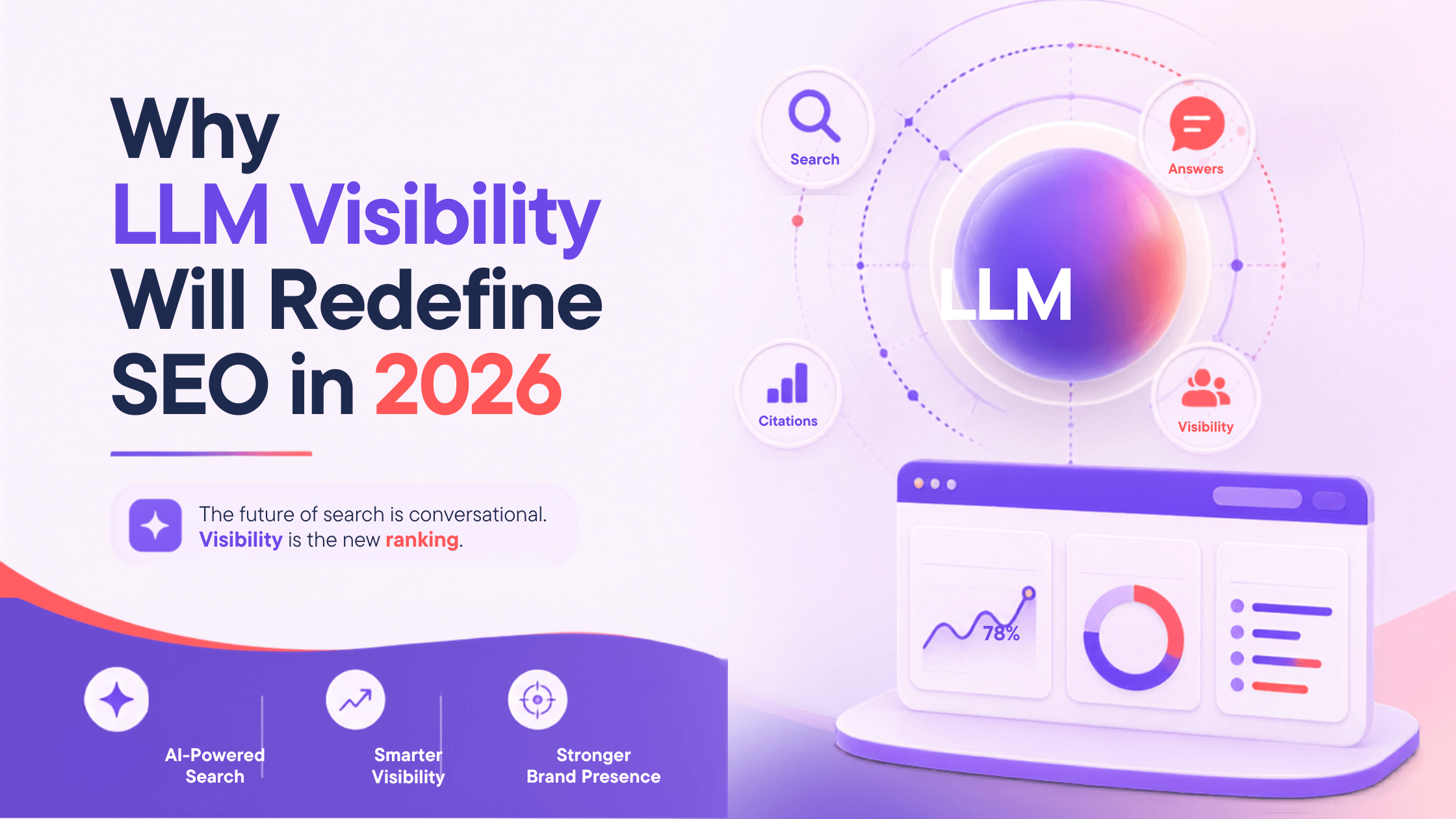
AI SEO LLM Brand Visibility is the most critical investment you can make in your digital marketing strategy today. The shift from click-based search to answer-based search is not a passing trend; it is the fundamental evolution of how humans access information. By focusing on entity clarity, quotable data, and structured content, you position your brand not just as a website, but as the definitive authority in your niche.
The brands that adapt now will own the digital real estate of the future. Those that ignore this shift will find themselves invisible, not just in the search results, but in the minds of the AI assistants that are becoming the primary gateway to the internet. Start implementing these strategies today to secure your brand’s place in the generative search landscape.
Xem thêm:
- AI SEO Case Study: Real-World Results, Strategies, and Lessons Learned
- AI Translation SEO: Mastering Multilingual Content for Global Search Dominance
- AI SEO Link Prospecting: The Complete Guide to Automating High-Quality Backlink Discovery
- AI SEO Informational Intent: The Complete Guide to Winning Search Visibility
- AI SEO H1 Optimization: The Complete Guide to Dominating Search Rankings in 2025
Bài viết cùng chủ đề:

AI SEO SEO Automation with Make: The Complete Workflow Guide

AI SEO SEO Automation with Zapier: The Complete Workflow Guide

AI SEO SEO Automation with n8n: The Complete Workflow Guide
AI SEO SEO Automation with Gemini: The Complete Guide to Scaling Organic Growth

AI SEO SEO Automation with Claude: The Complete Guide to Scaling Content in 2025

AI SEO SEO Automation with ChatGPT: The Complete Playbook for 2025

AI SEO & SEO Automation for Affiliate Sites: The 2025 Playbook for Passive Income Growth
AI SEO & SEO Automation for Bloggers: The Complete Guide to Scaling Your Content

AI SEO & SEO Automation for Agencies: The Complete 2025 Playbook

AI SEO and SEO Automation for Ecommerce: The Complete Playbook for 2025

AI SEO & SEO Automation for WordPress: The Complete Playbook for 2025
AI SEO SEO Automation Strategy: The Complete Playbook for 2025

Mastering the AI SEO SEO Automation Process: A Complete Guide to Scaling Organic Growth
AI SEO SEO Automation System: The Complete Guide to Scaling Organic Growth in 2025
AI SEO SEO Automation Platform: The Complete Guide to Scaling Organic Growth in 2025
AI SEO SEO Automation Software: The Complete Guide to Scaling Organic Growth in 2025















