
No products in the cart.
AI SEO Mobile First Indexing: The Complete Guide to Future-Proofing Your Rankings
31
Jul
Jul
The digital landscape has shifted dramatically. Google now crawls and indexes the mobile version of your website before the desktop version. This process, known as Mobile First Indexing, has become the standard. Simultaneously, artificial intelligence is reshaping how search engines understand content and how SEO professionals optimize for visibility. Understanding the intersection of AI SEO Mobile First Indexing is no longer optional; it is a fundamental requirement for maintaining and improving search rankings in a competitive market.
This guide provides a deep dive into the mechanics of mobile-first indexing, the role of AI in modern search, and actionable strategies to ensure your website thrives under these new rules. You will learn how to align your technical infrastructure, content strategy, and user experience to meet the demands of both Google’s crawlers and AI-driven ranking algorithms.
What is Mobile First Indexing and Why Does It Matter?
Mobile First Indexing means Google predominantly uses the mobile version of a page’s content for indexing and ranking. Historically, Google evaluated the desktop version of a site to determine relevance. With the majority of global web traffic coming from mobile devices, Google shifted its primary crawler to mimic a smartphone user. This change ensures that users get the most relevant results for their device, but it also forces webmasters to prioritize mobile experiences.
The shift to mobile-first indexing is not about having a separate mobile site. It is about having a responsive or dynamically served site that delivers the same high-quality content and structured data on mobile as it does on desktop. If your mobile site is stripped down, missing content, or slow, your rankings will suffer across all devices, not just mobile.
The Core Principles of Mobile-First Indexing
To succeed with AI SEO Mobile First Indexing, you must understand the core principles that govern how Google evaluates your site. These principles are the foundation of your technical SEO strategy.
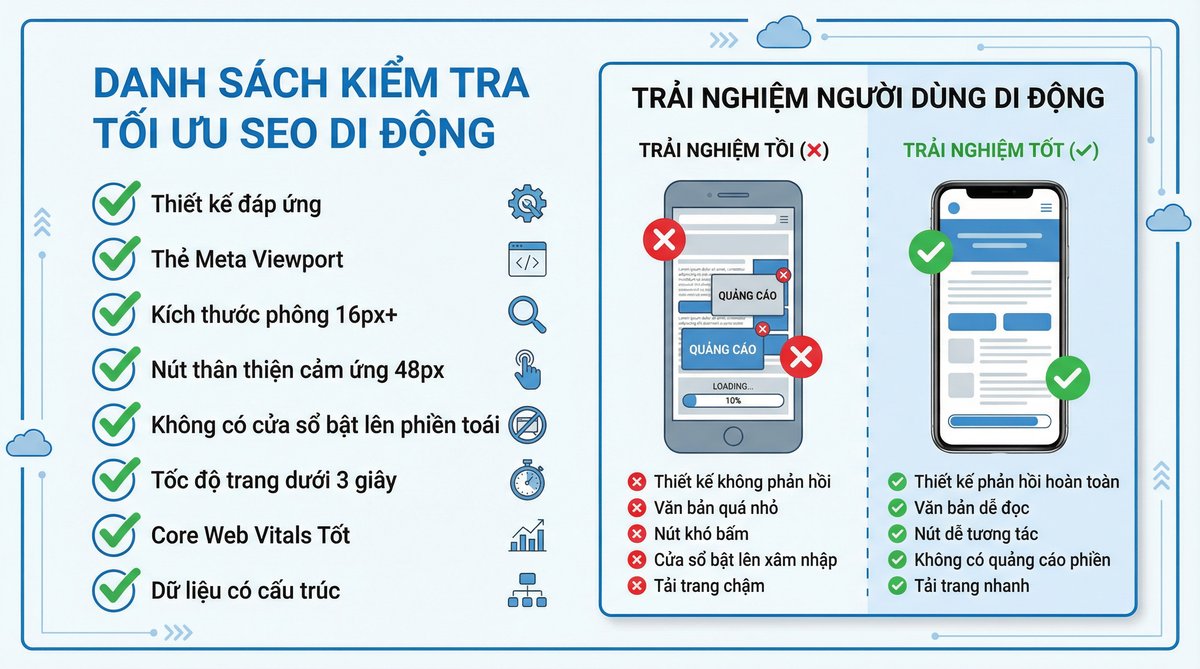
- Parity of Content: The mobile version of your page must contain the same text, images, videos, and structured data as the desktop version. Hiding content on mobile to improve load times is a critical error.
- Responsive Design: A responsive website that adapts fluidly to any screen size is the recommended approach. It simplifies crawling and eliminates the risk of configuration errors.
- Resource Loading: Googlebot can render JavaScript, but it is resource-intensive. Ensure that critical content is in the initial HTML response and that lazy-loading is implemented correctly so that content is not missed.
- Viewport Configuration: A proper viewport meta tag is essential. Without it, mobile users see a zoomed-out desktop version, which harms user experience and signals poor quality to Google.
- Server Response Time: Mobile users expect fast loading. Optimize your server response time to under 200ms. Use a Content Delivery Network (CDN) to serve assets from locations closer to the user.
- JavaScript Rendering: Test your pages using Google’s URL Inspection tool. Ensure that the rendered HTML contains all the text and links you intend to index. Avoid using JavaScript to inject critical content that is not present in the raw HTML.
- Internal Linking: Ensure that all important pages are linked from the mobile navigation or footer. Use descriptive anchor text that includes relevant keywords to help AI understand the context of the linked page.
- Image Optimization: Use modern formats like WebP and ensure images are compressed. Include descriptive alt text that explains the image content, as AI uses this to understand visual elements.
- Use Google Search Console: Navigate to the “Pages” report under “Indexing.” This shows you which pages are indexed and which are not. Pay close attention to errors related to mobile usability.
- Check the Mobile-Friendly Test: While Google has deprecated the standalone tool, the functionality is now integrated into the URL Inspection tool. Use it to see how Googlebot renders your page.
- Compare Desktop and Mobile Content: Use a tool like Screaming Frog to crawl both versions of your site. Compare the text, titles, and meta descriptions. Ensure they are identical or that the mobile version is a superset of the desktop version.
- Analyze Page Speed: Use PageSpeed Insights to get a score for both mobile and desktop. Focus on Core Web Vitals, specifically Largest Contentful Paint (LCP), First Input Delay (FID), and Cumulative Layout Shift (CLS).
- Review Structured Data: Ensure that JSON-LD structured data is present on both versions. Use the Rich Results Test to verify that Google can parse it correctly.
- Improved User Experience: Sites that rank well under this system are genuinely better for mobile users, leading to higher engagement and conversions.
- Faster Crawling: AI helps Google prioritize which pages to crawl and when. A well-structured mobile site ensures your most important pages are crawled frequently.
- Competitive Advantage: Many sites still lag in mobile optimization. By prioritizing this, you can outrank competitors who have not adapted.
- Technical Complexity: Implementing a flawless mobile experience requires significant technical expertise, especially for large sites with legacy code.
- Resource Intensity: Continuous monitoring and optimization are required. AI algorithms update frequently, and what works today may need adjustment tomorrow.
- Content Parity Issues: Maintaining identical content across desktop and mobile can be challenging for sites with dynamic content or user-generated sections.
- Blocking CSS, JavaScript, or Images: Your robots.txt file must not block these resources. Googlebot needs them to render the page and understand the layout.
- Using Interstitial Pop-ups: Intrusive pop-ups that cover the main content on mobile are penalized. Use them sparingly and ensure they are dismissible.
- Ignoring Mobile Navigation: If your mobile menu is a hamburger icon, ensure that all links are accessible. Do not hide important links behind complex interactions that crawlers cannot follow.
- Separate Mobile URLs (m-dot): While this is a valid configuration, it is prone to errors. If you use m-dot sites, ensure proper rel=canonical and rel=alternate tags are in place. Responsive design is safer.
- Slow Lazy-Loading: If you lazy-load images, ensure that the content is loaded before the user scrolls to it. Googlebot may not scroll, so critical images should be loaded immediately.
The Role of AI in Modern SEO and Indexing
Artificial intelligence is not just a buzzword; it is the engine behind Google’s ranking systems. The introduction of AI models like RankBrain and the more recent MUM (Multitask Unified Model) and BERT has transformed how search queries are understood. AI SEO Mobile First Indexing is about optimizing for these systems, not just for keywords.
AI helps Google understand the context and intent behind a search query. It can interpret natural language, synonyms, and complex concepts. For SEO, this means your content must be comprehensive, semantically rich, and structured logically. You are no longer writing for a keyword; you are writing to answer a question thoroughly.
How AI Algorithms Interact with Mobile Content
AI algorithms analyze mobile content differently than traditional crawlers. They assess the readability, structure, and completeness of the information presented on a mobile screen. This includes evaluating the hierarchy of headings, the use of bullet points for scannability, and the clarity of the core message without requiring the user to zoom or scroll excessively.
Furthermore, AI evaluates user interaction signals. Metrics like dwell time, bounce rate, and click-through rate are analyzed to determine if your content satisfies the user’s intent. A mobile page that is difficult to navigate or slow to load will generate negative signals, which AI uses to demote your rankings.
Key Components of an AI SEO Mobile First Indexing Strategy
Implementing a successful strategy requires a holistic approach. You must address technical infrastructure, on-page content, and user experience. Below is a breakdown of the critical components you need to audit and optimize.
Technical Infrastructure and Site Architecture
Your site’s technical health is the bedrock of indexing. If Googlebot cannot crawl and render your mobile pages efficiently, AI algorithms cannot evaluate your content.
Content Optimization for AI and Mobile Users
Content is still king, but the definition of quality has evolved. AI SEO Mobile First Indexing demands content that is both comprehensive and easily digestible on a small screen.
Write in short paragraphs. Use subheadings to break up text. Incorporate bullet points and numbered lists to present data clearly. Most importantly, answer the user’s query directly in the first 100 words. This increases the chance of earning a featured snippet, which is a prime position for mobile voice search.
Semantic relevance is crucial. Use LSI (Latent Semantic Indexing) keywords naturally throughout the text. For example, if your main keyword is “AI SEO Mobile First Indexing,” related terms like “mobile user experience,” “Googlebot,” “page speed,” and “structured data” should appear organically in the content.
Practical Guide: How to Audit Your Site for Mobile-First Indexing
Conducting a thorough audit is the first step toward optimization. This process will reveal gaps between your desktop and mobile experiences and highlight areas where AI algorithms may struggle to understand your content.
Optimizing Core Web Vitals for Mobile
Core Web Vitals are a set of signals that Google uses to measure user experience. They are critical for AI SEO Mobile First Indexing because they directly impact how users perceive your site’s performance.
| Metric | Good Threshold | Optimization Strategy |
|---|---|---|
| LCP (Largest Contentful Paint) | Under 2.5 seconds | Optimize server response times, preload key resources, and compress images. |
| INP (Interaction to Next Paint) | Under 200 milliseconds | Minimize JavaScript execution time, break up long tasks, and optimize event handlers. |
| CLS (Cumulative Layout Shift) | Under 0.1 | Set explicit width and height for images and videos. Reserve space for ads and embeds. |
Benefits and Limitations of AI-Driven Mobile Indexing

Understanding the advantages and potential drawbacks of this system helps you set realistic expectations and allocate resources effectively.
The Benefits of Aligning with AI and Mobile Indexing
The Limitations and Challenges
Common Mistakes to Avoid in AI SEO Mobile First Indexing
Many website owners make critical errors when trying to optimize for mobile-first indexing. Avoiding these pitfalls will save you from ranking drops and wasted effort.
Important Notes for Long-Term Success
Staying ahead in the SEO game requires vigilance and adaptation. The intersection of AI and mobile indexing will continue to evolve. Keep these notes in mind as you refine your strategy.
First, prioritize user intent over keyword density. AI is sophisticated enough to understand if your content is shallow or stuffed with keywords. Write for humans, and the algorithms will follow. Second, monitor your search performance regularly. Use tools like Google Search Console and Analytics to track changes in impressions, clicks, and average position. A sudden drop could indicate a technical issue with your mobile rendering.
Third, invest in voice search optimization. Mobile users frequently use voice search. This means your content should be conversational and answer questions directly. Use FAQ sections to target long-tail keywords and question-based queries. Finally, ensure your site is secure with HTTPS. Security is a ranking signal and a trust factor for both users and AI algorithms.
Frequently Asked Questions (FAQ)
What is the difference between mobile-first indexing and mobile-only indexing?
Mobile-first indexing means Google uses the mobile version of your content for indexing and ranking, but it still crawls the desktop version to check for consistency. Mobile-only indexing would mean Google ignores the desktop version entirely. Currently, Google uses mobile-first indexing, not mobile-only.
Does AI SEO Mobile First Indexing affect my desktop rankings?
Yes. If your mobile site is poor, your rankings will drop on both mobile and desktop search results. Google uses the mobile version as the primary source of truth for all devices.
How long does it take for Google to switch my site to mobile-first indexing?
Google automatically switches sites over time. You can check the “Indexing” report in Google Search Console to see if your site is flagged as “Mobile-First Indexing.” The transition can take weeks or months depending on the size of your site and the number of issues found.
Is a responsive design better than a dynamic serving setup?
For most sites, responsive design is the recommended approach. It is easier to maintain, requires less configuration, and eliminates the risk of serving incorrect content to crawlers. Dynamic serving can work, but it requires precise Vary: User-Agent headers and careful testing.
How does AI impact keyword research for mobile SEO?
AI has shifted keyword research from exact-match phrases to topics and entities. You should focus on grouping keywords by search intent and creating comprehensive content that covers the entire topic cluster. Use AI-powered tools to analyze search engine results pages (SERPs) and identify content gaps.
Conclusion
AI SEO Mobile First Indexing is not a temporary trend; it is the current and future state of search. The convergence of artificial intelligence and mobile-centric crawling demands a strategic overhaul of your digital presence. You must ensure that your technical infrastructure supports flawless mobile rendering, your content is comprehensive and semantically rich, and your user experience is seamless across all devices.
By conducting regular audits, prioritizing Core Web Vitals, and aligning your content with AI’s understanding of user intent, you position your website for sustained visibility and growth. The effort required is substantial, but the payoff is a resilient, high-performing online presence that thrives in an increasingly competitive and AI-driven search environment. Start by auditing your mobile experience today, and make the necessary changes to secure your rankings for the future.
Xem thêm:
- AI SEO AI Search Audit: The Complete Guide to Future-Proofing Your Rankings
- AI SEO Data Visualization: Turning Complex Rankings into Actionable Insights
- AI Keyword Research: The New Standard for Search Intent Discovery and Content Strategy
- AI SEO SEO Automation with Claude: The Complete Guide to Scaling Content in 2025
- AI SEO Featured Snippet Optimization: The 2025 Playbook for Position Zero
Bài viết cùng chủ đề:

AI SEO SEO Automation with Make: The Complete Workflow Guide

AI SEO SEO Automation with Zapier: The Complete Workflow Guide

AI SEO SEO Automation with n8n: The Complete Workflow Guide
AI SEO SEO Automation with Gemini: The Complete Guide to Scaling Organic Growth

AI SEO SEO Automation with Claude: The Complete Guide to Scaling Content in 2025

AI SEO SEO Automation with ChatGPT: The Complete Playbook for 2025

AI SEO & SEO Automation for Affiliate Sites: The 2025 Playbook for Passive Income Growth
AI SEO & SEO Automation for Bloggers: The Complete Guide to Scaling Your Content

AI SEO & SEO Automation for Agencies: The Complete 2025 Playbook

AI SEO and SEO Automation for Ecommerce: The Complete Playbook for 2025

AI SEO & SEO Automation for WordPress: The Complete Playbook for 2025
AI SEO SEO Automation Strategy: The Complete Playbook for 2025

Mastering the AI SEO SEO Automation Process: A Complete Guide to Scaling Organic Growth
AI SEO SEO Automation System: The Complete Guide to Scaling Organic Growth in 2025
AI SEO SEO Automation Platform: The Complete Guide to Scaling Organic Growth in 2025
AI SEO SEO Automation Software: The Complete Guide to Scaling Organic Growth in 2025















