
No products in the cart.
AI SEO URL Generator: The Complete Guide to Automated Link Optimization

10
Aug
Aug
An AI SEO URL Generator is transforming how websites structure their permalinks for search engine visibility. This technology uses machine learning algorithms to create clean, keyword-optimized URLs that improve click-through rates and search rankings. Modern content teams are adopting these tools to eliminate manual URL creation errors and ensure every link follows best practices. This guide explores how AI-powered URL generation works, its benefits, practical applications, and the common pitfalls to avoid when implementing this technology in your workflow.
What Is an AI SEO URL Generator?
An AI SEO URL Generator is a software tool that automatically creates search-engine-friendly URLs based on content analysis, keyword research, and established SEO guidelines. Unlike traditional URL generators that simply convert titles into slugs, AI-powered versions understand context, search intent, and semantic relevance. They analyze the entire content piece to extract the most meaningful keywords and phrases that should appear in the URL structure.
The core technology behind these generators involves natural language processing (NLP) and machine learning models trained on millions of high-ranking URLs. These models learn patterns that correlate with better search performance, such as appropriate URL length, keyword placement, and the use of hyphens versus underscores. The result is a URL that is both human-readable and algorithmically optimized.
How AI URL Generators Differ from Traditional Slug Tools
Traditional slug generators operate on simple rules. They take a title, convert it to lowercase, remove stop words, and replace spaces with hyphens. This approach often produces URLs that are too long, contain unnecessary words, or miss the primary keyword entirely. AI SEO URL Generators go several steps further by evaluating the content’s main topics, checking keyword density, and even considering the target audience’s search behavior.
For example, a traditional tool might generate /how-to-improve-your-website-ranking-in-google-search-results from a title. An AI generator might produce /improve-google-ranking after analyzing that the core topic is ranking improvement and that shorter URLs tend to perform better. This semantic understanding is what separates basic automation from intelligent URL optimization.
Why URL Structure Matters for SEO
URLs are a ranking factor, albeit a minor one compared to content quality and backlinks. However, their impact on user experience and click-through rate is significant. A well-structured URL provides both users and search engines with clear signals about the page’s content. Search engines use URLs to understand site hierarchy and context, while users use them to decide whether a link is worth clicking.
Research indicates that URLs containing the exact keyword match have a slight advantage in search results. More importantly, descriptive URLs receive higher organic click-through rates because they appear more trustworthy and relevant. An AI SEO URL Generator ensures that every URL on your site follows these proven patterns consistently, which is difficult to achieve manually across large websites.
Key Elements of an SEO-Friendly URL
- Brevity: URLs under 60 characters tend to display fully in search results and are easier to share.
- Keyword inclusion: The primary keyword should appear near the beginning of the URL.
- Hyphen separation: Hyphens are the standard word separator; underscores are not recognized as spaces.
- Lowercase letters: Avoid uppercase characters to prevent duplicate content issues.
- Static structure: Dynamic parameters like?id=123 provide no SEO value and should be replaced with static paths.
- Logical hierarchy: Subfolders should reflect site structure, such as /blog/category/post-name.
- Choose a reputable tool: Research options like Surfer SEO, Frase, or dedicated URL generators. Look for tools with transparent algorithms and positive user reviews.
- Input your content: Paste the full article text, title, and meta description into the tool. Some tools allow direct integration with your CMS.
- Review the generated URL: Examine the suggested URL for readability and keyword accuracy. Ensure it makes sense as a human-readable path.
- Customize if necessary: Adjust the URL to include brand terms or remove words that feel unnatural. The AI suggestion is a starting point, not a final mandate.
- Implement the URL: Publish your page with the new URL. If replacing an existing page, set up a 301 redirect from the old URL.
- Monitor performance: Track the page’s rankings and click-through rates. Use this data to refine your approach for future content.
- Use hyphens, not underscores: Google treats hyphens as word separators, while underscores join words together.
- Avoid stop words: Words like “and,” “or,” “but,” and “the” add no value to URLs and should be removed.
- Keep the structure flat: Deep folder hierarchies like /category/subcategory/sub-subcategory/post dilute link equity. Aim for no more than two or three levels.
- Make URLs case-sensitive consistent: Always use lowercase to prevent duplicate content issues.
- Include target keywords naturally: The URL should read like a sentence, not a keyword list.
How AI SEO URL Generators Work
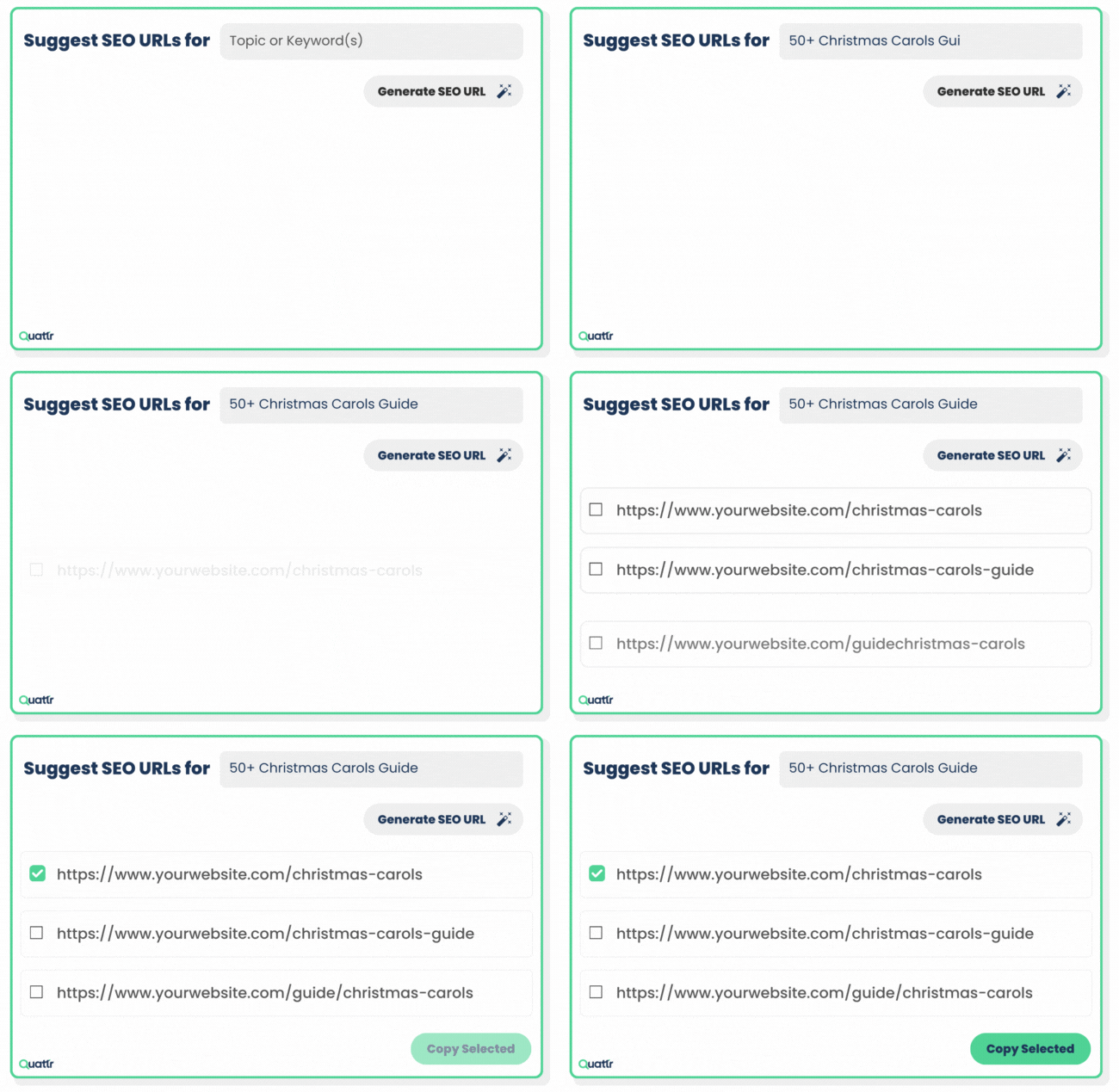
Understanding the technical process behind AI URL generation helps you appreciate its capabilities and limitations. The typical workflow involves several stages of analysis and optimization.
Content Analysis and Topic Extraction
The AI first reads the entire content, including headings, body text, image alt attributes, and meta descriptions. It uses NLP to identify the main topics, entities, and keyword clusters. This analysis goes beyond simple word frequency to understand the relationships between concepts. For instance, an article about “apple” might be about the fruit or the technology company, and the AI determines this from context.
Keyword Prioritization
Once topics are identified, the AI ranks potential keywords based on search volume, competition, and relevance to the content. It considers long-tail variations and semantic equivalents. The generator then selects the most impactful keyword combination for the URL, balancing search potential with readability.
URL Structure Generation
The AI constructs the URL using the selected keywords, applying rules about length, word order, and character usage. It may also consider the site’s existing URL structure to maintain consistency. Advanced generators can even suggest folder structures that align with your information architecture.
Predictive Performance Scoring
Some AI SEO URL Generators include a scoring system that predicts how well a URL might perform based on historical data. They compare the generated URL against thousands of similar URLs and their search performance metrics. This feedback loop allows the AI to refine its suggestions continuously.
Benefits of Using an AI SEO URL Generator
Implementing AI-powered URL generation offers measurable advantages for content teams, SEO specialists, and website owners. These benefits extend beyond simple time savings.
Consistency Across Large Content Portfolios
Maintaining uniform URL structures across hundreds or thousands of pages is challenging. Human error leads to inconsistent formats, missed keywords, and overly long slugs. AI generators apply the same standards to every URL, ensuring uniformity that helps search engines crawl and index your site more efficiently.
Improved Keyword Targeting
AI tools identify keyword opportunities that might be overlooked during manual URL creation. They analyze search intent and align the URL with what users are actually typing into search engines. This alignment increases the relevance signals sent to Google and other search engines.
Time and Resource Efficiency
Manual URL optimization for a large site can take hours. An AI SEO URL Generator produces optimized URLs in seconds. This efficiency allows SEO teams to focus on higher-value tasks like content strategy and link building instead of repetitive slug creation.
Reduction of Duplicate Content Issues
Poorly structured URLs can create duplicate content problems, especially when parameters or case variations exist. AI generators produce canonical-friendly URLs that reduce the risk of search engines seeing multiple versions of the same page.
Limitations and Considerations
While AI SEO URL Generators are powerful, they are not a complete solution. Understanding their limitations prevents over-reliance and potential mistakes.
Lack of Brand Context
AI tools analyze content but may not fully understand your brand voice or specific naming conventions. A URL that is perfectly optimized for SEO might not align with your brand’s preferred terminology. Human oversight is still necessary to ensure brand consistency.
Inability to Handle Existing URL Redirects
If you are updating URLs on an existing site, the AI generator cannot manage the redirect mapping. You still need to implement 301 redirects from old URLs to new ones to preserve link equity. The tool only creates new URLs; it does not handle migration logistics.
Dependence on Content Quality
The AI’s output is only as good as the content it analyzes. If your content is poorly written or lacks clear focus, the generated URL will reflect that ambiguity. Garbage in, garbage out applies to AI URL generation as well.
AI SEO URL Generator vs. Manual URL Creation
Comparing these two approaches helps clarify when to use AI tools versus traditional methods. The table below highlights key differences.
| Factor | AI SEO URL Generator | Manual URL Creation |
|---|---|---|
| Speed | Generates URLs in milliseconds | Takes minutes per URL |
| Keyword Research | Automatically integrates semantic keywords | Requires separate keyword research |
| Consistency | Uniform application of rules | Varies based on individual judgment |
| Scalability | Handles unlimited URLs | Impractical for large sites |
| Brand Alignment | May miss brand-specific terminology | Full control over naming |
| Cost | Subscription or per-use fees | Only labor costs |
For small websites with fewer than 50 pages, manual creation may suffice. For growing sites, e-commerce platforms, or content-heavy blogs, the AI approach offers clear advantages in speed and consistency.
Practical Applications of AI URL Generators
AI SEO URL Generators are used across various digital contexts. Understanding these applications helps you identify where the technology fits your workflow.
E-Commerce Product Pages
Online stores with thousands of products benefit immensely from automated URL generation. The AI can create URLs that include product type, brand, and key attributes while keeping them concise. For example, a product titled “Men’s Running Shoes – Lightweight Breathable – Size 10” might generate /mens-running-shoes-lightweight instead of a long, unwieldy slug.
Blog and Article Publishing
Content management systems can integrate AI URL generators directly into the publishing workflow. Writers submit their draft, and the system proposes an optimized URL before publication. This integration ensures that every article gets a proper URL without requiring the writer to think about SEO technicalities.
Programmatic SEO Pages
For sites that generate thousands of pages dynamically, such as city-specific landing pages or category pages, AI URL generators create logical, keyword-rich paths. This approach improves the crawlability of large-scale programmatic SEO campaigns.
Content Management System Integration
Popular platforms like WordPress, Shopify, and Webflow offer plugins or native features that leverage AI for URL suggestions. These integrations make the technology accessible to non-technical users who publish content regularly.
Step-by-Step Guide to Using an AI SEO URL Generator
Implementing this tool in your workflow is straightforward. Follow these steps to maximize its effectiveness.
Common Mistakes and How to Avoid Them

Even with AI assistance, mistakes happen. Being aware of these pitfalls helps you avoid them.
Over-Optimizing the URL
Stuffing multiple keywords into a URL looks spammy and can trigger search engine penalties. The AI might suggest a URL with three or four keywords, but you should limit it to one primary keyword and perhaps one modifier. A URL like /best-running-shoes-for-marathon-training is better than /best-running-shoes-marathon-training-race-walking.
Ignoring Readability
URLs that are technically optimized but impossible for humans to read hurt user trust. If a URL looks like a random string of characters, users may avoid clicking it. Always prioritize clarity over keyword density.
Changing URLs Without Redirects
If you use an AI generator to update existing URLs, you must implement 301 redirects. Failing to do so results in broken links and lost search rankings. This step is non-negotiable for site migrations.
Forgetting About URL Length
While AI tools generally respect length limits, some may produce longer URLs when the content is complex. Manually check that your URLs stay under 75 characters to ensure they display fully in search results and are shareable on social media.
Important Notes for Maximizing URL SEO
Beyond using an AI generator, several best practices enhance your URL strategy.
Frequently Asked Questions
What is the ideal length for an SEO-friendly URL?
The ideal length is between 30 and 60 characters. URLs shorter than 30 characters may lack descriptive power, while those longer than 60 characters risk being truncated in search results. Google displays approximately the first 600 pixels of a URL, which typically equates to 50-60 characters. Shorter URLs are also easier to copy, share, and remember.
Can an AI SEO URL Generator replace human SEO expertise?
No, these tools are designed to assist, not replace, human judgment. AI generators handle repetitive tasks and data analysis, but strategic decisions about brand voice, content targeting, and site architecture still require human expertise. The best results come from combining AI efficiency with human oversight and customization.
Are AI-generated URLs considered spam by Google?
No, Google does not penalize URLs simply because they were generated by AI. What matters is the quality and relevance of the URL structure. If the URL is descriptive, readable, and matches the content, it is treated the same as a manually created URL. The key is to avoid keyword stuffing and unnatural phrasing, regardless of how the URL was created.
How much does an AI SEO URL Generator cost?
Pricing varies widely. Basic tools or plugins may cost between $10 and $30 per month. Comprehensive SEO suites that include URL generation as part of a larger feature set can range from $50 to $200 per month. Some free tools offer limited functionality, but they often lack the advanced semantic analysis of paid versions. Consider your content volume and the value of time saved when evaluating costs.
Do I need to use an AI URL generator for every page on my site?
Not necessarily. For small sites with a handful of pages, manual URL creation is perfectly adequate. AI generators become valuable when you publish frequently, manage large product catalogs, or need to ensure consistency across a team of content creators. Evaluate your workflow to determine if the investment is justified.
Conclusion
An AI SEO URL Generator is a valuable addition to any modern SEO toolkit. It automates the tedious process of URL creation while applying data-driven best practices that improve search visibility and user experience. The technology excels at handling large content volumes, maintaining consistency, and identifying keyword opportunities that humans might miss. However, it is not a substitute for strategic thinking. The most effective approach combines AI-generated suggestions with human review to ensure brand alignment, readability, and proper redirect implementation. By understanding the capabilities and limitations of these tools, you can integrate them into your workflow to create a cleaner, more crawlable, and higher-performing website structure. Start with a trial of a reputable tool, test it on your next batch of content, and measure the impact on your search rankings and organic traffic.
Xem thêm:
- AI SEO Competitor Backlinks: The Complete Guide to Automated Link Gap Analysis
- AI Conclusion Generator: Generate Powerful Closing Paragraphs in Seconds
- AI Citation SEO: The Complete Guide to Earning and Optimizing AI-Generated Citations in Search
- AI SEO for Finance: The Complete Guide to Dominating Financial Search in 2025
- Generative Engine Optimization: The Ultimate Guide to Winning AI-Powered Search
Bài viết cùng chủ đề:

AI SEO SEO Automation with Make: The Complete Workflow Guide

AI SEO SEO Automation with Zapier: The Complete Workflow Guide

AI SEO SEO Automation with n8n: The Complete Workflow Guide
AI SEO SEO Automation with Gemini: The Complete Guide to Scaling Organic Growth

AI SEO SEO Automation with Claude: The Complete Guide to Scaling Content in 2025

AI SEO SEO Automation with ChatGPT: The Complete Playbook for 2025

AI SEO & SEO Automation for Affiliate Sites: The 2025 Playbook for Passive Income Growth
AI SEO & SEO Automation for Bloggers: The Complete Guide to Scaling Your Content

AI SEO & SEO Automation for Agencies: The Complete 2025 Playbook

AI SEO and SEO Automation for Ecommerce: The Complete Playbook for 2025

AI SEO & SEO Automation for WordPress: The Complete Playbook for 2025
AI SEO SEO Automation Strategy: The Complete Playbook for 2025

Mastering the AI SEO SEO Automation Process: A Complete Guide to Scaling Organic Growth
AI SEO SEO Automation System: The Complete Guide to Scaling Organic Growth in 2025
AI SEO SEO Automation Platform: The Complete Guide to Scaling Organic Growth in 2025
AI SEO SEO Automation Software: The Complete Guide to Scaling Organic Growth in 2025















