
No products in the cart.
AI SEO User Signals: The Complete Guide to Ranking in the Age of Machine Learning
31
Jul
Jul
Search engines have undergone a fundamental transformation. Gone are the days when stuffing keywords and building spammy links guaranteed top rankings. Today, Google’s core algorithms, particularly RankBrain and the Multitask Unified Model (MUM), rely heavily on AI to interpret human behavior. This shift has made AI SEO user signals the single most critical factor for sustainable organic growth. Understanding how machine learning models interpret clicks, dwell time, and engagement is no longer optional; it is the prerequisite for visibility in 2025 and beyond. This guide breaks down exactly what these signals are, how they work, and how to optimize for them without falling into common traps.
What Are AI SEO User Signals?
AI SEO user signals refer to the behavioral data points that machine learning algorithms collect and analyze to determine the relevance and quality of a webpage. Unlike traditional ranking factors that look at the page itself (like meta tags or backlinks), these signals focus on how real users interact with your site in the search results and on your pages. The core premise is simple: if a page satisfies a user, they will stay, read, click, and return. If it does not, they will bounce back to the SERP quickly.
These signals are processed through neural networks that learn patterns from billions of interactions. The algorithms do not just count clicks; they evaluate the context, the sequence of actions, and the relative satisfaction compared to other results for the same query. This means that a high click-through rate (CTR) is not enough if users immediately hit the back button. The AI looks for a holistic pattern of positive engagement.
The Core Components of User Engagement Metrics
To effectively optimize, you must understand the specific metrics that feed into the AI models. These are not just vanity metrics; they are direct inputs into the quality assessment process.
- Click-Through Rate (CTR): The percentage of users who click on your listing out of the total impressions. A low CTR tells the AI that your title and meta description are not compelling or relevant to the query.
- Dwell Time: The amount of time a user spends on your page before returning to the search results. Longer dwell times generally indicate that the content matches the user intent and provides value.
- Bounce Rate: The percentage of visitors who leave your site after viewing only one page. While a high bounce rate is not always negative (e.g., a user who finds a phone number immediately), a high bounce rate combined with a short dwell time is a strong negative signal.
- Pogo-sticking: This occurs when a user clicks your result, quickly realizes it is not what they wanted, and immediately clicks back to the SERP to choose another result. This is the most damaging signal because it directly tells the AI that your page failed to satisfy the query.
- Return Visits: Whether users come back to your site directly or via branded searches. This indicates brand loyalty and content authority, which the AI uses to assess long-term value.
- Ignoring Mobile Users: With the majority of searches happening on mobile, a poor mobile experience leads to high bounce rates. Ensure your font is readable, buttons are clickable, and t
- Interstitial Pop-ups: Intrusive pop-ups that cover the content immediately on page load cause users to leave instantly. Google explicitly penalizes this behavior. Use exit-intent pop-ups instead.
- Content Gating: Forcing users to sign up or pay to see the answer to their query is a direct trigger for pogo-sticking. The answer must be visible immediately.
- Autoplay Videos with Sound: This is a jarring experience that drives users away. Always set videos to mute by default and let the user choose to engage.
- Thin Content: If your page has a high dwell time but the user has to scroll through 3,000 words of fluff to find the answer, they will leave. The AI detects this “scroll depth vs. value” ratio.
How Machine Learning Interprets These Signals
The interpretation of these signals is not linear. Google’s AI, particularly RankBrain, uses vector embeddings to understand the relationship between queries and pages. It does not simply say “high bounce rate equals bad.” Instead, it analyzes whether the bounce rate is appropriate for the query type. For example, a “quick answer” query like “weather in Tokyo” will naturally have a high bounce rate because the user gets the answer instantly. Conversely, a “how-to” guide that has a high bounce rate is a clear failure signal.
The AI also uses these signals to train its models. When it sees a pattern where users consistently prefer result A over result B for a specific query, it adjusts the ranking weights. This is a continuous feedback loop. The more data the AI collects on user behavior, the more accurate it becomes at predicting which pages will satisfy future queries. This is why user signals are not static; they are dynamic and require constant monitoring.
The Role of Search Quality Raters
While AI handles the bulk of the analysis, human quality raters play a crucial role in training the algorithms. These raters follow strict guidelines to evaluate the quality of search results. Their feedback is used to refine the AI models, which then apply those learnings to user signals. The raters focus on Expertise, Authoritativeness, and Trustworthiness (E-E-A-T). If a page has high E-E-A-T, it is more likely to be rewarded with positive user signal interpretation, even if the raw metrics are slightly lower than a competitor with lower trust.
Practical Strategies to Optimize AI SEO User Signals
Optimizing for these signals requires a shift from “writing for bots” to “designing for human psychology.” The goal is to create a frictionless experience that encourages deep engagement. Here are actionable strategies that directly influence how the AI perceives your content.
1. Crafting High-CTR Titles and Meta Descriptions
Your title tag and meta description are your first impression. They are the primary drivers of CTR. To optimize for AI, you must align these elements with the user’s search intent. Use emotional triggers, numbers, and power words, but avoid clickbait that promises something the content does not deliver. A mismatch between the title and the content will lead to pogo-sticking, which is catastrophic for rankings.
Include your primary keyword naturally, but also consider the “people also ask” questions to make your description more relevant. The meta description should act as a mini-advertisement that clearly states the value proposition and the answer to the query.
2. Designing for Dwell Time
Dwell time is the most direct measure of content quality. To increase it, you need to structure your content for readability and engagement. Break up large blocks of text with subheadings, bullet points, and images. Use short paragraphs (2-3 sentences) to keep the reader moving. Embed relevant videos or interactive elements to give users a reason to stay longer.
One effective technique is the “skyscraper method” applied to user experience. Look at the top-ranking pages for your keyword and make your page objectively better. Add a table of contents with anchor links, include a summary box at the top, and ensure that the answer to the primary query appears within the first 200 words. This immediately satisfies the user and encourages them to read further.
3. Reducing Pogo-Sticking
Pogo-sticking is the enemy of rankings. It happens when the user’s intent is not met. The most common cause is a mismatch between the query type and the content format. If the query is “best coffee machines,” a listicle is required. If you write a long-form essay about the history of coffee, you will get pogo-sticking. Always match the content format to the dominant search intent (informational, transactional, or navigational).
Also, ensure your page loads fast. A slow page will cause users to bounce before the content even renders. Use Core Web Vitals as a benchmark. A page that loads in under 2.5 seconds is more likely to retain users than one that takes 5 seconds.
Comparing Traditional SEO vs. AI-Driven SEO
Understanding the difference between old-school tactics and the new AI-driven approach is essential for adapting your strategy. The table below highlights the key contrasts.
| Factor | Traditional SEO | AI SEO User Signals |
|---|---|---|
| Primary Focus | Keywords and backlinks | User behavior and satisfaction |
| Measurement | PageRank and domain authority | CTR, dwell time, and engagement |
| Content Strategy | Keyword density and exact match | Semantic relevance and intent matching |
| Optimization Target | Search engine crawlers | Human psychology and neural networks |
| Update Cycle | Static (update when algorithm changes) | Dynamic (continuous feedback loop) |
The shift is clear. Traditional SEO was a one-way street where you optimized a page and waited for the crawler to index it. AI-driven SEO is a two-way conversation where the user’s interaction with your page continuously informs the algorithm about your relevance.
Common Mistakes That Destroy Your User Signals
Many website owners inadvertently sabotage their rankings by making critical errors that the AI interprets as negative signals. Avoiding these mistakes is just as important as implementing positive strategies.
Advanced Techniques: Leveraging Schema and SERP Features
To further enhance your user signals, you need to dominate the search engine results page (SERP) itself. By using structured data (Schema markup), you can increase your CTR and reduce the likelihood of pogo-sticking because the user already knows what to expect.
Using FAQ Schema to Capture Featured Snippets
When you win a featured snippet, your page is placed at the top of the SERP. This drastically increases CTR and dwell time because users often click the result to verify the information or read more. Implement FAQ schema to target “People Also Ask” boxes. This not only gives you more real estate but also establishes your page as the authority on the topic, which the AI uses to reinforce positive signals.
Optimizing for Voice Search
Voice search queries are longer and more conversational. They often have a higher intent to get a quick answer. If your page is structured to answer these questions directly (using H2/H3 headings that match the question), you will capture voice search traffic. This traffic typically has a very high satisfaction rate because the user gets the answer immediately, leading to positive dwell time signals.
Monitoring and Measuring Your User Signals
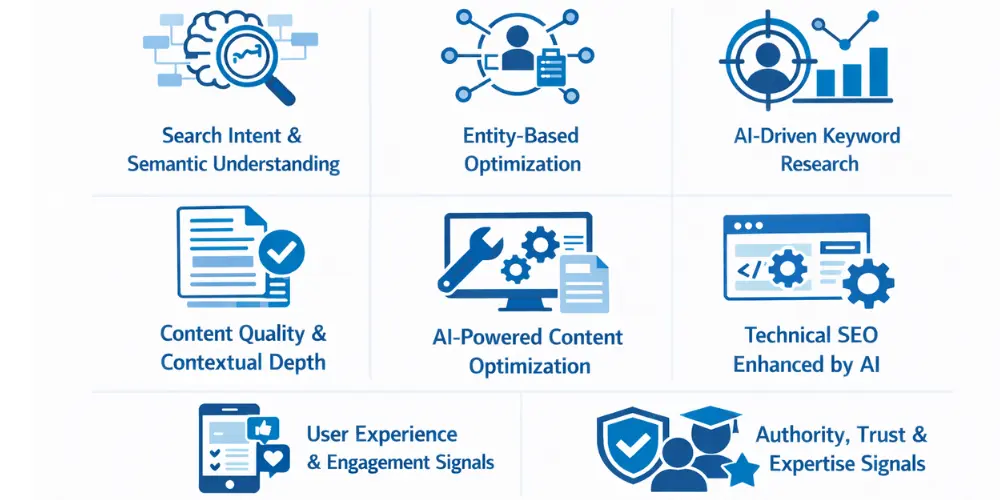
You cannot improve what you do not measure. While Google does not provide a direct “user signal score,” you can infer your performance through various analytics and SEO tools.
In Google Analytics 4 (GA4), focus on the “Engagement Rate” metric instead of just bounce rate. Look at “Average Engagement Time per Session.” A high engagement time is a strong proxy for dwell time. In Google Search Console, monitor your “Average CTR” and “Position.” If your CTR is low but your position is high, your title and meta description are not compelling. If your position drops, it often indicates that your user signals are deteriorating compared to competitors.
Use heatmap tools like Hotjar or Crazy Egg to visualize where users are clicking and how far they scroll. If you see that users are dropping off at a specific section, that content is likely not meeting their expectations. Revise that section to be more concise or add more value.
Important Notes on Algorithm Updates
Google releases thousands of updates each year. While most are minor, core updates can significantly shift the importance of user signals. After a core update, you may see fluctuations in rankings. The best defense is to maintain a high standard of user experience at all times. Do not chase algorithm updates; chase user satisfaction. The AI is designed to reward pages that satisfy users, so if you focus on that, you will be resilient to most updates.
Also, note that user signals are relative. The AI compares your page to other pages that rank for the same query. This means you are not just competing against the absolute quality of your page, but against the user experience of your direct competitors. You must continuously monitor their performance and improve your own to stay ahead.
Frequently Asked Questions (FAQ)
Are user signals a direct ranking factor?
Google has stated that they do not use user signals directly in the ranking algorithm. However, they are used as a training mechanism for the AI models. The AI learns from user behavior to predict which pages will be relevant for future queries. So, while they are not a “direct” factor, they have a profound indirect impact on how the algorithm evaluates your page.
How long does it take to see results from optimizing user signals?
It depends on the volume of traffic your page receives. If you have high traffic, the AI can learn from your user signals quickly, often within a few weeks. If you have low traffic, it may take several months for the AI to gather enough data to make a statistically significant judgment. Patience and consistency are key.
Does a high bounce rate always mean a penalty?
No. A high bounce rate is only a negative signal if it is combined with a low dwell time and indicates that the user did not find what they were looking for. For informational queries where the answer is on the page, a high bounce rate is normal and expected. The AI understands the context of the query.
Can I manipulate AI SEO user signals?
Attempting to manipulate these signals through click farms or bot traffic is extremely risky. Google’s AI is sophisticated enough to detect anomalous patterns that do not match human behavior. If you are caught, you will face a manual action penalty. The only sustainable way to improve these signals is to genuinely improve the user experience.
What is the most important user signal to focus on?
Dwell time is often considered the most important because it is the most direct measure of content satisfaction. However, CTR is the gatekeeper. If you cannot get the click, you cannot get the dwell time. Focus on CTR first to get traffic, then optimize for dwell time to keep it.
Conclusion
The era of AI SEO user signals is here to stay. The algorithms have evolved to understand human behavior at a granular level, and they reward pages that prioritize user satisfaction above all else. The key takeaway is to stop optimizing for the search engine and start optimizing for the person behind the search. By crafting compelling titles, delivering immediate value, and designing a frictionless user experience, you align your website with the core objectives of the AI. This alignment is the most sustainable and effective path to long-term organic success. Regularly audit your analytics, listen to what the data tells you about user behavior, and continuously refine your pages to meet those expectations.
Xem thêm:
- AI SEO WCAG: The Complete Guide to Accessible, AI-Optimized Content
- AI SEO Site Health: The Complete Guide to Automated Technical Audits in 2025
- Free AI SEO Tools: Supercharge Your Rankings Without Paying a Cent
- AI SEO Dynamic Content: The Complete Guide to Automated Personalization That Ranks
- AI SEO for Travel Websites: The Complete Guide to Dominating Search in 2025
Bài viết cùng chủ đề:

AI SEO SEO Automation with Make: The Complete Workflow Guide

AI SEO SEO Automation with Zapier: The Complete Workflow Guide

AI SEO SEO Automation with n8n: The Complete Workflow Guide
AI SEO SEO Automation with Gemini: The Complete Guide to Scaling Organic Growth

AI SEO SEO Automation with Claude: The Complete Guide to Scaling Content in 2025

AI SEO SEO Automation with ChatGPT: The Complete Playbook for 2025

AI SEO & SEO Automation for Affiliate Sites: The 2025 Playbook for Passive Income Growth
AI SEO & SEO Automation for Bloggers: The Complete Guide to Scaling Your Content

AI SEO & SEO Automation for Agencies: The Complete 2025 Playbook

AI SEO and SEO Automation for Ecommerce: The Complete Playbook for 2025

AI SEO & SEO Automation for WordPress: The Complete Playbook for 2025
AI SEO SEO Automation Strategy: The Complete Playbook for 2025

Mastering the AI SEO SEO Automation Process: A Complete Guide to Scaling Organic Growth
AI SEO SEO Automation System: The Complete Guide to Scaling Organic Growth in 2025
AI SEO SEO Automation Platform: The Complete Guide to Scaling Organic Growth in 2025
AI SEO SEO Automation Software: The Complete Guide to Scaling Organic Growth in 2025















