
No products in the cart.
AI SEO Workflow Automation: Streamline Your Search Strategy with Intelligent Automation
29
Jul
Jul
AI SEO workflow automation is reshaping the way businesses approach organic search. By integrating artificial intelligence into repetitive and data-intensive SEO tasks, marketing teams can drastically reduce manual effort while improving accuracy and scalability. From keyword research and content optimization to technical audits and performance reporting, intelligent automation handles the heavy lifting, freeing strategists to focus on creative and high-level decisions. This guide breaks down what AI SEO workflow automation is, how it works, the tools that make it possible, and the practical steps to build a system that consistently delivers results.
What Is AI SEO Workflow Automation?
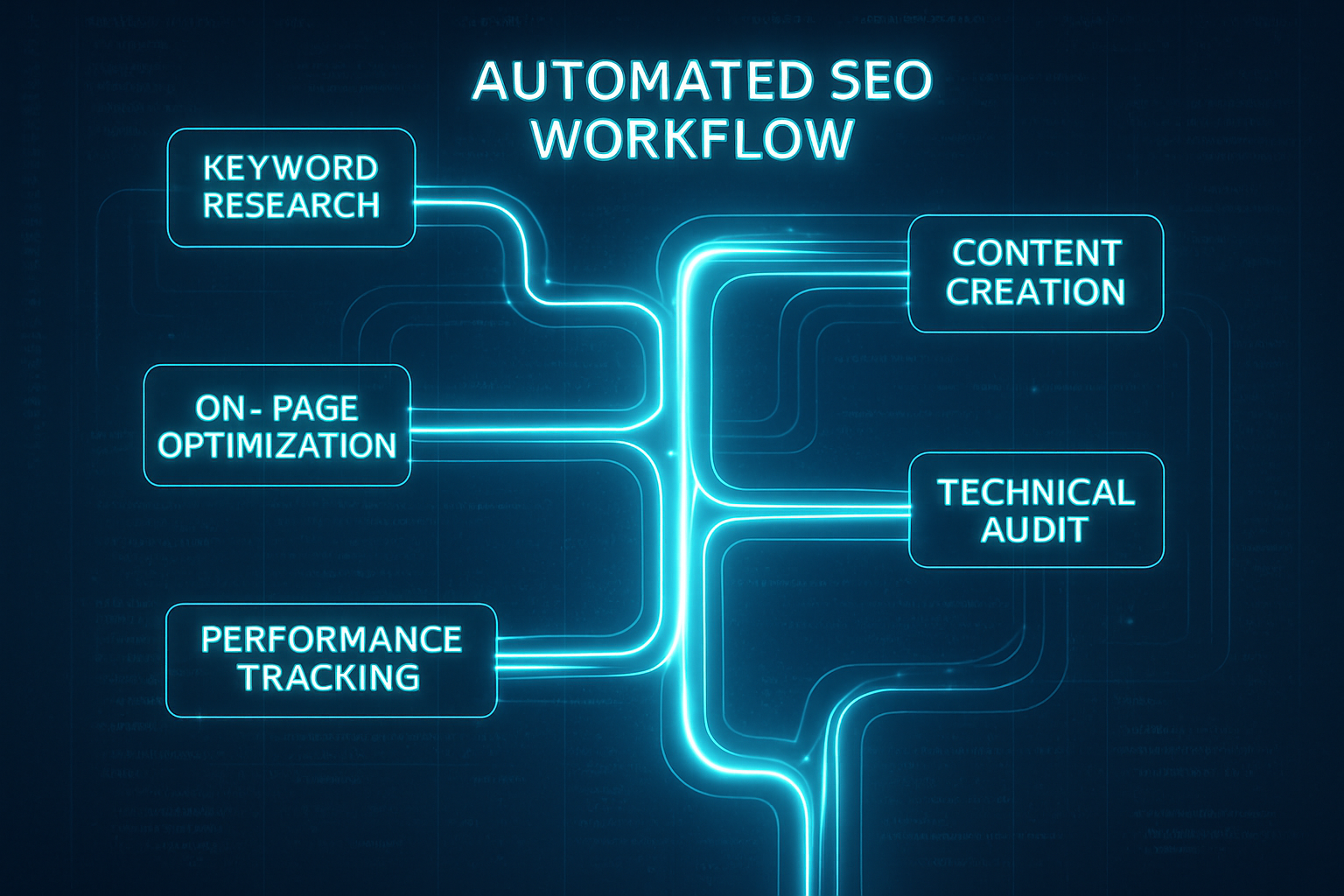
AI SEO workflow automation combines machine learning, natural language processing, and data integration to execute SEO tasks with minimal human intervention. It moves beyond basic rule-based macros or simple scheduled crawls. Instead, the system learns from large datasets, identifies patterns, and adapts its output based on real-time search data. The goal is to create a repeatable, self-improving pipeline that handles everything from content ideation to rank tracking without manual step-by-step management.
In a typical setup, the AI connects to multiple data sources—search consoles, rank trackers, competitor analysis tools, and content management systems. It then triggers actions such as generating topic clusters, updating meta tags, flagging technical errors, or adjusting internal link structures. These actions are not one-off events. They become part of a continuous feedback loop where the AI refines its models based on new performance metrics, making the entire SEO engine more intelligent over time.
The Evolution from Manual SEO to AI-Powered Workflows
Early SEO was a craft of spreadsheets, manual audits, and gut-feel keyword selection. Teams spent hours exporting data, formatting reports, and manually crafting meta descriptions. As search engines became more complex, tools like Screaming Frog and SEMrush emerged to automate parts of the process, but they still required significant human oversight and button-clicking. The rise of AI changed the paradigm from assisted automation to autonomous decision-making.
Today, AI-powered platforms can understand semantic relationships between thousands of keywords, predict ranking opportunities, and even generate full-fledged article drafts aligned with search intent. The shift is from reactive optimization to proactive orchestration. SEO professionals now design workflows where AI monitors for signals—such as a drop in click-through rates or a new competitor content piece—and initiates pre-defined improvement sequences without waiting for a human to start the process.
Core Components of an AI SEO Workflow Automation System
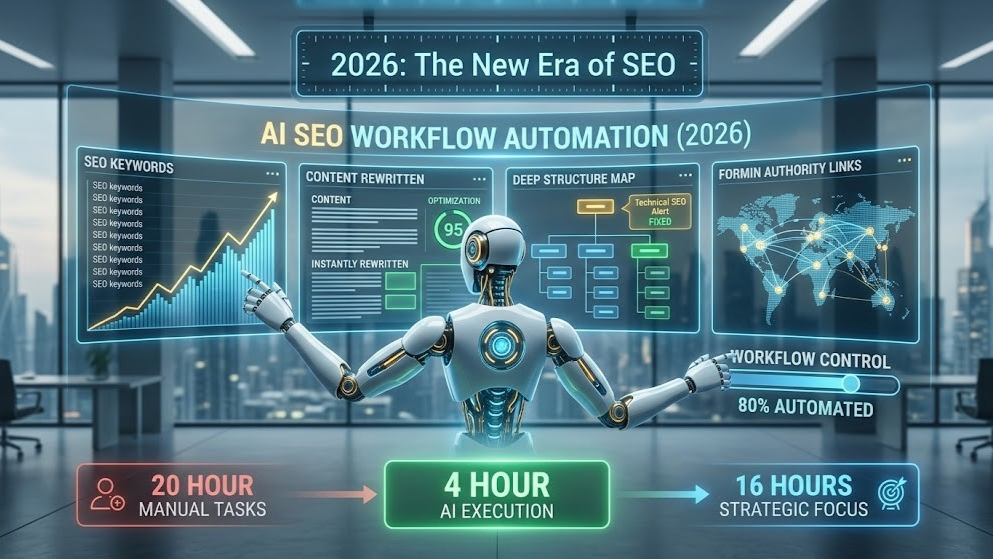
A robust AI SEO workflow automation stack consists of several interconnected modules. Each plays a specific role in the data-to-action pipeline:
- Data aggregation layer – Gathers information from Google Search Console, Bing Webmaster Tools, rank tracking APIs, analytics platforms, and backlink databases.
- Keyword and topic intelligence engine – Uses NLP models to map user intent, identify content gaps, and cluster long-tail queries into topic hubs.
- Content generation and optimization module – Creates or optimizes textual content, including outlines, drafts, meta tags, and alt text, while ensuring on-page SEO best practices.
- Technical audit crawler – Continuously scans the website for indexing issues, broken links, page speed problems, and schema markup errors.
- Link building and outreach automation – Identifies high-quality prospect sites, personalizes outreach emails, and tracks response rates.
- Reporting and alerting dashboard – Translates raw data into actionable insights, sending alerts when KPIs deviate from expected ranges and generating client-ready reports.
- Data intake – The system ingests real-time data from search APIs, site crawls, competitor monitoring, and conversion tracking pixels.
- Opportunity detection – AI models analyze the data to identify underperforming pages, content decay, new keyword gaps, or technical issues that are hurting rankings.
- Prioritization matrix – Each opportunity is scored based on potential traffic impact, business value, and implementation effort. The workflow automatically sorts tasks by priority.
- Automated action execution – For routine fixes, the AI triggers direct changes: updating meta descriptions, adding internal links, or resubmitting URLs for indexing. For content needs, it creates drafts and pushes them to a writer’s queue or publishes them directly if quality thresholds are met.
- Performance monitoring and feedback loop – After changes go live, the system tracks ranking shifts, click-through rates, and engagement. The results feed back into the AI models to refine future decisions.
- Content optimization and generation – SurferSEO, Frase, MarketMuse, and Jasper integrate NLP to align content with search intent. They provide real-time content scoring and generate briefs or full drafts.
- Technical SEO and auditing – Botify and DeepCrawl use machine learning to prioritize crawl budget issues and detect anomalies in site architecture. AI-driven log file analysis identifies patterns that standard crawlers miss.
- Keyword research and competitive intelligence – Ahrefs and SEMrush incorporate AI for keyword difficulty predictions, content gap analysis, and topic clusters. Their AI features can automatically group queries and suggest priority targets.
- Link building automation – Pitchbox and Respona use AI to personalize outreach sequences and score prospect domains based on relevance and authority signals.
- Workflow orchestration and reporting – Zapier and Make connect SEO tools to trigger actions across platforms. Combined with Google Data Studio or Looker Studio, AI can generate dynamic dashboards that flag anomalies without manual setup.
- Define clear automation goals – Pinpoint which tasks consume the most time and have the highest error rates. Common starting points are content brief generation, technical audit alerts, and weekly performance reporting.
- Select core platforms and APIs – Choose tools that offer robust API access. For instance, connect a rank tracker API to a content optimization tool, and pipe the output into a project management board like ClickUp or Asana using automation platforms.
- Build a centralized data repository – Store all SEO data (rankings, crawl data, analytics, backlinks) in a data warehouse or a unified spreadsheet using connectors. This serves as the single source of truth for the AI to analyze.
- Design trigger-action rules – Map out if-then scenarios. Example: If a page drops out of the top 10 for a primary keyword, automatically trigger a content refresh brief and assign it to a writer. If site speed falls below a threshold, alert the development team and create a ticket.
- Integrate human review checkpoints – Never fully automate publishing without a quality gate. Set rules that route AI-generated content into a draft state requiering editor approval, while allowing low-risk changes like meta description updates to go live immediately.
- Monitor, measure, and iterate – Track the performance of automated actions. Use A/B testing where possible, and continuously refine the rules and AI prompts based on real outcomes.
- Over-automating creative tasks – Letting AI write and publish blog posts without human editing nearly always results in generic, thin content that damages brand reputation and fails to convert.
- Ignoring data quality – An automation workflow is only as good as its input. Feeding it with inaccurate keyword data or outdated crawl reports leads to misguided optimizations that can actively hurt rankings.
- Setting and forgetting – AI models need recalibration as search trends shift. A workflow designed in Q1 may be irrelevant by Q3 if no one reviews the underlying assumptions.
- Neglecting user experience signals – Automation often focuses on traditional SEO metrics like keyword density and backlink counts, missing the bigger picture of user engagement. Make sure the workflow incorporates behavior metrics like bounce rate, dwell time, and conversion rates to guide content updates.
- Lack of integration between tools – Isolated AI outputs that don’t communicate with other platforms create data silos. The true power of automation comes from a connected ecosystem where each tool feeds into the next.
How AI SEO Workflow Automation Works: A Step-by-Step Process
Understanding the flow helps in designing your own system. While implementations vary, the core logic remains remarkably consistent:
Key Benefits of Automating SEO with Artificial Intelligence
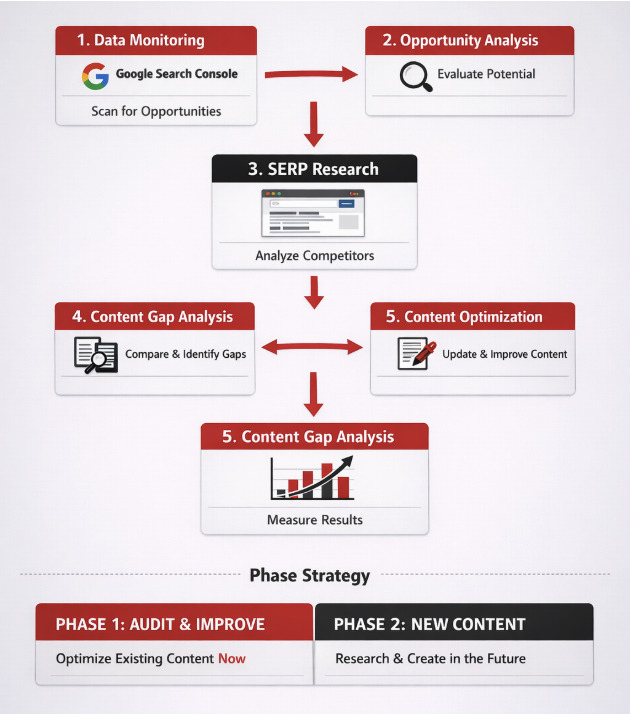
The primary advantage of AI SEO workflow automation is scalability. A single strategist can oversee a portfolio of hundreds of pages or multiple websites because the AI does the repetitive analytical work. Tasks that once took days—like a full technical audit or a comprehensive keyword mapping—are completed in minutes.
Accuracy improves because AI eliminates human calculation errors and fatigue. The system can detect subtle patterns, such as a gradual decline in organic traffic that correlates with a specific algorithm update, long before a manual analyst would spot it. Consistency is another major benefit. Every piece of content follows the same optimization rules, and every technical fix is applied uniformly across the site.
Data-driven decision-making becomes the default. Rather than relying on intuition, teams base strategies on predictive models that estimate the ROI of each action. This leads to smarter budget allocation and faster recovery from traffic losses. Additionally, AI handles routine reporting, freeing professionals to engage in creative brand storytelling and high-level campaign strategy that truly move the needle.
Limitations and Challenges of AI-Driven SEO Workflows
Despite the efficiency gains, AI SEO workflow automation is not a set-and-forget solution. The quality of output depends heavily on the quality of training data. If the underlying search data is sparse or outdated, the recommendations will be weak. Content generated purely by AI without human editing often lacks brand voice, empathy, and nuanced storytelling, which can hurt user engagement and conversion rates.
Search engine algorithms evolve continuously. An automation workflow built on yesterday’s best practices can become obsolete if it doesn’t incorporate ongoing learning from new ranking factor research. T For these reasons, human oversight remains essential. The most effective implementations treat AI as an augmentation layer, not a full replacement for seasoned SEO expertise.
Traditional SEO vs. AI SEO Workflow Automation: A Detailed Comparison
| Aspect | Traditional Manual SEO | AI SEO Workflow Automation |
|---|---|---|
| Speed of execution | Slow, dependent on human availability | Near real-time for data analysis and fixes |
| Scalability | Limited by team size | Virtually unlimited; handles large websites easily |
| Data analysis depth | Surface-level insights unless expert-driven | Deep pattern recognition across massive datasets |
| Creativity and brand voice | High, human-crafted | Moderate; requires human editing for nuance |
| Error rate | Higher due to manual repetition | Low for systematic tasks, potential for AI hallucinations |
| Adaptability to algorithm updates | Slow, reactive | Faster if models are retrained on new data |
| Cost efficiency at scale | Labor-intensive and expensive | High upfront tool cost, but low marginal cost per task |
Top Tools for Implementing AI SEO Workflow Automation
A variety of specialized platforms now embed AI directly into SEO operations. Choosing the right mix depends on your specific workflow needs:
How to Build Your Own AI SEO Workflow Automation System
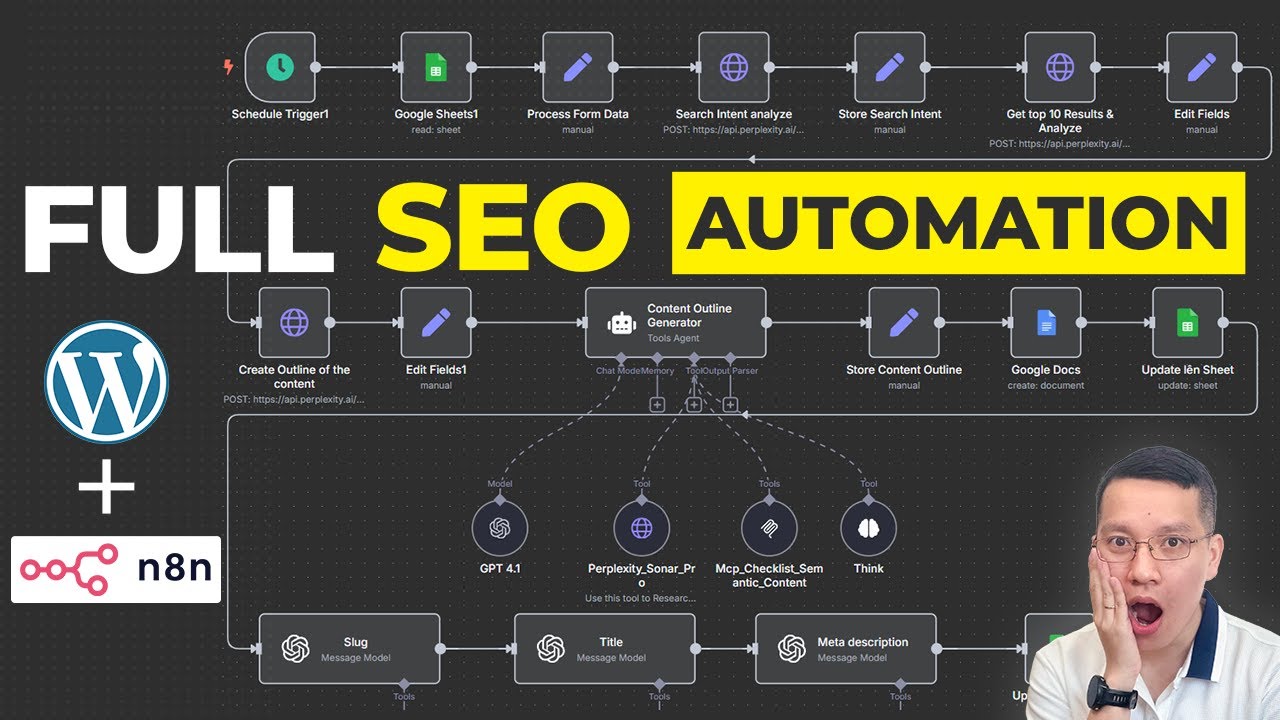
Creating a custom AI SEO workflow automation system doesn’t require building models from scratch. Instead, it’s about intelligently stitching together existing AI-powered tools and APIs. Follow this practical framework:
Common Mistakes to Avoid in AI SEO Workflow Automation
Even experienced teams stumble when first adopting AI-driven processes. Awareness of these pitfalls can save months of wasted effort:
Important Considerations for Long-Term Success
Data privacy and compliance must be at the core of any AI SEO workflow automation strategy. When processing user behavior data or using AI to generate content, ensure adherence to GDPR, CCPA, and other relevant regulations. Be transparent about AI-generated content when required by law or platform policies, and always fact-check statistical claims produced by language models.
Maintain a human strategic layer that sets the direction for automation. AI can execute tactics, but it cannot define brand positioning, understand nuanced industry shifts, or build genuine relationships with partners for backlink acquisition. The most successful implementations blend algorithmic efficiency with human creativity and empathy. Continuously invest in upskilling the team to work alongside AI, interpreting its outputs and making judgment calls that no machine can replicate.
Finally, stay agile. Search engine algorithms are notoriously dynamic. Build your automation with modularity in mind—swap out components as better tools emerge, and keep a close eye on official announcements from Google and other search engines regarding AI-generated content. A flexible architecture ensures that your SEO engine remains effective even as the ground shifts beneath it.
Frequently Asked Questions (FAQ)
What is AI SEO workflow automation?
AI SEO workflow automation is the process of using artificial intelligence to perform and streamline repetitive SEO tasks such as keyword research, content optimization, technical audits, and reporting. It creates a continuous loop where the system detects opportunities, takes action, and learns from outcomes, often with minimal manual involvement.
Which tools are best for automating SEO with AI?
The best tools depend on your specific needs. For content creation and on-page optimization, platforms like SurferSEO and MarketMuse excel. For technical audits, Botify and DeepCrawl offer AI-driven insights. Comprehensive suites like SEMrush and Ahrefs include AI features across keyword research, rank tracking, and competitive analysis. Workflow automation can be built using connectors like Zapier to tie these tools together.
Can AI fully replace human SEO professionals?
No, AI cannot fully replace human SEO experts. While AI handles data analysis and repetitive execution efficiently, strategic thinking, brand voice development, creative storytelling, and ethical judgment still require human input. The most effective approach is a partnership where humans define goals and verify quality, and AI accelerates the execution.
How much does AI SEO workflow automation cost?
Costs vary widely. Some AI features are included in existing SEO tool subscriptions starting at around $100 per month. Dedicated AI content and automation platforms can range from $50 to over $500 monthly per user. Custom enterprise setups with API integrations and data warehousing may cost several thousand dollars. Many teams start small and scale as they see ROI.
How to start automating SEO workflows with AI?
Begin by identifying the most time-consuming, rule-based tasks in your current process—typically keyword mapping, content brief creation, and technical error monitoring. Choose one AI-powered tool that addresses that pain point and integrate it into your workflow. Gradually add automation rules and connect additional tools as you become comfortable with the new system. Always retain a review step before publishing any content or implementing critical changes.
Conclusion
AI SEO workflow automation represents a fundamental shift from manual, reactive search optimization to a proactive, intelligent system that scales effortlessly. When thoughtfully implemented, it amplifies the capabilities of SEO teams, delivering faster insights, more consistent execution, and the ability to manage complex digital ecosystems with precision. The key lies not in chasing hype but in building a modular, human-guided framework where artificial intelligence handles the repetitive heavy lifting and human expertise steers the strategy. Start small, validate each automated step, and continuously refine the process. The result is a resilient SEO operation that not only keeps pace with search engine evolution but stays ahead of it.
Xem thêm:
- WP Trove AI Blogging: The Complete Guide to Automated Content Creation in 2025
- AI SEO Keyword Modifiers: The Complete Guide to Smarter Search Optimization
- AI SEO Quality Score: The Complete Guide to Scoring Higher in 2025
- AI SEO Webinars: How Virtual Training Is Reshaping Modern Search Strategy
- AI SEO Redirects: The Complete Guide to Smarter Link Management in 2025
Bài viết cùng chủ đề:

AI SEO SEO Automation with Make: The Complete Workflow Guide

AI SEO SEO Automation with Zapier: The Complete Workflow Guide

AI SEO SEO Automation with n8n: The Complete Workflow Guide
AI SEO SEO Automation with Gemini: The Complete Guide to Scaling Organic Growth

AI SEO SEO Automation with Claude: The Complete Guide to Scaling Content in 2025

AI SEO SEO Automation with ChatGPT: The Complete Playbook for 2025

AI SEO & SEO Automation for Affiliate Sites: The 2025 Playbook for Passive Income Growth
AI SEO & SEO Automation for Bloggers: The Complete Guide to Scaling Your Content

AI SEO & SEO Automation for Agencies: The Complete 2025 Playbook

AI SEO and SEO Automation for Ecommerce: The Complete Playbook for 2025

AI SEO & SEO Automation for WordPress: The Complete Playbook for 2025
AI SEO SEO Automation Strategy: The Complete Playbook for 2025

Mastering the AI SEO SEO Automation Process: A Complete Guide to Scaling Organic Growth
AI SEO SEO Automation System: The Complete Guide to Scaling Organic Growth in 2025
AI SEO SEO Automation Platform: The Complete Guide to Scaling Organic Growth in 2025
AI SEO SEO Automation Software: The Complete Guide to Scaling Organic Growth in 2025















