
No products in the cart.
How to Use AI for SEO: A Complete Guide to Smarter Rankings
29
Jul
Jul
Artificial intelligence is reshaping how search engine optimization works, moving it from guesswork to data-driven precision. Learning how to use AI for SEO means understanding where machines excel, where human judgment remains essential, and how to blend the two for measurable growth. This guide walks through every stage of the process, from keyword discovery and content creation to technical audits and performance tracking, giving you a practical framework that puts AI tools to work without sacrificing quality or authenticity.
What AI-Driven SEO Really Means
Using AI for SEO is not about handing over your entire strategy to a tool and hoping for the best. It is about leveraging machine learning, natural language processing, and predictive analytics to make faster, more informed decisions about how you optimize a website. AI models can identify patterns in massive datasets, such as search queries, user behavior, and competitor content, that would take a human analyst weeks to uncover.
When search engines like Google use AI in their ranking algorithms through systems like RankBrain and the Helpful Content System, the playing field changes. AI-powered tools can help you understand semantic relationships between topics, predict content performance, and automate repetitive tasks. The core shift is from reacting to ranking fluctuations to proactively building a site architecture and content plan that aligns with how modern search engines interpret relevance and quality.
In practice, this covers everything from generating topic clusters with natural language generation to running real-time site crawls that flag issues before they hurt core web vitals. The real value comes from integration: connecting AI insights directly into your content workflow, technical optimization process, and link-building efforts.
Key Components of an AI-Powered SEO Workflow
To grasp how to use AI for SEO effectively, break down your workflow into distinct stages where AI adds value. Each stage uses different types of AI models and serves a unique purpose within your overall strategy.
AI for Keyword Research and Topic Discovery
Traditional keyword tools provide volume and difficulty scores, but AI takes this further by understanding user intent behind a query. Tools trained on large language models can group keywords by the actual problem a searcher wants to solve, not just by string similarity. This allows you to build content that answers multiple related questions in one resource, which aligns perfectly with how Google’s semantic search handles query interpretation.
An AI keyword research tool often surfaces long-tail variations, question-based queries, and emerging trends by analyzing search engine autocomplete data, People Also Ask boxes, and competitor content gaps simultaneously. It can predict which subtopics will satisfy a user’s next likely question, enabling you to create comprehensive pillar pages and supporting clusters that strengthen topical authority.
AI-Assisted Content Optimization
Content optimization with AI goes well beyond checking keyword density. Modern tools analyze the top-ranking pages for a target query and extract the entities, topics, and content structure that correlate with high rankings. They score your draft on comprehensiveness, readability, and semantic richness, suggesting terms to include not because they match a keyword exactly, but because they build topical depth.
Some platforms can rewrite paragraphs to improve clarity, adjust tone to match a brand voice, or generate meta descriptions that balance click-through rate with relevance. However, AI-generated content still requires human oversight. Search engines increasingly reward first-hand experience and original insights, so treat AI output as a sophisticated assistant, not the author. The best results come when a subject matter expert edits and enriches AI-suggested outlines and drafts.
Technical SEO Automation with AI
Technical audits have traditionally been time-consuming, requiring manual crawling and log file analysis. AI-powered crawlers now mimic how a search engine bot processes JavaScript, renders pages, and evaluates core web vitals. They can prioritize fixes based on projected impact, learning over time which types of issues most affect your site’s indexing and ranking.
These tools use machine learning to detect unusual patterns, such as a sudden spike in broken internal links after a site migration or a drop in crawl budget efficiency due to parameter-heavy URLs. They also help with structured data implementation by validating schema markup and suggesting enhancements that improve eligibility for rich results like FAQ snippets, product carousels, and review stars.
AI for Link Building and Competitive Analysis
Finding link opportunities often meant manually scanning competitor backlink profiles. AI now automates this by identifying sites that link to multiple competitors but not to you, scoring them on metrics like domain authority, traffic, and relevance. Natural language processing can even evaluate the context around a link to determine if it is editorial, sponsored, or part of a low-quality directory.
For competitive analysis, AI can reverse-engineer why a competitor’s page outranks yours. It looks at content depth, page speed, backlink velocity, and user engagement signals to provide a prioritized list of actions that carry the highest probability of closing the gap.
Practical Benefits of Integrating AI into SEO
Understanding how to use AI for SEO becomes easier when you see the concrete benefits it brings to daily operations. These advantages compound over time as models learn from your data and refine their recommendations.
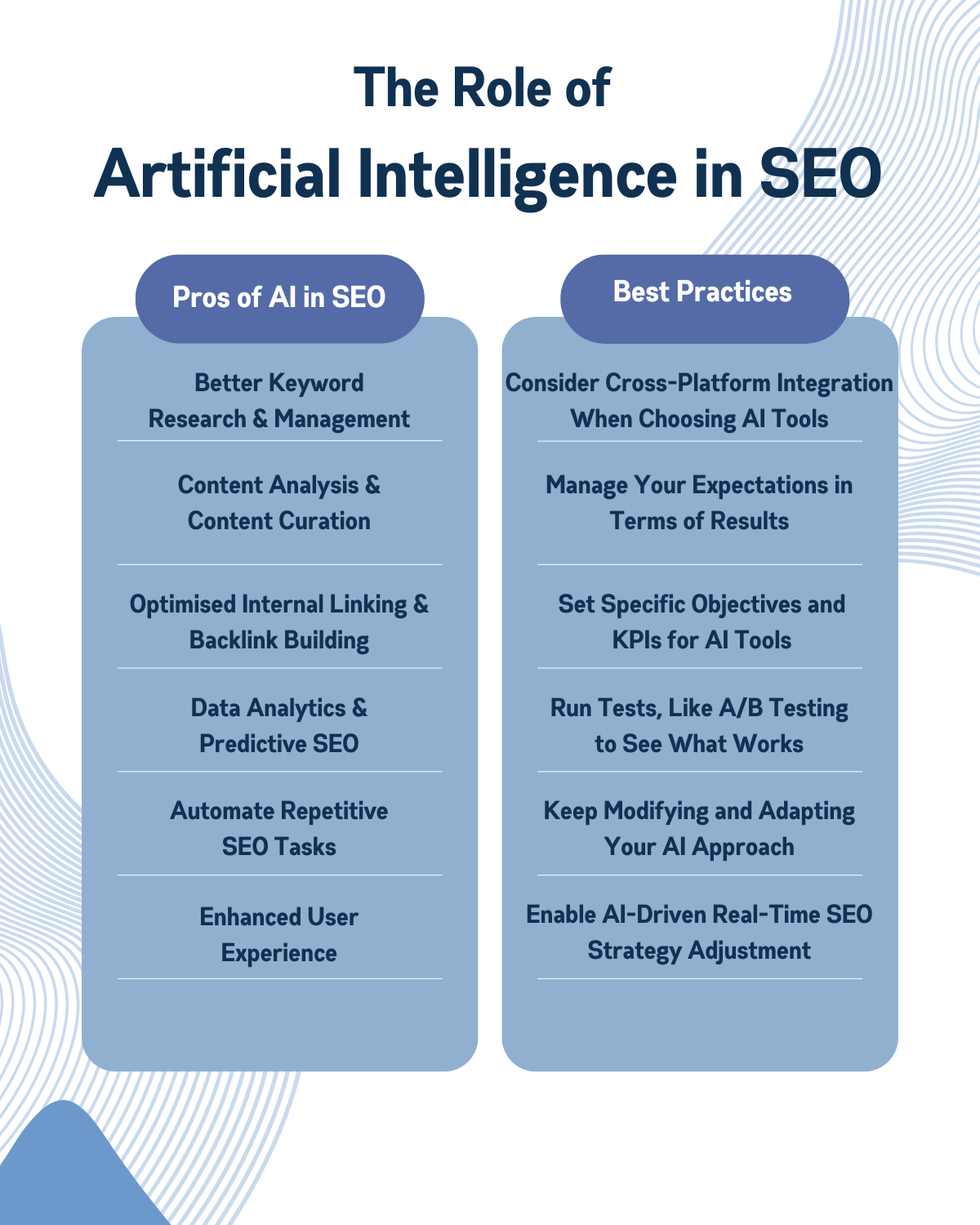
- Time savings on repetitive tasks: AI handles keyword grouping, content brief generation, meta tag creation, and crawl report analysis in minutes rather than hours, freeing strategists for higher-level thinking.
- Intent-based content planning: Instead of chasing individual keywords, you build topic clusters that match user journeys, increasing organic reach and reducing content cannibalization.
- Data-driven decision making: AI models process millions of data points to recommend optimizations backed by statistical probability, reducing reliance on gut feeling.
- Scalable personalization: AI can help tailor content recommendations and internal linking structures based on user behavior, improving engagement metrics that indirectly influence rankings.
- Rapid competitive response: When algorithm updates shift rankings, AI tools quickly detect the most likely factors and suggest adjustments faster than manual research.
- Publishing raw AI content: Always have a human editor add nuance, stories, and expertise. Google’s algorithms are adept at detecting machine-written, formulaic text.
- Ignoring search intent: AI tools may group keywords by topic but occasionally misread intent. A query ranking for informational blog posts might be given a commercial recipe by an AI that misclassified the intent. Verify intent manually for your top 50 keywords.
- Over-optimizing anchor text: AI link-building tools can suggest exact-match anchor text because it appears in competitor profiles, but this can trigger Penguin penalties. Keep anchor text varied and natural.
- Applying technical fixes without testing: AI crawlers sometimes flag false positives. A schema warning might be a deliberate implementation. Always test changes on a staging environment first.
- Neglecting brand voice: AI content optimizers can push you toward a neutral, encyclopedia-like tone that erases brand personality. Set strict style guidelines before using these tools.
Limitations and Risks You Must Manage
No tool is a complete replacement for strategy. Over-reliance on AI for SEO introduces specific risks that can damage your site’s reputation and rankings if left unchecked. The biggest danger is thin, derivative content. If you publish AI-generated text without substantial human editing, you risk being flagged by Google’s helpful content system for lacking originality and real-world experience.
AI models also reflect biases present in their training data. They may over-optimize for certain signals that worked historically but no longer correlate strongly with rankings. Another common pitfall is automation complacency: teams stop critically evaluating recommendations and apply changes blindly, sometimes creating new technical issues or accidentally removing valuable on-page elements. Data privacy is also a concern when using third-party AI tools that ingest your proprietary content or analytics.
How to Build an AI-Enhanced SEO Strategy Step by Step
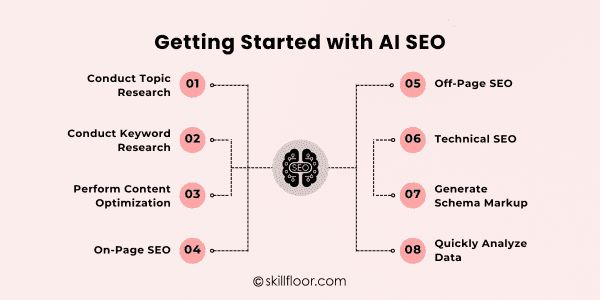
This section provides a concrete, actionable guide on how to use AI for SEO from start to finish, based on workflows used by agencies and in-house teams today. Each step combines a specific AI capability with human validation for maximum effect.
Step 1: Map Your Entire Topic Universe with AI
Start by entering your core service or product category into an AI keyword discovery tool. Let the tool generate a complete semantic map that shows parent topics, child subtopics, and supporting long-tail queries. Export this map into a spreadsheet and review it manually, removing any topics that do not align with your actual business expertise or audience needs. The AI identifies opportunity; you define strategic relevance.
Step 2: Create Data-Informed Content Briefs
For each priority topic, use an AI content optimizer to analyze the current top 20 search results. The tool will produce a brief that includes recommended word count, must-include subtopics, frequently mentioned entities, and an optimal heading structure. Add your own findings, such as unique statistics, case studies, and expert quotes that the AI cannot generate. This hybrid brief becomes the blueprint for your writers.
Step 3: Draft and Optimize with Human-AI Collaboration
If you use an AI writing assistant for the first draft, treat that output as a research compilation, not a final piece. Have an experienced writer restructure the narrative, inject original examples, and verify every factual claim. Then run the polished draft back through an AI content grader to see if any critical subtopics or semantic gaps remain. Iterate until the draft scores well on both the AI tool’s metrics and your editorial standards.
Step 4: Automate Technical Health Monitoring
Set up an AI-powered site audit tool to crawl your site weekly or after any major deployment. Configure alerts for critical issues such as 5xx errors, broken canonical tags, or sudden drops in page speed. The AI should prioritize fixes based on traffic impact. For each alert, schedule a manual review to confirm the fix is implemented correctly, and monitor the affected pages in real-time dashboards that connect SEO data with server logs.
Step 5: Enhance On-Page Elements with AI
Use AI to generate multiple title tag and meta description variations for key pages, then A/B test them via a platform that integrates with your SEO tool. AI can also suggest internal linking opportunities by scanning your content for mentions of target pages and adding contextually relevant anchor text. Implement these suggestions manually, ensuring every link adds value for the user rather than just serving crawlers.
Step 6: Scale Link Prospecting Without Spam
Connect your competitor backlink profiles to an AI link analysis tool. Filter the results to show only domains that meet quality thresholds: a minimum authority score, consistent organic traffic, and no history of linking to spam. The AI then ranks these prospects by how likely they are to respond to a personalized outreach based on past link acquisition patterns. You still write the pitch, but the AI eliminates the noise.
Step 7: Forecast and Report with Predictive Analytics
Advanced AI SEO platforms can forecast organic traffic based on your planned optimizations and historical data. These models consider seasonality, algorithm update impacts, and competitor movements. Use these forecasts to set realistic KPIs and to build a business case for further investment. When reporting, let AI generate narrative summaries of performance changes, highlighting statistically significant shifts that need your attention.
Common Mistakes When Using AI for SEO and How to Avoid Them
Even experienced marketers fall into traps when adopting AI tools. Avoiding these mistakes will keep your SEO program on track and prevent costly clean-up campaigns later.
Comparing Leading Approaches to AI SEO Implementation
Different organizations adopt AI for SEO at varying levels of integration. The table below compares three common approaches, helping you decide which suits your resources and goals.
| Approach | Tools Used | Human Involvement | Best For |
|---|---|---|---|
| Assistive AI | Keyword suggesters, content graders, technical crawlers | High; AI only provides recommendations | Small teams wanting to speed up manual tasks without loss of control |
| Collaborative AI | AI writing co-pilots, automated brief generators, predictive analytics | Moderate; AI creates drafts, humans refine heavily | Mid-size content operations scaling output while maintaining quality |
| Augmented AI | Full-stack AI SEO platforms, dynamic content personalization, automated internal linking | Lower; AI executes, humans monitor and set strategic guardrails | Large enterprises with vast sites requiring real-time optimization across thousands of pages |
Important Considerations Before Investing Heavily in AI SEO Tools
The market is crowded with overhyped tools. Focus on solving specific problems rather than buying a suite of features you will never use. Start with one tool that addresses your biggest bottleneck, whether that is keyword research, content optimization, or technical SEO. Integrate it deeply into your workflow before adding another. Check whether the AI model is updated frequently; a tool using stale training data will give outdated advice about algorithm changes and user trends.
Data ownership matters. Read the terms of service to understand how the platform uses your content and search data. If you are in a regulated industry or handle sensitive competitive information, choose tools that offer on-premise or private cloud deployment. Finally, ensure your team has the skills to interpret AI outputs. A tool that predicts a 30% traffic increase from a set of changes is only useful if someone can test those predictions against real outcomes and refine the model’s assumptions.
Frequently Asked Questions
How can AI help with local SEO specifically?
AI can optimize local SEO by automatically managing Google Business Profile responses, analyzing review sentiment to surface operational issues, and identifying location-specific keywords that include neighborhood names and service terms. It can also audit local citations across dozens of directories and flag inconsistencies in NAP data that hurt map pack rankings.
Does Google penalize AI-written content?
Google does not penalize content solely because it is AI-generated, but it does penalize low-quality, unoriginal content created primarily to manipulate search rankings. If the AI output is heavily edited by a human to add unique value, original data, and real-world experience, it can rank well. The key factor is whether the page demonstrates expertise, authoritativeness, and trustworthiness.
Which free AI tools are worth using for SEO?
Several free AI tools provide real value. Google Search Console’s performance reports use machine learning to identify query trends. Bing’s and Google’s own natural language APIs offer limited free tiers for entity extraction. Some browser extensions use AI to analyze on-page factors and generate schema markup. Always verify free tool outputs against your own analytics.
Can AI predict Google algorithm updates?
AI cannot predict the exact timing or target of an update, but it can detect early signals of ranking volatility by monitoring thousands of domains and correlating movement with known ranking factors. These predictive systems often give SEOs a 24- to 48-hour head start in identifying which types of pages or industries are being impacted, allowing faster diagnosis.
How do I train my own AI model for SEO tasks?
Training a custom model requires a substantial dataset of your own rankings, traffic, and content attributes. You would typically use a supervised learning approach, feeding the model historical data where the outcome is known, such as which pages gained traffic after specific on-page changes. This is resource-intensive and usually reserved for large publishers or enterprise SEO platforms.
Conclusion
Mastering how to use AI for SEO is not about replacing human judgment but amplifying it. The most successful teams treat AI as a tireless analyst that surfaces patterns, automates grunt work, and validates decisions with data. They pair that with the irreplaceable human ability to understand brand nuance, build genuine relationships for link building, and craft stories that resonate with readers. Start by automating one core task, measure the impact rigorously, and scale your AI integration as your confidence grows. This balanced approach will future-proof your SEO efforts against algorithm changes and competitive pressures alike.
Xem thêm:
- AI SEO SE Ranking: The Complete Guide to Dominating Search in 2025
- AI SEO Content Consistency: The Complete Guide to Scaling Quality Without Losing Your Voice
- AI SEO for Crypto: The Complete Guide to Dominating Search in 2025
- AI SEO News: Mastering the Latest Artificial Intelligence Developments Reshaping Search Optimization
- AI SEO Integrations: The Complete Guide to Smart Automation and Higher Rankings
Bài viết cùng chủ đề:

AI SEO SEO Automation with Make: The Complete Workflow Guide

AI SEO SEO Automation with Zapier: The Complete Workflow Guide

AI SEO SEO Automation with n8n: The Complete Workflow Guide
AI SEO SEO Automation with Gemini: The Complete Guide to Scaling Organic Growth

AI SEO SEO Automation with Claude: The Complete Guide to Scaling Content in 2025

AI SEO SEO Automation with ChatGPT: The Complete Playbook for 2025

AI SEO & SEO Automation for Affiliate Sites: The 2025 Playbook for Passive Income Growth
AI SEO & SEO Automation for Bloggers: The Complete Guide to Scaling Your Content

AI SEO & SEO Automation for Agencies: The Complete 2025 Playbook

AI SEO and SEO Automation for Ecommerce: The Complete Playbook for 2025

AI SEO & SEO Automation for WordPress: The Complete Playbook for 2025
AI SEO SEO Automation Strategy: The Complete Playbook for 2025

Mastering the AI SEO SEO Automation Process: A Complete Guide to Scaling Organic Growth
AI SEO SEO Automation System: The Complete Guide to Scaling Organic Growth in 2025
AI SEO SEO Automation Platform: The Complete Guide to Scaling Organic Growth in 2025
AI SEO SEO Automation Software: The Complete Guide to Scaling Organic Growth in 2025















