
No products in the cart.
Startup AI SEO: The Complete Playbook for Scaling Organic Growth in 2025
31
Jul
Jul
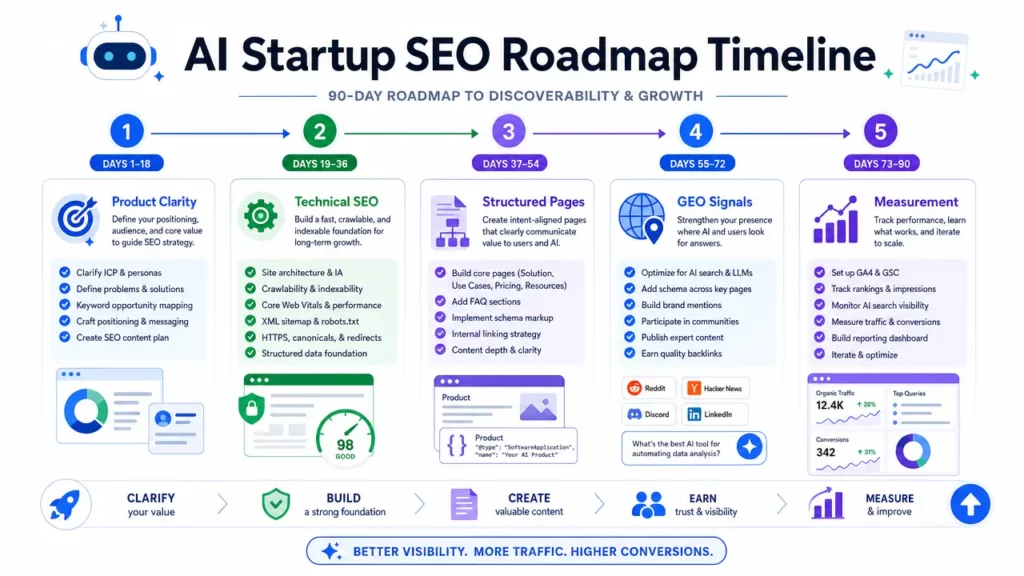
For early-stage companies, growth is the only metric that matters. Yet, competing with established brands on search engine results pages often feels like bringing a knife to a gunfight. This is where Startup AI SEO changes the game. By leveraging machine learning, natural language processing, and predictive analytics, startups can now outmaneuver larger competitors with less manual effort and a fraction of the budget. This guide breaks down exactly how to build an AI-powered SEO engine from the ground up, covering tools, workflows, and strategies that deliver measurable results.
What is Startup AI SEO?
Startup AI SEO refers to the application of artificial intelligence technologies to optimize a young company’s online visibility. Unlike traditional SEO, which relies heavily on manual keyword research, backlink outreach, and content audits, AI-driven SEO automates these processes. It uses algorithms to analyze search intent, predict content performance, and adapt to Google’s constantly shifting ranking factors in real time.
The core difference lies in speed and scale. A startup with a two-person marketing team can use AI to generate thousands of content briefs, identify topic clusters, and even automate technical audits. This allows the team to focus on strategic decisions rather than repetitive tasks. The goal is not to replace human judgment but to augment it with data-driven insights that would take weeks to gather manually.
Why Startups Must Adopt AI SEO Early
Startups face unique constraints: limited resources, high churn risk, and the need for rapid validation. Traditional SEO is a slow burn, often taking six to twelve months to show significant traction. AI accelerates this timeline by identifying low-competition, high-intent keywords that a human analyst might overlook. It also enables dynamic content optimization, where pages are tweaked based on real-time user behavior data.
Another critical reason is the shift in Google’s algorithm toward semantic understanding. The rise of BERT and MUM models means search engines now interpret context, not just keywords. AI tools are designed to align with these models, helping startups create content that answers questions comprehensively rather than just matching phrases. This alignment is no longer optional; it is a prerequisite for ranking.
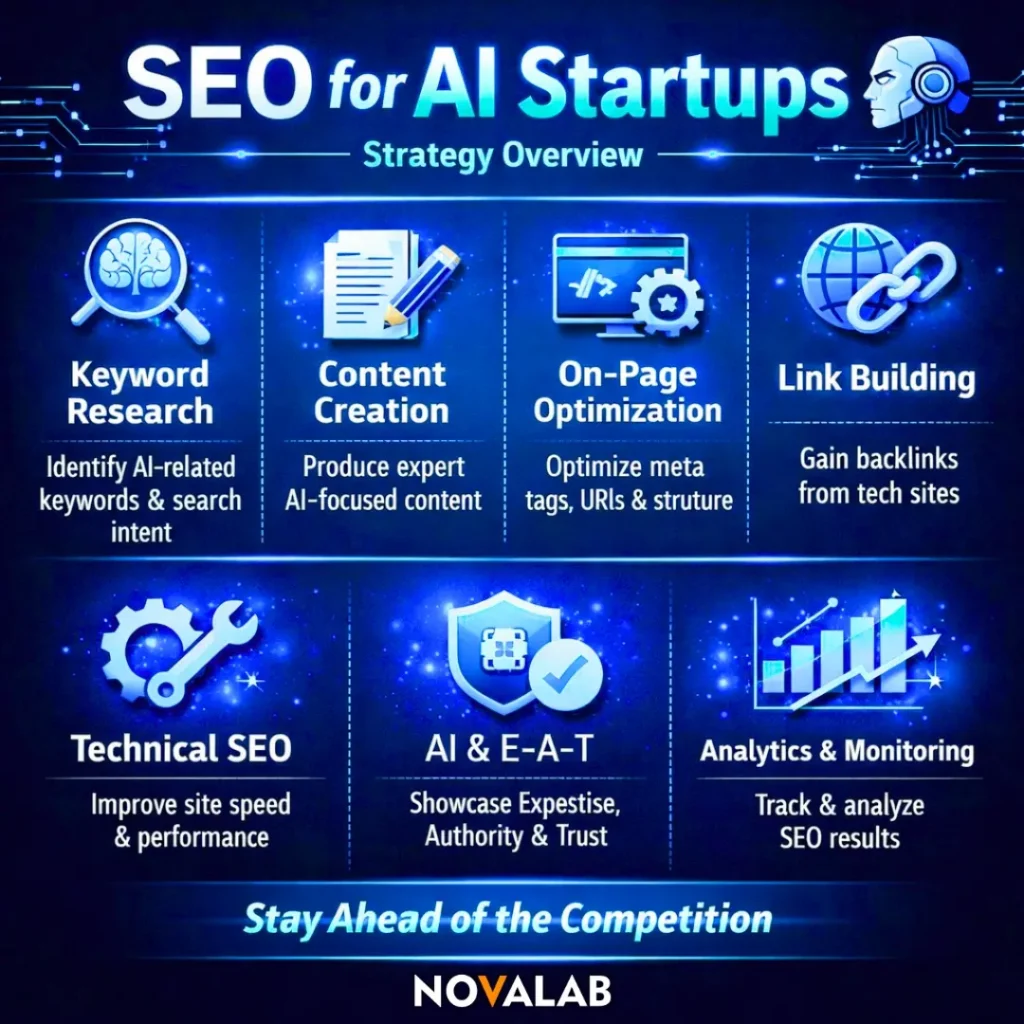
Core Components of an AI-Powered SEO Strategy
Building a successful Startup AI SEO framework requires integrating several distinct components. Each piece addresses a different part of the organic search funnel, from discovery to conversion.
1. AI-Driven Keyword Clustering and Intent Mapping
Gone are the days of targeting single keywords. AI tools like Clearscope, Surfer SEO, and MarketMuse analyze thousands of top-ranking pages to identify semantic relationships. They group keywords into clusters based on user intent—informational, navigational, or transactional. For a startup, this means you can build a content hub that covers a topic exhaustively, signaling authority to Google.
For example, if you sell project management software, an AI tool might cluster keywords like “agile workflow,” “sprint planning tools,” and “kanban board software” under a single “project management methodologies” pillar. This approach not only improves rankings but also enhances user experience by providing a logical path through your content.
2. Automated Content Generation and Optimization
AI writing assistants such as Jasper, Copy.ai, and Writesonic can draft initial versions of blog posts, product descriptions, and meta tags. However, the real value lies in optimization. Tools like Frase and Surfer analyze your draft against the top ten search results, suggesting specific terms to include, readability improvements, and structural changes. This ensures your content is not just unique but also perfectly aligned with what Google considers relevant.
It is crucial to note that AI-generated content requires human editing. Search engines penalize purely automated, low-value text. The best workflow involves using AI to create a detailed outline and first draft, then having a subject matter expert refine it with personal insights, case studies, and original data.
3. Predictive Analytics for Link Building
Backlinks remain a top ranking factor, but acquiring them is time-consuming. AI tools like Ahrefs and SEMrush now offer predictive link scoring. They analyze your existing backlink profile and compare it with competitors to identify which prospects are most likely to link to you. Some platforms even automate outreach emails, personalizing them based on the recipient’s content preferences.
For startups, this is a game-changer. Instead of cold emailing hundreds of bloggers, you can focus on a shortlist of high-authority sites that have a proven history of linking to similar content. This increases the success rate of your outreach campaigns and builds a more natural link profile.
4. Technical SEO Audits and Monitoring
Technical issues like slow page speed, broken links, and crawl errors can silently kill your rankings. AI-powered crawlers like Sitebulb and Lumar (formerly DeepCrawl) simulate Google’s crawling process and identify issues in minutes. They prioritize problems based on their impact on revenue, allowing you to fix critical errors first.
Moreover, these tools offer predictive recommendations. For instance, they might suggest restructuring your URL hierarchy or implementing schema markup for specific page types. This proactive approach prevents small issues from becoming major ranking penalties as you scale.
Benefits of Integrating AI into Your SEO Workflow
The advantages of Startup AI SEO extend beyond just ranking higher. They impact the entire operational efficiency of your marketing team.
- Cost Efficiency: AI tools reduce the need for large content teams and expensive consultants. A single subscription can replace hours of manual research.
- Speed to Market: You can publish optimized content in days, not weeks, allowing you to capture trending topics before competitors.
- Data-Driven Decisions: AI provides clear metrics on content performance, keyword difficulty, and ROI, eliminating guesswork from your strategy.
- Scalability: As your startup grows, AI systems can handle increased data volumes without requiring proportional increases in headcount.
- Competitive Intelligence: AI continuously monitors competitor moves, alerting you to new keywords they are targeting or content gaps they have missed.
- Publishing Unedited AI Content: This is the fastest way to get flagged as spam. Always add original data, personal experience, and a unique perspective.
- Ignoring Search Intent: AI tools can suggest keywords, but they cannot tell you if the user wants a tutorial, a product comparison, or a pricing page. Misinterpreting intent leads to high bounce rates.
- Over-Optimizing for Keywords: Stuffing your content with exact-match keywords will trigger Google’s spam filters. Use variations and synonyms naturally.
- Neglecting User Experience: AI can optimize for search engines, but if your page is cluttered with ads or has poor navigation, rankings will suffer. Google’s Core Web Vitals are a ranking factor.
- Failing to Update AI Models: Your AI tools need fresh data. If you do not regularly import new search query data, the recommendations become stale.
- Scaling Too Quickly: Publishing 100 low-quality AI articles in a week is worse than publishing 10 excellent ones. Focus on quality over quantity.
Limitations and Risks to Consider
While powerful, AI is not a silver bullet. Understanding its limitations is essential for avoiding costly mistakes.
Lack of Human Creativity: AI can analyze data but cannot replicate the unique voice, humor, or emotional resonance of a human writer. Content that is purely AI-generated often feels sterile and generic, which can harm brand perception.
Dependency on Data Quality: AI models are only as good as the data they are trained on. If your analytics are misconfigured or your keyword data is outdated, the A
Algorithm Volatility: Google’s algorithms change frequently. An AI tool that works well today might become less effective after a core update. Relying solely on automation without human oversight can lead to sudden drops in traffic.
Cost of Advanced Tools: While some AI tools are affordable, enterprise-level platforms with advanced predictive features can be expensive. Startups must carefully evaluate ROI before committing to high-tier subscriptions.
Startup AI SEO vs. Traditional SEO: A Comparative Analysis
To understand the value proposition, it helps to compare the two approaches side by side.
| Aspect | Traditional SEO | Startup AI SEO |
|---|---|---|
| Keyword Research | Manual analysis of search volumes and difficulty scores | Automated clustering and intent prediction using ML models |
| Content Creation | Human writers researching and drafting from scratch | AI generates drafts and briefs; humans edit and add expertise |
| Technical Audits | Manual crawling and log file analysis | Real-time automated crawlers with predictive issue prioritization |
| Link Building | Manual outreach and relationship building | Predictive prospect scoring and automated personalized emails |
| Time to Results | 6-12 months for significant traction | 3-6 months with faster iteration cycles |
| Cost Structure | High labor costs for specialists | Subscription-based software costs, lower labor overhead |
| Adaptability | Slow to react to algorithm updates | Rapid adjustment based on real-time data feeds |
Practical Implementation: A Step-by-Step Guide for Startups

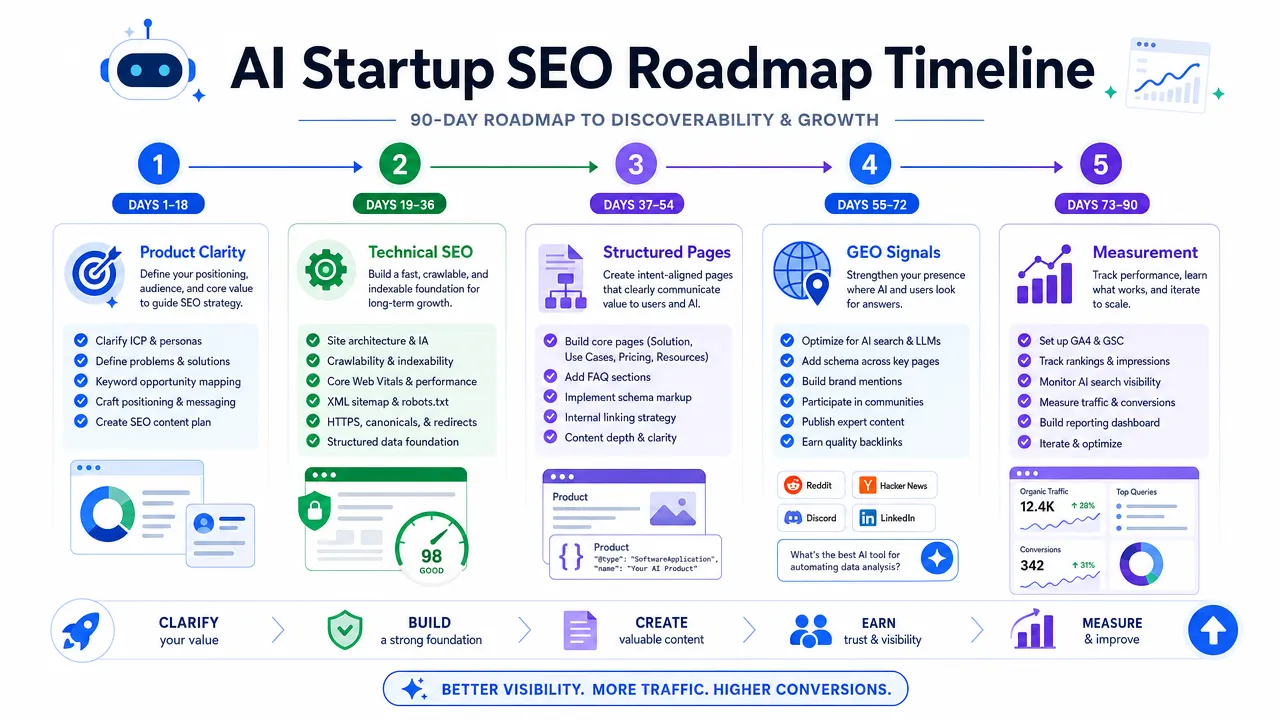
Implementing Startup AI SEO requires a structured approach.
Step 1: Audit Your Current Digital Footprint
Before deploying AI, you need a baseline. Use tools like Google Search Console and Ahrefs to export your current rankings, backlinks, and indexed pages. This data will serve as the training ground for your AI models. Identify which pages are underperforming and which keywords are close to the first page of results.
Step 2: Select the Right AI Tool Stack
Do not buy every tool on the market. Start with a core stack: one for keyword research (e.g., Ahrefs or Semrush), one for content optimization (e.g., Surfer or Frase), and one for technical audits (e.g., Sitebulb). Many startups also use a writing assistant like Jasper for initial drafts. Ensure the tools integrate with your CMS and analytics platforms.
Step 3: Build Your Topic Cluster Strategy
Use your AI keyword tool to generate a list of 50-100 core topics relevant to your product. The tool will suggest subtopics and related questions. Map these into a pillar page and cluster pages structure. The pillar page covers the broad topic, while cluster pages target specific long-tail keywords. Interlink them using descriptive anchor text.
Step 4: Generate and Optimize Content at Scale
For each cluster page, use your AI writing tool to generate a draft. Input the target keyword, the search intent, and any specific data points you want to include. Once the draft is ready, run it through your optimization tool to get a content score. Revise the draft to improve the score, adding unique examples, screenshots, and expert quotes. Publish only after a human editor has reviewed it for accuracy and tone.
Step 5: Automate Technical Monitoring
Set up your technical SEO crawler to run weekly scans. Configure alerts for critical issues like 404 errors, duplicate content, and slow-loading pages. Use the AI’s recommendations to create a prioritized backlog for your development team. Fixing these issues promptly prevents them from compounding.
Step 6: Use AI for Outreach and Digital PR
Compile a list of journalists and bloggers who cover your industry. Use an AI outreach tool to analyze their recent articles and suggest personalized opening lines. Track your email open rates and replies. Focus on building relationships with a core group of 20-30 influencers rather than mass emailing.
Common Mistakes Startups Make with AI SEO
Even with the best tools, pitfalls abound. Avoiding these errors will save you time and prevent penalties.
Important Notes on Ethics and Compliance
Google’s guidelines explicitly state that automation that manipulates search rankings is against their spam policies. However, using AI to assist in content creation is acceptable as long as the content is genuinely useful and not designed primarily for search engines. Always disclose AI involvement if you are publishing in industries with strict regulatory oversight, such as finance or healthcare.
Data privacy is another concern. Ensure your AI tools are GDPR-compliant and do not store sensitive user data. When using AI for outreach, avoid scraping personal emails without consent. Transparency builds trust with both users and search engines.
Frequently Asked Questions
How much does Startup AI SEO cost?
The cost varies widely. Basic content optimization tools start at around $50 per month. Comprehensive suites like Ahrefs or Semrush cost between $100 and $400 per month. Enterprise-level predictive analytics platforms can exceed $1,000 per month. A typical startup should budget $300-$800 per month for a solid AI tool stack, which is significantly less than hiring a full-time SEO specialist.
Can AI completely replace human SEO experts?
No. AI excels at data processing, pattern recognition, and repetitive tasks. However, it lacks strategic thinking, creative problem-solving, and the ability to build genuine relationships with influencers and customers. The most effective approach is a hybrid model where AI handles the heavy lifting and humans provide oversight, creativity, and final approval.
How long does it take to see results with AI SEO?
If you are targeting low-competition long-tail keywords, you can see improvements in 4-8 weeks. For competitive head terms, it may take 3-6 months. The key is continuous iteration. AI allows you to test different headlines, meta descriptions, and content structures quickly, accelerating the learning curve.
Is AI-generated content penalized by Google?
Google does not penalize content simply because it is AI-generated. It penalizes low-quality content that provides no value to users. If you use AI to create a comprehensive, accurate, and engaging article that satisfies search intent, it can rank well. Always review and edit AI output to ensure it meets your quality standards.
What are the best free AI SEO tools for startups?
Google Search Console is essential and free. Google’s PageSpeed Insights uses AI to analyze performance. For keyword ideas, Google’s autocomplete and “People Also Ask” boxes provide valuable data. Ubersuggest offers a limited free tier. AnswerThePublic visualizes search questions. These free tools are sufficient for initial testing before you invest in paid platforms.
How do I measure the ROI of AI SEO?
Track organic traffic, keyword rankings, and conversion rates. Use UTM parameters to attribute leads to specific content pieces. Compare your cost per acquisition (CPA) from organic search against paid channels. A positive ROI means your organic CPA is lower than your paid CPA. Review these metrics monthly to adjust your strategy.
Conclusion
Startup AI SEO is not a futuristic concept; it is a present-day necessity for any young company aiming to compete in the digital arena. By automating mundane tasks, providing deep analytical insights, and enabling rapid experimentation, AI empowers startups to punch above their weight class. The key is to use these tools as an accelerator, not a replacement, for human expertise. Focus on creating genuinely helpful content, building authentic relationships, and maintaining a clean technical foundation. When you combine the speed of AI with the judgment of experienced marketers, you create a compounding growth engine that is difficult for competitors to replicate. Start small, measure everything, and scale what works.
Xem thêm:
- AI SEO AI Search Analytics: The Complete Guide to Modern Search Intelligence
- AI SEO Content Outreach: The Complete Strategy Guide for 2025
- AI SEO for Bloggers: How to Build Smarter Content That Ranks and Converts
- AI Rich Snippets: What They Are, Why They’re Taking Over Search, and How to Win Them
- AI SEO Articles: How to Rank With Intelligent Content Creation
Bài viết cùng chủ đề:

AI SEO SEO Automation with Make: The Complete Workflow Guide

AI SEO SEO Automation with Zapier: The Complete Workflow Guide

AI SEO SEO Automation with n8n: The Complete Workflow Guide
AI SEO SEO Automation with Gemini: The Complete Guide to Scaling Organic Growth

AI SEO SEO Automation with Claude: The Complete Guide to Scaling Content in 2025

AI SEO SEO Automation with ChatGPT: The Complete Playbook for 2025

AI SEO & SEO Automation for Affiliate Sites: The 2025 Playbook for Passive Income Growth
AI SEO & SEO Automation for Bloggers: The Complete Guide to Scaling Your Content

AI SEO & SEO Automation for Agencies: The Complete 2025 Playbook

AI SEO and SEO Automation for Ecommerce: The Complete Playbook for 2025

AI SEO & SEO Automation for WordPress: The Complete Playbook for 2025
AI SEO SEO Automation Strategy: The Complete Playbook for 2025

Mastering the AI SEO SEO Automation Process: A Complete Guide to Scaling Organic Growth
AI SEO SEO Automation System: The Complete Guide to Scaling Organic Growth in 2025
AI SEO SEO Automation Platform: The Complete Guide to Scaling Organic Growth in 2025
AI SEO SEO Automation Software: The Complete Guide to Scaling Organic Growth in 2025















