
No products in the cart.
Advanced AI SEO: The Complete Guide to Dominating Search in 2025
31
Jul
Jul
The digital landscape has shifted dramatically. Traditional SEO tactics that relied on keyword stuffing and backlink schemes are no longer effective. Today, search engines like Google use sophisticated machine learning algorithms to understand user intent and content quality at a semantic level. This is where Advanced AI SEO comes into play. It represents the convergence of artificial intelligence, natural language processing, and predictive analytics to create a search strategy that is proactive, data-driven, and highly scalable. This guide provides a comprehensive roadmap for leveraging AI to transform your organic visibility, moving beyond basic automation to achieve true search dominance.
What is Advanced AI SEO?

Advanced AI SEO is the strategic application of machine learning models and natural language processing (NLP) to automate, enhance, and predict the performance of search engine optimization efforts. It goes beyond simple grammar checking or keyword suggestion. This approach involves using AI to analyze massive datasets to understand search intent, predict algorithm updates, generate content that matches entity-based search queries, and optimize technical infrastructure in real-time.
Unlike traditional SEO, which is often reactive and manual, Advanced AI SEO is proactive. It uses predictive analytics to forecast which topics will gain traction, identifies content gaps before competitors do, and automatically adjusts on-page elements based on user behavior signals. The core difference lies in the depth of analysis. Traditional tools tell you what is happening; advanced AI systems tell you why it is happening and what will happen next.
The Shift from Keywords to Entities
Modern search engines have moved away from matching exact strings of text. They now focus on entities—people, places, concepts, and things—and the relationships between them. Advanced AI SEO utilizes models like Google’s MUM (Multimodal Universal Model) and BERT to understand context. This means your content must be structured to answer questions comprehensively, not just target a specific phrase. AI tools help map out these entity relationships, ensuring your content covers a topic cluster thoroughly, establishing topical authority that algorithms recognize and reward.
Core Components of an Advanced AI SEO Strategy
Implementing this strategy requires a multi-faceted approach. It is not a single tool or tactic but a framework that integrates several AI-driven processes. The following components form the backbone of a successful implementation.
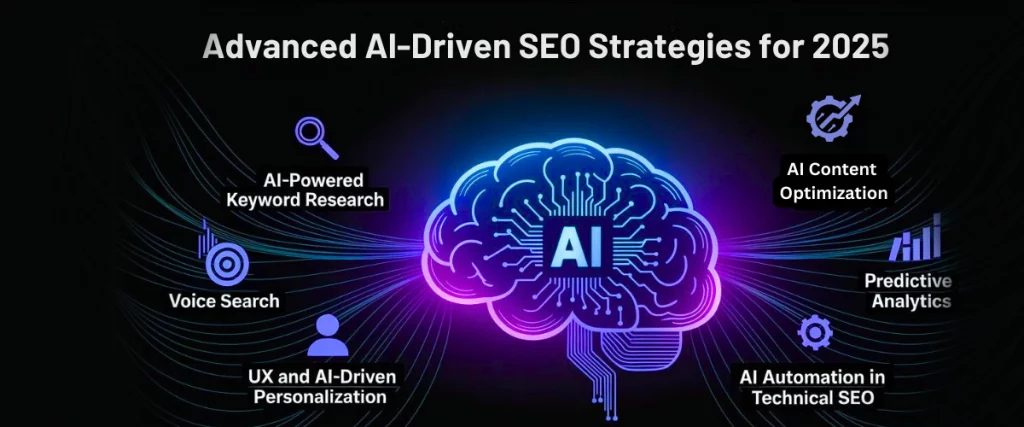
Predictive Keyword and Trend Analysis
Traditional keyword research provides a snapshot of current volume. Advanced AI SEO uses time-series forecasting and machine learning to predict future search trends. Tools like Google Trends with AI enhancements can analyze seasonal patterns, emerging topics, and the velocity of keyword growth. This allows you to create content that ranks for the “next big thing” before it peaks, giving you a significant first-mover advantage. The system analyzes search query patterns across different demographics and geographies to identify micro-moments that are underserved.
AI-Powered Content Optimization and Generation
Content creation is no longer about writing for a keyword density. Advanced AI SEO involves using large language models (LLMs) to draft comprehensive outlines, generate variations of headings, and even write full drafts that are factually accurate and stylistically aligned with your brand. However, the “advanced” aspect comes from the optimization layer. AI tools analyze top-ranking pages (SERPs) to determine the semantic terms, entities, and questions they cover. They then provide a “content score” based on the presence of these elements, guiding writers to create pieces that are more complete than the current competition.
Technical SEO Automation and Auditing
Crawling and indexing issues can silently kill your rankings. Advanced AI SEO platforms use machine learning to continuously monitor your site’s architecture. They can automatically detect JavaScript rendering issues, identify crawl budget waste, and predict which pages are likely to suffer from Core Web Vitals failures. Instead of waiting for a monthly audit report, these systems provide real-time alerts and even suggest code fixes. For large enterprise sites, this automation is critical for maintaining site health at scale.
Semantic Search and NLP Integration
To rank for voice search and conversational queries, your content must be structured for natural language processing. Advanced AI SEO tools analyze the “question intent” behind queries. They help you structure content using FAQ schemas, “People Also Ask” data, and natural language patterns. The goal is to ensure that search engines can easily extract the answer to a query and feature it in a rich snippet. This involves optimizing for “position zero” by providing clear, concise, and well-structured answers within the first 100 words of a section.
Benefits of Implementing Advanced AI SEO
The adoption of AI in SEO is not just a trend; it is a necessity for staying competitive. The benefits extend far beyond simple time savings, impacting the core metrics that drive business growth.
- Scalability: AI can analyze thousands of pages and keywords in minutes, a task that would take a human team weeks. This allows for rapid expansion of content and optimization efforts.
- Improved Accuracy: Machine learning algorithms reduce human error in data analysis. They can identify subtle patterns in user behavior that are invisible to the human eye.
- Enhanced User Experience: By optimizing for search intent and semantic relevance, AI helps create content that is more useful and engaging for the reader, leading to lower bounce rates and higher dwell time.
- Competitive Intelligence: AI tools can monitor competitor strategies in real-time, tracking their content updates, backlink acquisition, and keyword targeting. This provides actionable insights to outmaneuver them.
- Predictive Insights: Instead of reacting to algorithm updates, AI models can predict potential ranking volatility based on historical data and current trends, allowing you to adjust your strategy proactively.
- Ignoring Human Creativity: Relying solely on AI to generate content without human editing leads to bland, generic text. Always add a human touch to ensure originality and brand voice.
- Chasing “AI Scores” Over User Value: Some marketers become obsessed with getting a high “optimization score” from a tool. This can lead to content that is stuffed with semantic keywords but reads poorly. Prioritize the user experience over the tool’s score.
- Neglecting Historical Data: AI models need good data to make predictions. If your analytics tracking is broken or your historical data is sparse, the AI’s predictions will be inaccurate. Ensure your data collection is robust before relying on AI insights.
- Failing to Update AI Models: The digital landscape changes rapidly. An AI model trained on last year’s data will be outdated. Continuously retrain your models or use platforms that update their algorithms regularly.
- Over-Automation of Link Building: Using AI to mass-generate outreach emails can lead to spammy practices that harm your reputation. Use AI to identify prospects, but personalize the outreach manually.
Limitations and Challenges to Consider
While the power of Advanced AI SEO is undeniable, it is not a silver bullet. There are significant challenges and limitations that marketers must navigate to use these tools effectively.
The Risk of Homogenized Content
If every brand uses the same AI tools to optimize for the same semantic keywords, the resulting content can become generic and lack a unique voice. Google’s algorithms are sophisticated enough to detect “AI-generated” patterns that lack original thought or experience. The “Helpful Content” update specifically targets content that is mass-produced for search engines rather than for people. Therefore, human oversight is crucial to inject unique perspectives, case studies, and original data that AI cannot fabricate.
Data Privacy and Compliance
Advanced AI systems require vast amounts of data to function effectively. This raises concerns about data privacy and compliance with regulations like GDPR and CCPA. When using AI to analyze user behavior or personalize content, you must ensure that you are not violating user privacy. The “black box” nature of some AI algorithms also makes it difficult to understand why a specific decision was made, which can be problematic for auditing and accountability.
Advanced AI SEO vs. Traditional SEO: A Comparison

To fully grasp the value of this approach, it is helpful to compare it directly with the traditional methods that have been used for the past decade. The differences highlight the evolution of search strategy.
| Feature | Traditional SEO | Advanced AI SEO |
|---|---|---|
| Data Analysis | Manual review of spreadsheets and static reports. | Real-time processing of dynamic, multi-source datasets. |
| Keyword Targeting | Focus on exact-match keywords and high volume. | Focus on semantic entities, user intent, and predictive trends. |
| Content Creation | Human writers using keyword density guidelines. | Human-AI collaboration generating comprehensive, entity-rich drafts. |
| Technical SEO | Periodic audits and manual code fixes. | Continuous monitoring, automated detection, and predictive alerts. |
| Link Building | Outreach and manual link placement. | AI-driven prospect identification and digital PR automation. |
| Adaptability | Reactive to algorithm updates after they happen. | Predictive modeling to anticipate and prepare for updates. |
Practical Application: A Step-by-Step Guide
Transitioning to an Advanced AI SEO workflow requires a systematic approach.
Step 1: Audit Your Current Digital Footprint with AI
Start by using AI-powered auditing tools to analyze your existing content. Look beyond page speed and meta tags. Use NLP tools to analyze the “topical authority” of your site. Identify which of your pages are considered experts by search engines and which are thin or overlapping. This audit should also analyze your backlink profile for toxic links using AI pattern recognition, which is more accurate than manual review.
Step 2: Build a Predictive Content Roadmap
Use AI trend analysis tools to identify topics that are on the rise. Create a content matrix that maps these topics to specific stages of the buyer’s journey. For each topic, use AI to generate a list of related entities and questions that must be answered. This roadmap should be dynamic, updating weekly based on new search data. The goal is to create a “content hub” that covers a topic exhaustively, making it the definitive resource.
Step 3: Generate and Optimize with Human Oversight
Use LLMs to generate initial drafts and outlines. However, the “advanced” step is in the editing process. Use AI optimization tools that score your draft against the top 10 ranking pages for your target keyword. These tools will highlight missing semantic terms, suggest better heading structures, and analyze the readability for your target audience. The human editor must then inject personal experience, original quotes, and unique data points to ensure the content stands out from the AI-generated baseline.
Step 4: Automate Technical Health Monitoring
Set up AI-driven monitoring for your site’s technical health. Configure alerts for drops in crawl rate, spikes in 404 errors, or changes in Core Web Vitals. Use AI to prioritize these issues based on their potential impact on revenue. For example, an AI system can predict that a slow-loading page on a high-traffic product category will lose more revenue than a slow page on a low-traffic blog post, allowing you to prioritize fixes effectively.
Common Mistakes and How to Avoid Them
Even with the best tools, many brands fail to see results from Advanced AI SEO due to common implementation errors. Being aware of these pitfalls is the first step to avoiding them.
Important Notes on E-E-A-T and AI
Google’s Quality Rater Guidelines emphasize Experience, Expertise, Authoritativeness, and Trustworthiness (E-E-A-T). Advanced AI SEO must be aligned with these principles to succeed long-term. AI can help you identify gaps in your content regarding these factors, but it cannot replace them.
For example, AI can analyze a competitor’s content and note that they have a quote from a recognized industry expert. It can then suggest that you need similar authoritative citations. However, you must actually secure those citations. Similarly, AI can help you structure “About Us” pages and author bios to highlight credentials, but the actual credentials must be real. Search engines are becoming increasingly adept at detecting fabricated authority, so authenticity remains paramount.
Frequently Asked Questions (FAQ)
Is Advanced AI SEO only for large enterprises?
While enterprise companies often benefit the most due to scale, small and medium businesses can also leverage these tools. Many SaaS platforms offer tiered pricing, allowing smaller sites to use AI for keyword research and content optimization without the full cost of enterprise-level automation. The key is to start with the highest-impact areas, such as content optimization, before moving to complex technical automation.
Will AI replace SEO professionals?
No, A The role of the SEO expert is shifting from manual data analysis to strategic oversight and creative direction. Professionals who can interpret AI outputs, inject human creativity, and make strategic decisions will be in high demand. The “robot” will handle the repetitive tasks, while the human handles the nuance and strategy.
How does AI handle voice search optimization?
AI is critical for voice search because it focuses on natural language processing. Voice queries are longer and more conversational. AI tools analyze these long-tail, question-based queries to help you structure content in a way that provides direct answers. This often involves optimizing for featured snippets and using schema markup to help search engines understand the context of your content.
What is the cost of implementing Advanced AI SEO tools?
The cost varies significantly. Basic AI-powered content optimization tools can cost around $50 to $100 per month. More advanced platforms that include predictive analytics, technical auditing, and competitor tracking can range from $500 to over $2,000 per month. Enterprise-level custom solutions can be significantly higher. It is important to calculate the ROI based on the time saved and the potential increase in organic traffic.
How quickly will I see results from Advanced AI SEO?
Results are not immediate. While AI can speed up the analysis and content creation process, Google still needs time to crawl, index, and rank your new or updated content. Typically, you may start seeing improvements in 4 to 6 weeks for low-competition keywords, but it can take 3 to 6 months for significant movement on competitive terms. The predictive nature of AI helps you get ahead of the curve, but the search engine’s trust-building process remains a constant.
Conclusion
Advanced AI SEO represents a fundamental shift in how we approach search engine optimization. It moves the discipline from a reactive, manual craft to a proactive, data-driven science. By leveraging machine learning for predictive analysis, semantic content creation, and technical automation, businesses can achieve a level of efficiency and insight that was previously impossible. However, the human element remains irreplaceable. The brands that will dominate search in the coming years are those that successfully combine the analytical power of AI with the creativity, empathy, and strategic judgment of skilled human marketers. The future of SEO is not about man versus machine; it is about man and machine working in concert to deliver exceptional value to users.
Xem thêm:
- AI Blog SEO: The Complete Guide to Ranking With Machine Intelligence
- AI SEO AI Search Monitoring: The Complete Guide to Tracking Your Brand in the Age of Generative Engines
- AI SEO Natural Language Search: The Complete Guide to Ranking in the Conversational Era
- AI SEO Structured Data Generator: The Complete Guide to Automated Schema Markup
- AI SEO Archive Optimization: The Complete Guide to Maximizing Legacy Content Value
Bài viết cùng chủ đề:

AI SEO SEO Automation with Make: The Complete Workflow Guide

AI SEO SEO Automation with Zapier: The Complete Workflow Guide

AI SEO SEO Automation with n8n: The Complete Workflow Guide
AI SEO SEO Automation with Gemini: The Complete Guide to Scaling Organic Growth

AI SEO SEO Automation with Claude: The Complete Guide to Scaling Content in 2025

AI SEO SEO Automation with ChatGPT: The Complete Playbook for 2025

AI SEO & SEO Automation for Affiliate Sites: The 2025 Playbook for Passive Income Growth
AI SEO & SEO Automation for Bloggers: The Complete Guide to Scaling Your Content

AI SEO & SEO Automation for Agencies: The Complete 2025 Playbook

AI SEO and SEO Automation for Ecommerce: The Complete Playbook for 2025

AI SEO & SEO Automation for WordPress: The Complete Playbook for 2025
AI SEO SEO Automation Strategy: The Complete Playbook for 2025

Mastering the AI SEO SEO Automation Process: A Complete Guide to Scaling Organic Growth
AI SEO SEO Automation System: The Complete Guide to Scaling Organic Growth in 2025
AI SEO SEO Automation Platform: The Complete Guide to Scaling Organic Growth in 2025
AI SEO SEO Automation Software: The Complete Guide to Scaling Organic Growth in 2025















