
No products in the cart.
Agency AI SEO: The Complete Guide to Scaling Client Results with Artificial Intelligence
31
Jul
Jul
The digital marketing landscape has shifted beneath the feet of agencies worldwide. The term Agency AI SEO now represents the convergence of artificial intelligence tools and search engine optimization strategies within a client-service framework. For years, agencies relied on manual audits, backlink outreach, and content calendars to deliver results. Today, AI-powered platforms analyze search intent, generate content briefs, and predict ranking fluctuations with unprecedented speed. This guide explores how agencies can integrate AI into their SEO workflows, the tangible benefits and pitfalls, and the exact steps to future-proof their service offerings.
What is Agency AI SEO?
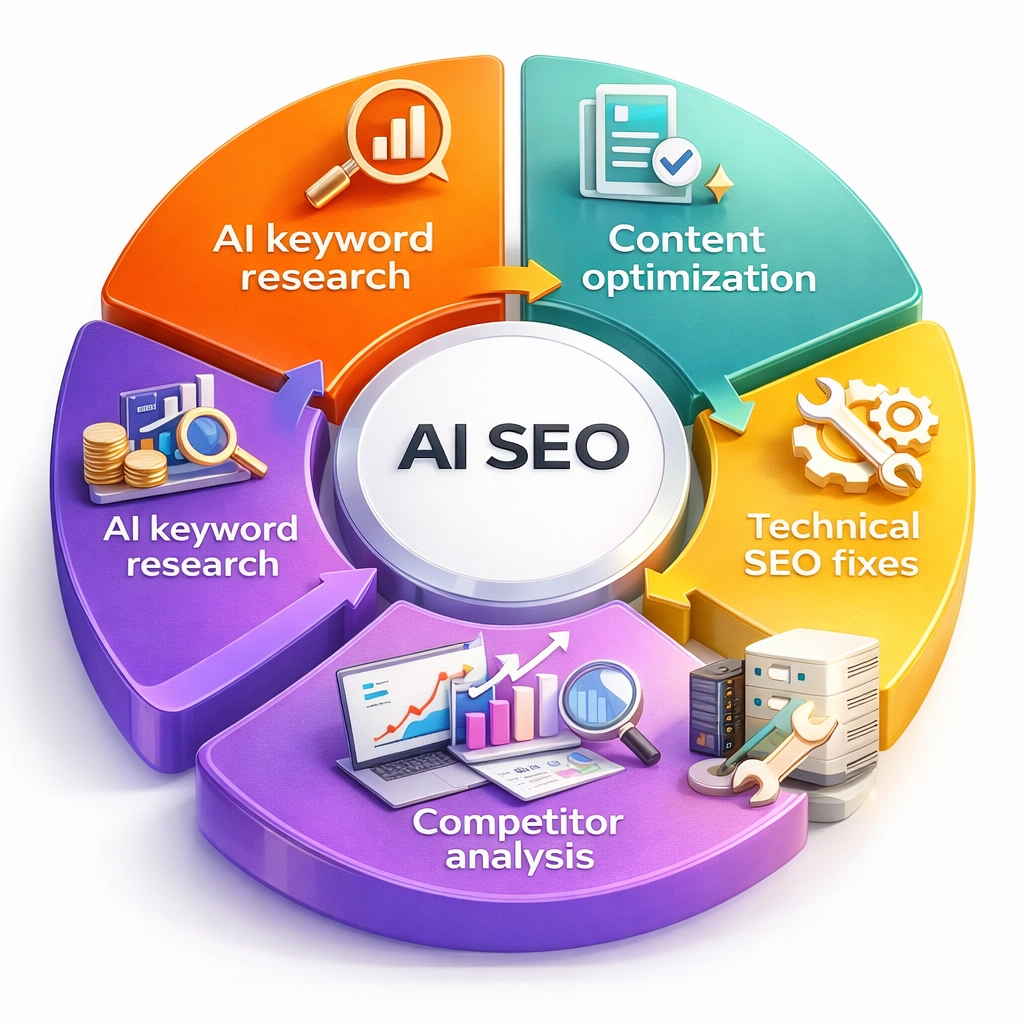
Agency AI SEO refers to the application of machine learning, natural language processing, and predictive analytics to manage search optimization for multiple client accounts. Unlike traditional SEO, which depends heavily on human intuition and manual data collection, AI-driven SEO automates repetitive tasks, uncovers patterns in large datasets, and provides actionable recommendations at scale. For an agency, this means moving from a reactive model—fixing issues after rankings drop—to a proactive model where algorithms flag opportunities before competitors seize them.
The core difference lies in the workflow. A traditional agency might spend 10 hours auditing a website’s technical health. An AI-powered agency uses a tool like Semrush or Ahrefs with machine learning features to generate the same audit in minutes, complete with prioritized fixes. The human team then focuses on strategy, creative content, and client communication—areas where AI still falls short. This hybrid approach is what separates modern agencies from those stuck in manual processes.
Why Agencies Must Adopt AI for SEO
The demand for faster, cheaper, and more effective SEO services has never been higher. Clients expect monthly reports that show growth, not just activity. AI enables agencies to meet these expectations by compressing the time between data collection and implementation. Consider the process of keyword research. A human analyst might identify 200 relevant keywords in a week. An AI tool can analyze millions of search queries, cluster them by intent, and predict click-through rates in under an hour. This efficiency translates directly into better client retention and higher profit margins.
Moreover, Google’s own algorithms are now deeply reliant on AI, particularly the RankBrain and BERT systems. Agencies that understand how to optimize for these AI-driven ranking factors gain a competitive edge. For instance, AI can help identify semantic gaps in content—words and concepts that Google expects to see on a page but are missing. Without AI, these gaps remain invisible to the human eye, resulting in pages that underperform despite having high-quality writing.
Core Components of an Agency AI SEO Strategy
Implementing AI in an agency setting is not about replacing your team with robots. It is about building a tech stack that amplifies human expertise. The following components form the backbone of a successful Agency AI SEO framework.
AI-Powered Keyword Research and Clustering
Traditional keyword tools group terms by volume and difficulty. AI takes this further by analyzing search engine results pages (SERPs) to understand the intent behind each query. Tools like Surfer SEO and MarketMuse use natural language processing to identify topic clusters, not just individual keywords. For an agency managing a client in the legal sector, AI can group keywords like “personal injury lawyer,” “car accident attorney,” and “slip and fall compensation” into a single topical map. This allows the content team to create comprehensive pillar pages that rank for hundreds of related terms simultaneously.
Automated Technical SEO Audits
Crawling a website for broken links, duplicate content, and slow-loading pages is a tedious but necessary task. AI-powered crawlers like Screaming Frog with machine learning add-ons can now prioritize issues based on their potential impact on rankings. Instead of presenting a client with a 500-item audit report, the agency delivers a focused list of the top 20 fixes that will move the needle. This prioritization is the key value-add of AI in technical SEO.
Content Generation and Optimization
AI writing assistants like Jasper and Copy.ai have matured significantly. They can produce draft blog posts, meta descriptions, and product descriptions in seconds. However, the real power lies in AI-driven content optimization. Tools like Clearscope and Frase analyze top-ranking pages for a given query and provide a list of terms and concepts that must be included. The agency’s human writers then use these briefs to craft authoritative, comprehensive content that satisfies both users and search engines. This process reduces the guesswork and increases the probability of ranking on page one.
Predictive Analytics for Reporting
Clients want to know what will happen next, not just what happened last month. AI models can analyze historical ranking data, backlink profiles, and content performance to forecast future traffic. This predictive capability allows agencies to set realistic expectations and adjust strategies before a decline occurs. For example, if the AI model detects that a client’s backlink growth is slowing down, the agency can proactively launch a digital PR campaign to fill the gap.
Benefits of Agency AI SEO
The advantages of integrating AI into an agency’s SEO services extend beyond mere time savings. They fundamentally change the economics of the business.
- Scalability: An agency can manage 50 clients with the same team size that previously handled 20. AI handles the heavy lifting of data processing, freeing up humans for strategic thinking.
- Accuracy: AI eliminates human error in data interpretation. It can detect subtle correlations between on-page changes and ranking fluctuations that a manual analyst might miss.
- Speed: What takes a human days, AI accomplishes in minutes. This speed is critical in competitive niches where being first to publish can determine success.
- Cost Efficiency: While AI tools have subscription costs, they are often cheaper than hiring additional junior staff. The return on investment is realized through higher client retainers and lower delivery costs.
- Competitive Intelligence: AI can monitor competitor strategies in real-time, alerting the agency to new backlinks, content gaps, or technical changes that the competition has made.
- Ignoring the Human Element: AI cannot build relationships with clients or understand their business nuances. Agencies that rely solely on AI for strategy often miss the mark.
- Using AI for Everything: Not every task needs AI. Simple tasks like updating meta titles or fixing broken links are better handled manually. Over-automation leads to unnecessary complexity.
- Neglecting Prompt Engineering: The quality of AI output depends heavily on the quality of the input. Agencies that fail to craft detailed, specific prompts get generic, useless results.
- Failing to Monitor AI Updates: AI tools are constantly evolving. What worked six months ago may be obsolete today. Agencies must stay updated on tool features and algorithm changes.
- Not Setting Client Expectations: Clients may have unrealistic expectations about what AI can achieve. Be transparent about the fact that AI is a tool, not a guarantee of page-one rankings.
Limitations and Risks of AI in SEO
Despite the hype, AI is not a silver bullet. Agencies that blindly trust AI outputs without human oversight risk damaging their clients’ online presence. The following limitations must be acknowledged.
Lack of Creative Judgment
AI can generate content, but it cannot replicate the nuanced voice of a brand or the emotional connection that a skilled copywriter creates. Google’s algorithms are increasingly sophisticated at detecting low-value, AI-generated content that lacks original insights. Agencies must use AI as a starting point, not the final product.
Data Dependency
AI models are only as good as the data they are trained on. If an agency feeds the AI with outdated or biased data, the recommendations will be flawed. This is particularly dangerous in local SEO, where business information changes frequently. A human must always verify the AI’s output before implementing changes.
Over-Reliance on Automation
Some agencies make the mistake of automating everything, including client communication. This leads to generic reports and a lack of personal touch. Clients hire agencies for expertise and partnership, not just software. The human element remains essential for building trust and managing expectations.
Agency AI SEO vs. Traditional SEO: A Comparison
| Aspect | Traditional SEO | Agency AI SEO |
|---|---|---|
| Keyword Research | Manual analysis of spreadsheets | Automated clustering and intent prediction |
| Content Creation | Human writers with limited data | AI-generated briefs with semantic analysis |
| Technical Audits | Manual crawling and issue identification | Automated crawling with prioritized fixes |
| Reporting | Historical data with manual interpretation | Predictive analytics and trend forecasting |
| Scalability | Limited by team size | High scalability with minimal team growth |
| Cost | High labor costs | Lower labor costs, higher tool subscription fees |
| Error Rate | Prone to human error | Lower error rate but requires human validation |
Practical Implementation: A Step-by-Step Guide for Agencies
Transitioning to an AI-powered workflow requires a structured approach.
Step 1: Audit Your Current Tech Stack
Before purchasing new tools, evaluate what you already have. Many existing platforms like Ahrefs, Semrush, and Moz have built-in AI features that are underutilized. Identify the gaps in your workflow—whether it is content optimization, technical auditing, or reporting—and then search for AI tools that fill those specific gaps.
Step 2: Train Your Team on AI Tools
Resistance to change is common. Organize training sessions where your team can experiment with AI tools in a sandbox environment. Show them how AI can reduce their workload, not threaten their jobs. Emphasize that their strategic thinking and client relationship skills are irreplaceable.
Step 3: Start with a Pilot Project
Choose one client with a moderate budget and a clear SEO goal. Implement AI tools for keyword research, content briefs, and monthly reporting. Measure the results against the previous quarter’s performance. Document the time saved and the quality of the output. Use this data to build a business case for rolling out AI across all accounts.
Step 4: Develop an AI Content Review Process
Create a standard operating procedure for AI-generated content. This should include a human review checklist that covers factual accuracy, brand voice, and originality. Never publish AI content without a human editor’s approval. This process protects your clients from Google penalties and maintains the quality of your deliverables.
Step 5: Refine Your Reporting with AI Insights
Move beyond simple traffic and ranking charts. Use AI to generate insights like “The page about ‘best CRM software’ is losing rankings because three new competitors published updated guides this week.” This level of detail demonstrates the value of your agency and justifies your retainer.
Common Mistakes Agencies Make with AI SEO
Adopting AI is not without its pitfalls. Being aware of these common mistakes will save your agency from costly errors.
Important Notes for Agency Owners
When implementing Agency AI SEO, keep these critical points in mind. First, data privacy is paramount. Many AI tools process data in the cloud, which may raise concerns for clients in regulated industries like healthcare or finance. Ensure your tools comply with GDPR and other relevant regulations. Second, the cost of AI tools can add up quickly. Create a budget that accounts for subscription fees, training time, and potential API usage costs. Third, always maintain a backup of your data. If an AI tool experiences an outage, you should still be able to deliver reports to your clients using manual methods.
Another crucial note is the importance of continuous learning. The AI landscape changes monthly. Dedicate time each week for your team to read industry blogs, attend webinars, and test new features. This investment in knowledge will keep your agency ahead of the curve and ensure you are using AI to its full potential.
Frequently Asked Questions
What is the best AI tool for agency SEO?
T For comprehensive keyword research and competitor analysis, Semrush and Ahrefs are industry standards. For content optimization, Clearscope and Surfer SEO are highly effective. For technical audits, Screaming Frog with AI add-ons works well. A combination of tools is often the best approach, with each serving a distinct purpose in the workflow.
Will AI replace SEO professionals?
A The role of the SEO expert is shifting from manual execution to strategic oversight. Professionals who can interpret AI outputs, apply creative judgment, and manage client relationships will remain in high demand. The future belongs to those who view AI as a collaborator, not a competitor.
How much does it cost to implement AI SEO in an agency?
The cost varies widely based on the tools chosen and the scale of implementation. Basic AI-powered SEO tools start at around $100 per month, while enterprise-level platforms can cost over $1,000 per month. Additionally, agencies should budget for training and potential API costs. However, the return on investment is typically positive, as AI reduces labor hours and increases client retention.
Can AI SEO guarantee first-page rankings?
No tool or strategy can guarantee first-page rankings. Google’s algorithms are complex and constantly changing. AI can significantly increase the probability of ranking by identifying the right keywords, optimizing content, and fixing technical issues. However, external factors like competitor actions and algorithm updates can always impact rankings. Agencies should set realistic expectations with clients and focus on long-term growth rather than short-term guarantees.
How does AI handle local SEO for multiple locations?
AI is particularly effective for local SEO because it can automate the management of Google Business Profiles, monitor local citations, and analyze review sentiment across multiple locations. Tools like BrightLocal and Yext use AI to detect inconsistencies in NAP (Name, Address, Phone) data and suggest corrections. This automation is invaluable for agencies managing clients with dozens of physical locations.
Conclusion
The integration of artificial intelligence into agency workflows is no longer a futuristic concept; it is a present-day necessity. Agency AI SEO empowers marketing firms to deliver faster, more accurate, and more scalable results for their clients. By automating tedious tasks, providing deep data insights, and enabling predictive analysis, AI frees up human talent to focus on what truly matters: strategy, creativity, and client relationships. However, success requires a balanced approach. Agencies must combine the analytical power of AI with the irreplaceable judgment of experienced professionals. Those who master this balance will not only survive the evolving digital landscape but thrive in it, setting new standards for what an SEO agency can achieve.
Xem thêm:
- AI SEO SEO Automation Software: The Complete Guide to Scaling Organic Growth in 2025
- WP Trove AI Blogging: The Complete Guide to Automated Content Creation in 2025
- AI SEO Content Workflow: The Complete Blueprint for Scaling Organic Growth in 2025
- AI SEO AI Mention Tracking: The Complete Guide to Monitoring Brand Visibility in the Age of Generative Search
- AI SEO APIs: The Ultimate Guide to Automating Search Optimization with Artificial Intelligence
Bài viết cùng chủ đề:

AI SEO SEO Automation with Make: The Complete Workflow Guide

AI SEO SEO Automation with Zapier: The Complete Workflow Guide

AI SEO SEO Automation with n8n: The Complete Workflow Guide
AI SEO SEO Automation with Gemini: The Complete Guide to Scaling Organic Growth

AI SEO SEO Automation with Claude: The Complete Guide to Scaling Content in 2025

AI SEO SEO Automation with ChatGPT: The Complete Playbook for 2025

AI SEO & SEO Automation for Affiliate Sites: The 2025 Playbook for Passive Income Growth
AI SEO & SEO Automation for Bloggers: The Complete Guide to Scaling Your Content

AI SEO & SEO Automation for Agencies: The Complete 2025 Playbook

AI SEO and SEO Automation for Ecommerce: The Complete Playbook for 2025

AI SEO & SEO Automation for WordPress: The Complete Playbook for 2025
AI SEO SEO Automation Strategy: The Complete Playbook for 2025

Mastering the AI SEO SEO Automation Process: A Complete Guide to Scaling Organic Growth
AI SEO SEO Automation System: The Complete Guide to Scaling Organic Growth in 2025
AI SEO SEO Automation Platform: The Complete Guide to Scaling Organic Growth in 2025
AI SEO SEO Automation Software: The Complete Guide to Scaling Organic Growth in 2025















