
No products in the cart.
AI SEO APIs: The Ultimate Guide to Automating Search Optimization with Artificial Intelligence
29
Jul
Jul
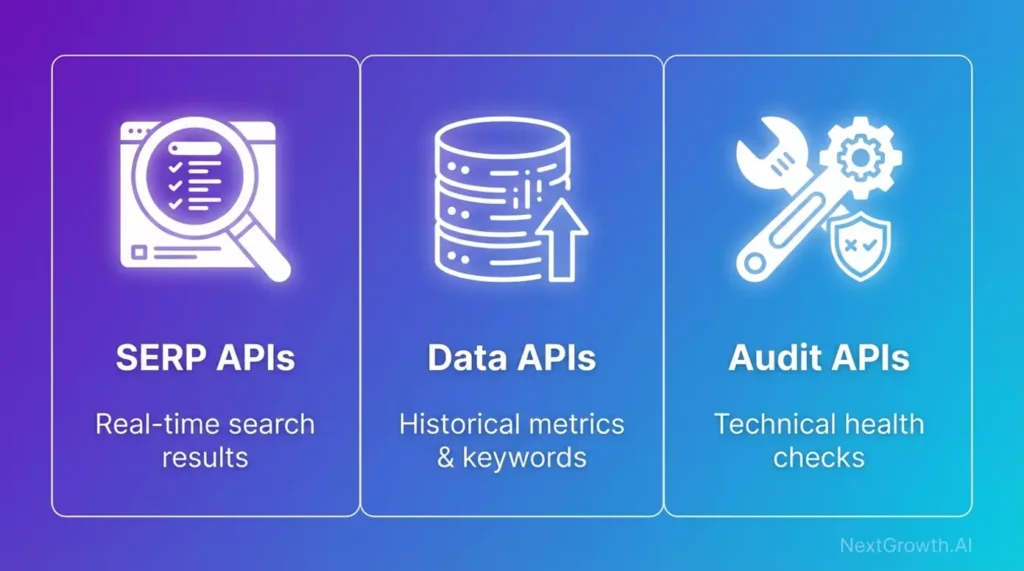
Mastering search engine optimization now demands more than just manual keyword tracking and content tweaking. AI SEO APIs have emerged as the backbone of modern digital marketing stacks, enabling businesses to connect directly to machine learning models and search data pipelines. These application programming interfaces allow you to pull real-time rankings, analyze content quality at scale, generate optimized copy, and even predict algorithm shifts—all without leaving your own tools and dashboards. Whether you run an agency handling hundreds of clients or manage an in-house marketing team, understanding how AI SEO APIs function unlocks a new level of efficiency and precision.
What Exactly Are AI SEO APIs?
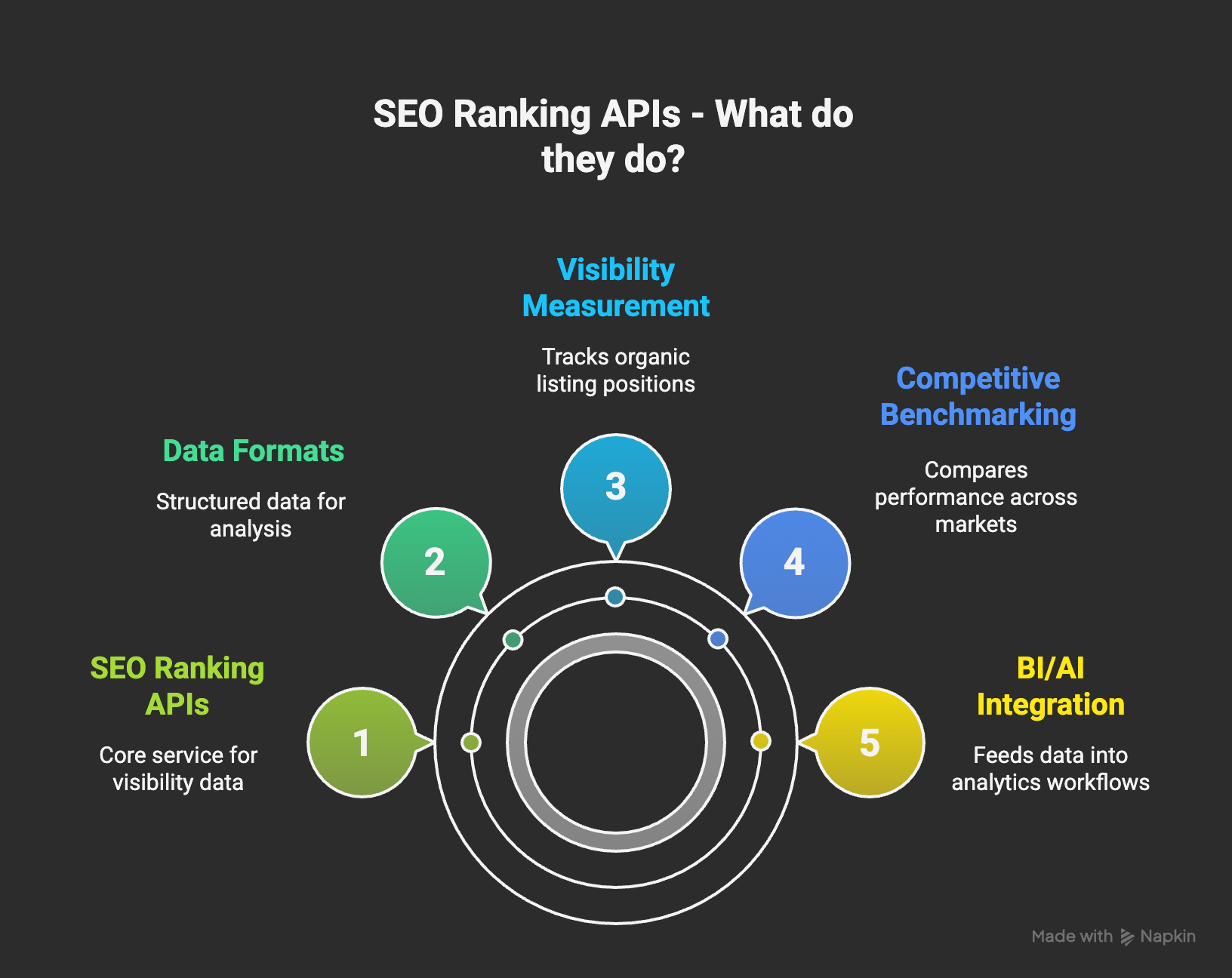
At their core, AI SEO APIs are web services that expose artificial intelligence capabilities specifically tailored for search engine optimization tasks. Unlike traditional SEO tools with graphical interfaces, an API gives you programmatic access to functionalities like natural language processing, ranking data, content scoring, and SERP feature detection. You send a request with parameters—such as a target keyword, a URL, or a block of text—and receive structured data in return. This data can be parsed, stored, and actioned by your own applications or workflows.
The “AI” component distinguishes these from older, rules-based SEO APIs. They use machine learning models trained on vast corpora of search results, user behavior signals, and language patterns. For example, an API might simulate how Google’s BERT or MUM algorithms evaluate content, providing granular suggestions on entity coverage, readability, and topical depth. Another might analyze backlinks and predict their likelihood to pass value based on historical patterns. The common thread is that AI SEO APIs transform raw data into strategic insights with minimal human intervention.
Core Components and How AI SEO APIs Work
To fully leverage these integrations, it helps to understand the technical anatomy. Most AI SEO APIs follow a RESTful architecture, accepting JSON payloads and returning responses in the same format. The typical flow involves authentication via an API key, sending a POST or GET request to an endpoint, and handling the response. Behind the scenes, the API provider’s servers run heavy computational workloads using GPUs or TPUs to process natural language, crawl simulation data, or run predictive models.
Natural Language Understanding Engines
Many AI-driven SEO APIs rely on transformer-based models. These engines can extract entities, measure sentiment, identify key phrases, and assess content’s alignment with search intent. When you submit a draft article, the API dissects it into tokens, compares the semantic structure to top-ranking pages, and returns an optimization score or a list of missing subtopics. This is far more advanced than simple keyword density checks.
Search Data Aggregation Layers
Some AI SEO APIs focus on fetching and interpreting live SERP data. They pool results from multiple geographic locations and device types, then apply AI to detect patterns usually hidden to the naked eye. For instance, an API might identify that a video carousel appears only when the query contains certain action verbs, or that featured snippets correlate strongly with question-based subheadings. This intelligence can be programmatically fed into content brief generators or rank tracking dashboards.
Predictive Analytics Modules
Advanced APIs go beyond reporting the current state and offer forecasting. By ingesting historical ranking fluctuations, algorithm update timelines, and competitive movements, machine learning algorithms can estimate the potential impact of an SEO change before you deploy it. This is especially valuable for enterprise teams managing large-scale site migrations or content pruning projects. The API might predict a temporary ranking dip or highlight which pages are at risk of losing traffic.
Key Categories of AI SEO APIs
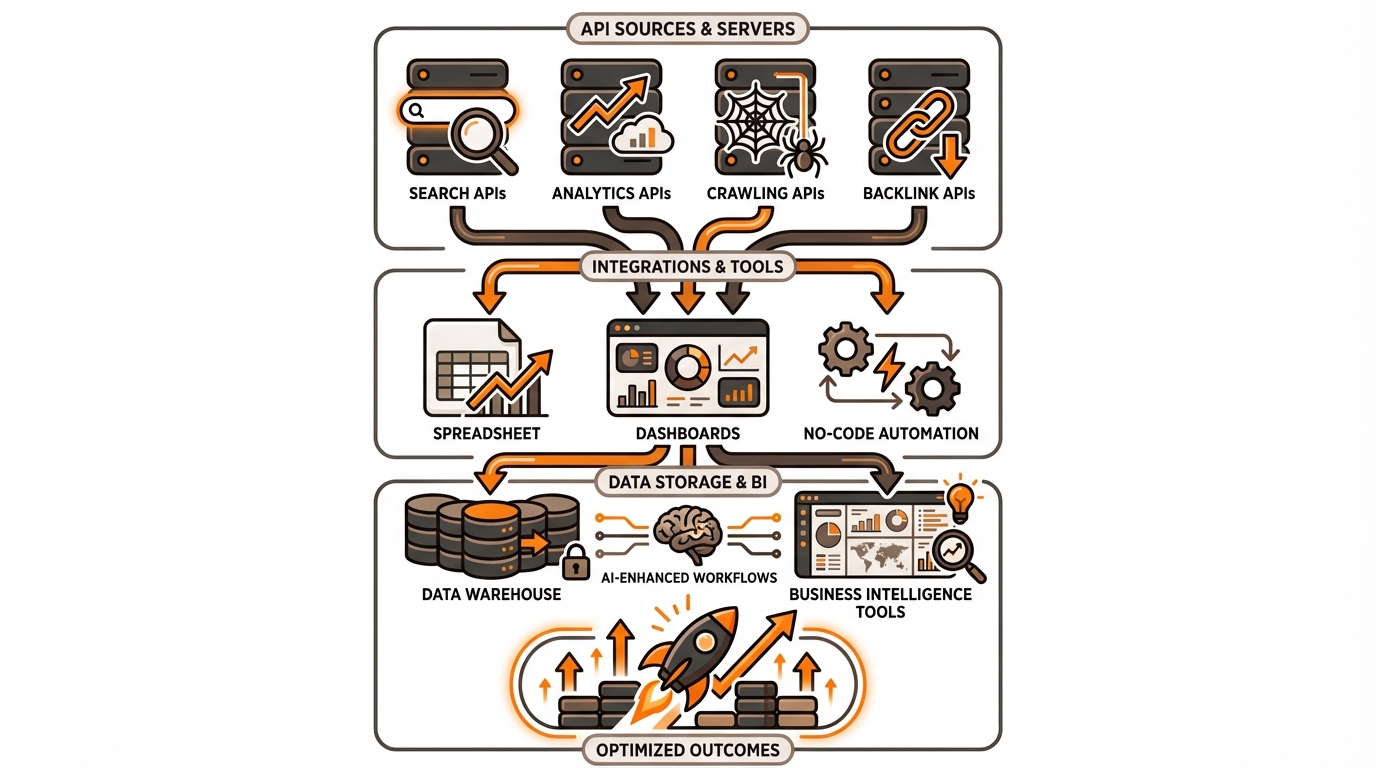
The landscape is diverse, but most solutions fall into a few distinct buckets. Understanding these categories helps you pick the right building blocks for your workflow, rather than overpaying for monolithic suites.
| Category | Primary Function | Example Data Returned |
|---|---|---|
| Content Intelligence APIs | Evaluate and optimize text for search intent, readability, and entity coverage | Content score, top competitor outlines, recommended keywords, internal link suggestions |
| Rank Tracking & SERP APIs | Retrieve real-time or scheduled ranking positions and SERP features | Position for URL/keyword, SERP feature presence (featured snippet, People Also Ask), local pack data |
| Technical SEO Audit APIs | Scan websites for crawlability, speed, structured data issues | Core Web Vitals metrics, missing schema types, broken link reports, mobile usability flags |
| Keyword Research APIs | Generate keyword ideas and provide search volume, difficulty, and trend data | Related queries, seasonality curves, CPC estimates, SERP feature opportunity scores |
| Backlink Analysis APIs | Assess link profiles and authority metrics using AI | Domain authority, spam score, anchor text distribution, lost/new link alerts |
| Generative AI APIs for SEO | Create or rewrite content like meta descriptions, title tags, and full articles | Generated text blocks, A/B test variations, schema markup suggestions |
In practice, many modern platforms combine elements from several categories. For instance, a content API might also pull live SERP data to ground its recommendations, or a rank tracker might use generative AI to suggest title tag improvements based on winning snippets. This convergence is one of the biggest trends in AI SEO APIs.
Benefits of Integrating AI SEO APIs Into Your Stack
Moving from manual analysis to API-driven automation delivers advantages that compound over time. The most immediate win is speed. Tasks that once took hours—like auditing a 10,000-page site for content gaps—become near-instantaneous. You can run daily checks and catch issues before they cause ranking drops. Scalability follows: the same API handles one URL or one million without extra effort on your side.
Accuracy is another major benefit. Human reviewers get fatigued and may overlook thin content or keyword cannibalization patterns. An AI model trained on the latest search behavior consistently applies criteria, often surfacing correlations that humans miss. Moreover, AI SEO APIs remove much of the guesswork from optimization. Instead of relying on outdated best practices, you base decisions on data that reflects how search engines actually interpret your pages right now.
Cost reduction is often overlooked. By embedding SEO intelligence directly into your CMS, you empower content creators to self-optimize in real time, reducing the need for multiple rounds of editorial review. Developers can build automated reports that replace expensive third-party licenses. And because APIs allow granular usage, you pay only for the data points you actually need, rather than full platform subscriptions.
Finally, competitive differentiation emerges. When your team can programmatically monitor SERP feature opportunities and automatically adjust content to capture them, you’re playing a faster game than competitors who rely on weekly manual checks. The first-mover advantage in featured snippets or “People Also Ask” boxes can translate directly into traffic gains.
Limitations and Challenges of AI SEO APIs
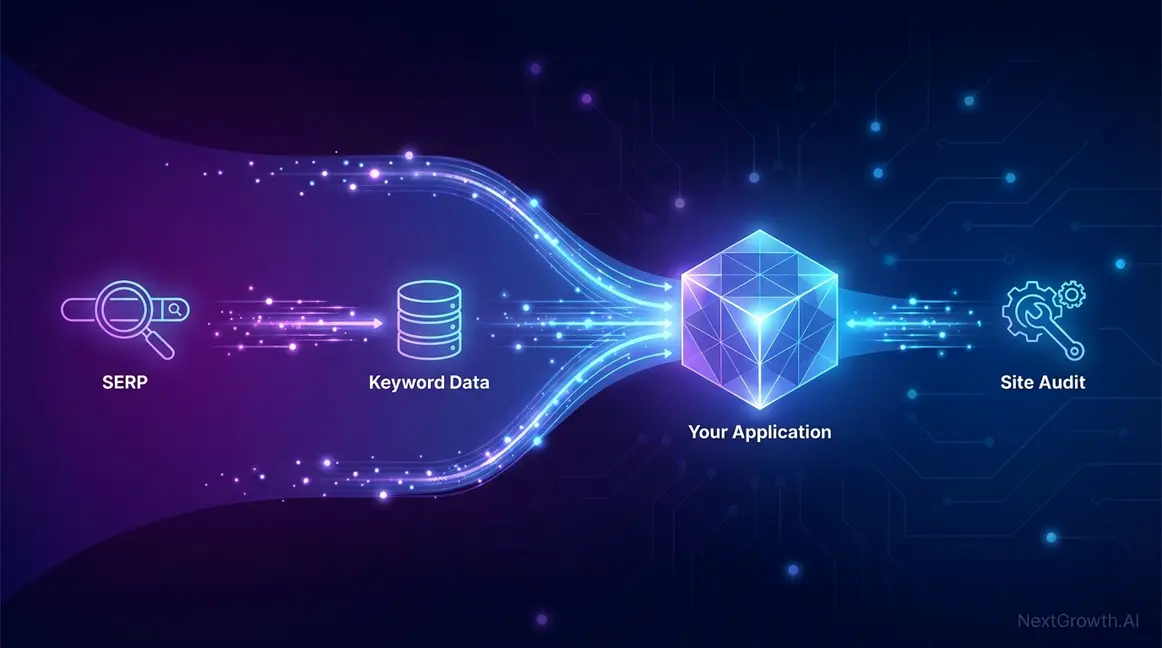
Despite their power, these tools come with caveats that any implementation plan must address. Data latency is a common pain point. Even the best rank tracking APIs have a delay between when a search engine updates its results and when the API reflects it. Real-time APIs claim freshness, but regulatory or technical constraints often introduce a lag of a few hours. For high-frequency trading of SEO data, this can be a problem.
Model opacity is another concern. Many AI SEO APIs operate as black boxes—you receive a content score but not the exact weighting behind it. This can make it difficult to explain recommendations to stakeholders or to fine-tune your own optimization strategy. Over-reliance on a single API’s scoring can also create a herd effect, where multiple sites end up with homogenized content because everyone follows the same AI-driven advice.
API rate limits and cost scaling can catch teams by surprise. If you’re running large crawls daily, the bill can skyrocket. Some providers impose complex usage tiers that require careful budgeting. Additionally, handling sensitive client data through third-party APIs raises security and compliance questions, especially under GDPR or CCPA. You need to verify data residency, encryption standards, and whether the provider uses your inputs to train its models.
Finally, AI is not infallible. Algorithms can misinterpret niche topics, especially in technical or medical fields where domain-specific language is common. An API trained on general web content may penalize perfectly valid industry jargon. Human oversight remains essential to validate critical recommendations before applying them to live sites.
Practical Applications: How to Use AI SEO APIs Effectively
To see concrete value, you need to map the APIs to real workflows. Below are battle-tested applications that span content, technical, and strategic SEO.
Automated Content Optimization at Scale
Imagine your editorial team produces 200 articles a month. Instead of manually checking each one for intent match, you plug a content intelligence API into your CMS. As writers draft, the API scores the document in real time against the top 10 ranking pages. It highlights missing entities, suggests header improvements, and flags overly complex sentences. A final report gets attached to the piece before publishing. This reduces the editorial bottleneck and ensures every page is primed for search before it goes live.
For e-commerce, a generative AI SEO API can create unique product descriptions for thousands of SKUs by combining product specifications with high-intent keyword clusters. A script pulls data from the PIM, sends it to the API, and populates the meta tags and page copy. The result is a dynamic, SEO-friendly catalog that would be impossible to produce manually.
Real-Time SERP Monitoring and Alerting
Large brands often watch hundreds of thousands of keywords. A rank tracking API can push data into a custom dashboard or a cloud database like BigQuery. The AI layer then runs anomaly detection: if a URL drops out of the top 3 for a high-value term without an obvious cause, an alert fires in Slack. Similarly, you can monitor for new SERP features—like a local pack appearing on a national query—and automatically trigger content tasks to address that shift. The speed advantage means you can react to algorithmic changes days before manual analysts even notice.
Technical SEO Audits in CI/CD Pipelines
Modern development teams push code multiple times a day. A technical SEO API integrated into the CI/CD pipeline checks every deploy for critical issues: accidentally blocked pages, missing canonical tags, performance regressions. If Lighthouse scores drop or new noindex tags appear, the deployment can be rolled back automatically. This “SEO as code” practice prevents costly mistakes from reaching production and keeps the entire engineering team accountable for search visibility.
Competitive Gap Analysis and Opportunity Mining
By combining a keyword research API with a content intelligence API, you can programmatically discover where competitors rank but you don’t. The system pulls their keyword list, filters by difficulty and volume, then cross-references your existing content. For each gap, the API generates a content brief, including recommended word count, headers, and entities. This brief flows directly into your project management tool, assigning a writer with all required information. The entire process runs weekly without any human intervention, keeping your pipeline filled with high-opportunity topics.
Comparing AI SEO API Providers: What to Look For
Choosing a provider goes beyond feature lists. You need to evaluate on dimensions that matter for long-term integration. Use the following criteria to guide your RFP or vendor evaluation.
| Evaluation Criteria | Why It Matters |
|---|---|
| Model Training Data Freshness | Models trained on stale SERP data will produce outdated advice. Look for providers that retrain frequently (at least quarterly) and disclose their training window. |
| API Latency and Uptime SLAs | If your CMS calls an API on every save, response time under 500ms is critical. Enterprise-grade SLAs (99.9% uptime) prevent workflow disruptions. |
| Customization and Fine-tuning | Some APIs let you upload proprietary data to bias the model. This is invaluable for niche industries where generic models underperform. |
| Data Compliance Certifications | Verify SOC 2, ISO 27001, and GDPR compliance. Confirm whether your content is used for model training (opt-out should be available). |
| Pricing Transparency | Beware of hidden costs like extra charges for crawling, data storage, or exceeding rate limits. Request a simulation for your expected volume. |
| Integration Ecosystem | Check for native connectors to popular CMSs, cloud platforms, and data warehouses. A well-documented REST API with open-source SDKs reduces integration time. |
| Support and Documentation Quality | Comprehensive docs with code examples in multiple languages and an active developer community signal a mature product. |
In addition to these criteria, perform a proof of concept with a subset of your data. Measure whether the API’s recommendations, when applied, actually improve organic traffic over a 4-8 week period. Direct correlation can be noisy, so pair it with a holdout group or use synthetic control methods where possible.
Common Mistakes When Using AI SEO APIs
Even well-intentioned teams fall into traps that undermine the value of these tools. Awareness is the first step to avoidance.
- Blindly following scores without context. A content API might flag a page as “low intent match,” but if that page serves a unique audience need not reflected in the top results, listen to your users. Scores are signals, not mandates.
- Ignoring rate limits and throttling logic. Aggressive API calls can lead to your IP being blocked or unexpected charges. Always implement exponential backoff and respect Retry-After headers.
- Neglecting data sanitization. If you accidentally send personally identifiable information (PII) in a content payload, that data may end up in logs. Build guardrails to strip sensitive text before API calls.
- Using a single API as the single source of truth. Cross-reference insights from multiple providers when possible. If two independent APIs both highlight a cannibalization issue, you have a stronger case for action.
- Skipping version pinning. AI models evolve. If an API provider updates its model without backward compatibility, your automated pipelines could break or produce inconsistent recommendations. Pin to a specific model version where the provider supports it, and test upgrades in a staging environment.
- Over-automating without human review loops. Automatically rewriting title tags or meta descriptions based on an API can backfire if the generated copy is tonally off-brand. Keep editorial approvals for customer-facing text, using the API as a recommendation engine rather than a final publisher.
Important Notes for Secure and Sustainable Implementation
Security is often the last consideration but the most damaging when overlooked. Always store API keys in environment variables or a secrets manager, never in source code repositories. Rotate keys regularly and set usage alerts to detect anomalies that might indicate a compromise. When integrating AI SEO APIs into production systems, use HTTPS exclusively and validate SSL certificates.
Sustainability also means controlling costs. Monitor API usage dashboards, set budget caps, and implement circuit breakers that pause non-critical calls when costs spike. Identify which endpoints truly drive ROI; a rank tracker called 100 times a day might be wasteful if rankings shift slowly in your niche. Optimize the frequency based on statistical significance of changes.
Long-term success requires ongoing model validation. Plan for quarterly reviews where you assess whether the API’s guidance still aligns with your organic performance. If traffic drops on pages optimized per the API’s suggestions, dig into root causes. The search landscape shifts, and a provider’s models might lag behind. A healthy feedback loop between your analytics and the API’s output ensures you’re not optimizing for a past version of the algorithm.
Frequently Asked Questions About AI SEO APIs
What is the difference between an AI SEO API and a traditional SEO API?
Traditional SEO APIs typically return raw data: rankings, backlinks, or on-page metrics without interpretation. An AI SEO API applies machine learning to that data to produce insights, predictions, and actionable recommendations. For example, instead of just giving you the list of keywords a page ranks for, it might analyze whether those keywords collectively satisfy the main topic intent and suggest missing semantic entities.
How much do AI SEO APIs typically cost?
Pricing varies widely. Some providers offer free tiers with limited monthly calls, suitable for testing. Mid-range plans for small businesses often range from $50 to $500 per month for a reasonable query volume. Enterprise contracts with custom SLAs, dedicated endpoints, and high throughput can exceed $10,000 monthly. Many charge per API call, per row of data returned, or per thousand words processed. Always calculate based on projected usage to avoid surprises.
Can AI SEO APIs replace human SEO experts?
No. These APIs are force multipliers, not replacements. They handle data processing and pattern recognition at scale, but strategy, creative direction, and nuanced interpretation still require human expertise. An API might tell you a page’s readability is too complex, but a human decides whether that complexity is necessary for a technical audience. The most successful implementations pair AI-driven signals with experienced practitioners who validate and contextualize the output.
Are there open-source AI SEO APIs available?
Several open-source projects provide NLP and SEO-related functionalities, but fully packaged AI SEO APIs with comprehensive search data are rare due to the cost of crawling and training. You can build your own stack by combining open-source libraries (like Hugging Face transformers for content analysis) with freely available APIs from search engines for basic data, but this requires significant engineering effort. Commercial offerings generally deliver faster time-to-value.
What programming languages can I use to connect to AI SEO APIs?
Most APIs are language-agnostic and communicate via JSON over HTTP. You can use Python, JavaScript (Node.js), PHP, Ruby, Java, or any language capable of making HTTP requests. Official SDKs are often provided for the most popular languages, simplifying authentication and pagination. Even low-code platforms can call these APIs through webhooks and HTTP connectors, making them accessible to non-developers.
Conclusion
AI SEO APIs represent a seismic shift from reactive, manual search optimization to proactive, data-driven automation. They allow anyone—from solo bloggers to Fortune 500 enterprises—to embed real-time intelligence into their content and technical workflows. The key is strategic integration: understanding exactly which API capabilities serve your specific goals, rigorously testing outputs, and maintaining the human oversight that turns machine signals into meaningful competitive advantage. As search engines themselves become more AI-centric, the organizations that master these programmatic building blocks will be the ones that consistently capture visibility. Start small with one high-impact use case, measure the business outcome, and expand from there. The era of guessing what works in SEO is over; the age of programmatic certainty has begun.
Xem thêm:
- AI Proofreading: The Complete Guide to Flawless, Professional Writing at Scale
- AI SEO Optimization: The Complete Guide to Dominating Search with Artificial Intelligence
- How to Build AI Content Systems: A Complete Guide to Scalable, Intelligent Content Operations
- WP Trove SEO Workflow: The Complete Guide to Streamlining WordPress Search Optimization
- AI SEO Generative Search Ranking: The Complete Playbook for 2025
Bài viết cùng chủ đề:

AI SEO SEO Automation with Make: The Complete Workflow Guide

AI SEO SEO Automation with Zapier: The Complete Workflow Guide

AI SEO SEO Automation with n8n: The Complete Workflow Guide
AI SEO SEO Automation with Gemini: The Complete Guide to Scaling Organic Growth

AI SEO SEO Automation with Claude: The Complete Guide to Scaling Content in 2025

AI SEO SEO Automation with ChatGPT: The Complete Playbook for 2025

AI SEO & SEO Automation for Affiliate Sites: The 2025 Playbook for Passive Income Growth
AI SEO & SEO Automation for Bloggers: The Complete Guide to Scaling Your Content

AI SEO & SEO Automation for Agencies: The Complete 2025 Playbook

AI SEO and SEO Automation for Ecommerce: The Complete Playbook for 2025

AI SEO & SEO Automation for WordPress: The Complete Playbook for 2025
AI SEO SEO Automation Strategy: The Complete Playbook for 2025

Mastering the AI SEO SEO Automation Process: A Complete Guide to Scaling Organic Growth
AI SEO SEO Automation System: The Complete Guide to Scaling Organic Growth in 2025
AI SEO SEO Automation Platform: The Complete Guide to Scaling Organic Growth in 2025
AI SEO SEO Automation Software: The Complete Guide to Scaling Organic Growth in 2025















