
No products in the cart.
How AI B2B SEO is Redefining Lead Generation and Organic Growth
29
Jul
Jul
The fusion of artificial intelligence and B2B search engine optimization has moved from experimental curiosity to competitive necessity. AI B2B SEO automates complex data analysis, transforms how enterprise marketers interpret buyer intent, and dramatically accelerates content strategies that once took months to execute. What used to rely on spreadsheets, manual audits, and guesswork now runs on algorithms that predict search trends, identify hidden revenue opportunities, and personalize content journeys for decision-makers deep inside the buying cycle. This shift impacts everything from technical site architecture to the very language used in whitepapers and case studies. The result is a discipline that delivers measurable pipeline growth, not just vanity traffic.
What Exactly is AI B2B SEO?
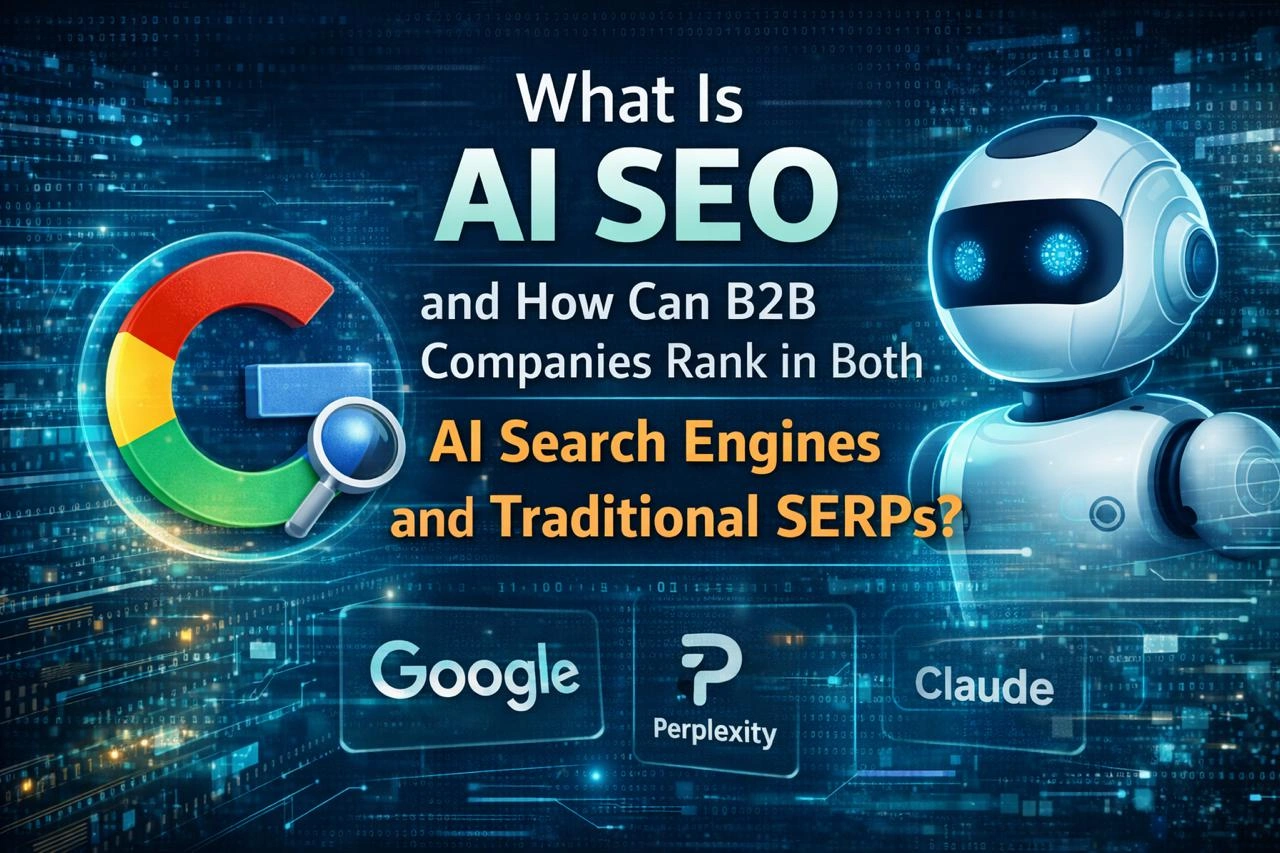
AI B2B SEO refers to the systematic use of machine learning, natural language processing, and predictive analytics to optimize every layer of a B2B website’s organic performance. Unlike traditional SEO that leans heavily on manual keyword lists and rule-based optimization, AI-driven approaches ingest millions of data points from search engines, CRM systems, competitor landscapes, and user behavior to make real-time recommendations. The technology identifies which topics resonate with buying committees, when to publish content for maximum impact, and how to align technical health scores with Google’s evolving algorithms. In essence, it turns SEO from a reactive guessing game into a proactive, data-science-driven engine. The core objective remains the same: connect high-value business buyers with exactly the information they need to move toward a purchase. AI simply makes that connection smarter and faster.
How AI Fundamentally Changes B2B SEO Components
The transformation touches every pillar of organic search. Below are the critical components where AI injects precision and scale that human teams alone cannot match.
Keyword Research and Intent Mapping
Manual keyword research typically clusters terms by volume and difficulty. AI B2B SEO goes deeper. Natural language models analyze the contextual relationships between thousands of queries used by CFOs, engineers, and procurement managers. They detect micro-intents such as “budget justification,” “technical comparison,” or “vendor evaluation” that hide behind broad head terms. Tools powered by AI segment audiences by buying stage and recommend clusters of B2B keywords that align with account-based marketing initiatives. This means your content calendar can be built around revenue signals, not just search volume.
Content Creation and Optimization at Scale
For B2B companies producing technical whitepapers, solution briefs, and in-depth blog posts, AI serves as a co-pilot. It can generate topic outlines based on competitor gaps, score existing content against top-performing pages for entity coverage, and suggest semantic improvements that align with E-E-A-T signals. By analyzing thousands of industry documents, AI identifies missing entities and subtopics that Google expects from an authoritative piece. The technology can even draft initial sections that human subject matter experts then refine, cutting production time by half while maintaining depth and accuracy.
Technical SEO Audits with Predictive Diagnostics
Crawling a large B2B site with tens of thousands of pages generates enormous log files. AI algorithms parse these logs, correlate crawl frequency with conversion events, and pinpoint technical issues before they cause ranking drops. They go beyond finding broken links and missing meta tags; they predict how a change in page speed or indexability might affect organic conversions based on historical patterns. An AI system might tell you that fixing a crawl budget waste on product category pages will increase leads from a specific region by 12 percent, allowing you to prioritize tasks by business outcome.
Link Building and Digital PR with Intelligent Prospecting
Outreach for B2B link building traditionally involves spray-and-pray email campaigns. AI transforms this by analyzing the link graphs of entire industries, identifying sites that link to multiple competitors but not to you, and scoring them by domain authority, traffic relevance, and editorial quality. It can predict the likelihood of a positive response based on past messaging patterns and even generate personalized pitch templates that match the tone of each target publication. This turns link acquisition from a volume game into a precision-targeted demand generation channel.
Performance Forecasting and ROI Measurement
Perhaps the most powerful evolution is the ability to forecast organic traffic and lead conversions under different scenario conditions. Using historical data, market seasonality, and competitive shifts, AI models predict the revenue impact of an upcoming content campaign or site migration. CMOs can see projected pipeline contribution before a single piece of content is written, making SEO investment conversations far more concrete and trusted at the boardroom level.
The AI B2B SEO Process: From Raw Data to Revenue
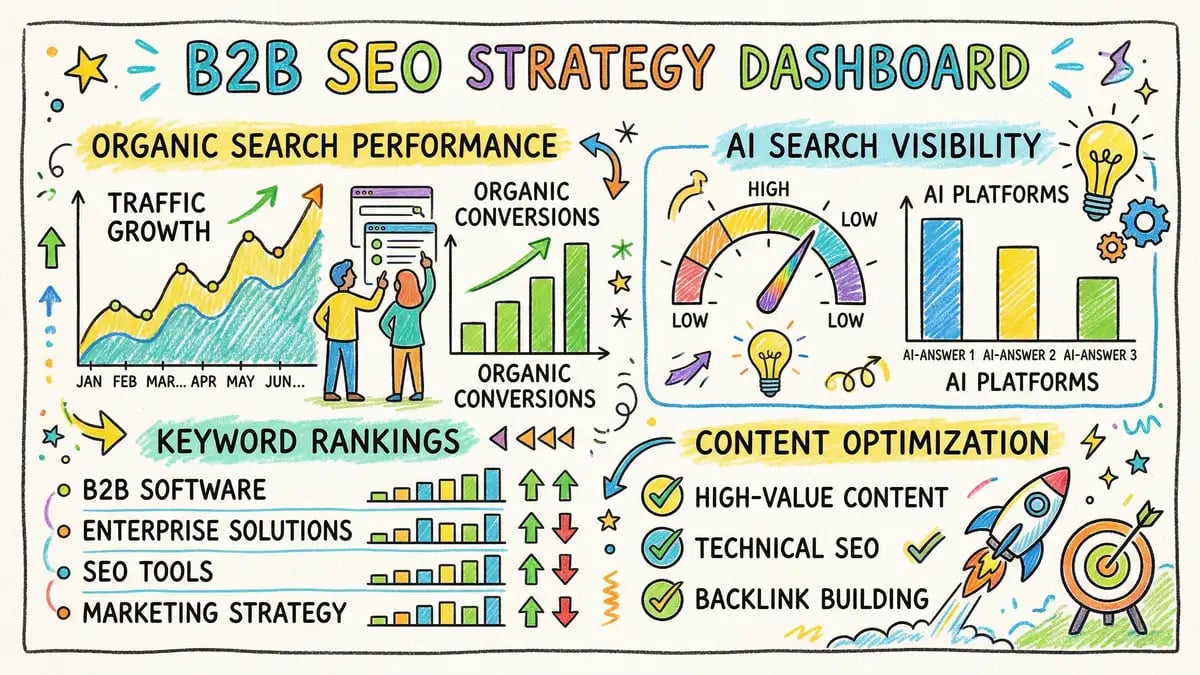
While every organization adapts the workflow differently, a mature AI B2B SEO process follows a recurring loop of data ingestion, insight generation, execution, and feedback. First, the system aggregates internal CRM data, web analytics, competitive intelligence, and search engine result page features. It then runs pattern recognition models to identify which content types, topics, and page attributes most strongly correlate with qualified lead conversions. Insights are translated into prioritized task lists—whether that means creating a new pillar page, refreshing outdated articles, or restructuring site architecture. Once executed, the loop continues by measuring how these changes shift lead quality, engagement time, and pipeline velocity, feeding back into the model for continuous refinement. This closed-loop approach ensures that SEO never drifts away from business goals.
Benefits of AI B2B SEO That Directly Impact the Bottom Line
The measurable advantages go far beyond saving time. Companies that embed AI into their organic strategy consistently report improvements in lead quality, content efficiency, and competitive differentiation. A few standout benefits include:
- Higher lead-to-MQL conversion rates: By aligning content with hidden intent patterns, visitors find material that answers their exact stage-specific questions, increasing demo request rates.
- Faster content development cycles: Research and briefing time shrinks from weeks to days, allowing teams to respond to market shifts and competitor moves faster.
- Greater share of voice in long-tail B2B queries: AI discovers high-intent, low-volume phrases that collectively drive a significant portion of qualified traffic.
- Reduced dependency on paid channels: As organic lead generation becomes more predictable and scalable, cost-per-lead drops relative to paid search and social.
- Enhanced content governance: AI flags duplicate, thin, or outdated pages that dilute authority, preserving domain health across sprawling B2B sites.
- Unify your data foundation. Connect your SEO platform with your MAP (Marketo, HubSpot) and CRM (Salesforce). Ensure you can track anonymous visitors to known leads and to opportunities. Without this, AI cannot learn which content drives revenue.
- Select the right AI tooling stack. Common enterprise options include BrightEdge, MarketMuse, SurferSEO for content intelligence, Botify or Deepcrawl for technical diagnostics, and custom models using Google’s Vertex AI or Amazon SageMaker for proprietary analysis. Start with one layer—content or technical—and expand.
- Train models with business-specific data. Off-the-shelf AI tools often lack context about what a “good lead” means for your business. Fine-tune recommendation engines by labeling URLs that have historically generated MQLs versus those that only attracted informational traffic.
- Run a hybrid content workflow. Let AI generate topic clusters and first-draft outlines. Have technical product marketers and customer success leaders review for accuracy and industry nuance. Publish with human oversight and track engagement signals.
- Create an AI-assisted technical workflow. Set up automated alerts for index bloat, orphaned pages, and page speed degradation. Use AI to simulate how core algorithm updates might impact your key landing pages, then pre-emptively adjust.
- Measure what matters. Replace “organic sessions” with “organic influenced pipeline” as the north star metric. Use multi-touch attribution models to see how AI-optimized pages accelerate deal velocity for specific accounts.
- Institutionalize feedback loops. Every quarter, audit which AI recommendations were implemented and whether the predicted uplift materialized. Re-train models on this outcome data to improve accuracy over time.
- Treating AI output as final copy. Publishing raw AI-generated text without human refinement leads to generic, factually questionable content that erodes trust with educated B2B audiences.
- Ignoring long-tail commercial intent queries. AI tools often surface broad informational topics. Teams must deliberately train models to uncover the “vs” comparisons, pricing queries, and integration questions that signal active buying behavior.
- Neglecting technical debt. Pouring AI resources into content while ignoring crawl budget inefficiencies and slow mobile rendering means great content may never get indexed properly.
- Failing to align with the sales cycle. B2B buyers revisit content multiple times across a 6-12 month journey. If AI recommendations only target early-stage awareness, you miss the middle and bottom-of-funnel micro-moments that convert.
- Over-segmentation without holistic view. Creating thousands of hyper-targeted pages for every intent can fragment domain authority and confuse search engines about your site’s topical expertise.
Limitations and Honest Challenges to Consider
AI B2B SEO is not magic. It requires clean, well-structured data sources to function properly. If your CRM is a mess or analytics tracking is broken, the insights will be misleading. Overreliance on automation can strip away the nuanced understanding of complex industries where subject matter expertise is paramount. An AI might suggest sensational language that departs from the measured tone expected by procurement leaders, damaging trust. T Most critically, Google’s guidelines against scaled content abuse mean that companies must use AI responsibly—the technology should augment human creativity and oversight, not replace it entirely. Finally, B2B sales cycles are long and multi-touch; attributing revenue directly to an AI-optimized page requires sophisticated attribution models that many organizations still lack.
Traditional B2B SEO vs AI-Driven B2B SEO: A Side-by-Side Comparison
| Aspect | Traditional B2B SEO | AI-Driven B2B SEO |
|---|---|---|
| Keyword Selection | Based on manually gathered lists and volume estimates | Based on predictive intent modeling and CRM pipeline data |
| Content Planning | Reactive to competitor moves and trending topics | Proactive gap analysis with ROI forecasting for each topic |
| Technical Audits | Periodic crawls with static checklists | Continuous monitoring with predictive issue scoring |
| Link Building | Mass outreach and generic prospecting | AI-scored prospect lists with personalized, data-backed pitches |
| Performance Reporting | Rear-view metrics like rankings and traffic | Forward-looking pipeline projections and conversion path analysis |
| Scalability | Highly dependent on team size and hours | Scalable across hundreds of thousands of pages without linear cost increase |
Practical Guide: Implementing AI B2B SEO in Your Organization
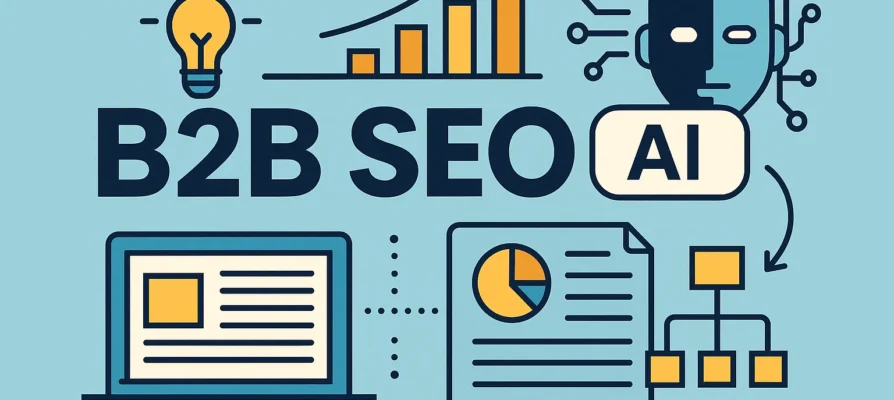
Moving from concept to execution requires a structured approach.
Common Mistakes That Undermine AI B2B SEO Success
Even sophisticated teams fall into traps that kill ROI and alienate buyers. The most frequent errors include:
Important Notes for Long-Term Success with AI B2B SEO
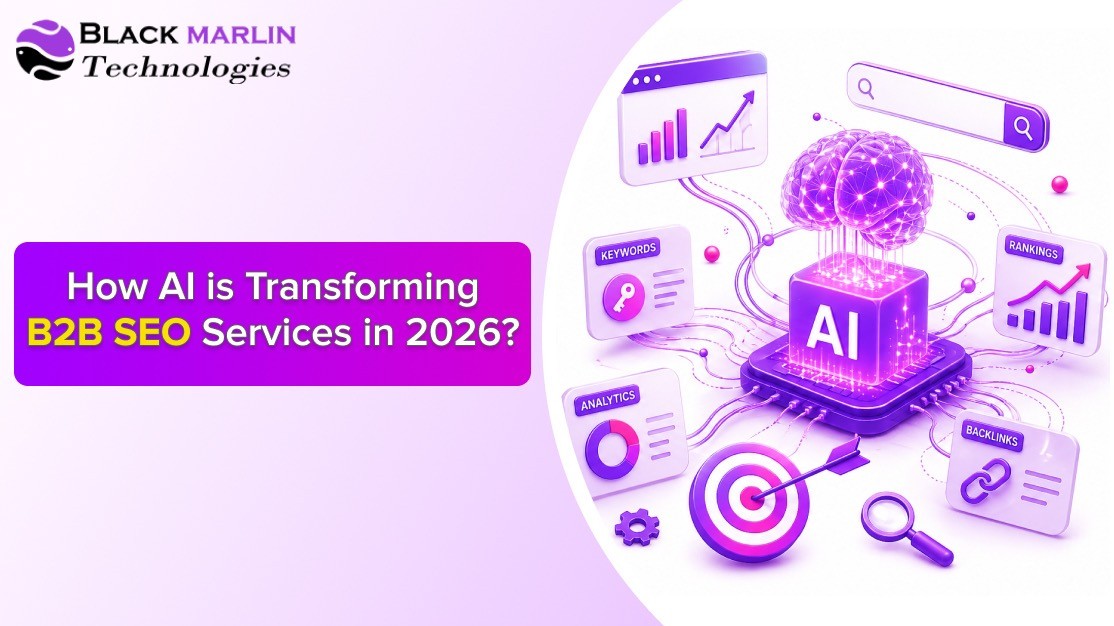
Sustained impact demands more than technology adoption. First, maintain a deep respect for E-E-A-T. Your content must still demonstrate first-hand industry experience, genuine expertise, and corporate trustworthiness—signals that AI alone cannot fabricate. Use AI to identify what to say, but let real practitioners shape how it’s said. Second, build internal competencies. Train SEO managers in data interpretation and prompt engineering so they can guide the machine rather than being replaced by it. Third, never lose sight of the end buyer. The most elegantly optimized page flops if it reads like a robot wrote it for a keyword. B2B decisions involve high stakes; content must reflect the serious, consultative nature of the relationship. Fourth, adapt to Google’s own AI evolution. With Search Generative Experience (SGE) rolling out, AI B2B SEO strategies must now optimize for appearing in AI-generated snapshots and maintaining visibility in a radically different SERP layout. Fifth, prioritize ethical data practices. Auditing competitor strategies via AI is fine; scraping personal data or manipulating rankings through deceptive AI content is not. Reputation damage in B2B circles is swift and long-lasting.
Frequently Asked Questions
How does AI B2B SEO differ from regular B2B SEO?
AI B2B SEO replaces manual, rule-based processes with machine learning models that analyze large datasets to predict intent, automate content optimization, and forecast organic revenue. It focuses on connecting SEO directly to pipeline metrics rather than just traffic growth.
Can AI completely replace B2B SEO strategists?
No. AI excels at data processing and pattern recognition, but it cannot replace the strategic thinking, industry empathy, and editorial judgment required to create content that genuinely influences complex B2B purchase decisions. Human oversight remains essential for credibility and brand voice.
Which AI tools are best for B2B keyword research?
Tools like MarketMuse, Clearscope, and Semrush’s AI-powered keyword magic tool are effective because they cluster keywords by topic authority and buyer intent rather than just search volume. Choose platforms that integrate with your CRM to map keywords to revenue opportunities.
Is AI-generated content penalized by Google for B2B websites?
Google does not penalize content simply because it is AI-generated, but it does penalize low-quality, unoriginal content created solely to manipulate rankings. B2B sites must ensure AI-assisted content demonstrates clear expertise, first-hand insight, and value to the reader to comply with quality guidelines.
How can AI improve B2B lead generation through organic search?
AI identifies search queries with high commercial intent that traditional keyword tools miss, optimizes landing pages to match those queries, and personalizes content recommendations based on visitor firmographic data. This directly increases demo requests and contact form submissions from relevant accounts.
What is the biggest risk of implementing AI B2B SEO too quickly?
The biggest risk is scaling low-quality, undifferentiated content that damages your domain’s authority and trust with search engines and buyers. A rapid rush to automate without proper content governance can result in a permanent drop in rankings that takes months to recover from.
Where AI B2B SEO is Headed Next
The convergence of generative AI, real-time search data, and deep CRM integration will make SEO an even more central piece of B2B revenue architecture. We are moving toward a reality where an AI engine can detect a spike in “budget holder” queries within a specific industry and automatically adjust your content strategy, technical structure, and even paid campaign bidding to capture that demand surge within hours. Companies that build the data foundation, the human-AI collaboration muscle, and the ethical framework now will own the organic acquisition channel in the years ahead. For B2B organizations that treat organic search as a profit center rather than a cost center, AI B2B SEO is the multiplier that turns their expertise into predictable, scalable growth.
Xem thêm:
- AI SEO Reports: How Intelligent Automation Redefines Search Performance Analysis
- AI SEO Ecommerce Schema: The Complete Guide to Structured Data That Drives Sales
- AI SEO Content Updates: The Complete Guide to Staying Ahead in 2025
- AI SEO Redirects: The Complete Guide to Smarter Link Management in 2025
- AI SERP Analysis: Unleashing the Power of Artificial Intelligence to Decode Search Results
Bài viết cùng chủ đề:

AI SEO SEO Automation with Make: The Complete Workflow Guide

AI SEO SEO Automation with Zapier: The Complete Workflow Guide

AI SEO SEO Automation with n8n: The Complete Workflow Guide
AI SEO SEO Automation with Gemini: The Complete Guide to Scaling Organic Growth

AI SEO SEO Automation with Claude: The Complete Guide to Scaling Content in 2025

AI SEO SEO Automation with ChatGPT: The Complete Playbook for 2025

AI SEO & SEO Automation for Affiliate Sites: The 2025 Playbook for Passive Income Growth
AI SEO & SEO Automation for Bloggers: The Complete Guide to Scaling Your Content

AI SEO & SEO Automation for Agencies: The Complete 2025 Playbook

AI SEO and SEO Automation for Ecommerce: The Complete Playbook for 2025

AI SEO & SEO Automation for WordPress: The Complete Playbook for 2025
AI SEO SEO Automation Strategy: The Complete Playbook for 2025

Mastering the AI SEO SEO Automation Process: A Complete Guide to Scaling Organic Growth
AI SEO SEO Automation System: The Complete Guide to Scaling Organic Growth in 2025
AI SEO SEO Automation Platform: The Complete Guide to Scaling Organic Growth in 2025
AI SEO SEO Automation Software: The Complete Guide to Scaling Organic Growth in 2025















