
No products in the cart.
AI Backlink Analysis: Smarter Link Audits, Stronger Rankings, Faster Growth
29
Jul
Jul
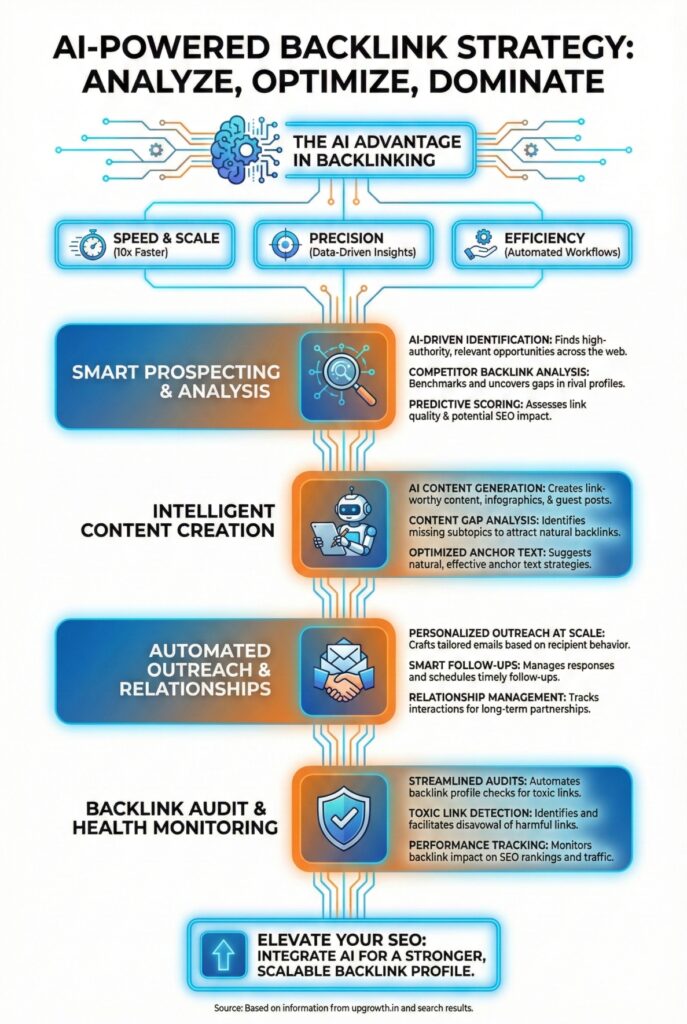
Search engine optimization has always been a game of trust signals, and backlinks remain one of the loudest voices in that conversation. For years, the process of auditing a link profile was manual, slow, and riddled with guesswork. AI backlink analysis changes that entirely. It transforms raw data from tools like Ahrefs, Majestic, and Google Search Console into actionable intelligence, helping you identify toxic links before they trigger a penalty, spot untapped opportunities your competitors missed, and understand the exact velocity at which your authority is growing. If you still sift through spreadsheets line by line, you are leaving rankings on the table.
What Is AI Backlink Analysis?
At its core, backlink analysis is the process of evaluating every external link pointing to your website: who is linking, how they link, what anchor text they use, and whether those links pass value or harm. AI backlink analysis supercharges this process using machine learning models, natural language processing, and pattern recognition algorithms that learn from massive datasets of ranking fluctuations and penalty histories. Instead of applying static rules like “domain authority below 20 is bad,” an AI model considers hundreds of signals simultaneously: the semantic relevance of the linking page’s content, the historical trust trajectory of that domain, unnatural anchor text clustering, link velocity spikes, and whether the surrounding textual context is genuinely editorial or fabricated.
Traditional tools flag a link based on a pre-set score. AI systems, by contrast, can recognize the subtle fingerprints of Private Blog Networks that have matured over two years, differentiate a natural mention from a paid insertion even when the post is well-camouflaged, and predict the probability that a link will still exist and hold value twelve months from now. This moves analysis from reactive cleanup to proactive strategy.
The Core Components of an AI-Powered Link Audit
A comprehensive AI backlink analysis platform doesn’t just count links. It dissects them across several layers. Understanding these components helps you choose the right tool and interpret the output correctly.
1. Contextual Relevance Scoring
Old-school relevance checks relied on keyword matching between the linking page and your site. AI goes deeper. It uses entity recognition and topic modeling to understand what the linking page is truly about. A link from a page that discusses “post-workout recovery routines” will carry more semantic weight for a supplement brand than a page with a high domain rating but written about “office ergonomics,” even if both contain the word “health.” AI models calculate a true relevance score by analyzing the entire content vector, not isolated keywords.
2. Toxic Link Probability Modeling
Detecting harmful links is the highest-stakes part of any audit. Here, AI replaces rigid threshold checks with probabilistic classification. The model ingests historical disavow files, real penalty recovery cases, and confirmed deindexed networks. It then assigns each link a toxicity probability based on patterns like: footer links in side-wide placements, links from domains with disproportionately high outbound link counts and zero organic traffic, exact-match anchor text appearing across dozens of unrelated referring domains within a short time window, and pages that mix thinly spun content with aggressive ad density. A single link with a 97% toxicity probability is a clear removal candidate.
3. Link Equity and Traffic Quality Prediction
Not all followed links pass value. AI models now incorporate browser clickstream data and traffic estimations to predict whether a link will actually send qualified referral visitors or if it sits on a page that ranks for nothing and receives no human eyes. This matters because Google’s systems increasingly consider user engagement signals. A link from a relevant blog post that consistently sends 200 monthly visitors is far more valuable than a.edu link buried in an unvisited forum thread. AI weights links by their predicted “equity flow score.”
4. Anchor Text Distribution Analysis
Manual examination of anchor text often ends with a simple ratio of branded versus exact-match anchors. AI backlink analysis clusters anchor text variations semantically, even if they use different words. It understands that “click here for SEO tips,” “learn more about search optimization,” and “best SEO guide” all belong to the same topical cloud. The system then compares your distribution against healthy, top-ranking competitors and raises alerts only when the semantic cluster for a specific money keyword exceeds natural thresholds, factoring in the site’s overall size and age.
5. Link Velocity and Temporal Pattern Detection
Gaining 5,000 links in a month isn’t inherently bad if they come from genuine viral content picked up by major news outlets. Gaining 5,000 links from low-quality directory sites, all with the same anchor text and all published on the same weekday, triggers a manipulation pattern. AI algorithms map link growth curves over time and compare them to statistical norms for your niche. They detect anomalous spikes, unnatural plateaus, and sudden link loss cliffs that warrant investigation.
How AI Backlink Analysis Works: The Underlying Process
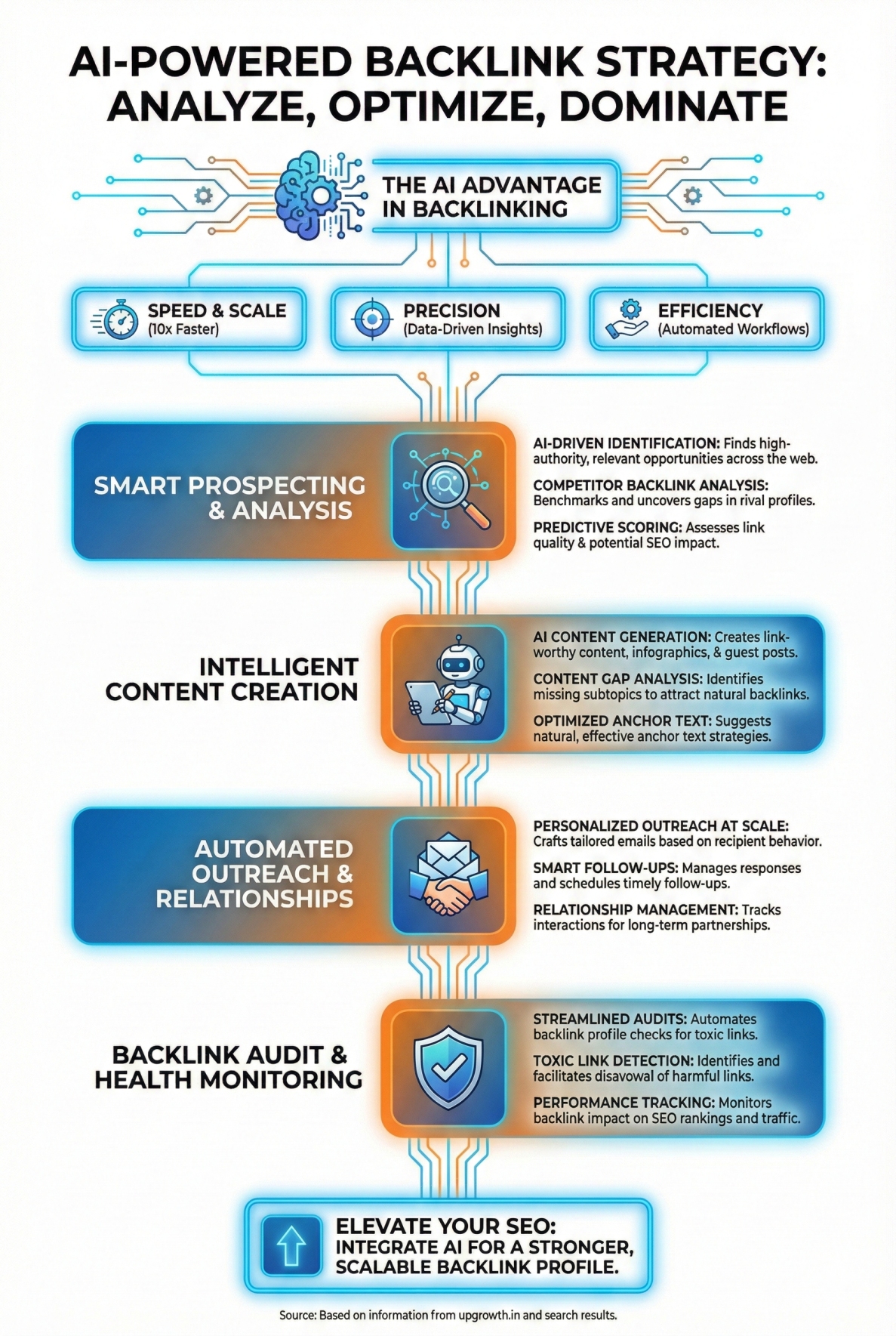
Whether you use a dedicated tool or an API integration, the workflow follows a logical pipeline. First, the system crawls and aggregates your backlink data from multiple sources, often combining link index APIs with your own Google Search Console export. Then it cleans the data, removing redirect chains and duplicates. The transformation phase is where AI shines:
- Feature extraction: modern models pull thousands of features per link, including domain history, WHOIS data patterns, content readability scores, image uniqueness, and even social sharing signals of the linking page.
- Embedding and clustering: linking pages are converted into vector embeddings. Links naturally group into meaningful clusters—one might represent genuine editorial coverage, another a low-value blog commenting campaign.
- Classification models: gradient-boosted trees, transformer networks, or ensemble models assign labels (toxic, suspicious, high-value, neutral) and confidence scores.
- Prioritization engine: the output is a ranked action list. Instead of a flat spreadsheet, you get a guided workflow: “These 23 links have a 95%+ chance of being algorithmically devalued; export for disavow review. These 14 domains show high authority and topical overlap; reach out for relationship building.”
- Reduction in false positives: manual or rule-based systems flag roughly 15-20% of clean links as potentially harmful. AI reduces this to under 4% in well-trained models, meaning fewer wasted hours chasing ghosts and a lower risk of accidentally disavowing quality links.
- Faster penalty recovery: when a site gets hit by a manual action or algorithmic devaluation, AI tools can analyze years of link history in minutes and surface the exact pattern that likely triggered the penalty—often a specific PBN footprint or a coordinated negative SEO attack—cutting recovery time by half.
- Competitor gap intelligence at scale: instead of exporting 50,000 competitor links and manually grouping them, AI instantly highlights “links your top 3 competitors share that you don’t” and ranks them by likelihood of acquisition success based on the target domain’s historical linking behavior.
- Proactive risk management: AI models can run continuous monitoring, alerting you when your site’s risk profile crosses a threshold before any manual action arrives, allowing you to pre-emptively disavow or clean up.
- Training data bias: many models are trained predominantly on English-language spam patterns. A site operating in a non-English niche with different linking norms may see inflated toxicity scores for perfectly normal regional directories.
- Adversarial adaptation: sophisticated black-hat SEOs now design PBNs specifically to mimic the signals AI tools look for in “clean” sites, including varied anchor text and realistic traffic patterns. No model stays ahead forever.
- Context blindness: an AI can’t fully understand that a link placed in a journalist’s article that reads “this company got caught spamming” is harmful despite being on a high-authority news domain, because the sentiment is profoundly negative. Sentiment analysis models are improving but still miss nuanced reputational damage.
- Dependency on link index freshness: even the best AI can only analyze what the crawlers find. If a major link index has not yet discovered a new harmful link, the analysis has a gap.
- Treating the AI score as absolute truth: a 2% toxicity probability still means two out of a hundred similar links are harmful. Blindly trusting the number leads to skipped reviews. Always calibrate with human judgment on critical domains.
- Neglecting follow-up audits: running one AI analysis and disavowing once does not solve the problem permanently. Spam attacks and negative SEO evolve. Set up weekly or monthly automated rescans.
- Ignoring the “messy middle”: analysts tend to focus on the clear toxic spam and the clear editorial wins, while ignoring thousands of links with moderate authority but low relevance. These collectively shape your site’s overall trust score. AI highlights them, but teams often skip cleansing this layer, missing a significant ranking lever.
- Over-disavowing based on AI fear: some tools flag any link from a domain with less than 10 traffic. If your niche is academic research or niche B2B, many high-value, contextually perfect links naturally come from low-traffic sources. Disavowing them bleeds your authority. Always verify the “why” behind a high-risk flag.
- Failing to integrate with overall SEO strategy: AI link analysis data should feed into your content planning. If the model finds you’re over-optimized for exact-match anchors about “cheap CRM,” but your sales pages rank for transactional queries, you may need to build more branded, top-of-funnel links to balance your profile. The data drives editorial decisions, not just technical cleanup.
Benefits You Can Quantify
Shifting to AI backlink analysis produces measurable outcomes beyond saved time. Marketers who adopt it often report:
Limitations and Blind Spots to Watch
AI is powerful, but it is not immune to error. Trusting it blindly is dangerous. The most common limitations include:
AI Backlink Analysis vs. Traditional Manual Analysis: A Detailed Comparison
Many teams still run link audits manually, particularly in highly regulated industries. Here’s how the two approaches stack up across key dimensions.
| Factor | Manual Analysis | AI Backlink Analysis |
|---|---|---|
| Speed for 50,000 links | 40-80 hours, often split across multiple analysts | 5-15 minutes for initial classification |
| Pattern recognition | Prone to missing subtle footprints (e.g., a PBN using identical template themes but different IPs) | Detects non-obvious footprint clusters via network graph analysis |
| Consistency | Varies by analyst fatigue; same link might be judged differently on Tuesday morning vs. Friday afternoon | Applies identical logic to every link; scoring is reproducible |
| Anchor text nuance | Humans excel at understanding the creative or ironic use of anchor text | Struggles with sarcasm, idioms, or highly specialized jargon without extensive domain fine-tuning |
| Cost per audit | High labor cost; $500-$2,000+ depending on profile size | Variable; many platforms include AI modules at $100-$300/mo, making per-audit cost negligible at scale |
| Strategic insight | Analyst can read competitor blog posts and deduce relationship-building tactics | Delivers statistical patterns; needs a human to translate “95% similar link profile” into a replicable outreach strategy |
The table makes clear that the strongest approach is a hybrid one: let AI do the heavy lifting of filtering, scoring, and clustering, then have a skilled SEO review the high-impact decisions before acting on them.
Practical Guide to Implementing AI Backlink Analysis
Moving from curiosity to execution requires a structured plan. Follow these steps to integrate AI into your link auditing workflow without confusion.
Step 1: Select Your Data Sources and Tooling
Start by choosing a platform that offers genuine AI backlink analysis, not just a renamed rule engine. Look for features like “toxicity probability” (not just “toxic”), semantic anchor text grouping, and automated disavow file generation. Tools that provide APIs let you connect data directly to your internal dashboards. Common enterprise-grade options include SEMrush’s Backlink Audit tool with its AI-driven toxicity classifier, Ahrefs’ link intersect combined with their machine learning processing for new link alerts, and dedicated solutions like Kerboo or LinkResearchTools which specialize in link risk management. For smaller budgets, some custom Google Sheets extensions now integrate with OpenAI’s API to run qualitative analysis on exported link lists, though they require careful prompt engineering.
Step 2: Aggregate and Normalize Your Backlink Profile
AI models work best with a complete picture. Connect your link index provider (e.g., Ahrefs or Majestic) and Google Search Console simultaneously. Many spammy links are not found in third-party indexes but are visible in Search Console’s “Top linking sites” report. Normalize all URLs to a common format, remove internal links, and strip UTM parameters before feeding the data into the AI system. Clean ingestion prevents false flags later.
Step 3: Run the Initial AI Analysis and Review the Risk Matrix
After processing, you’ll receive a dashboard with links binned by risk and value. Do not immediately export and disavow everything marked “high risk.” Instead, sort by the toxicity probability score. Manually spot-check a random sample of 20-30 links in each bin. Look for patterns: are all high-risk links coming from domains ending in.xyz and using a specific CMS? Does a medium-risk group consist entirely of legitimate industry forum posts? This verification step tunes your trust in the model and catches systematic errors early.
Step 4: Automate the Decision Pipeline
Once you’re confident in the model’s accuracy for your niche, set up automated rules. For example: “Any link with toxicity probability >95% AND originating from a domain with zero organic keywords → automatically add to disavow draft.” For links in the 70-95% range, create a task for a junior analyst to review within 48 hours. Automate alerts when your site gains links from domains that match a known PBN fingerprint, allowing you to disavow before Google indexes them. This proactive stance is only possible with real-time AI monitoring.
Step 5: Transform Competitive Intelligence into Link Acquisitions
Use the AI’s clustering output to understand the topical neighborhoods where your competitors earn links. The system might reveal that three out of four of your main rivals have extensive links from review sites that compare software in your category, but with a distinct focus on integration capabilities. Your content gap is clear: you lack a technical integration page that those review sites want to link to. Build that asset, then use the AI-generated prospect list to launch a targeted outreach campaign. This closes the loop from analysis to ROI.
Common Mistakes That Sabotage AI Backlink Analysis
Even with advanced tools, teams undermine their results through easily avoidable errors. Recognize these pitfalls and correct them.
Important Notes for Staying Penalty-Proof
Google’s algorithms, including SpamBrain, now preemptively devalue links without waiting for a manual penalty. This means your rankings can drop without a notice in Search Console. AI backlink analysis helps you see what Google likely already ignores. Key practices: maintain a natural anchor text distribution with 50-70% branded or URL anchors; avoid reciprocal link patterns visible as two-way linking clusters; ensure link growth is continuous but not linear, mimicking natural editorial discovery; and periodically review the link profile of any site you acquire. Mergers often bring legacy toxic links that the previous owner ignored.
Frequently Asked Questions
What exactly is AI backlink analysis?
AI backlink analysis uses machine learning and natural language processing to automatically evaluate the quality, relevance, and risk level of every link pointing to a website. It goes beyond static metrics by learning from historical data on what links actually impact rankings or cause penalties, then classifying links with probabilistic scores and actionable recommendations.
Can AI backlink analysis replace manual link reviews entirely?
Not completely. AI handles scale and pattern recognition far better than humans, but it still struggles with context, sarcasm, and the intent behind a link. The optimal workflow uses AI for initial triage and clustering, with experienced SEOs reviewing borderline cases and making final strategic decisions, especially for high-stakes disavow actions.
How accurate are AI toxicity scores?
Top AI-driven tools achieve over 90% accuracy in identifying truly harmful links on well-trained datasets. However, accuracy varies by niche. In industries with unusual linking norms or in languages other than English, the false positive rate can increase. Always validate the first few audits manually to build trust in the model.
Does AI backlink analysis help with link building, or just cleanup?
It supports both. By analyzing competitor profiles, AI can identify untapped link opportunities and prioritize them by likelihood of acquisition. It can also uncover content gaps: topics that earn links for your rivals but not for you. This moves the analysis beyond defense into an active growth tool.
What data sources do I need to run an effective AI analysis?
At minimum, connect a major backlink index (like Ahrefs or SEMrush) and Google Search Console. The combination provides both the broad view of discovered links and the specific list Google itself uses for your site. For advanced work, also integrate log file data and web analytics to correlate actual organic traffic drops with specific link-loss events.
How often should I perform an AI-driven link audit?
High-risk sites in competitive niches benefit from real-time or weekly automated monitoring. For stable, established brands with consistent editorial link growth, a monthly deep audit plus continuous alerts for anomalies is usually sufficient. After a site migration, domain acquisition, or viral content event, run an immediate full analysis.
Bringing Intelligence to Your Link Strategy
Link graphs grow more complex every day, and Google’s evaluation systems advance in lockstep. AI backlink analysis isn’t a luxury anymore; it is the rational response to link data that no team can process manually. By understanding what the technology does, where its blind spots lie, and how to embed it into a repeatable workflow, you turn backlink management from a defensive chore into a competitive weapon. Start with a single audit, verify the results against your own expertise, and gradually increase automation. The outcome is a cleaner, stronger, faster-growing link profile that supports long-term organic visibility without constantly living in fear of the next algorithm update.
Xem thêm:
- AI A/B Testing: The Complete Guide to Automated Experimentation That Outperforms Traditional Methods
- AI SEO Screaming Frog: The Complete Guide to Smarter Technical Audits
- AI SEO Keyword Clustering Tool: The Complete Guide to Smarter Content Optimization
- AI SEO Product Category SEO: The Complete Guide to Scaling Category Pages
- AI Rewrite Tool: The Ultimate Guide to Rewriting Content with Artificial Intelligence
Bài viết cùng chủ đề:

AI SEO SEO Automation with Make: The Complete Workflow Guide

AI SEO SEO Automation with Zapier: The Complete Workflow Guide

AI SEO SEO Automation with n8n: The Complete Workflow Guide
AI SEO SEO Automation with Gemini: The Complete Guide to Scaling Organic Growth

AI SEO SEO Automation with Claude: The Complete Guide to Scaling Content in 2025

AI SEO SEO Automation with ChatGPT: The Complete Playbook for 2025

AI SEO & SEO Automation for Affiliate Sites: The 2025 Playbook for Passive Income Growth
AI SEO & SEO Automation for Bloggers: The Complete Guide to Scaling Your Content

AI SEO & SEO Automation for Agencies: The Complete 2025 Playbook

AI SEO and SEO Automation for Ecommerce: The Complete Playbook for 2025

AI SEO & SEO Automation for WordPress: The Complete Playbook for 2025
AI SEO SEO Automation Strategy: The Complete Playbook for 2025

Mastering the AI SEO SEO Automation Process: A Complete Guide to Scaling Organic Growth
AI SEO SEO Automation System: The Complete Guide to Scaling Organic Growth in 2025
AI SEO SEO Automation Platform: The Complete Guide to Scaling Organic Growth in 2025
AI SEO SEO Automation Software: The Complete Guide to Scaling Organic Growth in 2025















