
No products in the cart.
AI SEO Keyword Clustering Tool: The Complete Guide to Smarter Content Optimization
10
Aug
Aug
Search engine optimization has evolved far beyond simple keyword matching. Modern SEO professionals understand that search intent, topical authority, and semantic relevance drive rankings more than isolated keyword density. This is where an AI SEO Keyword Clustering Tool becomes indispensable. These intelligent platforms analyze vast datasets, group related search terms into meaningful clusters, and reveal the underlying themes that connect user queries. By leveraging machine learning algorithms, these tools transform raw keyword lists into structured content strategies that align with how Google interprets topical relevance. This comprehensive guide explores everything about AI-powered keyword clustering, from fundamental concepts to advanced implementation strategies.
What Is an AI SEO Keyword Clustering Tool?
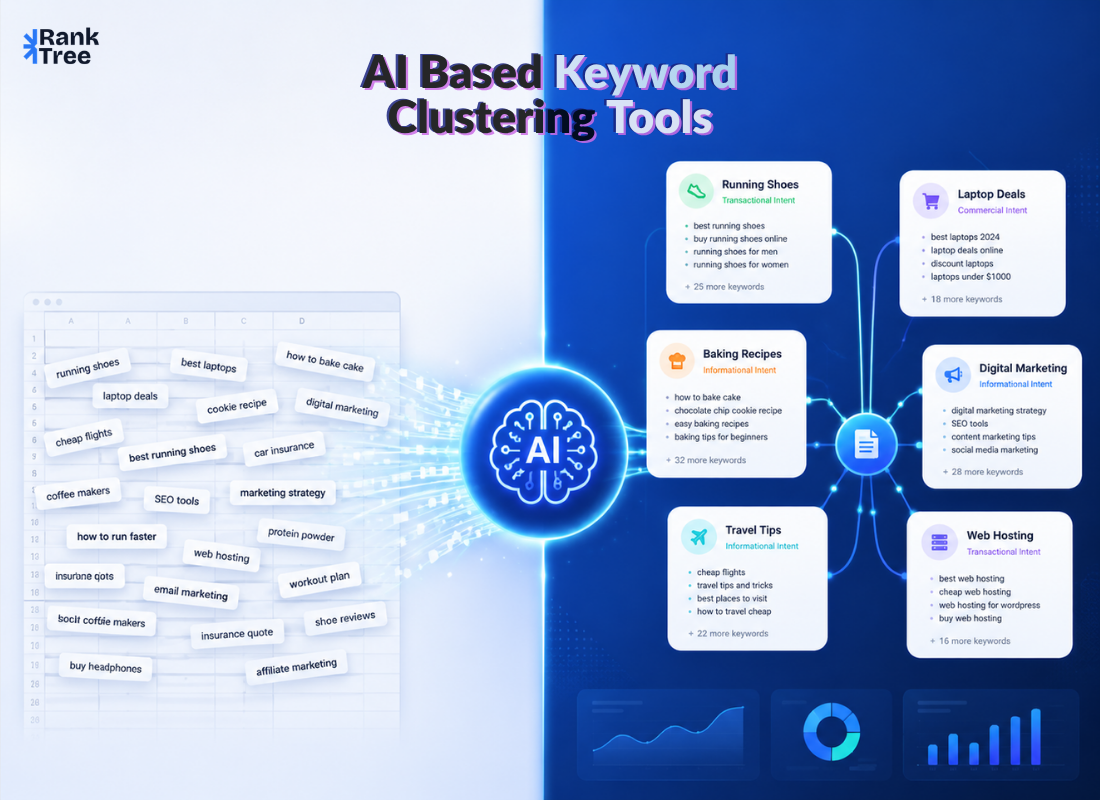
An AI SEO Keyword Clustering Tool is a software solution that uses artificial intelligence and natural language processing to automatically group keywords based on search intent, semantic similarity, and topical relevance. Unlike traditional grouping methods that rely on exact-match variations or manual categorization, AI-powered tools understand the contextual meaning behind queries. They analyze SERP features, user behavior patterns, and linguistic relationships to create clusters that reflect genuine content needs.
The core function involves processing thousands of keywords simultaneously, identifying patterns that human analysts might miss. For instance, the tool recognizes that “best running shoes for flat feet” and “arch support sneakers for overpronation” belong to the same cluster because they target identical user intent, even though they share no exact keywords. This semantic understanding enables content teams to create comprehensive resources that satisfy multiple related queries within a single piece of content.
How AI Clustering Differs from Traditional Keyword Grouping
Traditional keyword grouping typically involves manual spreadsheet sorting or basic rule-based automation. Marketers might group keywords by head term, by product category, or by matching URL structures. These methods often produce fragmented groups that fail to capture the full scope of user intent. AI clustering, conversely, employs deep learning models trained on massive search datasets to understand language nuances, synonym relationships, and contextual relevance.
The AI approach also considers SERP features like featured snippets, People Also Ask boxes, and related searches. If Google consistently displays video results for certain queries, the clustering tool groups those keywords together and flags the content format preference. This level of insight goes beyond simple keyword association and provides actionable intelligence for content optimization.
Why Keyword Clustering Matters for Modern SEO
Search engines have shifted from evaluating individual pages to assessing entire topical ecosystems. Google’s RankBrain and BERT algorithms prioritize content that demonstrates comprehensive coverage of a subject area. Keyword clustering supports this by enabling websites to build topical authority through interconnected content structures. When you create content around keyword clusters rather than isolated keywords, you signal expertise and relevance to search engines.
User behavior also drives the importance of clustering. Modern searchers use conversational queries, voice search, and long-tail phrases that rarely match exact keywords. A single page optimized for one keyword cannot possibly rank for all the variations users employ. Clustering solves this by grouping dozens or hundreds of related queries that share the same search intent, allowing one well-structured page to capture traffic from multiple entry points.
The Connection Between Clusters and Topical Authority
Topical authority refers to a website’s perceived expertise in a specific subject area. Search engines evaluate this by analyzing the breadth and depth of content coverage. Keyword clusters form the foundation of topical authority because they define the subtopics that constitute a complete knowledge base. For example, a fitness website targeting “weight loss” would create clusters for nutrition, exercise routines, mindset, supplements, and medical considerations. Each cluster becomes a pillar of content that interlinks with related clusters.
AI clustering tools accelerate this process by automatically identifying all the subtopics associated with a primary keyword. They analyze competitor content, search volume patterns, and user engagement metrics to determine which clusters matter most. This data-driven approach ensures that content strategies address actual user needs rather than assumptions about what topics to cover.
Key Features to Look for in an AI SEO Keyword Clustering Tool
Not all keyword clustering tools deliver equal value. The most effective platforms share several critical features that distinguish them from basic grouping utilities. Understanding these features helps you select the right tool for your specific SEO requirements.
Semantic Analysis Capabilities
The best AI clustering tools go beyond surface-level keyword matching. They employ advanced NLP models that understand word embeddings, contextual relationships, and latent semantic indexing. This means the tool recognizes that “cheap flights to Paris” and “budget airfare France” target the same user need despite using completely different vocabulary. Semantic analysis also identifies entity relationships, such as connecting “iPhone 15 battery life” with “Apple smartphone charging issues.”
Search Intent Classification
Effective clustering requires understanding why users search for specific terms. Top-tier tools classify keywords into intent categories: informational, navigational, transactional, and commercial investigation. This classification ensures that clusters contain keywords with matching intent. Mixing informational and transactional keywords in one cluster creates content that fails to satisfy either user group. AI tools automate this classification with high accuracy, analyzing SERP results and user behavior signals.
SERP Feature Integration
Modern search results contain diverse features beyond organic listings. AI clustering tools analyze which SERP features appear for each keyword group. If a cluster consistently triggers image packs, the tool recommends visual content formats. If video carousels dominate, the tool suggests creating video content to complement written material. This integration ensures that content strategies align with actual search result landscapes.
Scalability and Processing Speed
Enterprise-level SEO campaigns involve tens of thousands of keywords. The clustering tool must process this volume efficiently without sacrificing accuracy. Look for platforms that handle bulk uploads, provide real-time processing, and offer API access for integration with other SEO tools. Processing speed matters because keyword research is iterative; you will refine clusters as you gather more data.
How AI Keyword Clustering Tools Work: The Technical Process
Understanding the underlying mechanics of AI clustering tools helps you interpret their outputs and maximize their value. The process typically involves several sophisticated stages that transform raw keyword data into actionable clusters.
Data Collection and Preprocessing
The tool begins by collecting keyword data from multiple sources: search engine APIs, competitor analysis, website analytics, and third-party keyword databases. This raw data includes search volume, competition metrics, cost-per-click data, and historical performance. Preprocessing cleans this data by removing duplicates, correcting spelling variations, and normalizing formats. The tool also enriches keywords with additional attributes like geographic modifiers, device type, and seasonality patterns.
Vectorization and Embedding
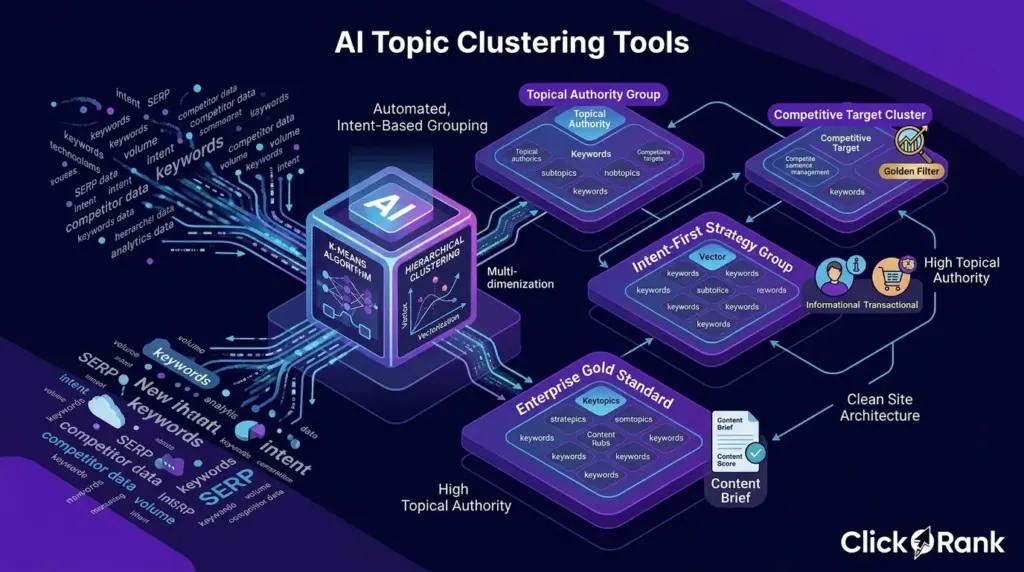
AI models cannot process text directly; they require numerical representations. The tool converts keywords into vectors using techniques like Word2Vec, GloVe, or BERT embeddings. These embeddings capture semantic relationships by placing similar words and phrases close together in multidimensional space. For example, “laptop” and “notebook computer” occupy nearby vector positions because they share contextual meaning. This mathematical representation enables the AI to calculate similarity scores between keywords.
Clustering Algorithms
Once keywords exist as vectors, the tool applies clustering algorithms to group them. Common approaches include K-means clustering, hierarchical clustering, and DBSCAN (Density-Based Spatial Clustering of Applications with Noise). Each algorithm has strengths and weaknesses. K-means works well for large datasets but requires specifying the number of clusters in advance. Hierarchical clustering creates tree-like structures that reveal relationships between clusters. DBSCAN identifies clusters of arbitrary shape and handles outliers effectively.
Advanced tools combine multiple algorithms and use machine learning to optimize cluster boundaries. They also incorporate SERP analysis data to validate that keywords within a cluster actually produce similar search results. This validation step ensures that clusters reflect real-world search behavior rather than purely mathematical relationships.
Cluster Refinement and Labeling
The initial clustering output often requires refinement. The tool merges overly fragmented clusters, splits overly broad ones, and reassigns misclassified keywords. AI models then generate descriptive labels for each cluster by analyzing the most representative keywords and their common themes. These labels become the basis for content briefs and page titles. Some tools also assign priority scores to clusters based on search volume, competition, and business value.
Benefits of Using an AI SEO Keyword Clustering Tool
Implementing AI-powered clustering delivers measurable advantages across the entire SEO workflow. These benefits extend beyond simple time savings to fundamentally improve content quality and search performance.
Time and Resource Efficiency
Manual keyword grouping for a campaign with 5,000 keywords might take several days of analyst time. AI tools accomplish the same task in minutes. This efficiency allows SEO teams to focus on strategy and content creation rather than tedious data manipulation. The time savings compound across multiple campaigns and ongoing keyword research cycles.
Improved Content Relevance and Quality
Clusters reveal the complete range of questions and concerns users have about a topic. Content creators use this insight to develop comprehensive resources that address every aspect of the subject. Instead of writing thin content targeting one keyword, they produce authoritative guides that satisfy multiple search intents. This comprehensive approach naturally attracts backlinks, increases dwell time, and reduces bounce rates.
Better Internal Linking Structure
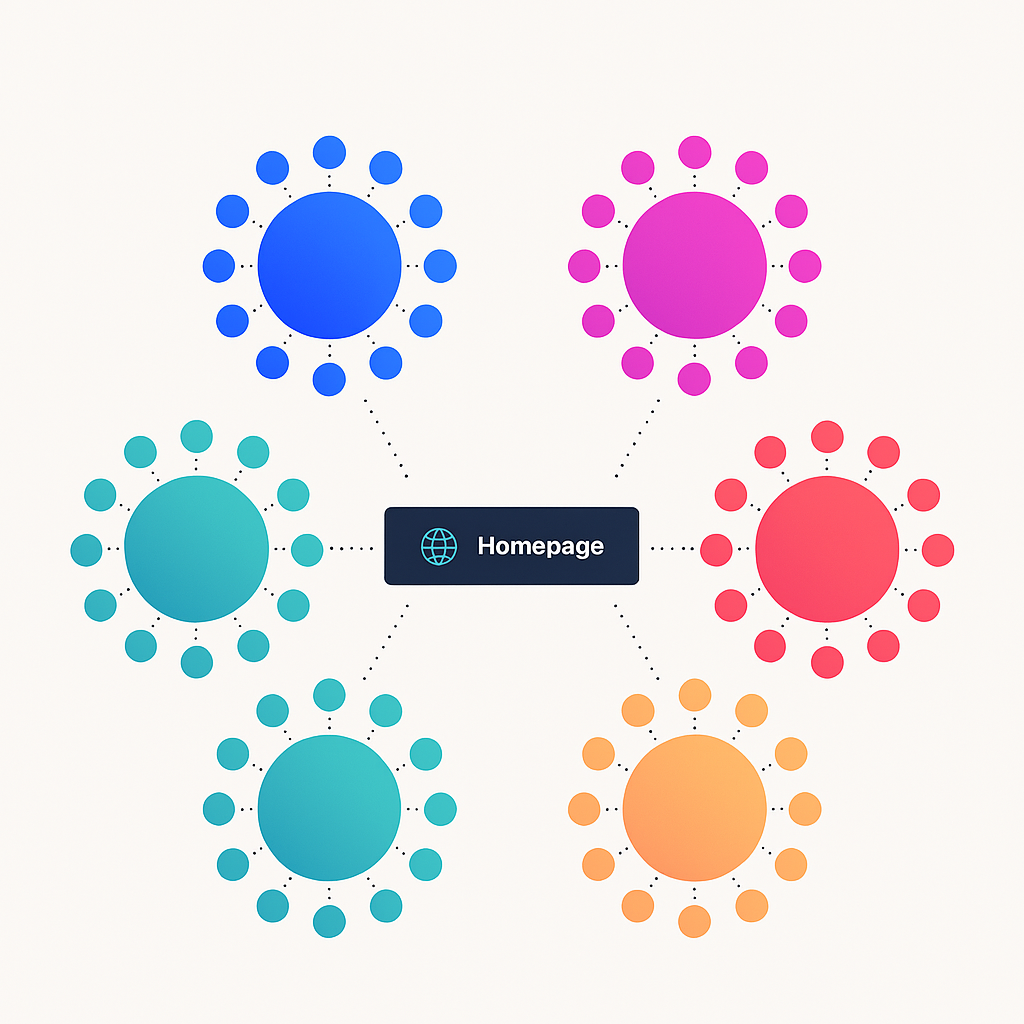
Keyword clusters naturally map to website architecture. Each cluster corresponds to a pillar page, with cluster keywords informing supporting blog posts and product pages. This structure creates logical internal linking opportunities that distribute page authority throughout the site. Search engines understand these relationships and reward sites with clear topical hierarchies.
Enhanced SERP Visibility
Pages optimized for keyword clusters capture traffic from multiple related queries. This multi-query visibility increases overall impressions and click-through rates. Additionally, comprehensive content that addresses cluster topics has higher chances of earning featured snippets and appearing in People Also Ask sections. These SERP features drive additional traffic without requiring top-three rankings.
Limitations and Challenges of AI Keyword Clustering
While AI clustering tools offer substantial benefits, they also present certain limitations that users must understand. Recognizing these challenges helps you set realistic expectations and implement mitigation strategies.
Data Quality Dependency
AI clustering accuracy depends entirely on the quality of input data. If your keyword list contains outdated terms, incorrect search volumes, or irrelevant variations, the resulting clusters will reflect these flaws. Regular data refreshes and manual review of source keywords remain essential practices.
Over-Reliance on Automation
AI tools provide recommendations, not absolute truths. Clusters generated by algorithms may occasionally group keywords that human judgment would separate due to subtle contextual differences. SEO professionals should review cluster outputs and adjust boundaries based on their domain expertise and business knowledge.
Dynamic Search Behavior
Search patterns evolve constantly. New trends emerge, seasonal shifts occur, and user language changes. Clusters that made sense six months ago may no longer reflect current search behavior. Continuous monitoring and re-clustering are necessary to maintain relevance. Most tools offer scheduled re-clustering features, but these require configuration and oversight.
Comparing AI Keyword Clustering Tools: Key Considerations
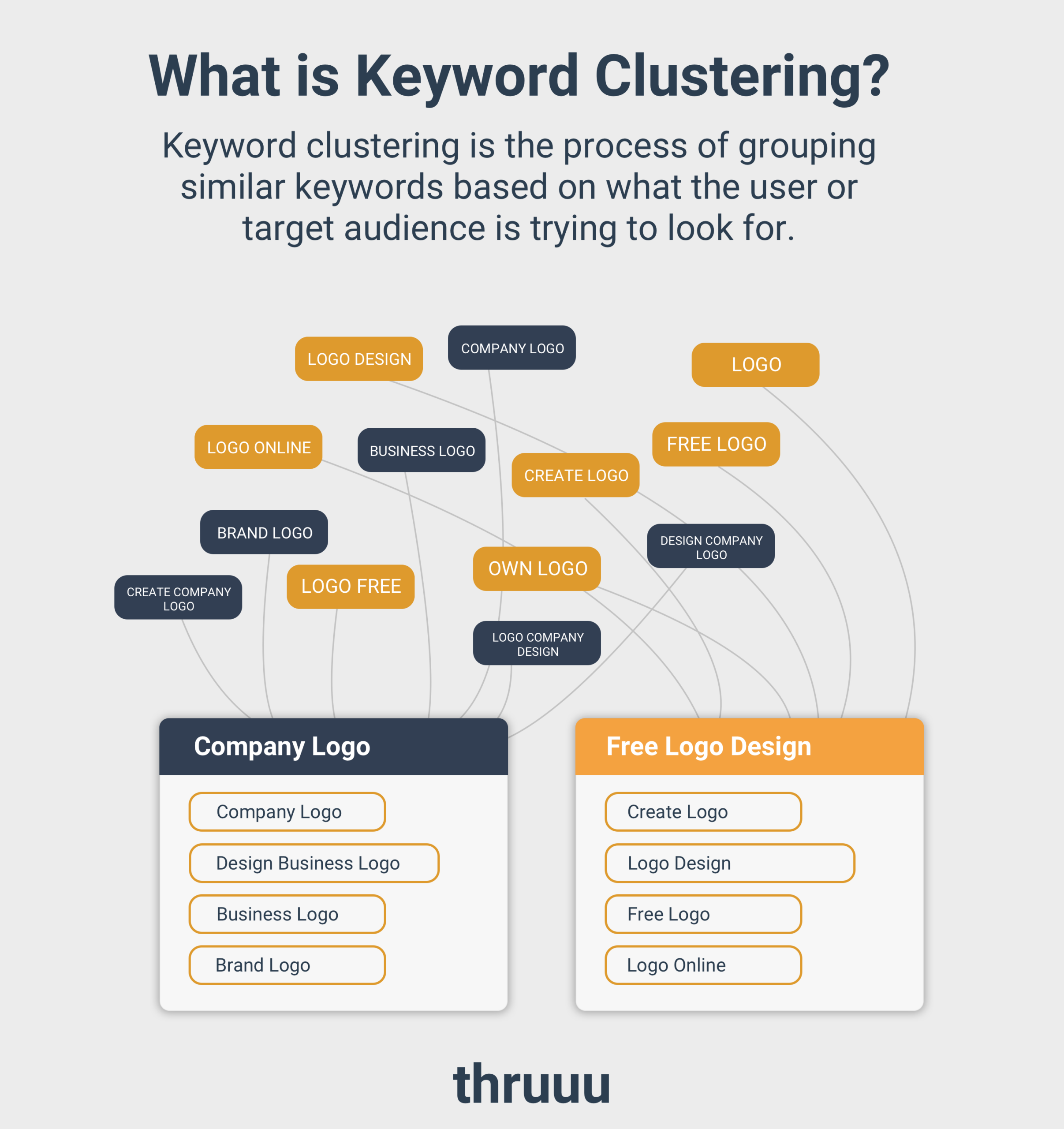
The market offers numerous AI clustering solutions, each with distinct strengths and pricing models. Evaluating these tools requires understanding your specific needs and comparing features systematically.
| Feature | Entry-Level Tools | Mid-Range Tools | Enterprise Solutions |
|---|---|---|---|
| Keyword Volume Capacity | Up to 1,000 keywords | 10,000-50,000 keywords | Unlimited with API access |
| Semantic Analysis Depth | Basic synonym detection | Advanced NLP models | Custom-trained AI models |
| SERP Feature Integration | Limited | Standard SERP analysis | Real-time SERP tracking |
| Collaboration Features | Single user | Team workspaces | Full workflow integration |
| Pricing Model | Monthly subscription | Tiered plans | Custom enterprise contracts |
Popular tools in this space include Ahrefs with its clustering features, SEMrush’s Topic Research, and specialized platforms like Keyword Insights AI and ClusterAI. Each tool approaches clustering differently, so testing multiple options with your own keyword data provides the best evaluation.
Practical Guide: How to Use an AI SEO Keyword Clustering Tool Effectively
Implementing AI clustering requires a systematic approach that integrates the tool into your broader SEO workflow. Follow these steps to maximize the value of your clustering investment.
Step 1: Define Your Seed Keywords
Start with a list of core topics relevant to your business. These seed keywords should represent your primary products, services, or content themes. For an e-commerce site selling outdoor gear, seeds might include “camping tents,” “hiking backpacks,” “sleeping bags,” and “portable stoves.” Your clustering tool will expand these seeds into comprehensive keyword lists.
Step 2: Gather Comprehensive Keyword Data
Use keyword research tools to expand your seed list. Collect all relevant variations, long-tail phrases, and question-based queries. Include competitor keywords and terms from your website’s search analytics. The more comprehensive your initial list, the more accurate your clusters will be. Aim for at least 500-1,000 keywords per seed topic for meaningful clustering.
Step 3: Configure Clustering Parameters
Most AI tools allow configuration of clustering sensitivity. Higher sensitivity produces more granular clusters with fewer keywords each; lower sensitivity creates broader clusters. The optimal setting depends on your content strategy. If you plan to create detailed pillar pages, broader clusters work well. If you need specific blog posts for each subtopic, choose higher sensitivity.
Step 4: Run the Clustering Analysis
Upload your keyword list and initiate the clustering process. The AI tool will process the data and generate cluster groups. Review the initial output carefully. Check whether keywords within each cluster genuinely share search intent. Look for any obvious misclassifications and note them for manual adjustment.
Step 5: Validate Clusters with SERP Analysis
For each cluster, manually review the top 10 search results for several representative keywords. If the same pages rank for multiple keywords within the cluster, the cluster is valid. If different pages dominate different keywords, the cluster may need splitting. This validation step ensures your content strategy aligns with actual search engine behavior.
Step 6: Map Clusters to Content Assets
Assign each validated cluster to a specific content asset. Primary clusters become pillar pages or cornerstone content. Secondary clusters become supporting blog posts or category pages. Document this mapping in your content calendar and ensure each piece of content targets one cluster exclusively to avoid cannibalization.
Step 7: Create Content Briefs from Cluster Data
Use the keywords within each cluster to develop detailed content briefs. Include the cluster label as the working title, list all major keywords as required sections, and note any SERP features to target. This brief guides writers to create comprehensive content that addresses every aspect of the cluster topic.
Common Mistakes When Using AI Keyword Clustering Tools
Even experienced SEO professionals make errors when implementing clustering strategies. Recognizing these common pitfalls helps you avoid them and achieve better results.
Ignoring Search Intent Variations
Some users assume that all keywords in a cluster share identical intent. In reality, subtle intent differences exist even within well-formed clusters. For example, “best hiking boots” and “hiking boots review” both indicate commercial investigation, but the first suggests comparison shopping while the second implies seeking expert opinions. Content must address these nuances within the overall cluster topic.
Creating Content for Every Cluster
Not every cluster deserves dedicated content. Some clusters have minimal search volume or low commercial value. Prioritize clusters based on business impact, not just search metrics. Focus content creation efforts on clusters that align with revenue goals and audience needs.
Neglecting Cluster Interlinking
Clusters work together to build topical authority. Failing to interlink related cluster content weakens the overall SEO impact. Create contextual links between pillar pages and supporting content, and between related clusters. This internal linking structure distributes authority and helps search engines understand your site’s topical coverage.
Treating Clusters as Static
Search behavior changes constantly. Clusters that worked last quarter may need adjustment this quarter. Schedule regular re-clustering sessions, at least quarterly, to account for new trends, seasonal shifts, and evolving user language. Most AI tools support scheduled re-analysis, making this process straightforward.
Important Notes for Maximizing AI Clustering Success
Several best practices enhance the effectiveness of AI keyword clustering tools. These notes reflect lessons learned from extensive real-world implementation across diverse industries.
Combine AI clustering with human expertise. The AI provides data-driven groupings, but your domain knowledge adds context that algorithms cannot capture. Review cluster outputs with your subject matter experts to ensure alignment with business reality.
Integrate clustering with your broader SEO stack. Connect your clustering tool with rank tracking, content management, and analytics platforms. This integration creates a feedback loop where content performance data informs future clustering decisions.
Document your clustering methodology. Record which parameters you used, how you validated clusters, and what adjustments you made. This documentation ensures consistency across team members and provides a reference for future optimization.
Monitor cluster performance over time. Track rankings and traffic for keywords within each cluster. Identify clusters that underperform and investigate whether the issue lies in content quality, cluster structure, or external factors like algorithm updates.
Frequently Asked Questions About AI SEO Keyword Clustering Tools
What is the difference between keyword grouping and keyword clustering?
Keyword grouping typically refers to manual or rule-based categorization of keywords into predefined buckets. Keyword clustering uses AI algorithms to automatically discover natural groupings based on semantic similarity and search intent. Clustering reveals relationships that manual grouping might miss, such as connecting synonyms and conceptually related terms that share no exact keywords.
How many keywords should be in a single cluster?
Optimal cluster size varies by topic and content strategy. Informational topics might support clusters of 50-100 keywords, while commercial topics with narrower intent might have clusters of 10-20 keywords. The key is that all keywords in a cluster can be addressed within a single comprehensive piece of content without sacrificing depth or relevance.
Can AI clustering tools replace manual keyword research?
AI clustering tools automate the grouping process but do not replace the initial keyword discovery phase. You still need keyword research tools to identify potential keywords and gather search volume data. The clustering tool then organizes those keywords into actionable groups. Both processes work together in a complete SEO workflow.
How often should I re-cluster my keywords?
Re-clustering frequency depends on your industry dynamics. Fast-moving industries like technology or fashion benefit from monthly re-clustering. Stable industries might only need quarterly updates. Monitor your keyword performance and search trend reports to determine the optimal cadence for your specific situation.
Do AI clustering tools work for local SEO?
Yes, AI clustering tools effectively handle local SEO keywords. They can group location-specific queries, identify geographic modifiers, and cluster keywords by service area. Some tools offer dedicated local SEO clustering features that account for map pack results and location-based search intent.
Conclusion: Transforming SEO Strategy with AI Keyword Clustering
AI SEO Keyword Clustering Tools represent a fundamental advancement in how digital marketers approach search optimization. These platforms leverage artificial intelligence to reveal the semantic relationships between queries, enabling content strategies that align with modern search engine algorithms. The shift from isolated keyword targeting to comprehensive cluster-based content creation marks a maturation of SEO practice.
The benefits extend beyond rankings. Clustering improves content quality, enhances user experience, and builds sustainable topical authority. Organizations that adopt AI clustering gain competitive advantages through faster workflows, deeper insights, and more effective resource allocation. The technology continues evolving, with emerging capabilities in predictive analytics and real-time optimization promising even greater value.
Successful implementation requires balancing automation with human judgment. The AI provides powerful data processing and pattern recognition, but strategic oversight ensures that clusters align with business objectives and audience needs. By following the practical guidance in this article, SEO professionals can harness the full potential of AI keyword clustering to drive meaningful, measurable improvements in search performance.
Xem thêm:
- AI SEO LLM Visibility: The Complete Guide to Ranking in ChatGPT, Perplexity, and AI Overviews
- AI SEO Backlink Prospects: The Complete Guide to Smarter Link Building in 2025
- AI SEO NLP Optimization: The Complete Guide to Ranking in the AI Search Era
- AI SEO Monitoring Workflow: The Complete Guide to Automated Rank Tracking and Performance Analysis
- AI SEO Ecommerce Product SEO: The Complete Playbook for 2025
Bài viết cùng chủ đề:

AI SEO SEO Automation with Make: The Complete Workflow Guide

AI SEO SEO Automation with Zapier: The Complete Workflow Guide

AI SEO SEO Automation with n8n: The Complete Workflow Guide
AI SEO SEO Automation with Gemini: The Complete Guide to Scaling Organic Growth

AI SEO SEO Automation with Claude: The Complete Guide to Scaling Content in 2025

AI SEO SEO Automation with ChatGPT: The Complete Playbook for 2025

AI SEO & SEO Automation for Affiliate Sites: The 2025 Playbook for Passive Income Growth
AI SEO & SEO Automation for Bloggers: The Complete Guide to Scaling Your Content

AI SEO & SEO Automation for Agencies: The Complete 2025 Playbook

AI SEO and SEO Automation for Ecommerce: The Complete Playbook for 2025

AI SEO & SEO Automation for WordPress: The Complete Playbook for 2025
AI SEO SEO Automation Strategy: The Complete Playbook for 2025

Mastering the AI SEO SEO Automation Process: A Complete Guide to Scaling Organic Growth
AI SEO SEO Automation System: The Complete Guide to Scaling Organic Growth in 2025
AI SEO SEO Automation Platform: The Complete Guide to Scaling Organic Growth in 2025
AI SEO SEO Automation Software: The Complete Guide to Scaling Organic Growth in 2025















