
No products in the cart.
AI Rewrite Tool: The Ultimate Guide to Rewriting Content with Artificial Intelligence
29
Jul
Jul
An AI rewrite tool has become a cornerstone of modern content creation, enabling bloggers, marketers, students, and professionals to rephrase existing text with speed and precision. Instead of manually tweaking every sentence, users can now rely on advanced algorithms to generate fresh, unique, and contextually accurate versions of any written material. Whether you need to avoid plagiarism, simplify complex ideas, or adapt a single article for multiple platforms, an AI rewrite tool streamlines the process while preserving the original meaning.
In this comprehensive guide, you will discover exactly how these tools work, the underlying technology, practical use cases, and how to choose the right solution. You will also learn about the benefits and limitations, common mistakes to avoid, and answers to the most pressing questions about AI rewriting. By the end, you will have a clear understanding of how to integrate an AI rewrite tool into your workflow effectively and ethically.
What Is an AI Rewrite Tool?
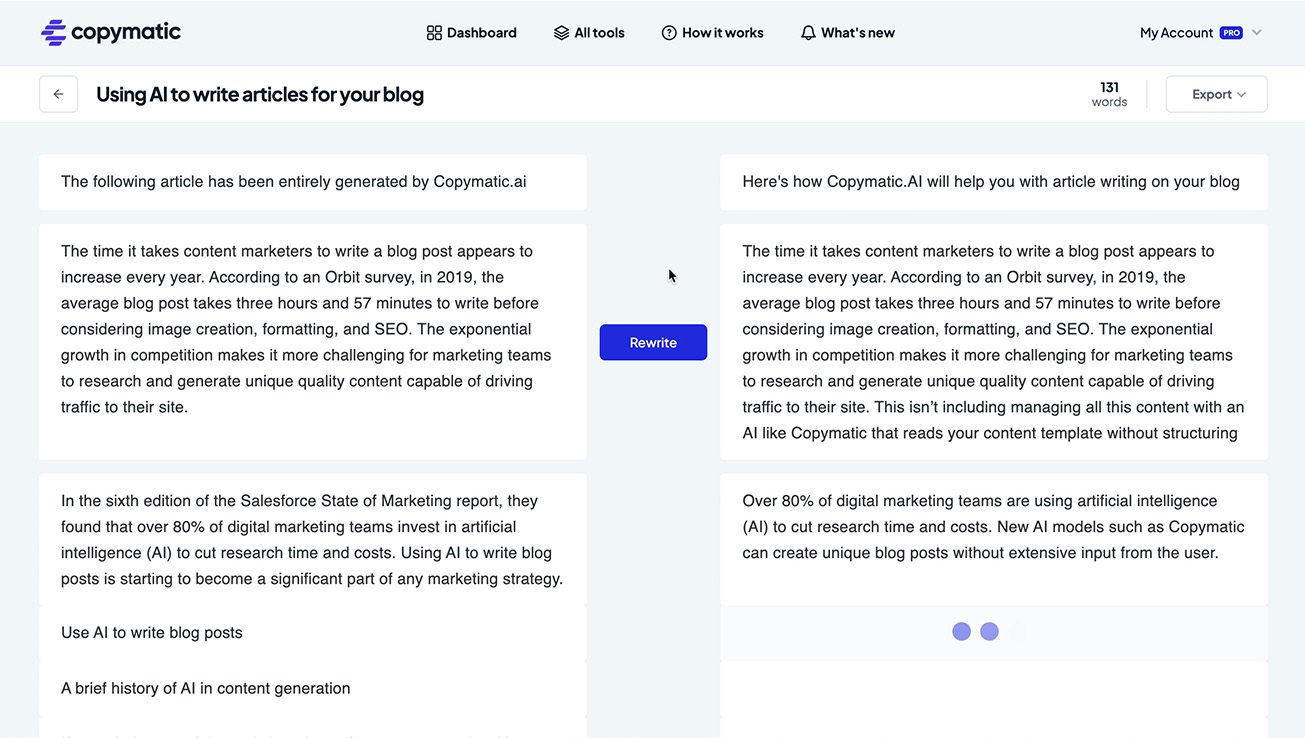
An AI rewrite tool is a software application that uses artificial intelligence and natural language processing (NLP) to automatically rephrase, restructure, or paraphrase text while maintaining its original intent. Unlike basic synonym replacers or spinning tools that swap words mechanically, modern AI rewrite tools understand context, tone, and semantic relationships. They analyze the input at a deep level, then generate output that sounds natural and human-written.
These tools rely on large language models (LLMs) trained on vast corpora of text. The models learn grammar, style, and common phrase patterns, allowing them to reconstruct sentences without losing coherence. The result is a rewritten piece that can be used for content repurposing, academic paraphrasing, email drafting, or enhancing readability.
Many AI rewrite tools offer multiple modes: standard paraphrasing, fluency improvement, formal or casual tone conversion, shortening, expanding, and even creative rewriting. Some are integrated into writing assistants like Grammarly, while others function as standalone web apps or API services. The core purpose remains the same: to produce a fresh version of the input text that is unique enough to satisfy plagiarism checkers and distinct enough to serve a new audience.
How Does an AI Rewrite Tool Work?
Understanding the internal mechanism helps users appreciate both the power and the limits of an AI rewrite tool. At its core, the process involves three key stages: preprocessing, generation, and post-processing.
1. Text Analysis and Tokenization
The tool first breaks the input text into smaller units called tokens – words, subwords, or characters. It identifies sentence boundaries, parts of speech, and syntactic dependencies. This step ensures the model captures the full structure before attempting to rewrite.
2. Context Encoding
Using a transformer-based architecture (similar to GPT models), the tool encodes the tokens into numerical representations that capture both local word meaning and global context. This is where an AI rewrite tool differs fundamentally from older spinner software. The attention mechanism allows the model to weigh the importance of each token in relation to others, preserving the intended message even when sentence structure changes drastically.
3. Paraphrasing and Generation
Once encoded, the model generates new tokens one by one, predicting the most probable sequence that conveys the same meaning in a different form. Advanced tools let users influence the output through parameters like creativity (temperature), word variation, and length control. Some AI rewrite tools also incorporate back-translation techniques, where text is translated into another language and back to the original, introducing natural variation.
4. Post-Processing and Quality Control
The final output undergoes grammar checks, readability scoring, and sometimes plagiarism evaluation. The tool may highlight changes or offer side-by-side comparisons. The best AI rewrite tools allow iterative refinement, letting the user pick alternative suggestions for individual sentences.
Types of AI Rewrite Tools
The market offers a broad spectrum of AI rewrite tools, each designed for specific tasks. Recognizing these categories helps you select the right one for your needs.
- Standalone Paraphrasers: Focus exclusively on rewriting text. These are often web-based and support various modes like standard, fluency, creative, and shorten. Examples include QuillBot and Wordtune.
- All-in-One Writing Assistants: Platforms like Grammarly, ProWritingAid, and Copy.ai embed AI rewriting as one feature among grammar checking, tone detection, and content generation.
- SEO-Optimized Rewriters: Tools like Frase.io or Surfer SEO integrate rewriting capabilities to create search-optimized variations of existing content, ensuring keyword density and semantic relevance.
- Academic-Focused Paraphrasers: Designed for students and researchers, these tools emphasize avoiding plagiarism while retaining citations and technical accuracy. Ref-N-Write and Writefull are prime examples.
- Multilingual Rewriters: Support multiple languages and can paraphrase between them, useful for localization or translation rewriting.
- API-Based Rewriters: For developers, platforms like OpenAI’s GPT API or AI21 Labs provide programmable rewriting endpoints that can be integrated into custom applications.
- Loss of Nuance: Subtle emotion, sarcasm, or cultural references may be flattened or misinterpreted. The tool might produce text that is technically correct but emotionally off-target.
- Factual Errors: When rewriting, AI can inadvertently alter dates, figures, or proper nouns. Without human review, such errors can damage credibility.
- Over-Optimization for SEO: Some AI rewrite tools focus too heavily on keyword insertion, leading to awkward phrasing or keyword stuffing that harms readability and rankings.
- Context Drift: In longer texts, the model may lose the thread, causing the rewritten version to veer away from the original argument or conclusion.
- Ethical Concerns: Academic dishonesty or misleading content can result if the tool is used to mask copied work without proper attribution. Responsible use is essential.
- Blindly Trusting the Output: Never publish rewritten content without a human review. Even the best AI rewrite tool can produce ambiguous or factually incorrect sentences. Always fact-check and refine.
- Ignoring Tone Consistency: Switching between formal and casual within the same document can confuse readers. Set the tone mode before generating and maintain consistency throughout.
- Overusing the Tool for Original Writing: An AI rewrite tool is designed to rephrase existing text, not create new ideas from scratch. Using it as a crutch for original thinking can lead to shallow content.
- Neglecting SEO Naturalness: Forcing keywords into the rewrite mode often results in unnatural phrasing. Instead, let the tool rewrite naturally, then manually insert keywords where they fit organically.
- Using Without Permission on Copyrighted Material: Rewriting copyrighted text does not automatically make it legal to use. Always ensure you have the right to reuse and modify the source material.
- Skipping the Plagiarism Check: Even if the tool promises uniqueness, verify it. Some AI rewrite tools produce text that still matches source sequences closely enough to trigger detection algorithms.
- Short Paragraphs Work Better: AI models perform best with self-contained input of 100-200 words. If you have a long document, break it into sections and rewrite chunk by chunk.
- Provide Context When Possible: Some advanced tools allow you to input a target description (e.g., “rewrite for a casual tech blog”). Use that feature to guide the output.
- Leverage Built-in Thesaurus Features: When an AI rewrite tool highlights synonyms, don’t hesitate to click through alternatives. This gives you finer control over word choice.
- Use Version History: If the platform supports it, save the generated versions so you can compare or roll back if a later edit goes wrong.
- Combine With Other AI Tools: For maximum efficiency, pair an AI rewrite tool with a summarizer (to condense source material) and a grammar checker. This forms a complete editing pipeline.
- Ethical Use in Academia: Many institutions consider extensive AI rewriting without original thought a form of cheating. Always consult your school’s academic integrity policy before using such tools for assignments.
Key Benefits of Using an AI Rewrite Tool
Integrating an AI rewrite tool into your content strategy delivers measurable advantages, from time savings to quality improvements.
Enhanced Productivity and Speed
Manual rephrasing is time-consuming. An AI rewrite tool can transform a 1,000-word article in under a minute, freeing up hours for research, strategy, or creative ideation. This speed is particularly valuable when handling high-volume content needs like product descriptions or social media posts.
Improved Readability and Clarity
AI rewrite tools can simplify complex sentences, remove jargon, and adjust reading levels. For example, a dense technical document can be rewritten at an eighth-grade reading level without losing key information, making it accessible to a broader audience.
Plagiarism Prevention
Rewriting source material with an AI tool helps produce unique content that passes originality scans. When you need to reference existing information without copying, the tool can generate a completely new expression of the same ideas.
Content Repurposing Across Channels
A single blog post can be rewired into a newsletter, a social media snippet, a video script, or an email sequence using tone and length adjustments. An AI rewrite tool ensures each version is tailored to the platform’s style while maintaining brand voice.
Writer’s Block Overcoming
Staring at a blank page is daunting. By feeding a rough draft or bullet points into an AI rewrite tool, writers can quickly get several alternative phrasings, spurring new ideas and accelerating the writing process.
Limitations and Challenges

Despite their power, AI rewrite tools are not flawless. Understanding their boundaries prevents misuse and disappointment.
AI Rewrite Tool vs. Traditional Article Spinner
Many confuse an AI rewrite tool with a basic article spinner. The table below highlights the critical differences.
| Feature | AI Rewrite Tool | Traditional Article Spinner |
|---|---|---|
| Technology | Transformer models, NLP, deep learning | Synonym replacement, rule-based |
| Output Quality | Human-like, coherent sentences | Often robotic, awkward, or nonsensical |
| Context Awareness | Maintains meaning across paragraphs | Works word by word, loses context |
| Plagiarism Evasion | High uniqueness, passes Copyscape | Unreliable, often detected easily |
| Grammar & Syntax | Grammatically correct, proper syntax | Frequent grammar errors, broken syntax |
| Use Cases | Professional content, academic, SEO | Black-hat SEO, quickly flagged |
Practical Guide: How to Use an AI Rewrite Tool Step by Step
Following a structured approach ensures you get the best results from any AI rewrite tool. Are you simplifying, adapting for a different audience, optimizing for specific keywords, or just creating a unique version? This clarity guides mode selection and parameter tuning.
Step 2: Prepare the Source Text
Ensure the input is clean and well-structured. Remove unnecessary formatting, fix obvious grammatical errors, and break down very long paragraphs. A high-quality input significantly improves the output of an AI rewrite tool.
Step 3: Choose the Right Mode and Settings
Most tools offer modes such as Standard, Fluency, Creative, Shorten, Expand, Formal, or Casual. For a blog post, Standard or Creative might work best. For academic work, Formal is safer. Adjust the synonym slider or creativity level if available—higher creativity can produce fresher text but may drift more from the original meaning.
Step 4: Generate and Compare
Run the tool and examine the rewritten text side by side with the original. Many AI rewrite tools highlight changed words or phrases, making it easy to spot where the meaning may have shifted. Look for unintended alterations in numbers, technical terms, or brand names.
Step 5: Human Editing and Polish
Treat the AI output as a strong first draft. Read it aloud to check for natural flow. Verify facts, refine word choices, and reinsert any specific citations or hyperlinks that were removed. This combination of AI rewriting and human judgment delivers the highest quality.
Step 6: Final Checks
Run a plagiarism checker on the final version, even if you rewrote your own content, to ensure originality. Use a grammar tool to catch any residual errors. If the content is for SEO, check for keyword placement and readability scores using tools like Yoast or Clearscope.
Common Mistakes When Using an AI Rewrite Tool and How to Avoid Them
Even experienced users fall into pitfalls that reduce the effectiveness of the rewriting. Awareness is the first line of defense.
Important Notes for Effective AI Rewriting
Frequently Asked Questions About AI Rewrite Tools
What is an AI rewrite tool?
An AI rewrite tool is software that uses artificial intelligence to automatically rephrase or paraphrase text, producing a new version that retains the original meaning but with different wording and sentence structure.
How does an AI rewrite tool differ from a simple synonym replacer?
A simple synonym replacer swaps words with their dictionary equivalents, often resulting in awkward sentences. An AI rewrite tool understands context and grammar, reconstructing whole sentences to read naturally and coherently.
Can an AI rewrite tool help avoid plagiarism?
Yes, when used correctly. An AI rewrite tool can generate unique content that passes plagiarism checks. However, ethical use requires that the underlying ideas are properly attributed, and the rewritten text is not a direct substitute for original thought in academic settings.
Is it legal to use an AI rewrite tool?
Using the tool itself is legal. However, the legality of the output depends on the source material. Rewriting copyrighted content and publishing it as your own can still constitute infringement. Always ensure you have rights to the original text or are creating substantially transformative work.
What is the best AI rewrite tool?
The best AI rewrite tool depends on your specific needs. For general-purpose paraphrasing, QuillBot is popular. For professional writing integrated with grammar checks, Grammarly offers a robust rewriting feature. For SEO content, tools like Surfer SEO and Frase provide targeted rewriting. Evaluate based on accuracy, tone options, and pricing.
Can AI rewrite tools replace human writers?
No. While an AI rewrite tool dramatically speeds up the rewriting process, it cannot replicate human creativity, emotional depth, or strategic thinking. The best results come from a hybrid approach where AI handles the heavy lifting and humans add nuance and verification.
Do I still need to edit text after using an AI rewrite tool?
Always. Even advanced AI rewrite tools can introduce minor errors or lose subtle meaning. A thorough human review ensures clarity, factual correctness, and brand voice alignment.
Are there free AI rewrite tools?
Many tools offer free tiers with limited word counts or features. QuillBot and Wordtune have free versions. However, for professional use, paid subscriptions typically provide higher quality, more modes, and no watermarks.
Conclusion
The AI rewrite tool has evolved from a basic spinner into a sophisticated writing partner, capable of transforming how content is produced and refined. By understanding its inner workings, choosing the right type for the task, and applying a thoughtful human-edit layer, you can unlock unparalleled efficiency and quality. The key lies in using the tool as an assistant rather than a replacement—leveraging its speed and linguistic versatility while applying your own judgment and creativity. As AI models continue to improve, the gap between human and machine rewriting will narrow, but for now the most effective approach is a strategic blend of both.
Xem thêm:
- AI SEO AI Visibility Tracking: The Complete Guide to Modern Search Performance
- AI SEO Entity Recognition: The Complete Guide to Mastering Semantic Search
- The Ultimate Guide to AI SEO WordPress Plugins: Automate Rankings and Smart Content Strategy
- AI SEO Forums: The Hidden Hubs Where Search Strategy Gets Rewired by Machine Intelligence
- AI SEO Entity Authority: The Complete Guide to Dominating Search in 2025
Bài viết cùng chủ đề:

AI SEO SEO Automation with Make: The Complete Workflow Guide

AI SEO SEO Automation with Zapier: The Complete Workflow Guide

AI SEO SEO Automation with n8n: The Complete Workflow Guide
AI SEO SEO Automation with Gemini: The Complete Guide to Scaling Organic Growth

AI SEO SEO Automation with Claude: The Complete Guide to Scaling Content in 2025

AI SEO SEO Automation with ChatGPT: The Complete Playbook for 2025

AI SEO & SEO Automation for Affiliate Sites: The 2025 Playbook for Passive Income Growth
AI SEO & SEO Automation for Bloggers: The Complete Guide to Scaling Your Content

AI SEO & SEO Automation for Agencies: The Complete 2025 Playbook

AI SEO and SEO Automation for Ecommerce: The Complete Playbook for 2025

AI SEO & SEO Automation for WordPress: The Complete Playbook for 2025
AI SEO SEO Automation Strategy: The Complete Playbook for 2025

Mastering the AI SEO SEO Automation Process: A Complete Guide to Scaling Organic Growth
AI SEO SEO Automation System: The Complete Guide to Scaling Organic Growth in 2025
AI SEO SEO Automation Platform: The Complete Guide to Scaling Organic Growth in 2025
AI SEO SEO Automation Software: The Complete Guide to Scaling Organic Growth in 2025















