
No products in the cart.
AI Content Refresh: The Ultimate Guide to Reviving Old Content with Artificial Intelligence
29
Jul
Jul
A staggering 60% of all web content is never updated after publication, yet refreshed pages see up to 106% more organic traffic. An AI Content Refresh uses artificial intelligence to analyze, rewrite, and optimize existing pages so they stay relevant, rank higher, and convert better. This guide walks you through every step—from choosing the right AI tools to avoiding common pitfalls—so your content library works harder without starting from scratch.
What Is an AI Content Refresh?

An AI Content Refresh is the process of using artificial intelligence models to audit, update, and repurpose published content. Instead of manual line-by-line editing, AI scans the text, compares it against current search intent, rewrites outdated sections, and enhances SEO elements. The technology can adjust readability, inject new keywords, restructure paragraphs, and even generate fresh media ideas.
The core idea is to preserve the existing equity of a URL—its backlinks, age, and authority—while dramatically improving its value for both readers and search engines. An AI refresh goes beyond simple grammar fixes; it elevates content to match today’s standards, user expectations, and search engine algorithms. By leveraging natural language processing and machine learning, the refresh becomes faster, more thorough, and often more data-driven than human-only efforts.
Why AI Content Refresh Matters for SEO and User Engagement
Search engines reward freshness and comprehensiveness. A page that hasn’t been touched in two years may be missing the latest statistics, breaking news, or new terminology that queries now demand. When Google detects that content is stale, rankings slip. A well-executed AI Content Refresh signals to crawlers that the page is alive and authoritative again.
From the user’s perspective, nothing is more frustrating than landing on a post that references deprecated software or outdated best practices. By refreshing with AI, you can instantly align the message with current trends, reduce bounce rates, and increase time on page. Moreover, AI tools can identify gaps—missing subheadings, low dwell-time sections, or questions that readers ask but the content fails to answer—allowing you to plug those holes in minutes.
Key Components of AI-Powered Content Refresh
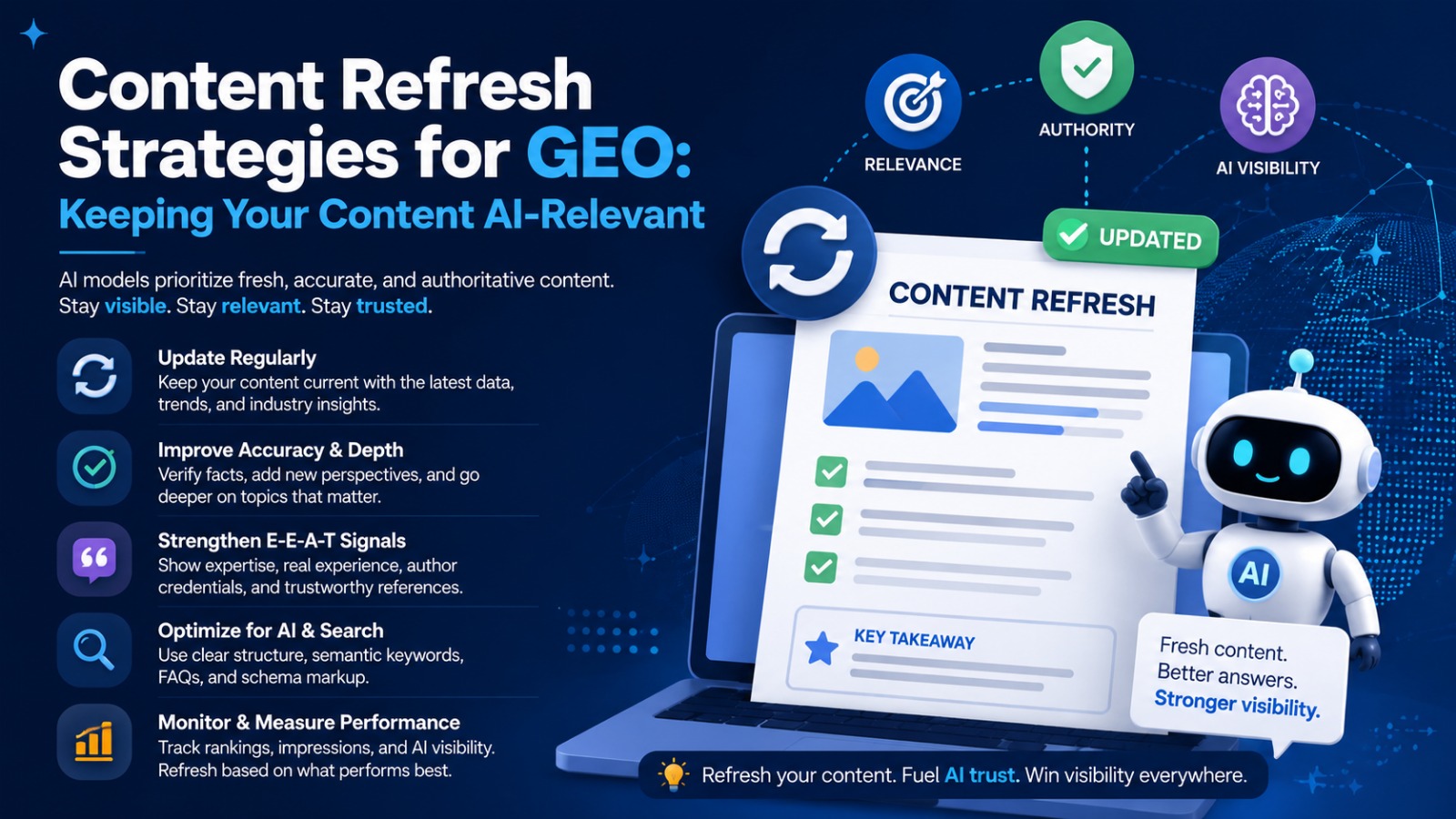
A successful refresh isn’t just about hitting a “rewrite” button. It requires a structured approach where AI handles specific, repeatable tasks. Breaking the process into components ensures no critical element is overlooked.
Content Audit and Prioritization
AI tools can crawl your entire site, analyze traffic and ranking data, and flag pages that are declining. They calculate the effort-to-impact ratio, pinpointing posts where a minor refresh could yield significant organic gains. This data-driven selection replaces gut feeling and saves hours of manual spreadsheet work.
Semantic Analysis and Intent Matching
Modern AI models understand search intent. They compare your article against the top 10 ranking pages for the target keyword and identify missing concepts, entities, and sub-topics. The refresh then adds those elements seamlessly, making the piece more comprehensive and aligned with what users actually want.
On-Page SEO Optimization
AI can automatically suggest—or even implement—optimized title tags, meta descriptions, header structures, and internal linking. It balances keyword density, proposes LSI keywords, and ensures proper schema markup. The result is a page that sends the strongest possible relevance signals to search engines.
Readability and Tone Refinement
Old content often rambles, uses passive voice, or feels formal. AI rewriting modules can shorten sentences, break long paragraphs, and inject a conversational yet authoritative tone. This makes the content more accessible and keeps mobile readers engaged.
Step-by-Step Process for Refreshing Content Using AI
Integrating AI into your refresh workflow doesn’t require you to be a developer. Following a clear sequence ensures consistent quality across all refreshed pages.
- Identify High-Potential Pages: Use an SEO tool with AI capabilities (such as Ahrefs, Semrush, or Surfer) to filter posts with declining impressions but valuable backlinks.
- Run an AI Content Audit: Feed the URL into an AI platform. It will scan for outdated facts, thin sections, broken links, and keyword gaps. Mark priority fixes.
- Define Refresh Goals: Decide whether you need a light update (new stats, links) or a full rewrite. AI can suggest the depth based on competitor content freshness.
- Generate AI-Powered Drafts: Using a tool like ChatGPT or Jasper, create variant rewrites of weak paragraphs, meta data, and introductions. Always keep the core message and original unique value intact.
- Optimize for EEAT: AI can flag where experience or citations are lacking. Add author credentials, recent data sources, and first-hand insights to meet Google’s quality standards.
- Incorporate Visual Refresh: AI image generators can create updated hero images, charts, and infographic ideas. Even simple visual updates signal novelty to both users and search engines.
- Review and Humanize: Have a human editor review the AI-enhanced content. Preserve brand voice, fact-check all generated statistics, and smoothen any robotic transitions.
- Republish and Monitor: Update the publication date, push the page live, and submit it to Google Search Console. Track ranking improvements for the next 4-6 weeks.
Tools and Technologies for AI Content Refresh

The market offers a wide range of AI tools tailored to different parts of the refresh cycle. Choosing the right stack can cut refresh time by 70% or more.
- ChatGPT / Claude / Gemini: General-purpose LLMs for rewriting, idea generation, and drafting updated sections.
- Surfer SEO: AI-driven content editor that scores your content against competitors and suggests keywords, headers, and word count.
- MarketMuse: Specialized in content planning and audits, it identifies topic clusters and missing subtopics.
- Frase: Combines research, writing, and optimization into one interface, perfect for refreshing FAQ-rich pages.
- Wordtune: Fine-tunes sentence-level readability and tone without losing original meaning.
- Clearscope: Provides real-time content grading and semantic keyword recommendations.
- Perplexity AI: Helps verify facts and gather recent citations for updating data-heavy articles.
Best Practices to Maximize Impact of AI Content Refresh
Simply running content through an AI writer won’t guarantee results. Adhering to proven practices separates average refreshes from traffic-surging overhauls.
- Always preserve the URL: Changing the slug erases backlink equity. Keep the same URL and focus on enriching the content.
- Update the publication date only when significant changes are made: Google prefers genuine freshness. A minor tweak with a new date can be seen as manipulative.
- Combine AI with human experience: AI lacks first-hand anecdotes. Inject case studies, customer stories, or personal insights to build EEAT signals.
- Refresh internal links: Use AI to identify new pillar pages and add relevant internal links to and from the refreshed content.
- Don’t neglect old comments and social proof: Retain user-generated content on the page if it adds value. Social signals can indirectly support rankings.
- Repurpose simultaneously: While refreshing a blog post, have AI generate a corresponding email sequence, social media snippets, or a short video script.
Common Mistakes to Avoid When Using AI to Refresh Content
Even experienced marketers stumble when first adopting AI refresh workflows. Awareness of these pitfalls can save you from ranking drops or reader backlash.
Over-Optimizing for Search Engines
AI can aggressively stuff keywords when given loose instructions. Readability always comes first. If a sentence sounds forced, rephrase it. Google’s helpful content system penalizes pages written for search engines rather than people.
Deleting Content That Still Holds Value
AI audits may suggest removing entire sections because they lack a target keyword. However, some paragraphs build trust or provide necessary context. Every deletion should be a deliberate decision, not an automatic AI output.
Ignoring Brand Voice
AI tends toward a neutral, sometimes bland tone. Feed the tool clear brand guidelines, examples of approved copy, and personality prompts. Without this, the refreshed content may sound like generic assistant prose.
Forgetting to Update Structured Data
Changes to article body, author info, or FAQ sections often leave schema markup outdated. Review JSON-LD data after refresh to keep rich snippets valid.
Publishing Without Human Review
AI can invent statistics, link to non-existent pages, or misinterpret a nuance. A thorough fact-check and editorial pass are non-negotiable. The best AI Content Refresh blends machine speed with human judgment.
Comparison: Traditional Content Refresh vs AI Content Refresh
| Aspect | Traditional Content Refresh | AI Content Refresh |
|---|---|---|
| Time to audit a 2000-word article | 2-3 hours (manual competitor analysis) | 10-15 minutes (automated semantic scan) |
| Keyword gap discovery | Manual spreadsheets, prone to oversight | AI instantly surfaces all missing terms and entities |
| Content rewriting speed | Slow, depends on writer bandwidth | Multiple variants generated in seconds |
| Consistency across pages | Varies with writer’s skill | Uniform improvements when using same AI model |
| Cost for 10 articles | $500-$2000 (writer fees) | $50-$300 (AI subscriptions plus editor time) |
| Freshness of updated data | Manual research, may miss latest reports | AI can pull in recent data if connected to real-time search |
| EEAT enhancement | Manual addition of quotes, credentials | AI suggests where to add experience but still needs human insertion |
Real-World Applications and Measurable Results
A SaaS company in the project management niche applied an AI Content Refresh to 45 old blog posts. Using Surfer for gap analysis and ChatGPT for rewriting, they completed the project in three weeks instead of the estimated four months. Three months later, organic traffic to those pages increased by 87%, and the number of pages ranking in the top three for target terms doubled.
An e-commerce brand refreshed its long-form buying guides with AI-enhanced product comparisons and updated pricing information. The bounce rate dropped from 72% to 54%, and conversion rate improved by 1.3 percentage points. These tangible outcomes highlight how AI refresh bridges the gap between stale content and high-performing assets.
Integrating AI Content Refresh into a Long-Term Strategy
The most successful teams don’t treat refresh as a one-time project. They set up a recurring audit calendar—quarterly for high-traffic pages, biannually for supporting posts. AI makes this sustainable. Alerts via tools like ContentKing or Little Warden can notify you when a page begins to decline, triggering an automated refresh checklist.
Pairing AI refresh with dynamic content personalization further boosts engagement. For instance, a refreshed blog post can use AI to display different examples based on the visitor’s industry, extracted from your CRM data. This level of sophistication turns a static page into a conversion engine.
Key Considerations Before Launching an AI Refresh Initiative
- Content inventory integrity: Before refreshing, ensure your CMS allows simplified version control so you can roll back changes if needed.
- AI model updates: The tool you use today might receive a major upgrade next month. Keep prompts flexible; avoid over-customizing scripts that break with new model versions.
- Plagiarism checks: Even though AI generates original text, some phrases might overlap with competitor content. Run refreshed pieces through Copyscape or Grammarly’s plagiarism checker.
- Training the team: AI-powered refresh shifts the skill set from pure writing to editing, prompting, and data validation. Invest in upskilling your content team.
Frequently Asked Questions
How often should I perform an AI Content Refresh?
Pages that target high-volume, fast-changing topics should be refreshed every 3-6 months. Evergreen content with stable search intent can undergo an annual AI refresh. Monitor ranking trends and click-through rates to determine the optimal frequency for each asset.
Can AI completely replace human writers in a content refresh?
No. AI excels at processing data and generating draft text, but it lacks authentic experience, nuanced judgment, and the ability to tell original stories. The best results combine AI’s speed with a human’s editorial eye, fact-checking, and brand voice refinement.
Will Google penalize AI-refreshed content?
Google’s guidelines focus on content value, not its origin. As long as the refreshed page is helpful, accurate, and created for users, AI assistance does not incur a penalty. Avoid using AI to create thin, keyword-stuffed rewrites—that will be caught by the helpful content system.
What is the first step to start refreshing content with AI?
Begin with a small test: choose five declining blog posts, run them through an AI SEO tool like Frase or Surfer, identify the biggest gaps, rewrite the weakest sections with an AI assistant, and publish. Track the organic traffic change over eight weeks before scaling to your entire library.
How much does an AI Content Refresh cost compared to hiring an agency?
Using a combination of AI subscriptions (typically $50-$200/month) and an in-house editor, refreshing a single post can cost under $15 in labor and tools. An agency might charge $300-$800 per refresh. The savings compound when refreshing dozens of pages monthly.
Does AI Content Refresh work for all types of content?
It works best for informational articles, listicles, how-to guides, and product comparisons. Highly editorial pieces, opinion columns, and deeply personal narratives still benefit from a human-led refresh, though AI can help with research and structure suggestions.
Conclusion
An AI Content Refresh turns your aging blog library into a living asset that keeps generating traffic, leads, and authority. By fusing machine intelligence with editorial wisdom, you can multiply the value of every published word without the cost and delay of manual rewrites. Start with a data-driven audit, apply AI strategically, and never skip the human polish—your content will stay relevant, rank consistently, and meet the ever-evolving expectations of both users and search engines.
Xem thêm:
- AI SEO Topic Cluster Generator: The Complete Guide to Building Authority Pages That Rank
- AI SEO Rendering: The Complete Guide to Modern Search Visibility
- Gemini SEO: Mastering Search Optimization in Google’s AI-First Era
- AI SEO Ubersuggest: The Complete Guide to Smarter Keyword Research in 2025
- AI SEO Content Formatting: The Complete Guide to Higher Rankings in 2025
Bài viết cùng chủ đề:

AI SEO SEO Automation with Make: The Complete Workflow Guide

AI SEO SEO Automation with Zapier: The Complete Workflow Guide

AI SEO SEO Automation with n8n: The Complete Workflow Guide
AI SEO SEO Automation with Gemini: The Complete Guide to Scaling Organic Growth

AI SEO SEO Automation with Claude: The Complete Guide to Scaling Content in 2025

AI SEO SEO Automation with ChatGPT: The Complete Playbook for 2025

AI SEO & SEO Automation for Affiliate Sites: The 2025 Playbook for Passive Income Growth
AI SEO & SEO Automation for Bloggers: The Complete Guide to Scaling Your Content

AI SEO & SEO Automation for Agencies: The Complete 2025 Playbook

AI SEO and SEO Automation for Ecommerce: The Complete Playbook for 2025

AI SEO & SEO Automation for WordPress: The Complete Playbook for 2025
AI SEO SEO Automation Strategy: The Complete Playbook for 2025

Mastering the AI SEO SEO Automation Process: A Complete Guide to Scaling Organic Growth
AI SEO SEO Automation System: The Complete Guide to Scaling Organic Growth in 2025
AI SEO SEO Automation Platform: The Complete Guide to Scaling Organic Growth in 2025
AI SEO SEO Automation Software: The Complete Guide to Scaling Organic Growth in 2025















