
No products in the cart.
AI Keyword Clustering: Build a Smarter Search Strategy With Data-Driven Topic Groups

29
Jul
Jul
Modern SEO demands more than a simple list of keywords. Search engines now prioritize topical depth and intent alignment over isolated term matching. AI keyword clustering is the engine that transforms a chaotic spreadsheet of thousands of keywords into a clear, scalable content architecture. By letting machine learning models detect hidden semantic relationships, search volume patterns, and user intent signals, SEO professionals can build website silos that Google instantly understands. This guide dissects every layer of AI-powered keyword grouping, from its foundational concepts to hands‑on implementation, while exposing the traps that silently kill organic growth.
What Is AI Keyword Clustering?
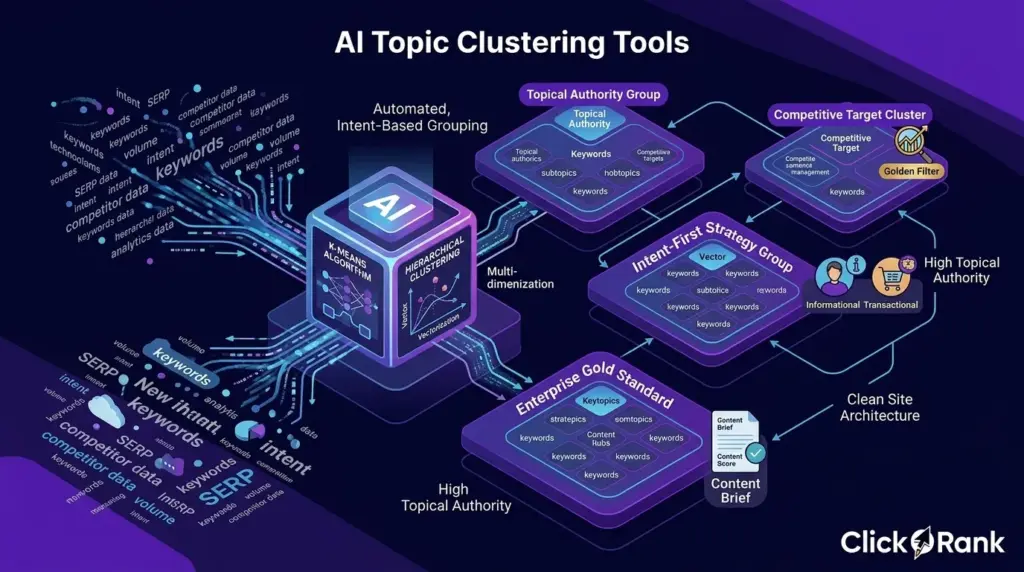
AI keyword clustering is the process of automatically grouping related keywords into cohesive topic clusters using natural language processing and machine learning algorithms. Instead of manually dragging keywords into folders based on shaky assumptions, an AI engine measures how closely words co-occur in search results, how they relate semantically through contextual embeddings, and how their ranking landscape signals shared intent. The outcome is a set of data-backed clusters where each group represents a distinct user need.
Traditional keyword grouping relied on gut feeling and literal word overlaps – you might put “cheap running shoes” and “affordable jogging sneakers” together, but you would likely miss the connection between “trail running form techniques” and “ankle stability drills”. AI clustering catches these non-obvious links because it reads beyond the surface bytes. It understands that both queries solve the same underlying problem, making it a cornerstone of topical authority.
Why Manual Keyword Grouping Breaks Under Scale
When an SEO strategy contains only 50 keywords, a human can group them with acceptable precision. The problem explodes with keyword lists of 5,000, 20,000, or more. Cognitive fatigue sets in, consistency crumbles, and valuable cross-topic relationships get overlooked. Teams often default to grouping by URL structure or broad category labels, which forces keywords into rigid boxes that do not reflect how real searchers navigate a topic.
Manual grouping also introduces subjective bias. An e‑commerce manager might obsess over product‑centric labels while completely missing the informational queries that fuel the awareness stage. AI removes that bias by letting the data decide. It surfaces clusters based on objective similarity metrics – cosine similarity between word vectors, search result overlap, or transactional signals – resulting in a map that mirrors the actual search landscape rather than internal org charts.
How AI Keyword Clustering Works Under the Hood
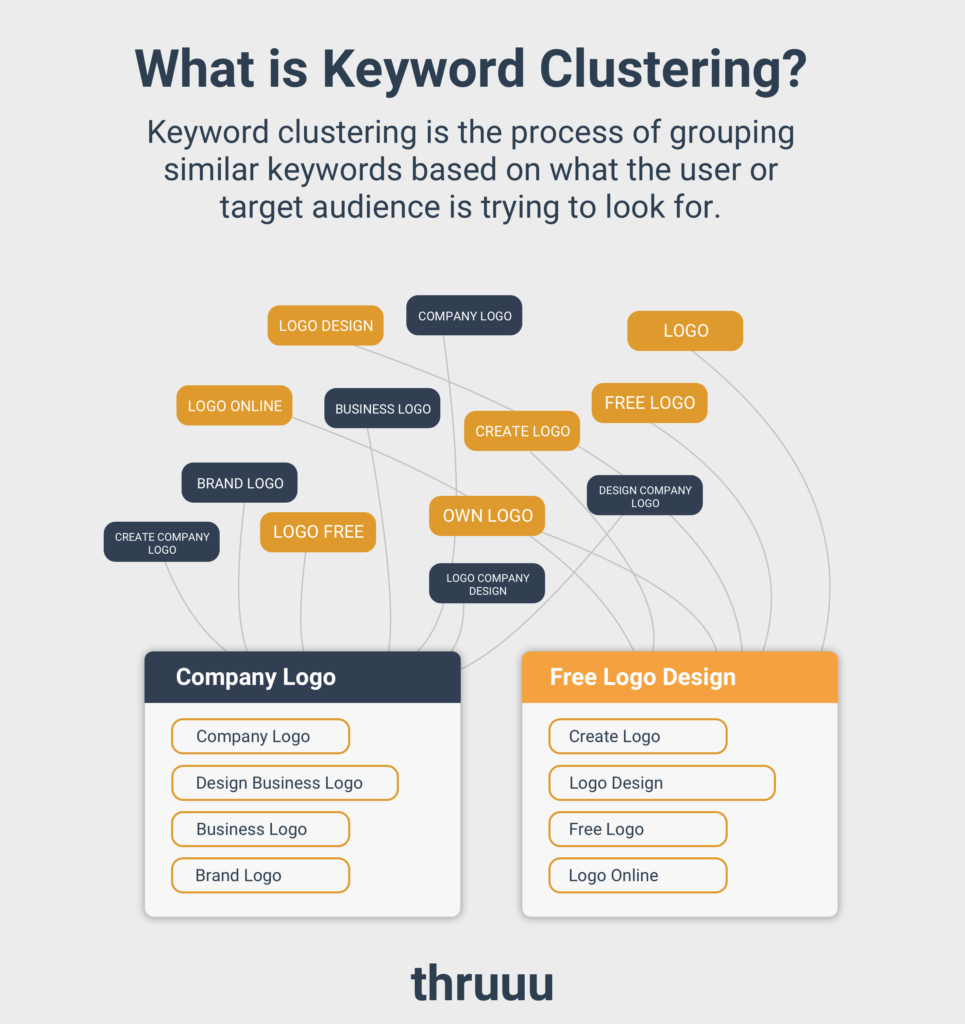
1. Keyword Collection and Preprocessing
Everything begins with a clean, consolidated seed list pulled from sources like Google Search Console, paid keyword tools, competitor gap analyses, and autocomplete suggestions. Preprocessing strips out punctuation, normalizes case, and filters noise such as location-specific terms if they aren’t relevant to the cluster analysis. Removing near‑duplicates and extremely low‑volume queries helps the algorithm focus on meaningful patterns.
2. Converting Keywords Into Machine‑Understandable Vectors
The real magic starts here. Each keyword is transformed into a high‑dimensional vector using language models like BERT, Sentence‑Transformers, or even fine‑tuned word2vec embeddings. These vectors capture semantic meaning: “buy graphic tees online” and “order printed t‑shirts” will sit close in vector space because the model has learned that the phrases represent the same purchase intent, even without sharing many literal words. Some advanced pipelines also embed SERP data, such as the top 10 URLs or common entities appearing in featured snippets, to add a layer of search‑engine reality.
3. Applying Clustering Algorithms
With vectors in hand, the system runs clustering algorithms that partition keywords into groups of high intra‑cluster similarity. Popular choices include:
- K‑Means – fast and effective when the approximate number of clusters is known, though it assumes spherical clusters and equal cluster sizes.
- Agglomerative Hierarchical Clustering – builds a tree of groupings that can be cut at different levels to reveal topic granulates; excellent for understanding hierarchical relationships like “men’s shoes → running shoes → trail running shoes.”
- DBSCAN – density‑based and robust to outliers, it naturally identifies clusters of any shape and leaves noise points unassigned, which is perfect for filtering out low‑value miscellany.
- Latent Dirichlet Allocation (LDA) – traditionally a topic modeling technique, LDA assumes each keyword is a mix of topics and is handy when you want a soft clustering with probability scores.
- Dramatic Time Savings: Clustering 10,000 keywords manually might take a week of full‑time work; an AI tool finishes the job in minutes, freeing strategists to focus on content creation and technical SEO.
- Topical Authority at Scale: Google rewards sites that cover a subject comprehensively. AI‑built clusters reveal exactly which supporting articles you need around a pillar page, turning a scattered blog into a tightly interlinked knowledge hub.
- Intent‑Precise Content Mapping: Because AI models weigh contextual signals, clusters naturally align with informational, commercial, transactional, and navigational intent. You avoid the common mistake of writing a buyer’s guide for a keyword that people use to find a quick definition.
- Content Gap Detection: When an AI cluster forms around a concept but no corresponding URL exists on your site, you instantly see a gap. This proactive insight guides editorial calendars with data, not guesswork.
- Improved Internal Linking: Knowing which articles belong to the same cluster allows you to automatically suggest relevant internal links, spreading PageRank and helping users navigate deeper into your topic.
- Consistent Keyword Targeting Across Teams: A centrally generated cluster map ensures that writers, editors, and link builders all work from the same blueprint, eliminating keyword cannibalization and duplicate effort.
- Garbage In, Garbage Out: If the initial keyword list is polluted with irrelevant brand terms, typos, or geo‑modifiers that were not stemmed properly, the clusters become noisy and untrustworthy. Rigorous data cleaning is non‑negotiable.
- Nuanced Intent Misclassification: A phrase like “apple” might be a fruit, a technology company, or a record label. Without entity‑level disambiguation, AI can clump these together. Multi‑modal models that incorporate search result data mitigate this, but they aren’t perfect.
- Over‑Clustering: Algorithms set to high granularity can produce dozens of tiny clusters that are impossible to manage or turn into standalone pages. The sweet spot typically requires manual tuning of cluster count or distance thresholds.
- Computational Cost: Running dense vector embeddings on hundreds of thousands of keywords without optimized infrastructure can become expensive. Some advanced cloud‑based tools pass this cost on through steep subscription pricing.
- Blind Faith in Automation: Teams that skip the human review step often publish content structures that feel machine‑generated and miss brand‑voice nuances. The best results always blend algorithmic grouping with editorial judgment.
- Neglecting Keyword Intent During Cleaning: Filtering out informational queries because they don’t convert immediately starves your upper funnel. Let the AI handle intent separation – don’t pre‑judge.
- Setting the Cluster Count Arbitrarily: Randomly picking 20 clusters for a massive dataset produces giant, meaningless buckets. Use elbow curves or tool recommendations, then adjust based on content team capacity.
- Ignoring Low‑Volume Keywords: They often form the long‑tail edges of a cluster and signal hyper‑specific user needs. A cluster that consists mostly of low‑volume terms might still drive highly qualified traffic with minimal competition.
- Treating the Cluster Map as Static: Search patterns shift with seasonality, trends, and algorithm updates. Re‑cluster your keyword universe at least quarterly to catch emerging subtopics and fading terminology.
- Skipping Competitor Cluster Analysis: Running the same AI clustering on a competitor’s keyword footprint reveals how they have structured their topical authority. Overlay their clusters with yours to find gaps they are exploiting.
- Human Curation Remains Vital: Use the AI as a powerful first draft, not a final answer. Your understanding of brand voice, UGC sentiment, and business priorities adds a layer no algorithm can replicate.
- Combine Multiple Signals: The most robust clusters blend semantic embeddings, SERP commonality, and even click‑stream data when available. Relying on a single signal makes clusters fragile if one data source degrades.
- Document Your Clustering Rationale: When a cluster is controversial or manually adjusted, record the reasoning. This documentation helps onboard new team members and justifies content investment to stakeholders.
- Monitor Query Refresh Rate: Google’s auto‑suggest and related searches evolve. Feed fresh data into your clustering pipeline to capture new language patterns before competitors do.
Each algorithm has trade‑offs. A common production setup runs hierarchical clustering first to discover the natural structure, then uses K‑Means with the optimal number of clusters derived from silhouette scores or elbow methods.
4. Cluster Validation and Human Curation
AI output is a draft, not the final blueprint. A human sanity check verifies whether the clusters map to real content sections, adjusts obviously mismatched keywords, and merges tiny clusters into larger themes. The curator can also assign a meaningful label to each cluster – something the algorithm cannot do on its own – by inspecting the top keywords and SERP features. This hybrid loop marries machine efficiency with strategic oversight.
Types of AI Keyword Clustering Methods – A Side‑by‑Side Look
| Clustering Type | Core Mechanism | Best Used For | Scalability |
|---|---|---|---|
| Semantic Embedding Clustering | Uses transformer models (BERT, GPT‑based) to measure contextual similarity | Capturing nuanced intent and long‑tail variations | High, with GPU acceleration |
| SERP Overlap Clustering | Groups keywords that share a large percentage of common URLs in the top 10 search results | Ensuring content addresses Google’s unified intent interpretation | Medium, depends on API rate limits |
| Topic Modeling (LDA, NMF) | Treats keywords as mixtures of latent topics | Discovering broad themes and content pillars from raw data | High |
| Hard Rules + String Matching | AI‑enhanced regex or fuzzy matching with learning thresholds | Quick initial pre‑grouping before deep learning | Very high, low resource cost |
Key Benefits of Integrating AI Keyword Clustering Into Your SEO Workflow

Shifting to AI keyword clustering fundamentally upgrades both the speed and the quality of your content strategy. The gains are not marginal; they reshape how entire site architectures are designed.
Limitations and Real‑World Challenges
No technology is a silver bullet, and AI clustering carries its own set of caveats. Recognizing them upfront prevents wasted investment.
AI Keyword Clustering vs. Manual Grouping: A Detailed Comparison

| Factor | Manual Grouping | AI Keyword Clustering |
|---|---|---|
| Processing Speed | A few hundred keywords per hour | Tens of thousands per minute |
| Consistency | Prone to drift over time and across analysts | Uniform rules applied to the entire dataset |
| Semantic Depth | Limited to literal keyword matching and instinct | Captures latent relationships via vectors and SERP data |
| Intent Detection | Requires manual SERP checking for each keyword | Automatically inferred from linguistic patterns and ranking signals |
| Iteration Capability | Redoing clusters after a new crawl is painfully slow | Re‑run instantly with updated keywords |
| Cost | High labor cost as scale grows | Tool subscription or cloud compute, but low marginal cost |
| Transparency | Every decision traceable to a human thought process | Can be a black box unless the tool explains groupings |
Practical Guide: Rolling Out AI Keyword Clustering in Five Steps
Step 1: Assemble a High‑Quality Seed List
Export all relevant queries from Google Search Console, your rank tracker, and paid keyword research tools. Merge and deduplicate. Remove branded keywords if you intend to build topical authority around non‑brand topics, but keep them in a separate cluster for branded content planning. Apply negative filters to strip out adult, job‑related, or geographically irrelevant terms unless they match your site’s scope.
Step 2: Choose Your Clustering Engine
Several purpose‑built platforms now offer AI keyword clustering without requiring coding. Options include dedicated tools like Keyword Cupid, ClusterAi, or modular features inside SEO suites such as Ahrefs’ Keyword Explorer (via list analysis), Surfer SEO’s topical cluster builder, and MarketMuse’s content inventory features. For data science teams, open‑source Python libraries like scikit‑learn combined with sentence‑transformers provide unlimited customization. Select based on your internal skill set and volume needs.
Step 3: Configure and Run the Analysis
If the tool exposes sensitivity controls, start with a moderate number of clusters – typically between 50 and 150 for a list of 10,000 keywords, depending on your site’s breadth. Set the engine to use both semantic similarity and SERP overlap when available. Run the clustering and export the results, including the probability score or silhouette coefficient for each keyword’s assignment so you can spot weak cluster members later.
Step 4: Validate and Label the Clusters
Open the output and scan each group. Read the top five keywords in the cluster, and quickly check Google for two or three of them to confirm they share the same dominant intent and content format. Give each cluster a human‑readable name, such as “yoga for beginners,” “advanced backbend tutorials,” or “yoga mat reviews.” If a cluster feels too broad, run a sub‑clustering pass only on that subset. If a cluster is too small to justify a standalone page, consider merging it with a closely related parent group.
Step 5: Map Clusters to Site Architecture and Content Plans
With labeled clusters in hand, build a spreadsheet that links each cluster to an existing URL or flags it as new content. Design pillar pages for broad clusters and supporting articles for granular sub‑clusters. Create an internal linking plan where the pillar links out to all children, and children cross‑link when they share the same parent. This structure is what search engines interpret as a signal of expertise and authority on the topic.
Common Mistakes That Sabotage AI Keyword Clustering Projects
Even with powerful algorithms, avoidable errors can derail the entire effort. Watch out for these pitfalls:
Important Notes for Long‑Term Success With AI‑Driven Clustering
Adopting AI clustering is not a one‑off project; it’s a shift in how you think about keyword research. Keep these principles in mind as you mature the practice:
Frequently Asked Questions
What exactly is AI keyword clustering?
It is the automated process of using machine learning and natural language processing to divide a large set of keywords into topical groups based on semantic similarity, search intent, and ranking signals. The output is a set of clusters where each group represents a distinct topic that can be covered by a single pillar page and its supporting content.
How does AI keyword clustering improve SEO performance?
It enables you to build a logically connected website structure that Google interprets as in‑depth topical coverage. Clusters prevent keyword cannibalization, reveal content gaps, and guide internal linking. When every cluster is addressed with dedicated, interlinked pages, search engines boost rankings across the entire topic domain.
Can AI clustering tools understand search intent?
Advanced tools do not guess intent from keywords alone. They analyze the features of the search engine results page – such as the presence of shopping ads, featured snippets, video carousels, or “People also ask” boxes – and incorporate this data into the clustering model. This makes the groups inherently intent‑aware, separating buy‑now queries from learn‑more queries even when the wording is ambiguous.
What is the difference between keyword clustering and topic clustering?
Keyword clustering focuses on grouping raw search queries into sets that will be targeted by pages. Topic clustering, often called the pillar‑cluster model, takes those keyword groups and builds a structural hierarchy – one broad pillar page and multiple detailed cluster pages – with strategic internal links. AI keyword clustering produces the blueprint; topic clustering is the architectural execution.
Do I need coding skills to use AI for keyword clustering?
No. Many commercial SEO platforms now offer one‑click AI clustering features that require zero programming. However, data science skills unlock custom workflows, such as fine‑tuning your own embedding model on your industry’s corpus or integrating clustering directly into a content management system via API.
How accurate is AI in grouping keywords?
Accuracy depends heavily on the quality of the input data and the sophistication of the model. When using state‑of‑the‑art transformer embeddings combined with SERP overlap validation, precision often exceeds 85‑90% for English language keywords. Human review typically corrects the remaining edge cases within an hour of work, even for large lists.
What are the best AI keyword clustering tools available today?
Popular stand‑alone tools include Keyword Cupid and ClusterAi, which specialize solely in grouping. Platforms such as Ahrefs, Semrush, and Surfer SEO have added clustering modules to their suites. For those who prefer open‑source control, Python libraries like sentence‑transformers and scikit‑learn offer limitless flexibility. The best choice depends on your budget, volume, and internal expertise.
How often should I update my keyword clusters?
Re‑clustering every three months aligns with most editorial cycles and captures seasonal shifts. Rapidly changing niches, such as crypto or fashion, benefit from monthly refresh. At a minimum, revisit clusters whenever you launch a major new product line, enter a new market, or notice a significant organic traffic plateau.
Can AI clustering handle multiple languages?
Yes. Multilingual embedding models like LaBSE and XLM‑RoBERTa enable clustering across dozens of languages simultaneously. However, the quality depends on the training data available for each language. For nuanced local markets, it is often better to cluster language‑specific keyword lists separately and then manually connect cross‑lingual equivalents.
Is AI keyword clustering suitable for small websites?
Absolutely. Even sites with only 200 keywords benefit from the structure AI provides. A small local business, for example, might discover that “emergency plumber near me” and “weekend plumber” belong in the same urgent‑service cluster, while “bathroom renovation cost” spawns a separate informational cluster. Starting with AI clustering early prevents content sprawl and establishes long‑term topical clarity.
Building a Future‑Proof Content Strategy With AI Keyword Clustering
AI keyword clustering has moved from an experimental data‑science trick to a foundational SEO discipline. Search engines no longer evaluate pages in isolation; they assess entire site‑level topical maps. By harnessing machine learning to reveal the natural groups hidden within your keyword data, you align your content efforts with the way Google interprets relevance and authority. The process saves hundreds of hours, surfaces opportunities competitors miss, and turns a random assortment of blog posts into a cohesive, high‑ranking knowledge network. Whether you use a dedicated clustering tool or assemble a custom Python pipeline, the outcome is the same: a sharper, more confident, and measurably more effective search strategy.
Xem thêm:
- AI SEO Content Briefs: The Complete Guide to Smarter Content Planning
- AI SEO Documentation: The Complete Guide to Building Smarter Search Strategies
- AI SEO Content Syndication: The Complete Guide to Scaling Your Reach in 2025
- AI SEO Content Relevance: The Complete Guide to Ranking in the Age of Machine Learning
- AI SEO Vector Search: The Complete Guide to Semantic Search Optimization
Bài viết cùng chủ đề:

AI SEO SEO Automation with Make: The Complete Workflow Guide

AI SEO SEO Automation with Zapier: The Complete Workflow Guide

AI SEO SEO Automation with n8n: The Complete Workflow Guide
AI SEO SEO Automation with Gemini: The Complete Guide to Scaling Organic Growth

AI SEO SEO Automation with Claude: The Complete Guide to Scaling Content in 2025

AI SEO SEO Automation with ChatGPT: The Complete Playbook for 2025

AI SEO & SEO Automation for Affiliate Sites: The 2025 Playbook for Passive Income Growth
AI SEO & SEO Automation for Bloggers: The Complete Guide to Scaling Your Content

AI SEO & SEO Automation for Agencies: The Complete 2025 Playbook

AI SEO and SEO Automation for Ecommerce: The Complete Playbook for 2025

AI SEO & SEO Automation for WordPress: The Complete Playbook for 2025
AI SEO SEO Automation Strategy: The Complete Playbook for 2025

Mastering the AI SEO SEO Automation Process: A Complete Guide to Scaling Organic Growth
AI SEO SEO Automation System: The Complete Guide to Scaling Organic Growth in 2025
AI SEO SEO Automation Platform: The Complete Guide to Scaling Organic Growth in 2025
AI SEO SEO Automation Software: The Complete Guide to Scaling Organic Growth in 2025















