
No products in the cart.
Unlock Endless Authentic Feedback: A Deep Dive Into the AI Review Generator

29
Jul
Jul
Consumers today lean heavily on the opinions of strangers before they click the buy button, book the table, or download the app. Over 90% of shoppers read at least one review before making a purchase. For businesses, accumulating a steady flow of fresh, detailed, and believable feedback across multiple platforms has become a non-negotiable part of survival. This is precisely where an AI review generator enters the conversation — not as a shortcut to deception, but as a sophisticated tool that transforms the way we capture, structure, and share genuine customer experiences.
In the past, the review pipeline was either painfully manual or embarrassingly fake. A business would either beg customers for a sentence or two, or resort to purchasing fabricated testimonials that any discerning reader could spot a mile away. The modern AI review generator bridges that gap by using natural language processing to craft reviews that are nuanced, grammatically flawless, and contextually relevant, all while ideally being rooted in real user data or detailed input. It is the difference between a generic “Good product” and a vivid, 200-word narrative that helps a potential buyer visualize the experience.
This comprehensive guide peels back the layers of what an AI review generator actually is, how the technology works under the hood, and how to deploy it ethically without running afoul of consumer trust or platform guidelines. From practical applications to the razor-thin line between automation and fabrication, you will walk away with the knowledge to make AI a productive, honest part of your reputation management stack.
What Is an AI Review Generator?
An AI review generator is a software application powered by large language models and machine learning algorithms designed to produce human-like text that mimics the tone, structure, and depth of a genuine customer testimonial. Unlike simple template spinners that swap out adjectives, a true AI-powered review generator analyzes input parameters — such as product features, user sentiment, star rating, and target demographic — to construct original narratives that feel organic.
These generators are not merely one-click “write a fake review” machines. In their most ethical form, they function as advanced writing assistants. A business owner might input bullet points collected from a post-purchase survey, and the automatic review writer turns fragmented feedback into a coherent, flowing paragraph suitable for publication. The engine understands context, avoids clunky repetition, and can even adjust the emotional register from ecstatic enthusiasm to measured satisfaction based on the sentiment data provided.
The rise of generative AI has blurred the line between human and machine-written content. Today’s tools are capable of producing multi-paragraph testimonials that incorporate specific feature mentions, overcome objections, and compare a product favorably to unnamed alternatives — all the elements of a high-converting review.
How AI Review Generators Work Under the Hood
The magic of an AI review generator lies in its layered technological architecture. It is rarely just one neural network performing a trick; it is a stack of processes that together understand intent, context, and linguistic nuance. Demystifying this process helps users leverage the tool more effectively and steer clear of outputs that sound robotic.
Natural Language Processing and Sentiment Control
At the core of every AI-generated review tool sits a sophisticated natural language processing engine. When you provide a prompt such as “write a 4-star review for noise-canceling headphones focusing on comfort and battery life,” the AI does not simply retrieve a pre-written block. It parses the semantic relationships between the product type, the requested rating, and the features. The sentiment layer ensures that a 4-star review contains a minor, constructive drawback — perhaps “the charging case is a bit bulky” — because a flawless 5-star rating would feel disingenuous and lower reader trust.
Training Data and Contextual Awareness
Leading AI review generators have been fine-tuned on vast corpora of real e-commerce reviews, forum discussions, and editorial testimonials. This exposure gives the model an innate understanding of how people actually talk about products. It knows that a review for a restaurant will likely touch on ambience and service speed, while a review for a SaaS platform will dwell on ease of onboarding and customer support responsiveness. The output reflects deep contextual awareness, not a sterile fill-in-the-blank exercise. More advanced enterprise solutions allow you to upload your existing genuine review library so the AI can clone the brand’s unique voice and recurring customer vernacular, making the AI-powered review generation indistinguishable from organic feedback collected over years.
Key Benefits You Can Realistically Expect
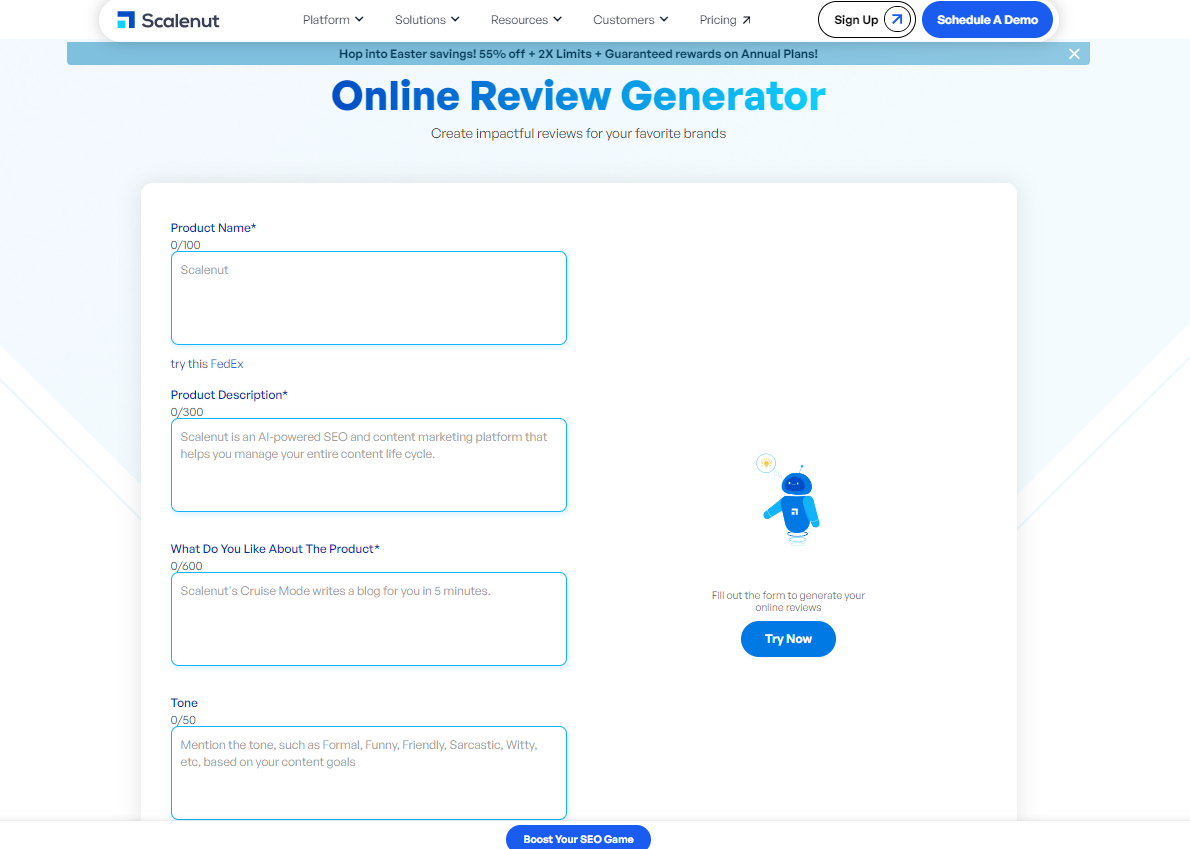
When used ethically, an AI review generator solves persistent pain points that have plagued marketing and customer success teams for decades. The value is not in fabricating opinions but in removing the heavy lifting from the content creation process.
- Time efficiency meets high volume: Drafting 50 unique, high-quality reviews manually can take hours. An automatic review generator can produce them in minutes, allowing teams to focus on verification and strategy rather than staring at a blank screen.
- Consistent quality and spelling: Human-written reviews vary wildly in clarity. AI ensures every piece of feedback is coherent, uses proper punctuation, and avoids rambling tangents that dilute the persuasive power of social proof.
- Multilingual scalability: Many AI review tools can natively generate or translate reviews into dozens of languages while preserving nuance. A brand selling globally can populate localized landing pages with culturally appropriate testimonials almost instantly.
- Overcoming writer’s block for real customers: The most underrated use case is helping genuine customers articulate their feelings. A business can ask a happy client “Can I turn your voice notes into a polished review with AI?” The tool amplifies the customer’s authentic voice instead of inventing one.
- SEO and content freshness: Search engines love regularly updated pages with unique content. A steady drip of well-written AI-generated reviews on product pages signals that a site is active, which can positively impact rankings for long-tail commercial queries.
- Absence of genuine lived experience: AI cannot smell a candle or feel the stitching on a jacket. If you do not feed it authentic sensory data points from a real user, the output will lack the incidental, specific details that a human would note (like “the zipper pull has a lovely matte finish”).
- Regulatory and platform crackdowns: The FTC has explicitly stated that fake reviews, including those generated by AI without clear substantiation, are illegal. Platforms like Google, Yelp, and Amazon deploy sophisticated algorithms to detect and remove synthetic reviews. A single violation can result in a permanent ban and a shattered reputation.
- The uncanny valley of generic positivity: Without careful prompt engineering, an AI review creator defaults to bland, overly enthusiastic language littered with adjectives like “amazing,” “game-changer,” and “blown away.” Readers have developed a sixth sense for this hollow praise and scroll past it.
- Legal liability for the business: If a business publishes AI-generated reviews that misrepresent the product’s capabilities and a consumer relies on that misinformation, the company could face charges of deceptive trade practices.
- Transform survey responses into testimonial gold. You already collect Net Promoter Score feedback and post-purchase comments. Feed the raw, bullet-pointed answers into the generator with a prompt like: “Turn this feedback into a structured review from a verified buyer. Mention the specific problem solved and the timeframe.” This ensures every word is backed by a living customer’s experience.
- Amplify verbal feedback from sales calls. Sales teams often hear glowing praise on discovery calls that never makes it online. Record the call (with permission), transcribe the relevant segment, and let the AI review builder shape it into a coherent written review. The customer then quickly approves the draft, turning a fleeting compliment into permanent social proof.
- Create industry-specific review templates for human editors. Use the AI to generate a framework review that touches on important aspects like shipping time, packaging, and ease of use. A human editor then overlays the real customer’s unique twists and quirky observations. This hybrid approach cuts writing time in half while preserving a completely authentic fingerprint.
- Generate negative or neutral review examples for training. You can use an AI review generator to simulate how a dissatisfied customer might phrase a complaint. This helps train your customer service team on appropriate public responses. No fake review is ever published; it stays strictly within internal training docs.
- Scale localized review snippets for multi-region markets. If a review in English genuinely applies to a product sold in Germany, you can use the AI to adapt and culturally localize the testimonial, noting that the text is based on a verified purchaser. The AI ensures the tone matches local expectations while preserving the factual core.
- Publishing without a human fact-checking layer. AI can hallucinate features, pricing, or even invent staff members who helped the “customer.” Imagine a glowing review that mentions a “free 24/7 hotline” you don’t offer. Always have a product expert verify every claim before hitting publish.
- Using identical sentence structures across dozens of reviews. If all your AI-generated customer reviews start with “I recently purchased the…” and end with “Highly recommended!”, both algorithms and human visitors will flag the pattern. Vary the prompt heavily, request different tones, and mix in authentic, unedited reviews to break the mold.
- Ignoring platform-specific review guidelines. Google’s prohibited content policy explicitly outlaws fake engagement and content that does not represent a genuine experience. Even if your intention is harmless — like generating a review from a testing team’s notes — if the reviewer is not a real customer, you are inviting a penalty. Always map generated text back to a verified transaction.
- Over-optimizing for keywords. Some marketers stuff AI product review scripts with exact-match keywords hoping to rank in search snippets. A review that reads “I love this AI review generator software tool for generating reviews with AI” is transparently spammy and will hurt conversions more than it could ever help.
The Limitations and Ethical Tightrope You Must Walk
No honest discussion of an AI review generator can ignore the ethical elephant in the room. The same technology that can elegantly articulate a real buyer’s experience can also be weaponized to flood the internet with fabricated praise. Understanding these limitations is critical for any professional who wants to preserve long-term credibility.
AI Review Generator vs. Traditional Review Collection: A Side-by-Side Comparison
To decide whether an AI-assisted review approach fits your workflow, it helps to stack up the old way against the new. The table below breaks down the practical differences between asking customers to write freely and using an intelligent generator to refine their input.
| Aspect | Traditional Manual Reviews | Ethical AI Review Generator |
|---|---|---|
| Time per review | 15-30 minutes for a thoughtful write-up | 30 seconds to generate a draft from supplied facts |
| Consistency of detail | Highly variable; many one-liners | High; can be tailored to always mention pros, cons, and use case |
| Human authenticity | Guaranteed, but often poorly expressed | Depends 100% on the truthfulness of the source data fed to it |
| Risk of penalty | None, as long as the review is real | High if used to invent non-existent customers; zero if used as an editing tool for real feedback |
| Volume capability | Low; limited by customer willingness | Extremely high; can scale to thousands of tailored variations |
5 Practical and Honest Ways to Use an AI Review Generator
The most successful businesses treat an AI review generator not as a fiction writer, but as a junior copy editor and writing coach. Here are five practical applications that bolster your review profile without crossing ethical boundaries.
Common Mistakes Businesses Make With AI-Generated Reviews
Enthusiasm for automatic review generation often outpaces caution, leading to easily avoidable blunders that tank credibility. Knowing these pitfalls will keep your reputation pristine.
Important Considerations Before You Generate a Single Word
Before you open any AI review creation platform, study the legal and social contract that governs testimonials. The landscape is shifting rapidly, and what was tolerated even six months ago may now land you in regulatory hot water.
FTC endorsement guidelines: The Federal Trade Commission requires that endorsements reflect the honest opinions and experiences of the endorser. If a review was drafted by an AI using client notes, you must ensure the final published version accurately reflects that client’s genuine belief. If you offer an incentive for a review, you must disclose it. AI does not exempt you from disclosure; the platform publishing the review must represent a real person’s experience.
Google’s strict stance on automated content: Google’s automated content policy for reviews is unambiguous. Content that is created by a program and intended to manipulate search rankings, without adding original value from real users, is considered spam. However, using AI to clean up the grammar of a genuine review is not automatically a violation. The key is that the review must stem from an authentic interaction and provide unique, human-centered insight.
E-E-A-T signals in review content: Google’s quality rater guidelines emphasize Experience, Expertise, Authoritativeness, and Trustworthiness. An AI-generated review that lacks specific sensory detail and demonstrates no firsthand experience will not bolster your E-E-A-T signals. In fact, it might harm your site’s perceived trustworthiness. Always inject a layer of raw, personal narrative — the chipped paint on the antique vase, the surprisingly quick setup time — that only a human could know.
Frequently Asked Questions
Can an AI review generator create undetectable fake reviews?
Technically, advanced models can produce text that mimics human writing very closely, but AI detection tools and platform algorithms are also evolving. More importantly, publishing completely fabricated reviews violates the terms of service of almost every major platform and is illegal in many jurisdictions. The goal should never be undetectable fakes; it should be an efficient way to give real experiences a professional polish.
Is it legal to use AI-generated reviews on my website?
It is legal to use AI as a writing assistant if the review is based on genuine customer feedback and reflects that customer’s true opinion. It becomes illegal when the AI is used to invent fictional customers or fabricate experiences that never happened. Always verify that the source material comes from a verified purchaser and that the final copy accurately represents their sentiment.
How do I make AI-written reviews sound more human and less generic?
Feed the generator very specific, quirky details. Instead of prompting “write a review for a coffee mug,” prompt “write a review for a ceramic travel mug with a sliding lid that a customer put in a backpack while hiking; the lid stayed on but the coffee cooled faster than expected.” Injecting small disappointments and physical observations makes the output feel lived-in. Then, edit the output manually to insert one or two colloquial phrases unique to your brand’s audience.
Will Google penalize my site for having too many similar-sounding reviews?
Not directly for the similarity alone, but if the review content is low-quality, thin, or clearly intended to manipulate rankings without providing genuine value, your pages could be hit by various signals, including the helpful content system. A pattern of boilerplate, AI-generated reviews that lack unique user experience signals may result in lower rankings over time. The safest approach is always to diversify with a good mix of raw customer submissions and AI-polished drafts.
What is the best free AI review generator available right now?
Several generic large language models can generate review drafts for free when prompted correctly, but dedicated AI review generator tools with built-in verification layers and integration to feedback platforms usually come with a paid subscription. Free versions often lack the nuance and safety guardrails needed for business use. If you are testing the waters, a well-crafted prompt on a general-purpose AI chat interface can demonstrate the concept, but professional reputation management demands a more structured, compliance-aware tool.
Building Trust in an Era of Automated Persuasion
The AI review generator is not a villain, nor is it an infallible savior. It is a tool that lies exactly at the intersection of technological capability and human integrity. When used to sculpt the raw, messy truth of customer satisfaction into clear, persuasive prose, it becomes a massive lever for authentic growth. When used to conjure praise from thin air, it becomes a fast track to brand erosion and regulatory scrutiny.
The most effective reputation strategists of the coming decade will be those who master the art of human-in-the-loop curation — where AI handles the grammar, structure, and scale, and a real person validates the truth, emotion, and experiential detail. As you explore an AI-powered review solution, keep the original voice of your customer at the center of the frame. No matter how elegant the algorithm, it can never replace the simple, messy reality of a human being genuinely delighted by what you sold them. Let the machine do the heavy lifting on syntax, but never let it invent the soul of the story.
Xem thêm:
- AI SEO Planning: How Machine Intelligence Transforms Search Strategy from Reactive to Predictive
- AI Rank Tracking: How Artificial Intelligence Revolutionizes SERP Monitoring
- AI Zero Search Volume Keywords: The Hidden Traffic Strategy Smart SEOs Use to Dominate Niche Markets
- AI SEO Natural Language Keywords: The Complete Guide to Conversational Search Optimization
- AI Citation SEO: The Complete Guide to Earning and Optimizing AI-Generated Citations in Search
Bài viết cùng chủ đề:

AI SEO SEO Automation with Make: The Complete Workflow Guide

AI SEO SEO Automation with Zapier: The Complete Workflow Guide

AI SEO SEO Automation with n8n: The Complete Workflow Guide
AI SEO SEO Automation with Gemini: The Complete Guide to Scaling Organic Growth

AI SEO SEO Automation with Claude: The Complete Guide to Scaling Content in 2025

AI SEO SEO Automation with ChatGPT: The Complete Playbook for 2025

AI SEO & SEO Automation for Affiliate Sites: The 2025 Playbook for Passive Income Growth
AI SEO & SEO Automation for Bloggers: The Complete Guide to Scaling Your Content

AI SEO & SEO Automation for Agencies: The Complete 2025 Playbook

AI SEO and SEO Automation for Ecommerce: The Complete Playbook for 2025

AI SEO & SEO Automation for WordPress: The Complete Playbook for 2025
AI SEO SEO Automation Strategy: The Complete Playbook for 2025

Mastering the AI SEO SEO Automation Process: A Complete Guide to Scaling Organic Growth
AI SEO SEO Automation System: The Complete Guide to Scaling Organic Growth in 2025
AI SEO SEO Automation Platform: The Complete Guide to Scaling Organic Growth in 2025
AI SEO SEO Automation Software: The Complete Guide to Scaling Organic Growth in 2025















