
No products in the cart.
AI SEO Entity Authority: The Complete Guide to Dominating Search in 2025
10
Aug
Aug
Search engines have moved beyond simple keyword matching. The new frontier is understanding the relationships between people, places, things, and concepts. This is where AI SEO Entity Authority comes into play. It represents the intersection of artificial intelligence, entity-based search, and the trust signals that make a brand or website the definitive source on a topic. This guide explains how to build, measure, and leverage this authority to secure top rankings and sustainable organic traffic.
What is AI SEO Entity Authority?
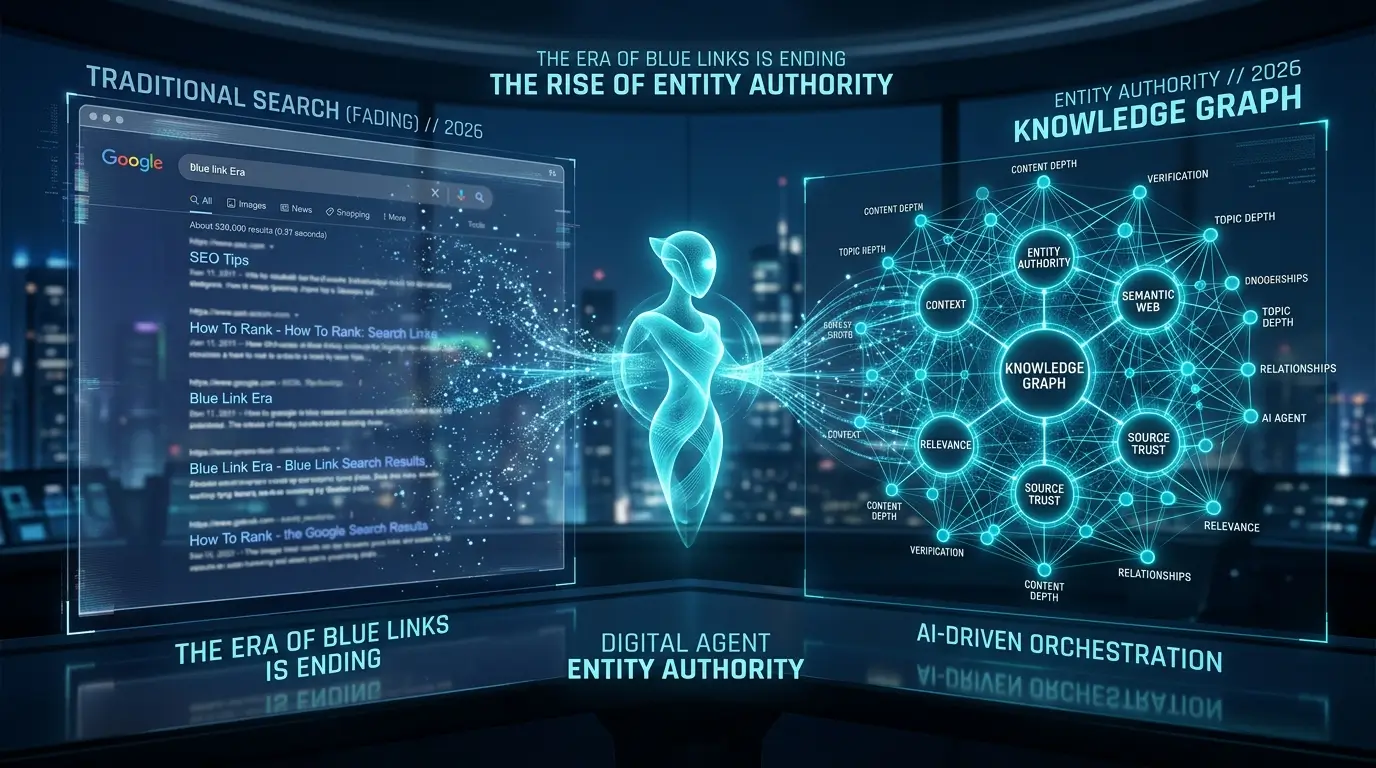
AI SEO Entity Authority is the measure of how much trust and relevance a search engine assigns to a specific entity (a person, brand, organization, or concept) for a given topic. It is not about a single page. It is about the collective signals that tell Google, Bing, or other AI-driven engines that your entity is the most credible source of information on that subject.
This authority is built through a combination of structured data, consistent mentions across the web, high-quality backlinks from related entities, and content that clearly demonstrates topical depth. The “AI” component refers to how machine learning models like Google’s RankBrain and MUM (Multitask Unified Model) process these signals to understand context and semantic relationships, rather than just counting keywords.
The Shift from Keywords to Entities
Traditional SEO focused on exact-match keywords. If you wanted to rank for “best running shoes,” you repeated that phrase. Modern AI-driven search understands that “best running shoes” is related to entities like “Nike,” “Asics,” “marathon training,” and “pronation.” The algorithm evaluates which entity provides the most comprehensive and authoritative coverage of that entire topic cluster.
This shift means that a website with a strong entity footprint can rank for hundreds of related queries without targeting each one individually. The AI recognizes the site as an authority on the broader subject, not just a single page.
Why Entity Authority Matters for AI Search Engines
AI models are designed to mimic human understanding. When a human expert writes about a topic, they reference other experts, cite data, and provide unique insights. AI SEO Entity Authority replicates this process in the digital space. It signals to the algorithm that your content is not just a rehash of existing information but a primary source of knowledge.
Search engines use entity authority to combat content saturation. With millions of pages published daily, the algorithm needs a reliable way to filter out low-effort, AI-generated spam. A strong entity footprint acts as a quality gate. It tells the system that your brand has a history of accuracy and user satisfaction.
The Role of Knowledge Graphs
Google’s Knowledge Graph is a database of entities and their relationships. When you build entity authority, you are effectively populating this graph with accurate information about your brand. This includes your logo, founder, headquarters, product lines, and industry classifications. The more accurate and consistent this data is, the easier it is for the AI to connect you to relevant search queries.
For example, a local bakery that consistently appears in local business directories, has a verified Google Business Profile, and publishes content about sourdough techniques will build a strong entity profile. The A
Core Components of AI SEO Entity Authority
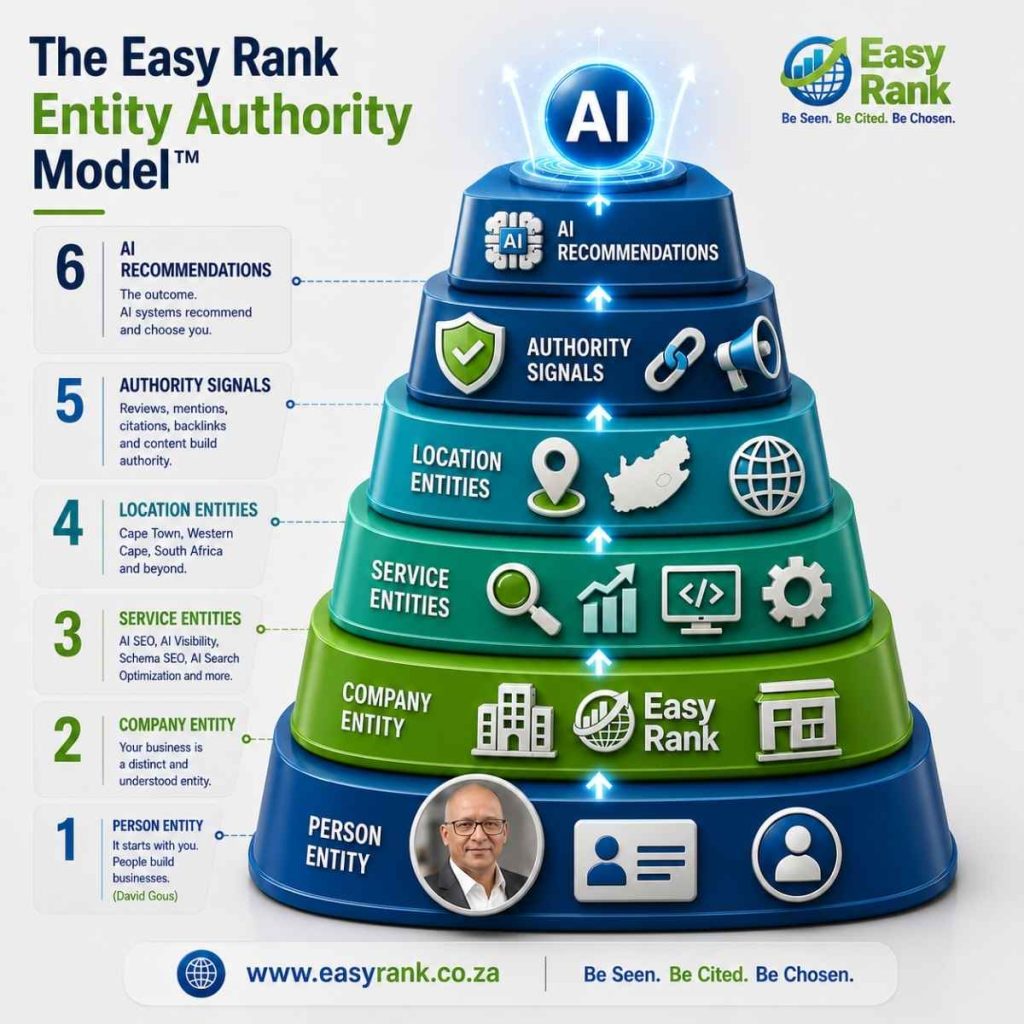
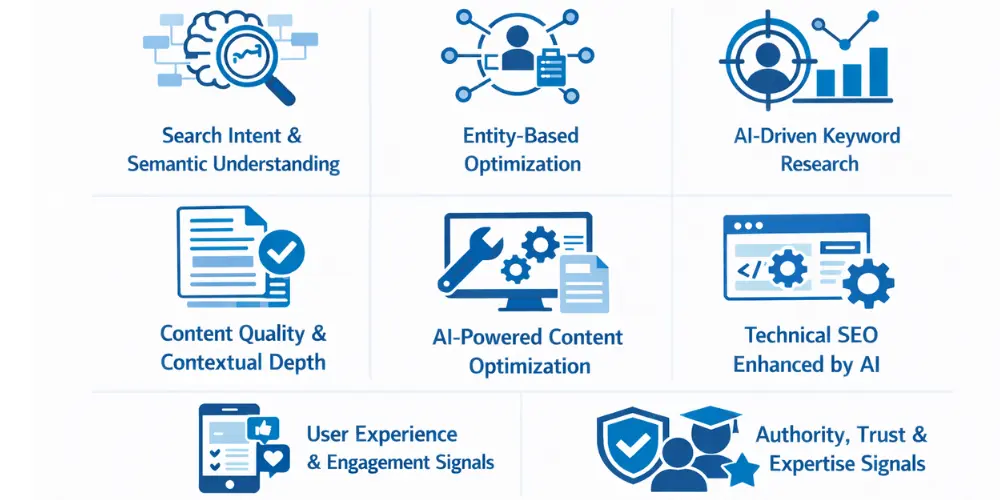
Building this type of authority requires a multi-faceted approach. It is not a single tactic but a system of interconnected signals. The following components form the foundation of a robust entity strategy.
Structured Data and Schema Markup
Schema markup is the language that helps search engines understand the context of your content. Using vocabulary like Organization, Person, Product, or Article provides explicit clues about your entity. This is the technical baseline for entity authority.
- Organization Schema: Defines your company name, logo, contact info, and social profiles.
- Person Schema: Establishes the author or founder as a real, credible individual.
- Article Schema: Connects your content to the author and publisher entities.
- FAQ Schema: Helps the AI understand the specific questions your content answers.
- Long-Term Stability: Algorithm updates rarely penalize true authority. Once you are established, you are less vulnerable to fluctuations.
- Higher CTR: A recognized entity with a Knowledge Panel often gets more clicks because it appears more trustworthy.
- Voice Search Optimization: Voice assistants rely heavily on entity resolution to answer questions. Strong authority improves your chances of being the source.
- Competitive Moat: It is difficult for competitors to copy your entity footprint. It is built on reputation and history.
- Time-Intensive: This is not a quick win. It takes months or years to build significant authority.
- Requires Consistency: You must be disciplined about maintaining consistent branding and messaging across all channels.
- Difficult to Measure Directly: The lack of a direct metric can make it hard to justify the investment to stakeholders.
- Consistency is King: Your brand name, logo, and messaging must be uniform everywhere.
- Quality over Quantity: One authoritative piece of content is worth more than ten mediocre ones.
- Monitor Your Brand Mentions: Use tools like Google Alerts to track unlinked mentions. These still contribute to entity recognition, and you can reach out to get them linked.
- Stay Updated: The AI algorithms are constantly evolving. What works today may need adjustment tomorrow. Follow reputable SEO news sources to stay ahead.
Consistent NAP (Name, Address, Phone) Citations
For local entities, consistency is critical. If your business name appears as “ABC Consulting” on one site and “ABC Consulting LLC” on another, the AI may treat them as two separate entities. This dilutes your authority. Ensure your NAP is identical across all directories, social platforms, and your own website.
Topical Authority Clusters
You cannot be an authority on everything. AI SEO Entity Authority is built by dominating a specific niche. This involves creating a pillar page that covers a broad topic and then creating cluster content that addresses specific subtopics in depth. Each piece of cluster content links back to the pillar page, creating a semantic web that the AI can crawl and understand.
For instance, a financial advisor entity would have a pillar page on “Retirement Planning” and cluster pages on “401k Rollovers,” “Roth IRA Limits,” and “Social Security Strategies.” This structure demonstrates deep knowledge of the entire domain.
How to Build AI SEO Entity Authority
Building this authority is a strategic process that takes time. It requires a shift from page-level optimization to entity-level optimization.
Step 1: Define Your Entity
Start by clearly defining who you are. What is your brand name? What is your unique value proposition? What specific topics do you want to be known for? Create a brand guideline document that includes your official name, tagline, and a list of core topics. This document will serve as your reference for all content creation and citation building.
Step 2: Audit Your Current Digital Footprint
Search for your brand name and see what comes up. Look for inconsistencies in your NAP, outdated information, or missing profiles on relevant platforms. Use tools like Ahrefs or Semrush to see which entities are linking to you and what anchor text they are using. This audit reveals the current state of your entity profile.
Step 3: Implement Technical Schema
Add Organization schema to your homepage and Person schema to your author pages. Use the “sameAs” property to link your website to your official social media profiles, Wikipedia page (if you have one), and Crunchbase profile. This tells the AI that all these separate URLs belong to the same entity.
Step 4: Create Entity-Focused Content
Stop writing generic blog posts. Instead, create content that answers specific questions related to your entity. Use tools like “People Also Ask” and “Related Searches” to find the exact queries your target audience is using. Then, write comprehensive guides that cover these queries in a way that demonstrates your unique expertise and experience.
Step 5: Earn Links from Related Entities
Backlinks are still a major ranking factor, but the quality of the linking entity matters more than ever. A link from a university, a government site, or a well-known industry publication carries significant weight. Focus on digital PR and guest posting on sites that are already established entities in your niche. This transfers some of their authority to you.
Measuring AI SEO Entity Authority
You cannot manage what you do not measure. While t
| Metric | What It Indicates | How to Track It |
|---|---|---|
| Branded Search Volume | How many people are searching for your name specifically. | Google Search Console, Google Trends |
| Knowledge Panel Presence | Whether Google recognizes you as a distinct entity. | Manual search for your brand name |
| Link Diversity | The number of unique domains linking to you. | Ahrefs, Semrush, Moz |
| Visibility for Non-Branded Keywords | Ranking for topics related to your niche without using your brand name. | Rank tracking tools |
Using AI Tools for Analysis
Several AI-powered tools can help you analyze your entity footprint. Tools like InLinks and EntityHub can map out your existing entities and suggest related ones to target. They can also help you identify gaps in your schema implementation. These platforms use natural language processing to understand the semantic relationships between your content and the rest of the web.
Benefits and Limitations of Entity Authority
Understanding the pros and cons of this approach helps set realistic expectations for your SEO strategy.
Key Benefits
Limitations to Consider
AI SEO Entity Authority vs. Traditional Domain Authority
It is important to distinguish between these two concepts. Domain Authority (DA) is a third-party metric that predicts ranking potential based on the quantity and quality of backlinks. AI SEO Entity Authority is a broader concept that includes links but also factors in brand recognition, schema, and content relevance.
| Feature | Domain Authority | Entity Authority |
|---|---|---|
| Focus | Backlinks | Brand, Links, Content, Schema |
| Scope | Whole Domain | Specific Entity or Brand |
| Measured By | Moz, Ahrefs | Search Engine Algorithms |
| Durability | Can drop with link loss | More resilient to link changes |
You can have a high DA but low entity authority if your backlinks come from unrelated sites. Conversely, a small, niche brand can have high entity authority within its specific field, even with a lower overall DA.
Common Mistakes in Building Entity Authority
Many SEO professionals make critical errors when trying to implement this strategy. Avoiding these pitfalls will save you time and resources.
Ignoring the “SameAs” Property
Failing to link your social profiles and other web properties to your main website confuses the AI. It cannot connect the dots between your Twitter account and your website if you do not explicitly tell it they are related.
Creating Thin Content for the Sake of Clusters
Publishing 50 low-quality articles to cover a topic cluster will harm your authority. The AI is sophisticated enough to detect content that lacks depth. It is better to have 10 excellent, comprehensive articles than 100 shallow ones.
Focusing Only on Google
While Google is the dominant player, other AI-driven engines like Bing (which powers ChatGPT search) and Perplexity are growing. Ensure your entity information is consistent across all major platforms, including Bing Places and Apple Business Connect.
Neglecting User Experience Signals
If users click on your site and immediately bounce back to the search results, the AI interprets this as a lack of relevance. Ensure your pages load fast, are easy to navigate, and directly answer the user’s query. Engagement metrics are part of the entity authority calculation.
Important Notes for Long-Term Success
Building AI SEO Entity Authority is a marathon, not a sprint. The following principles should guide your ongoing efforts.
Frequently Asked Questions
How long does it take to build AI SEO Entity Authority?
It typically takes 6 to 12 months of consistent effort to see significant results. This timeline depends on the competitiveness of your niche and the current state of your digital footprint. Established brands with a strong history may see results faster than new startups.
Is AI SEO Entity Authority the same as Google E-E-A-T?
They are closely related but not identical. E-E-A-T (Experience, Expertise, Authoritativeness, Trustworthiness) is a framework used by human quality raters to evaluate content. Entity Authority is the algorithmic interpretation of those signals. Building entity authority is the technical way to demonstrate E-E-A-T to the AI.
Can small businesses compete with large brands for entity authority?
Yes. While large brands have a head start, they often spread their authority across many topics. A small business can focus on a hyper-niche and become the definitive entity for that specific subject. Local SEO is a prime example where small entities can dominate.
Does AI-generated content hurt entity authority?
Not automatically. The problem is not that AI writes the content, but that it is often generic and lacks unique experience. If you use AI to draft content and then heavily edit it with your own data, case studies, and insights, it can still build authority. Unedited, mass-produced AI content will dilute your entity footprint.
What is the fastest way to improve entity authority?
The fastest way is to fix your technical foundation. Ensure your schema markup is correct, your NAP is consistent, and your “sameAs” properties are in place. This allows the AI to accurately map your entity immediately. After that, focus on earning a few high-quality links from authoritative, related entities.
Conclusion
AI SEO Entity Authority represents the evolution of search optimization. It moves the focus from manipulating keywords to building a genuine, recognizable digital identity. By implementing structured data, creating in-depth topical content, and earning trust from related entities, you position your brand to be the definitive answer in your niche. This approach requires patience and consistency, but the payoff is a resilient, sustainable SEO strategy that thrives in the age of artificial intelligence. The brands that start building their entity footprint today will be the ones that dominate the search results tomorrow.
Xem thêm:
- AI SEO Content Freshness: The Complete Guide to Keeping Your Rankings Alive in 2025
- AI People Also Ask: The Complete Guide to Optimizing for Google’s AI-Powered Q&A Feature
- AI SEO Semantic Architecture: The Complete Blueprint for Modern Search Dominance
- AI SEO LLM Recommendations: The Complete Guide to Future-Proof Search Rankings
- AI SEO Content Scaling: The Complete Playbook for 2025 and Beyond
Bài viết cùng chủ đề:

AI SEO SEO Automation with Make: The Complete Workflow Guide

AI SEO SEO Automation with Zapier: The Complete Workflow Guide

AI SEO SEO Automation with n8n: The Complete Workflow Guide
AI SEO SEO Automation with Gemini: The Complete Guide to Scaling Organic Growth

AI SEO SEO Automation with Claude: The Complete Guide to Scaling Content in 2025

AI SEO SEO Automation with ChatGPT: The Complete Playbook for 2025

AI SEO & SEO Automation for Affiliate Sites: The 2025 Playbook for Passive Income Growth
AI SEO & SEO Automation for Bloggers: The Complete Guide to Scaling Your Content

AI SEO & SEO Automation for Agencies: The Complete 2025 Playbook

AI SEO and SEO Automation for Ecommerce: The Complete Playbook for 2025

AI SEO & SEO Automation for WordPress: The Complete Playbook for 2025
AI SEO SEO Automation Strategy: The Complete Playbook for 2025

Mastering the AI SEO SEO Automation Process: A Complete Guide to Scaling Organic Growth
AI SEO SEO Automation System: The Complete Guide to Scaling Organic Growth in 2025
AI SEO SEO Automation Platform: The Complete Guide to Scaling Organic Growth in 2025
AI SEO SEO Automation Software: The Complete Guide to Scaling Organic Growth in 2025















