
No products in the cart.
AI SaaS SEO: The Ultimate Guide to Dominating Organic Growth in 2025
29
Jul
Jul
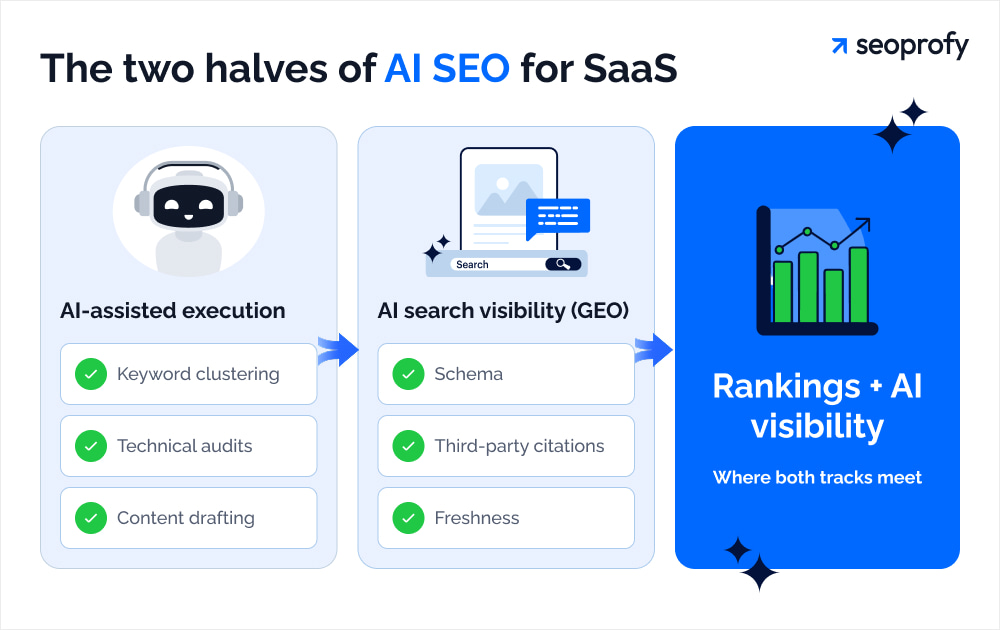
AI SaaS SEO represents the fusion of artificial intelligence and search engine optimization tailored specifically for software-as-a-service businesses. This approach moves beyond manual keyword research and content tweaking, harnessing machine learning models to analyze search intent, automate technical audits, and generate content strategies that scale. By integrating AI into every layer of SEO, SaaS companies now achieve faster rankings, higher conversion rates, and a measurable competitive edge. In the following sections, you will gain a thorough understanding of how AI transforms SaaS SEO, which tools drive the best results, and how to avoid the most common implementation traps.
What Is AI SaaS SEO?
AI SaaS SEO is a strategic discipline that applies artificial intelligence technologies to optimize a SaaS product’s visibility in organic search results. It encompasses everything from automated keyword discovery and content generation to predictive analytics for ranking factors. Unlike basic on-page optimization, AI SaaS SEO uses natural language processing and deep learning to decipher user intent behind every query, ensuring that landing pages, blog posts, and product pages answer exactly what searchers need.
Modern AI models analyze millions of data points in seconds—identifying content gaps, clustering keywords by semantic relevance, and even suggesting internal linking structures. For SaaS companies, this means moving from reactive SEO fixes to a proactive, data-first system. Instead of guessing what topics will attract high-quality leads, AI tools can forecast traffic potential, buyer intent, and conversion likelihood for each piece of content. The result is a content pipeline that aligns perfectly with the customer journey, from awareness to retention.
The backbone of AI SaaS SEO rests on three pillars: intelligent data processing, continuous learning algorithms, and seamless integration with SEO workflows. These pillars empower marketers to automate tedious tasks like meta tag optimization, image alt text generation, and schema markup creation, freeing up strategic thinking for creative campaigns. As search engines like Google rely more heavily on AI-driven ranking systems (such as RankBrain and MUM), a SaaS brand that adopts AI-native SEO practices positions itself to thrive amid constant algorithm updates.
The Core Components of AI SaaS SEO
Automated Keyword Research and Clustering
Traditional keyword research often produces a static list of head terms and long-tail variations. AI SaaS SEO tools like Semrush’s Keyword Magic Tool with AI integrations or Ahrefs’ machine learning analysis can sift through billions of queries to uncover hyper-relevant opportunities. They go further by grouping keywords into topic clusters based on semantic similarity and user intent type—informational, commercial, transactional, or navigational. This clustering allows SaaS companies to build pillar pages and cluster content that search engines recognize as comprehensive and authoritative.
An AI engine can detect emerging trends before they spike, enabling a SaaS brand to publish early and capture first-mover traffic. It also analyzes competitor keyword portfolios to expose gaps where minimal effort can yield high returns. With predictive difficulty scores, the system recommends which terms to target next based on current domain authority and content freshness, turning keyword strategy from guesswork into a calculated science.
AI-Driven Content Creation and Optimization
Creating content that ranks for AI SaaS SEO goes beyond inserting keywords. AI writing assistants such as Jasper and Copy.ai can generate initial drafts, but true optimization comes from tools like Clearscope, MarketMuse, and Surfer SEO. These platforms analyze top-ranking pages for a target query and provide a content brief that includes recommended word count, related terms, heading structure, and readability metrics. The AI then evaluates your draft in real time, offering suggestions to meet topic depth and relevance standards.
The beauty of AI content optimization lies in its ability to balance search bot requirements with human readability. Natural language generation models trained on SaaS-specific vocabulary can produce technical guides, comparison posts, and case studies that resonate with both Google’s crawler and a decision-maker evaluating the product. Some enterprise platforms even personalize content for different audience segments—tailoring the language, examples, and calls to action based on the visitor’s industry or company size.
Technical SEO Automation
Technical health remains a cornerstone of any AI SaaS SEO strategy. AI-powered crawlers like Sitebulb or DeepCrawl (now part of Lumar) can scan millions of pages, detect broken links, slow-loading pages, duplicate content, and indexing issues without human intervention. More advanced AI systems go a step further: they prioritize fixes by impact on revenue and organic traffic, automatically generate structured data markup, and even test the effect of page speed improvements on rankings.
In a SaaS environment, where product updates and feature launches create frequent URL changes, AI-driven technical monitoring becomes indispensable. The system can instantly flag 404 errors, redirect chains, or canonical tag conflicts, and often implement fixes via API integrations. This real-time oversight keeps the site’s SEO integrity intact, preventing silent traffic drops that typically go unnoticed until a manual audit occurs weeks later.
Predictive Analytics and Performance Forecasting
Perhaps the most strategic component of AI SaaS SEO is the ability to forecast outcomes. Machine learning algorithms ingest historical ranking data, backlink profiles, content freshness, and user engagement signals to predict how a page will perform after optimization. This allows a SaaS marketing team to prioritize projects based on projected ROI rather than instinct. For instance, an AI model might indicate that updating five existing product comparison pages would generate 40% more organic conversions than creating ten new blog posts—a decision grounded in data.
Predictive analytics also extend to link building. AI can evaluate potential backlink opportunities by analyzing referring domain authority, relevance, and the likelihood of the link being followed. Some platforms even automatically compose personalized outreach emails, track response rates, and suggest follow-up timing. The result is a leaner, more effective off-page SEO operation that complements the on-page and technical efforts seamlessly.
Benefits and Limitations of AI SaaS SEO
Employing AI for SaaS SEO delivers transformative benefits that directly impact growth metrics. The most immediate advantage is speed. Tasks that once required days—comprehensive keyword mapping, competitive content audits, log file analysis—now complete in hours or minutes. This velocity enables lean marketing teams to compete with enterprise-level output. Additionally, AI brings a level of precision unattainable manually. It identifies subtle semantic relationships across topics, preventing content cannibalization and ensuring each page serves a distinct purpose in the conversion funnel.
Another significant benefit is scalability. A SaaS company targeting dozens of verticals and buyer personas can generate hundreds of optimized page variations while maintaining brand consistency. AI-based personalization further tailors the search experience, showing different meta titles or landing page copy to users from different geographies or industries, all while respecting canonical and hreflang tags. The result is a huge expansion in keyword footprint without a linear increase in headcount.
However, AI SaaS SEO is not without limitations. Over-reliance on automation can lead to generic, soulless content that fails to convey genuine product value or thought leadership. AI tools sometimes misinterpret search intent if training data is skewed, producing content optimized for the wrong audience segment. T Finally, the risk of algorithm devaluation looms: Google’s guidelines emphasize helpful, people-first content, and an overly AI-generated site lacking human oversight can be penalized. The key is using AI as an accelerator, not a replacement for human creativity and strategic judgment.
AI SaaS SEO vs. Traditional SEO: A Detailed Comparison
| Aspect | Traditional SEO | AI SaaS SEO |
|---|---|---|
| Keyword Research | Manual spreadsheet analysis, limited to seed keywords and competitor checks | Automated topic clustering, semantic intent mapping, and predictive difficulty scoring |
| Content Optimization | Writer uses basic keyword density guidelines and manual SERP analysis | AI content briefs, NLP-driven scoring, real-time optimization suggestions, personalization at scale |
| Technical Audits | Periodic crawls with manual issue tagging, often reactive | Continuous AI monitoring, automatic prioritization, and self-healing integrations |
| Link Building | Manual prospecting, template-based outreach, low efficiency | Predictive link opportunity scoring, AI-generated personalized outreach, automated follow-ups |
| Data Analysis | Reports assembled monthly, dashboards show what happened | Real-time predictive analytics and prescriptive recommendations on what to do next |
| Scalability | Heavily dependent on team size and hours | Scales near-infinitely with API-based workflows and AI content generation |
| Cost Model | High headcount or agency retainers | Tool subscription costs plus strategic oversight; lower marginal cost per page |
How to Implement an AI SaaS SEO Strategy
Audit Your Current SEO Baseline with AI
Start by running your SaaS website through an AI-powered auditing tool like Semrush Site Audit with its machine learning anomaly detection, or use a dedicated platform like OnCrawl. The A This baseline reveals whether key product pages are indexed, how internal PageRank flows, and where content quality falls short of top competitors. Document the findings in a prioritized backlog, tagging each issue with a projected traffic lift based on historical patterns the AI has seen across similar SaaS sites.
Develop a Topic Cluster Strategy Using Machine Learning
Feed your core product terms, use cases, and buyer pain points into an AI keyword clustering tool. The system will output pillar topics (e.g., “project management for remote teams”) surrounded by support articles that address specific features, comparisons, and how-tos. For a SaaS product, this often includes integration guides, security documentation, and ROI case studies. Validate each cluster by checking search volume, conversion intent, and alignment with your product roadmap. The AI can also suggest the optimal content format—long-form guide, video, interactive tool—based on SERP features dominating the top results.
Create an AI-Optimized Content Calendar
Use predictive analytics to sequence content production. An AI model might recommend writing the “pricing” comparison piece before the “alternatives” listicle because the former shows higher purchase intent and faces less aggregated competition. For each planned piece, generate an AI content brief that lists required subheadings, semantic entities, and content length. While a human writer develops the draft, AI optimization tools score the work as it progresses. This hybrid approach preserves brand voice while meeting search engine expectations.
Automate On-Page and Technical Optimization
Implement an AI system that continuously analyzes every new and existing page. The AI can auto-generate meta descriptions, adjust title tags based on CTR data, and insert internal links to related content using natural language processing. For e-commerce-like SaaS pricing pages, dynamic schema markup (Product, SoftwareApplication) can be kept up-to-date via AI scripts connected to your CMS. Set up triggers that alert the team when a high-value page’s ranking dips beyond a threshold, and have the AI suggest the most likely cause—content decay, a new competitor, or a technical change.
Integrate AI into Link Building and Digital PR
Train an AI prospecting engine to scan niche SaaS directories, technology review sites, and partner blogs for link opportunities. The AI evaluates the domain’s relevance, traffic, and link equity potential, then ranks them. Integration with an email marketing platform allows the system to draft personalized pitches, referencing the recipient’s recent article and how your tool or data can add value. Track response rates and use that feedback to refine the AI’s outreach templates, turning link building into a data-driven growth loop rather than a manual grind.
Common Pitfalls and How to Avoid Them
One frequent mistake in AI SaaS SEO is over-automating content to the point where every article sounds identical. Even if the SEO scores look perfect, readers quickly disengage when they recognize templated phrasing. To prevent this, always inject original research, real customer quotes, or unique product insights that AI cannot fabricate. Schedule a human editorial review for every piece generated with AI assistance, ensuring tone, accuracy, and perspective remain authentic.
Another pitfall is ignoring the messy reality of SaaS buyer journeys. AI topic models might suggest content clusters that make logical sense but fail to reflect how actual users discover and evaluate the software. For example, an AI tool might deprioritize a “how to migrate data from competitor X” article because the search volume appears low, yet that piece could capture high-intent users at decision stage. Cross-reference AI recommendations with sales call recordings, customer support tickets, and win/loss analysis to unearth bottom-of-funnel topics the pure search data overlooks.
Technical teams sometimes let AI crawlers overwhelm server resources. Aggressive AI audits can inadvertently DDoS a website, especially during coordinated scans. Set crawl rate limits and schedule deep audits during off-peak hours. Additionally, over-optimizing for AI-driven scoring tools can lead to keyword stuffing or unnatural structuring that tries to please the optimization algorithm rather than the end user. Remember that Google’s ultimate goal is satisfying the searcher; a page perfectly scored by an AI tool still underperforms if real visitors bounce instantly.
Data Privacy and Compliance Blind Spots
SaaS companies handling sensitive customer data must be cautious when integrating third-party AI tools. Some content generation or analytics platforms store input data on shared servers, potentially violating GDPR or SOC 2 requirements. Vet every AI vendor’s data processing agreement and, where possible, opt for on-premise or private cloud deployment models. Ensure that auto-generated schema markup never inadvertently exposes proprietary information in search results. A misconfigured FAQ schema generated by AI could reveal support ticket details that should remain internal.
Key Considerations for Long-Term Success
Long-term success with AI SaaS SEO depends on building a feedback loop between your AI systems and real-world performance data. Feed conversion metrics, not just rankings, back into the content prioritization engine. Over time, the AI learns which topics generate qualified trials and which ones attract window shoppers, shifting the entire SEO strategy toward revenue influence. This evolution turns SEO from a traffic volume game into a predictable growth channel tied to customer acquisition cost and lifetime value.
Maintain a human-in-the-loop approach, especially for pages that explain complex technical concepts or build your brand narrative. AI handles scale; humans provide the nuance, empathy, and creative leaps that forge emotional connections with buyers. Schedule quarterly strategic reviews where the team examines AI-generated insights alongside qualitative feedback from sales and customer success. Adjust the AI’s weighting parameters to align with evolving business goals, such as entering a new market or defending against a rising competitor.
Stay informed about AI search advancements, including Google’s Search Generative Experience and Bing’s deep search capabilities. These features answer queries directly in the SERP, reducing click-through rates for certain informational queries. AI SaaS SEO must adapt by creating content that cannot be fully summarized by an AI snippet—proprietary data, interactive tools, original frameworks. Emphasize content types that drive users to your owned properties, where deeper engagement occurs.
Frequently Asked Questions
What is AI SaaS SEO?
AI SaaS SEO is the application of artificial intelligence technologies—such as machine learning, natural language processing, and predictive analytics—to optimize a software-as-a-service company’s website for search engines. It automates keyword research, content creation, technical audits, and performance forecasting to drive organic growth with greater efficiency and precision.
How does AI improve SaaS content marketing?
AI improves SaaS content marketing by analyzing search intent at scale, generating data-informed content briefs, and scoring drafts for SEO completeness in real time. It identifies gaps in topic coverage, suggests semantic keywords that enhance relevance, and can even personalize page content for different visitor segments, leading to higher engagement and conversion rates.
Can AI replace human SEO strategists for a SaaS product?
AI cannot fully replace human SEO strategists because genuine expertise, creative strategy, and brand storytelling require human judgment. While AI excels at data processing and task automation, a skilled strategist interprets business context, integrates cross-channel insights, and ensures that content remains helpful and original—factors search engines prioritize heavily.
What are the best AI tools for SaaS SEO?
Top-tier AI tools for SaaS SEO include Surfer SEO and MarketMuse for content optimization, Clearscope for topical analysis, Semrush and Ahrefs with embedded AI features for keyword research and competitor insights, Jasper and Copy.ai for AI-assisted writing, and Sitebulb or Lumar for intelligent technical audits. The ideal stack depends on your budget and specific growth stage.
Is AI-generated content penalized by Google?
Google does not penalize content solely because it is AI-generated; it penalizes low-quality, unoriginal, or unhelpful content regardless of how it was created. If AI-generated material is extensively reviewed, edited, and enriched with human insight to meet user needs, it can rank perfectly well. The critical factor is delivering genuine value to the searcher.
How do you measure ROI from AI SaaS SEO?
Measure ROI by tracking organic conversions, trial sign-ups, and revenue influenced by AI-optimized pages. Use multi-touch attribution to connect content discovered through organic search to closed deals. Compare the cost of AI tool subscriptions and team time against the incremental growth in organic pipeline, factoring in the saved cost of manual labor that AI replaced.
Conclusion
AI SaaS SEO is not just a fleeting trend; it is the new standard for how software companies sustain and accelerate organic growth. By blending machine intelligence with human expertise, a SaaS organization can build a self-optimizing marketing machine that responds to algorithm shifts, competitor moves, and evolving buyer needs in near real time. The key lies in strategic implementation—auditing your foundation, selecting the right AI tools, maintaining a creative editorial guardrail, and always tying optimization efforts back to business results. Those who embrace this holistic, AI-augmented approach will leave behind competitors still relying on outdated manual processes.
Xem thêm:
- AI SEO SEO Automation with Gemini: The Complete Guide to Scaling Organic Growth
- AI SEO Mobile First Indexing: The Complete Guide to Future-Proofing Your Rankings
- AI SEO Course: The Definitive Guide to Automating and Dominating Search Rankings
- The 2024 AI SEO Glossary: 50+ Must-Know Terms for Search Professionals
- AI SEO Content Research: The Complete Guide to Data-Driven Content That Ranks
Bài viết cùng chủ đề:

AI SEO SEO Automation with Make: The Complete Workflow Guide

AI SEO SEO Automation with Zapier: The Complete Workflow Guide

AI SEO SEO Automation with n8n: The Complete Workflow Guide
AI SEO SEO Automation with Gemini: The Complete Guide to Scaling Organic Growth

AI SEO SEO Automation with Claude: The Complete Guide to Scaling Content in 2025

AI SEO SEO Automation with ChatGPT: The Complete Playbook for 2025

AI SEO & SEO Automation for Affiliate Sites: The 2025 Playbook for Passive Income Growth
AI SEO & SEO Automation for Bloggers: The Complete Guide to Scaling Your Content

AI SEO & SEO Automation for Agencies: The Complete 2025 Playbook

AI SEO and SEO Automation for Ecommerce: The Complete Playbook for 2025

AI SEO & SEO Automation for WordPress: The Complete Playbook for 2025
AI SEO SEO Automation Strategy: The Complete Playbook for 2025

Mastering the AI SEO SEO Automation Process: A Complete Guide to Scaling Organic Growth
AI SEO SEO Automation System: The Complete Guide to Scaling Organic Growth in 2025
AI SEO SEO Automation Platform: The Complete Guide to Scaling Organic Growth in 2025
AI SEO SEO Automation Software: The Complete Guide to Scaling Organic Growth in 2025















