
No products in the cart.
AI SEO Course: The Definitive Guide to Automating and Dominating Search Rankings
29
Jul
Jul
An AI SEO course is no longer a futuristic luxury—it is the fastest route to mastering how artificial intelligence reshapes content creation, keyword strategy, and technical optimization. Search engines themselves now use machine learning to understand intent, and marketers who complete a structured AI SEO program are seeing dramatic reductions in manual labor alongside significant ranking improvements. This comprehensive guide breaks down everything you need to know about choosing the right training, the exact skills you will acquire, and how to apply them in real campaigns.
What Exactly Is an AI SEO Course?
An AI SEO course is a structured educational program designed to teach you how to leverage artificial intelligence tools and machine learning principles to improve organic search performance. Unlike traditional SEO training that focuses solely on manual keyword research and link building, these courses blend classic optimization theory with hands-on instruction using large language models, automated content platforms, and predictive analytics. The core purpose is to shrink the time from strategy to execution by teaching you to prompt, refine, and validate AI-generated outputs for ranking success.
Most reputable AI SEO courses cover the full spectrum of modern search work, from generating topic clusters with AI to using natural language processing for semantic analysis. You will learn to interpret Google’s algorithms through the lens of machine learning, understanding how entities, context, and user satisfaction signals are evaluated. The training typically spans technical audits assisted by AI, automated schema markup generation, and content refresh strategies that would take human teams weeks to complete.
The Core Components of a Modern AI SEO Curriculum
Every high-quality AI SEO course breaks down into four pillars that mirror the actual workflow of an AI-powered SEO professional. These components are never taught in isolation because the real power comes from connecting AI content generation with data-driven technical decisions.
- AI-Powered Keyword and Topic Research: Using tools to scrape real-time data, cluster semantically related terms, and predict search demand before competitors notice the trend.
- Generative Content Engineering: Prompt design, tone consistency, factual validation, and structuring articles to meet E-E-A-T standards without sacrificing creativity.
- Technical SEO Automation: Deploying scripts and AI crawlers to find and fix broken internal links, audit page speed, generate dynamic sitemaps, and optimize structured data at scale.
- Predictive Analytics and Performance Tracking: Training models on historical ranking data to forecast content decay, identify link-building opportunities, and measure content ROI.
- AI Literacy and Prompt Architecture: You begin by learning how different AI models interpret instructions, why temperature and top-p sampling matter, and how to craft prompts that produce SEO-ready output on the first try.
- Data-Driven Content Briefing: Moving beyond basic keyword insertion, you learn to feed SERP data, competitor analysis, and user intent classifications directly into your AI sessions to produce comprehensive outlines.
- Automated On-Page Optimization: At this stage, you configure AI to write title tags and meta descriptions under pixel-width constraints, suggest internal links based on semantic relevance, and restructure headers for featured snippet eligibility.
- Technical Diagnostics and Repair: You connect AI to crawl data to automatically prioritize fix lists, generate.htaccess rules for redirects, and produce structured data scripts that validate against Schema.org without manual coding.
- Content Gap and Opportunity Analysis: Using AI to compare your site’s entity coverage against top-ranking competitors reveals exactly which subtopics to cover next and which formats (video, listicle, tool) will win the featured snippet.
- Autonomous Workflow Design: The final mastery involves chaining multiple AI agents together—one researches, another drafts, a third critiques, and a fourth publishes—creating a multi-layered quality assurance loop that requires minimal human touchpoints.
- 80% reduction in content research time: AI instantly synthesizes competing pages, extracts entities, and generates a ready-to-edit outline, cutting days off the planning phase.
- Zero-click information dominance: By training AI to structure answers for featured snippets and people-also-ask boxes, your content captures visibility even when users don’t click through.
- Massive crawl budget optimization: AI-driven audits identify low-value pages for pruning or consolidation, ensuring search bots spend time only on pages that drive revenue.
- Personalized SEO at scale: E-commerce and enterprise sites use AI to generate unique product descriptions, category text, and location pages that avoid duplicate content penalties.
- Clear performance attribution: AI models can be trained to tie ranking changes directly to specific content updates, giving you undeniable proof of SEO’s business value.
- Instructor credibility: Look for practitioners who publicly share case studies with exact numbers—traffic increases, time saved, revenue impact. Transcripts of their live experiments carry more weight than theoretical modules.
- Tool-agnostic approach: A quality course does not act as an extended sales demo for a single SaaS platform. It teaches underlying principles of prompt engineering, JSON output parsing, and AI validation that apply across any model (Claude, GPT, Gemini) or API.
- Hands-on technical labs: The course must include environments where you run Python scripts, connect to APIs, and process crawl data. Watching video hours without executing the steps yourself leads to a false sense of competence.
- Updated for generative engine optimization (GEO): As Google’s AI Overviews and Bing’s Copilot reshape SERPs, the curriculum should address how to get cited as a source by those engines, not just rank in traditional blue links.
- Active community or mentorship: The field moves too fast for solo learning. Live office hours, prompt-sharing channels, and weekly audit sessions with instructors prevent you from falling behind.
- Can you show me an example of an automated SEO dashboard built during the course?
- How do you address AI content detection and the risk of algorithmic devaluation?
- What percentage of the curriculum focuses on technical SEO versus content generation?
- Do you provide templates for prompt libraries and verification checklists?
- How do you help students handle industry-specific compliance (YMYL, medical, legal) when using AI?
Why Traditional SEO Skills Are No Longer Enough
Search algorithms have evolved beyond simple keyword matching. Google’s RankBrain, BERT, and MUM systems use neural networks to process information, which means ranking today requires an understanding of how machines interpret content. An AI SEO course bridges this gap by teaching you to think like a model. You learn how embeddings work, why topic authority outweighs keyword density, and how to structure information so that AI crawlers instantly grasp relevance.
Manual SEO practitioners often hit a ceiling when managing hundreds of pages. AI training dismantles that barrier by showing you how to automate sitewide content audits, rewrite meta descriptions in bulk, and generate localized landing pages that meet exact buyer intent. Without these skills, marketers are left spending 80% of their time on tasks that AI can execute in seconds, with higher accuracy and consistency. The course essentially retrains your brain to be an orchestrator of AI agents rather than a repetitive executor.
The Six Skill Levels You Master in an AI SEO Course
Structured properly, an AI SEO course takes you from foundational AI literacy to advanced autonomous campaign management. Understanding this progression helps you pick a program that matches your current ability and doesn’t skip critical stages. The journey is not about learning tool tips; it is about rewiring your optimization methodology.
AI SEO Course vs. Standard SEO Certification: A Detailed Comparison
Many professionals wonder whether they should invest in a dedicated AI-focused program or simply stick with a general SEO certification. The difference is not incremental; it is fundamental to the speed, scale, and sophistication of your output. The table below clarifies what each path actually delivers in practice.
| Criteria | AI SEO Course | Standard SEO Certification |
|---|---|---|
| Core Methodology | Human-AI collaboration, prompt engineering, and automated decision-making | Manual analysis, spreadsheet-based tracking, human-only execution |
| Content Production Speed | 50–100+ pages per week with quality gatekeeping | 10–20 articles per week with full manual writing |
| Technical Audit Depth | Instant crawl analysis, auto-generated fix code, predictive prioritization | Tool-assisted but requires manual interpretation and implementation |
| Data Analysis | Machine learning clustering, trend prediction, cross-channel attribution | Google Analytics and Search Console manual review |
| Future-Proofing | Constantly updated with new models, generative engine optimization (GEO) | May lag behind algorithm shifts by months |
The time spent in an AI SEO course yields output that is not just faster—it is fundamentally more aligned with how search engines will operate in the next decade. Standard certifications teach you the rules of yesterday’s game; AI training prepares you to play while the rules are being rewritten.
Practical Benefits You Gain Immediately After Completion
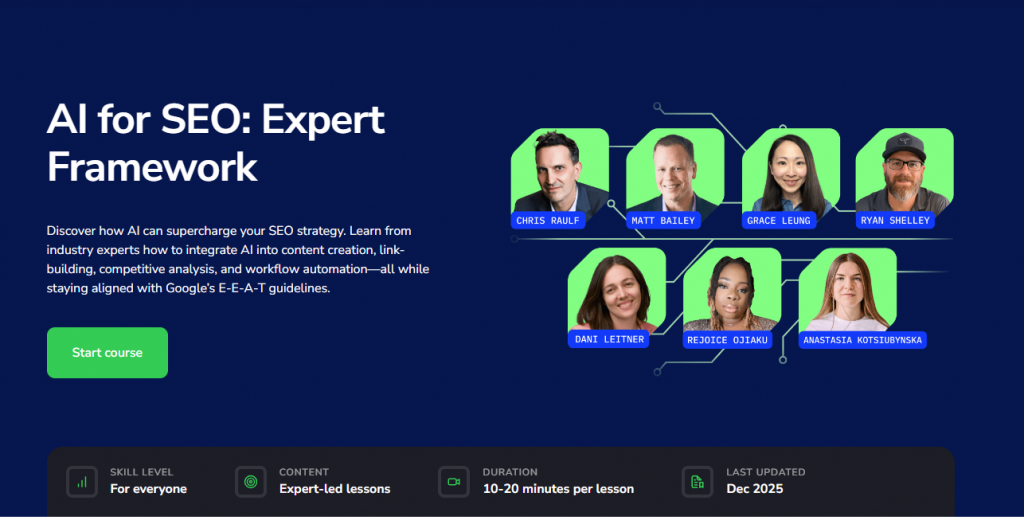
Graduates of well-structured AI SEO courses report benefits that materialize within the first week of applying the training. These are not abstract improvements—they show up directly in workload reduction, ranking gains, and client retention metrics. The most striking advantage is the shift from reactive SEO firefighting to proactive, strategic growth.
The Biggest Mistakes Professionals Make When Learning AI SEO
Even the most motivated marketers hit roadblocks because they treat AI SEO courses as a fast-forward button on their old manual processes. The technology does not reward shortcuts; it rewards a deep understanding of how to direct and verify machine outputs. Avoiding these common errors will save you months of frustration and potential ranking disasters.
Over-trusting unedited AI output. Large language models hallucinate facts and dates. Publishing content without fact-checking erodes E-E-A-T and invites manual penalties. The course must teach rigorous verification frameworks, not just content generation.
Ignoring prompt refinement cycles. Writing a single vague prompt and accepting the first draft is the equivalent of keyword stuffing in 2010. Advanced AI SEO involves iterative prompting: you generate, critique using another AI instance, then re-prompt with stricter constraints until the output meets exact guidelines.
Neglecting the technical backbone. A fantastic AI-written page will not rank if it sits on a technically broken site. Many learners obsess over content generation and skip modules on AI-assisted log file analysis, JavaScript rendering, and Core Web Vitals optimization. The course must emphasize the equal weighting of content and technical health.
Failing to build custom training data. Generic AI tools have no knowledge of your brand’s unique tone, proprietary data, or successful historical content. Top-tier courses teach you how to fine-tune models or create knowledge bases that ground AI outputs in your specific domain expertise.
How to Select a High-Value AI SEO Course That Avoids Hype
The market is flooded with programs that slap “AI” on their old curriculum and sell at a premium. Genuine training goes far beyond showing you how to open ChatGPT and ask for a blog post. Use these filters to identify courses that will genuinely transform your workflow rather than waste your time.
Essential Questions to Ask Before Enrolling
During your evaluation, request a detailed syllabus and ask these pointed questions. The answers reveal whether the course creators practice what they preach.
Real-World Application: A Step-by-Step AI SEO Workflow
To move from theory to execution, This sequence replaces days of disjointed tasks with a seamless pipeline that runs with human oversight at key quality gates.
Phase 1: Strategic Intelligence Gathering. You prompt your AI assistant with a domain and target market, pulling a complete SERP analysis, entity map, and list of authoritative sources cited by top-ranking pages. Within minutes, you have a visual map of topic gaps and a prioritized list of content assets to create or refresh.
Phase 2: AI-Generated Content Blueprint. Instead of a simple title, the AI produces a multi-layered outline specifying headers, target word count, semantic keywords for each section, and rich snippet opportunities. You review this blueprint in under 15 minutes, adjusting the narrative arc and injecting proprietary insights.
Phase 3: Drafting with Brand-Guardrails. The AI writes the full article, adhering to style guidelines you have stored in a custom prompt library. A separate AI instance performs a factual accuracy scan against trusted databases, flagging any statement that needs a citation or correction.
Phase 4: Automated On-Page Optimization. The same system generates title tag variations, meta descriptions that fit pixel lengths, schema markup in JSON-LD, and an internal linking map that connects the new page to relevant existing assets. All code is ready to paste or deploy via API.
Phase 5: Scheduled Content Refresh Monitoring. Your AI workflow sets automated alerts for when the page’s ranking for a target keyword dips below a threshold. It then re-crawls the top ten competitors, identifies what they have added or improved, and suggests micro-updates to maintain position.
Important Notes on AI SEO Course Implementation and Ethics
Completing an AI SEO course comes with the responsibility to maintain ethical standards. Google’s guidelines are clear: using AI to produce scaled content intended solely to manipulate rankings is a violation. The training must ingrain the difference between AI-assisted quality content—where human expertise guides and enriches the final output—and robotic publishing mills. Always disclose AI usage where appropriate, and ensure every piece of content provides genuine value that a human expert would stand behind.
Furthermore, be mindful of data privacy when feeding client information into AI models. Reputable courses cover API security settings, data anonymization, and the importance of staying within the bounds of GDPR and similar regulations. Treat AI as a highly efficient assistant, not as a replacement for strategic judgment. The most successful AI SEO professionals spend more time on strategy and review than ever before, precisely because the production tasks are accelerated.
Frequently Asked Questions About AI SEO Courses
What exactly will I learn in a typical AI SEO course?
You will learn to integrate large language models into every phase of SEO, from keyword clustering and content generation to technical audits and performance forecasting. A complete curriculum covers prompt engineering, automated schema markup, SERP analysis with AI, and building workflows that scale content production without sacrificing quality or uniqueness.
Do I need coding experience to take an AI SEO course?
Not necessarily, but the most valuable programs introduce basic scripting. You should be comfortable running pre-written Python scripts for crawl data analysis and understanding API documentation. Many courses start with no-code tools and gradually introduce light automation, ensuring accessibility while pushing you toward advanced capabilities.
Will AI-generated content get my site penalized by Google?
Not if it is produced following quality guidelines taught in a proper AI SEO course. Google penalizes low-value, purely machine-generated content aimed at manipulating rankings. A good course emphasizes human review, fact-checking, and substantial value addition, aligning with E-E-A-T standards and keeping your content safe and competitive.
How long does it take to complete an AI SEO course and see results?
Most comprehensive courses span four to eight weeks of part-time study. You can begin applying basic techniques, such as AI-assisted keyword research and meta description generation, within days. Significant traffic and ranking improvements typically manifest within one to three months as you deploy full automated workflows and refresh existing content.
Are AI SEO tactics only for large enterprises with big budgets?
No. An AI SEO course specifically democratizes access. Freelancers and small agencies use the same techniques to compete against larger players, handling content production and technical audits at a fraction of the cost. The key is learning to leverage free or low-cost AI tools and APIs efficiently, which the training provides.
How do I choose the best AI SEO course for practical skills?
Prioritize courses that feature live project work, real case studies with data, and direct access to instructors. Look for curricula that cover both content-focused and technical AI applications, avoid programs that are solely tool vendor demonstrations, and confirm the material has been updated to reflect the latest developments in generative engine optimization.
The Strategic Imperative of AI SEO Education
Mastering an AI SEO course is not about staying current with a trend; it is about becoming the professional who builds the frameworks others will eventually follow. Search continues to shift toward understanding intent and rewarding authoritative, well-structured information. Those who learn to deploy artificial intelligence thoughtfully—not as a cheat code, but as an amplifier of human expertise—will define the next generation of search winners. The tools and techniques exist today to automate drudgery, uncover hidden opportunities, and scale quality to levels previously unimaginable. The only remaining variable is your willingness to learn them systematically. The course is the accelerator; your commitment to applying its principles determines the outcome.
Xem thêm:
- The 2024 AI SEO Glossary: 50+ Must-Know Terms for Search Professionals
- AI SEO AI Search Tracking: The Complete Guide to Monitoring AI-Driven Discovery
- AI SEO Organic Traffic: The Complete Playbook for Sustainable Growth in 2025
- AI SEO Trends 2026: The Strategies That Will Define Search Next Year
- AI Structured Data: The Complete Guide to Automating Schema Markup for Smarter Search
Bài viết cùng chủ đề:

AI SEO SEO Automation with Make: The Complete Workflow Guide

AI SEO SEO Automation with Zapier: The Complete Workflow Guide

AI SEO SEO Automation with n8n: The Complete Workflow Guide
AI SEO SEO Automation with Gemini: The Complete Guide to Scaling Organic Growth

AI SEO SEO Automation with Claude: The Complete Guide to Scaling Content in 2025

AI SEO SEO Automation with ChatGPT: The Complete Playbook for 2025

AI SEO & SEO Automation for Affiliate Sites: The 2025 Playbook for Passive Income Growth
AI SEO & SEO Automation for Bloggers: The Complete Guide to Scaling Your Content

AI SEO & SEO Automation for Agencies: The Complete 2025 Playbook

AI SEO and SEO Automation for Ecommerce: The Complete Playbook for 2025

AI SEO & SEO Automation for WordPress: The Complete Playbook for 2025
AI SEO SEO Automation Strategy: The Complete Playbook for 2025

Mastering the AI SEO SEO Automation Process: A Complete Guide to Scaling Organic Growth
AI SEO SEO Automation System: The Complete Guide to Scaling Organic Growth in 2025
AI SEO SEO Automation Platform: The Complete Guide to Scaling Organic Growth in 2025
AI SEO SEO Automation Software: The Complete Guide to Scaling Organic Growth in 2025















