
No products in the cart.
The 2024 AI SEO Glossary: 50+ Must-Know Terms for Search Professionals
29
Jul
Jul
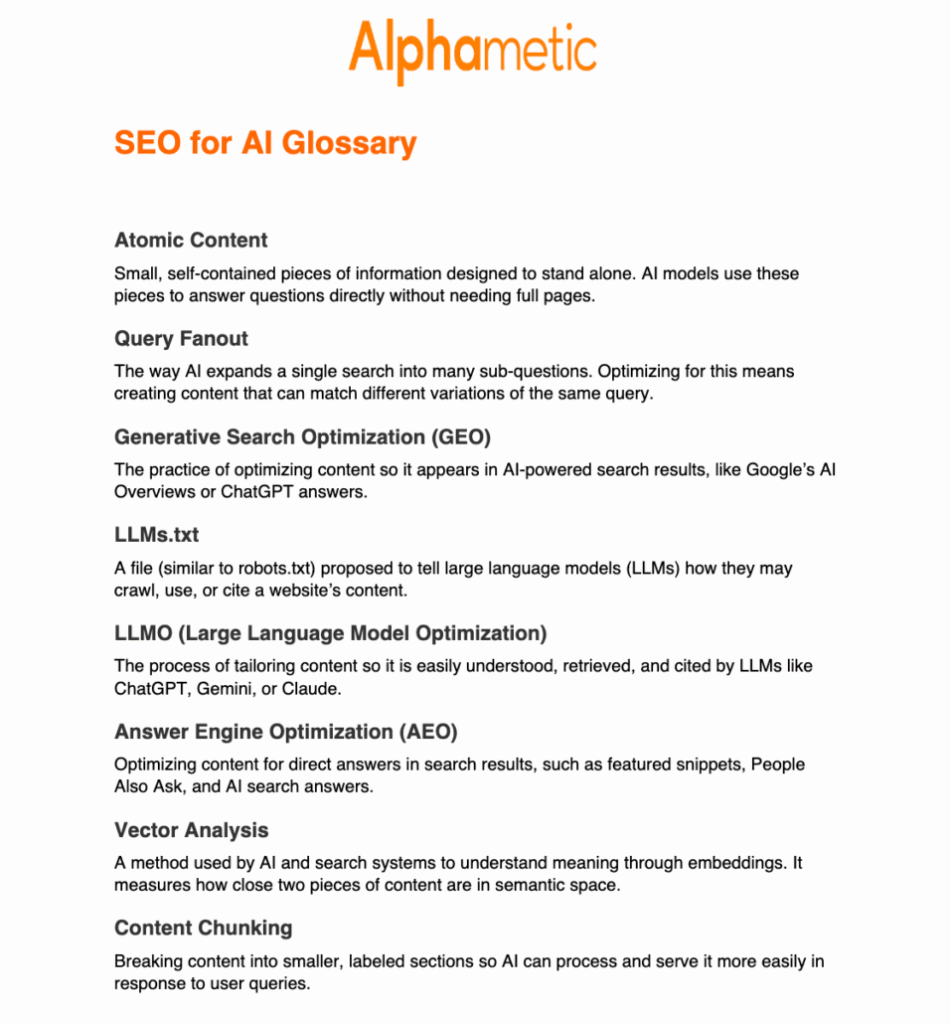
Search engines are no longer just matching keywords to pages. They understand intent, context, and meaning through layers of artificial intelligence. For any SEO, mastering the AI SEO glossary has become as essential as knowing title tags and backlinks. This guide unpacks every critical term—from large language models and transformer architectures to Google’s latest Search Generative Experience—explaining exactly what they mean for your organic strategy and how to adapt in an AI-first search world.
What Is an AI SEO Glossary?
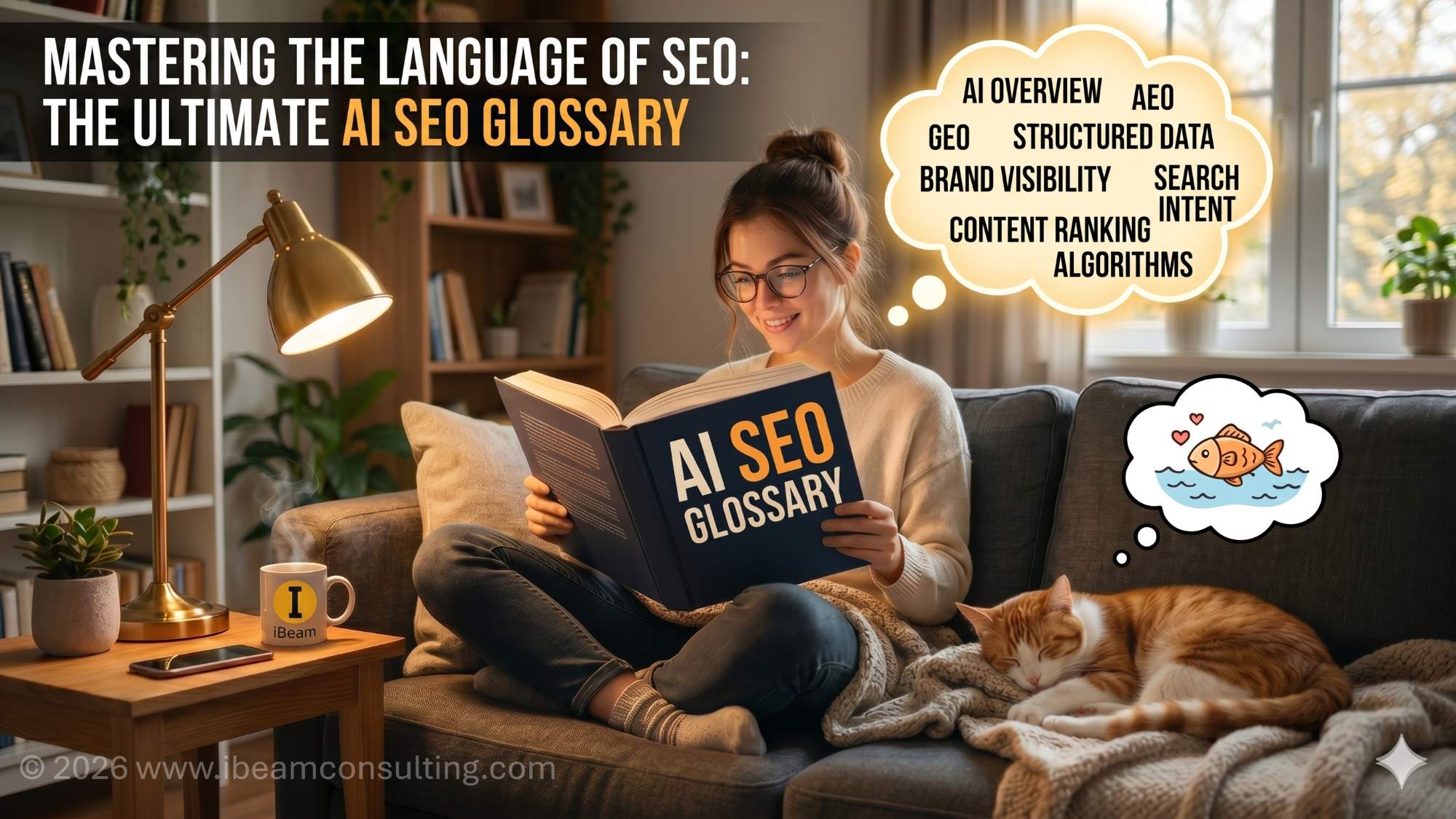
An AI SEO glossary is a curated collection of definitions that bridges the gap between artificial intelligence and search engine optimization. It covers the algorithms, machine learning concepts, natural language processing breakthroughs, and content generation technologies reshaping how websites rank and how users find information. Instead of treating AI as a black box, this glossary gives you the vocabulary to analyze algorithm updates, evaluate AI writing tools, and communicate strategy with developers and data scientists.
Every term in this resource has direct implications for your daily work—whether you are auditing a site, building topical authority, or responding to a drop in organic traffic after a core update. By internalizing these definitions, you move from reactive SEO to proactive, AI-informed optimization.
Why Every SEO Professional Needs an AI Vocabulary
The cost of ignoring AI terminology is steep. Without understanding concepts like vector embeddings or passage ranking, you risk making decisions based on outdated ranking factor myths. Grasping the AI SEO glossary gives you several clear advantages:
- Better algorithm resilience: Recognize which signals matter when Google applies BERT or MUM, and build content that satisfies semantic search.
- Smarter content creation: Differentiate between AI-assisted drafting and AI spinning, and know how to prompt large language models effectively while preserving E-E-A-T.
- Future-proof architecture: Implement schema markup and entity optimization that align with knowledge graph expansion and generative AI snapshots.
- Cross-team alignment: Speak the same language as engineers when discussing model fine-tuning, retrieval-augmented generation, or vector databases for site search.
- Competitive edge: Early adopters who understand AI overviews and multimodal search can capture featured snippets and zero-click real estate before competitors catch up.
- Artificial Intelligence (AI) – The broad field of creating systems that perform tasks requiring human-like intelligence. In SEO, AI powers everything from search ranking to automated content audits.
- Machine Learning (ML) – A subset of AI where systems learn from data without explicit programming. RankBrain is a prime example; it teaches itself to weigh signals like dwell time based on historical search behavior.
- Deep Learning – A more advanced form of ML using multilayered neural networks. Deep learning drives image recognition in Google Lens and the understanding behind voice search queries.
- Neural Network – Computing systems inspired by biological neurons. Google’s neural matching uses this architecture to connect your query to relevant concepts even when the exact words don’t match.
- Transformer Model – A deep learning architecture that processes entire sequences of words simultaneously, using attention mechanisms. BERT and GPT are transformer-based. For SEOs, transformers explain why context now outweighs isolated keywords.
- RankBrain – Google’s first AI ranking system. It interprets ambiguous queries and maps them to known intent clusters, making click-through rate and content comprehensiveness vital ranking signals.
- Neural Matching – A system that extends understanding beyond synonyms to conceptual relationships. A page about “fixing a leaky faucet” can rank for “drip repair” without using that exact phrase, provided the topic is thoroughly explained.
- BERT (Bidirectional Encoder Representations from Transformers) – A language model that reads words in both directions to understand full context. SEO copy must now flow naturally because BERT penalizes awkward phrasing written solely for keyword placement.
- MUM (Multitask Unified Model) – A multimodal model that simultaneously processes text, images, and soon video, across 75 languages. MUM can answer complex queries like “What do I need to prepare for a hiking trip in Patagonia in November?” by pulling weather data, gear lists, and safety tips from diverse sources. For SEO, this means single pages need to answer layered follow-up questions and integrate visual assets that support the text.
- Passage Ranking – The ability to identify and rank a specific passage within a page, even if the page as a whole isn’t the best overall match. This rewards deep, well-structured long-form content where each section can stand alone as an answer.
- Search Generative Experience (SGE) / AI Overviews – Google’s integration of generative AI into SERPs. AI overviews synthesize information from top results and display it directly above organic listings. The SEO response involves optimizing for citation within these snapshots through crystal-clear source authority, concise definitions, and list-based formatting.
- Large Language Model (LLM) – A massive model trained on vast text corpora to predict and generate language. GPT-4, PaLM 2, and Gemini are LLMs. In content marketing, LLMs assist with ideation, drafting, and summarization, but outputs must be fact-checked.
- Generative AI – AI that creates new content—text, images, code, audio. For SEO, it powers AI writing assistants, image generators for alt-text optimization, and even schema markup generators. The key is using it as a co-pilot, not a replacement for human expertise.
- Prompt Engineering – The skill of crafting precise instructions to get the desired output from an LLM. A well-prompted SEO asks for “a meta description under 155 characters that includes the primary keyword, invokes curiosity, and uses a professional tone,” rather than “write meta description.”
- Hallucination – When an AI confidently produces factually incorrect information. In SEO, hallucinated statistics or fabricated quotes destroy trust and E-E-A-T scores. Every AI-generated content piece requires human verification against authoritative sources.
- Retrieval-Augmented Generation (RAG) – A technique that grounds LLM outputs in a specific set of trusted documents. An enterprise SEO team can use RAG to let an AI answer user questions strictly from approved product documentation, reducing hallucination risk while scaling support content.
- Embeddings – Numerical representations of words, sentences, or whole documents that capture semantic meaning. Search engines use embeddings for vector search, allowing retrieval based on conceptual similarity rather than exact string matching. For SEO, this means content that thoroughly covers a topic’s subtopics will rank on a wider set of related queries.
- Vector Search – A search method that uses embeddings to find content by semantic proximity. Google applies vector search in its core ranking, and internal site search tools increasingly adopt it, requiring content to be organized around topic clusters rather than isolated keyword pages.
- Semantic Search – The overarching shift from matching strings to understanding meaning, intent, and context. Every term in this AI SEO glossary contributes to this principle; modern SEO is about semantic relevance, not just on-page optimization.
- Knowledge Graph – Google’s database of entities (people, places, things) and their relationships. Optimizing for the Knowledge Graph means building clear entity signals through schema markup, Wikipedia references, and consistent NAP information.
- Entity SEO – The practice of optimizing for entities rather than keywords. Instead of targeting “best camping stoves,” you build a topical entity around “camping stove” with attributes such as fuel type, weight, BTUs, and connect it to related entities like “backpacking,” “Jetboil,” and “leave no trace.”
- Structured Data / Schema Markup – Standardized formats (JSON-LD, Microdata) that explicitly tell search engines what your content means—product reviews, recipes, events, FAQs. It feeds the Knowledge Graph and enables rich results that boost click-through rate.
- E-E-A-T (Experience, Expertise, Authoritativeness, Trustworthiness) – The framework Google uses to assess content quality, especially for YMYL topics. AI-generated content can satisfy E-E-A-T only if it transparently cites credible sources and is reviewed by a subject-matter expert with real-world experience.
- AI Content Detection – Tools that estimate the probability a piece of text was AI-generated. While Google focuses on content usefulness over how it was produced, unedited AI text with repetitive patterns or generic phrasing often correlates with low quality. The defense is human editing, unique insights, and first-party data.
- Bias in AI – Systematic errors in AI models stemming from skewed training data. In search, bias can affect visibility for certain demographics or viewpoints. Proactive SEOs audit their content to ensure inclusive language and diverse source representation.
- Training Data – The dataset used to teach an AI model. The quality, freshness, and breadth of training data directly influence outputs. For SEO, this explains why an LLM may not know about your newest product: its training cutoff date has passed. Supplementing with real-time data or RAG fills this gap.
- Treating AI content as a finished product. Publishing raw LLM output without editing leads to generic phrasing, factual inaccuracies, and thin value. Always layer on unique expertise, case studies, and manual fact-checking.
- Ignoring passage ranking structure. Long articles that bury the core answer five paragraphs down miss the chance to appear in AI overviews or featured snippets. Place a concise answer immediately after the heading, then expand.
- Forgetting that MUM is multimodal. Optimizing only text ignores that MUM understands images and videos. An unoptimized image with a generic filename misses an opportunity to reinforce the topic. Use descriptive alt text, captions that add context, and videos with auto-generated transcripts.
- Over-prompting with keyword stuffing. Even with AI assistants, forcing an LLM to insert “best affordable men’s running shoes” seven times produces unnatural copy that BERT penalizes. Instead, provide a topic brief with entities and intent.
- Disregarding entity disconnect. If your brand isn’t recognized as an entity in the Knowledge Graph, your E-E-A-T signals are weaker. Claim and optimize your Google Business Profile, maintain consistent NAP citations, and use Organization schema to solidify your entity footprint.
The Evolution of AI in Search: From RankBrain to SGE
To understand current terminology, you need to see how Google’s AI capabilities have stacked over the past decade. Each milestone introduced new functions that changed the SEO playbook. The timeline below tracks the major launches and their core impact.
| Algorithm / System | Year Announced | Primary Function | SEO Impact |
|---|---|---|---|
| RankBrain | 2015 | Machine learning model that interprets never-before-seen queries and adjusts ranking components | Shifted focus from exact-match keywords to query intent; rewarded comprehensive content that satisfied multiple related needs |
| Neural Matching | 2018 | Uses neural networks to understand how queries relate to pages conceptually, not just lexically | Made synonym usage and topic clustering far more important; reduced the power of keyword density |
| BERT | 2019 | Bidirectional transformer model that grasps the nuance of word order and prepositions | Emphasized natural writing; thin content that ignored query context lost rankings; forced a rethink of long-tail optimization |
| MUM | 2021 | Multimodal model that understands information across text, images, and languages, answering complex tasks in one go | Accelerated the need for cohesive topic clusters, original research, and content that solves multi-step user journeys |
| Search Generative Experience (SGE) / AI Overviews | 2023-2024 | Generates AI-powered snapshots at the top of results, synthesizing multiple sources | Threatens traditional click-through rates for informational queries; raises the bar for truly unique value, first-party data, and hands-on experience |
Key AI SEO Terms Defined
Below you will find a practical, search-focused breakdown of the terms that define the modern AI SEO glossary. Each definition is paired with its real-world SEO relevance so you can apply the concept immediately.
Core AI Concepts
Google’s AI Algorithms & Systems
Content & AI Terms
Entity & Knowledge Graph Terms
Responsible AI and Quality Signals
How to Apply AI Concepts to Your SEO Strategy
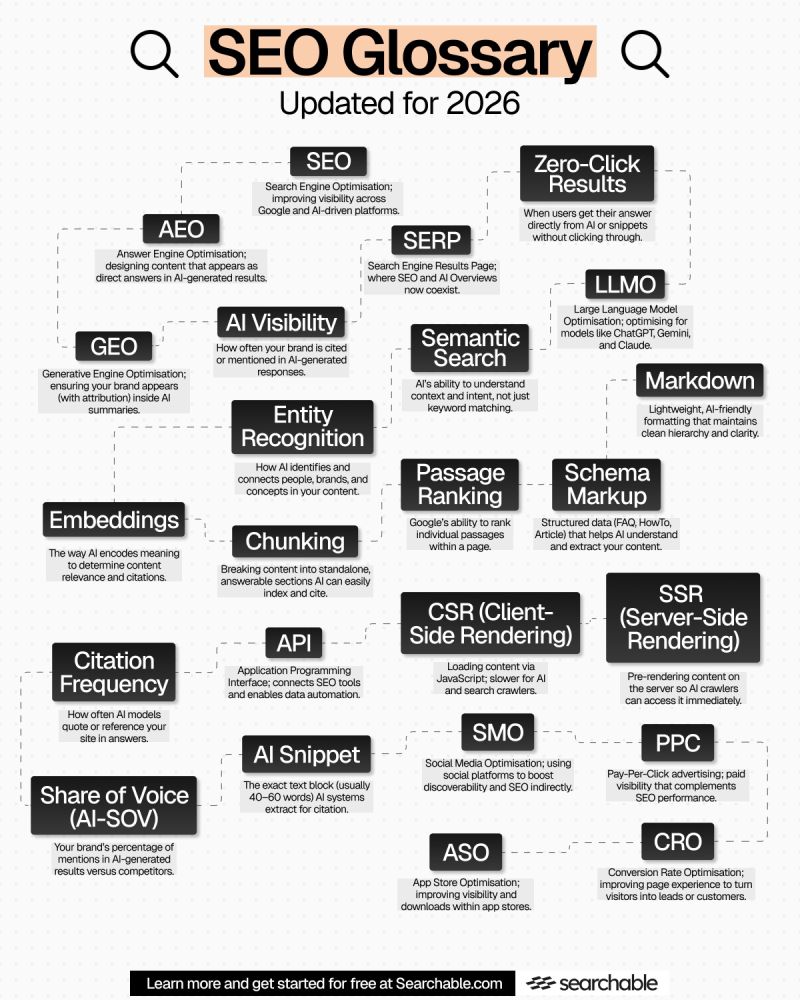
Understanding the AI SEO glossary is only the first step. Practical application turns vocabulary into rankings. Start with these actionable workflows built around the terms you just learned.
Optimize for semantic search and passage ranking. Audit your pillar pages. Does each H2 section answer a distinct sub-question completely enough to stand as a passage ranking candidate? Add succinct definitions early in each section, use FAQ schema on relevant queries, and link to more detailed internal resources. This increases the chance that Google’s AI extracts your content for an AI overview or a featured snippet.
Build entity-rich content hubs. Use entity SEO principles: map your main topic, list the related entities (tools, brands, locations, concepts), and create dedicated assets that connect them. For a recipe site, link each ingredient page to nutritional guides, cooking techniques, and equipment reviews. This creates a dense entity graph that reinforces semantic relevance without a single keyword repetition.
Integrate AI responsibly into content production. Set up a human-in-the-loop system. Use an LLM to generate outlines, alternate headings, or meta descriptions, then have a subject-matter expert inject original anecdotes, proprietary data, and hands-on tips. Always verify any factual claim the AI inserts against a primary source. This approach leverages generative AI’s speed while protecting E-E-A-T.
Prepare for AI overviews. Identify queries where Google already shows an AI-generated snapshot. Analyze the sources it cites: what formatting do they use? Concise bulleted steps, tables, or direct definitions tend to get pulled in. For your target page, structure the answer in a 40–60 word plain-text box immediately after the H2, mirroring the snippet pattern. Additionally, strengthen the page’s perceived authoritativeness with clear author bios and referenced studies.
Harness embeddings for internal search and site architecture. If your website has an on-site search, consider a vector database that suggests content based on meaning rather than exact keywords. This improves user engagement metrics that Google’s AI may use as quality signals. Even without vector search, clustering blog posts by semantic topic using embedding similarity tools can reveal gaps in your content coverage.
Common AI SEO Mistakes and How to Avoid Them
The rapid evolution of AI in search creates pitfalls that even experienced professionals stumble into. Recognizing these errors protects your traffic and credibility.
Important Considerations for Using AI in Search Strategy
Several critical points separate transactional AI use from strategic integration. Keep these always in mind.
Context window limits matter. LLMs have a maximum context length. Long-horizon prompts that feed an entire site audit may lose precision toward the end. Work in batches and use chunking strategies when analyzing datasets.
AI outputs can amplify existing biases. If a model was trained predominantly on English-language, Western-centric data, it may underrepresent global perspectives. When targeting international audiences, validate content with native-speaking local experts and use region-specific data sources.
Not all AI tools have the same training data recency. For time-sensitive content, choose tools with up-to-date indexes or integrate live search plugins. Relying on a model with a cutoff date in 2022 will produce outdated statistics, harming trustworthiness.
Human creativity remains the differentiator. As AI-written baseline content floods the web, original research, provocative opinion, and emotionally resonant storytelling stand out. The AI SEO glossary equips you to leverage machines, but the winning edge still comes from human insight.
Frequently Asked Questions
What is the difference between AI and machine learning in SEO?
AI is the broader concept of machines mimicking human intelligence to solve problems. Machine learning is a specific AI technique where algorithms learn patterns from data without being explicitly programmed. In SEO, Google’s RankBrain is a machine learning system that adjusts weighting for signals like content freshness based on user behavior, while AI includes broader capabilities like natural language understanding through BERT.
How does Google’s MUM change SEO?
MUM processes information across multiple formats and languages simultaneously, allowing Google to answer complex queries that would have required several searches before. This pushes SEOs to create comprehensive resources that cover a topic from multiple angles, integrate high-quality images and videos with descriptive metadata, and consider the user’s full journey across devices and languages.
Can AI write SEO-optimized content?
Yes, AI can generate drafts, outlines, meta descriptions, and suggest internal linking opportunities. However, fully automated AI content without human oversight often lacks original experience, nuanced insight, and factual verification. The most effective approach combines AI efficiency with human editing, proprietary data, and genuine author expertise to meet Google’s E-E-A-T guidelines.
What are AI overviews and how do they affect organic traffic?
AI overviews, previously called Search Generative Experience snapshots, are AI-generated summaries that appear at the top of Google’s search results for certain queries. They synthesize information from multiple sources and push traditional organic listings further down the page. This can reduce click-through rates for informational queries, making it essential to optimize content to be cited within these overviews through clear, authoritative, well-structured answers.
Is AI content penalized by Google?
Google does not penalize content solely because it was generated by AI. However, if the content is low-quality, spammy, unoriginal, or created to manipulate rankings without providing real value, it may be demoted. The key is to ensure AI-assisted content is helpful, people-first, and demonstrates experience and trustworthiness, regardless of how it was produced.
Conclusion
The language of search is now the language of artificial intelligence. A firm grasp of the AI SEO glossary empowers you to decode ranking fluctuations, build content that aligns with Google’s neural models, and use AI tools ethically to enhance rather than dilute quality. As entity understanding, passage ranking, multimodal search, and generative snapshots become the norm, terms once reserved for data science labs are now everyday SEO vocabulary. Return to this resource whenever an algorithm update introduces a new acronym or when planning your next content hub—because in the age of semantic search, understanding the words behind the machine is the truest form of optimization.
Xem thêm:
- Does AI Content Rank in Google? The Real Truth About AI-Generated SEO (2025 Update)
- AI SEO Generative Search Optimization: The Complete Playbook for 2025
- AI SEO Product Schema: The Complete Guide to Structured Data That Ranks
- AI SEO Organic Rankings: The Complete Guide to Dominating Search in 2025
- The Ultimate Guide to AI Prompt Optimization: Unlocking Precision in Every AI Interaction
Bài viết cùng chủ đề:

AI SEO SEO Automation with Make: The Complete Workflow Guide

AI SEO SEO Automation with Zapier: The Complete Workflow Guide

AI SEO SEO Automation with n8n: The Complete Workflow Guide
AI SEO SEO Automation with Gemini: The Complete Guide to Scaling Organic Growth

AI SEO SEO Automation with Claude: The Complete Guide to Scaling Content in 2025

AI SEO SEO Automation with ChatGPT: The Complete Playbook for 2025

AI SEO & SEO Automation for Affiliate Sites: The 2025 Playbook for Passive Income Growth
AI SEO & SEO Automation for Bloggers: The Complete Guide to Scaling Your Content

AI SEO & SEO Automation for Agencies: The Complete 2025 Playbook

AI SEO and SEO Automation for Ecommerce: The Complete Playbook for 2025

AI SEO & SEO Automation for WordPress: The Complete Playbook for 2025
AI SEO SEO Automation Strategy: The Complete Playbook for 2025

Mastering the AI SEO SEO Automation Process: A Complete Guide to Scaling Organic Growth
AI SEO SEO Automation System: The Complete Guide to Scaling Organic Growth in 2025
AI SEO SEO Automation Platform: The Complete Guide to Scaling Organic Growth in 2025
AI SEO SEO Automation Software: The Complete Guide to Scaling Organic Growth in 2025















