
No products in the cart.
AI Schema Generator: Automate Structured Data for Rich Results and Better SEO
29
Jul
Jul
An AI schema generator is a tool that uses artificial intelligence to automatically create structured data markup for web pages. Instead of manually writing JSON-LD or Microdata code, website owners, marketers, and developers can input a URL or content and receive ready‑to‑implement schema that search engines like Google can parse. This technology bridges the gap between complex technical SEO and everyday content management, making rich results—such as star ratings, FAQs, product prices, and event times—more accessible than ever before.
Structured data is the foundation of modern search visibility. When a page correctly implements schema markup, it can earn enhanced listings that increase click‑through rates by up to 30%. Yet traditional schema creation demands detailed knowledge of Schema.org types, property hierarchies, and formatting rules. An AI schema generator removes that friction by analyzing the page content, recognizing entities, and mapping them to the appropriate schema types in seconds, enabling businesses of all sizes to compete for SERP features.
What Is an AI Schema Generator and How Does It Work?
At its core, an AI schema generator is a software application that automates the process of producing structured data. It usually leverages natural language processing (NLP) and machine learning models trained on Schema.org vocabulary. The tool scans a webpage’s textual content, images, headings, and metadata, identifies the topic (e.g., a recipe, an article, a product), and then suggests or directly generates the most fitting schema markup. Advanced generators can even crawl an entire site to output bulk schema files.
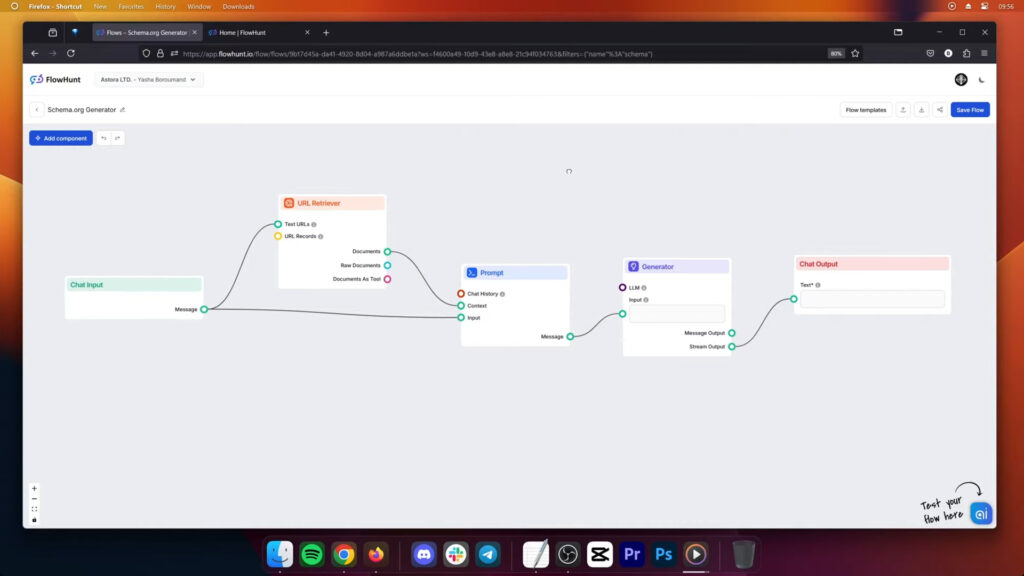
The typical workflow involves three stages. First, content ingestion: the user provides a URL, pastes raw text, or uploads a document. Second, entity extraction and classification: the AI parses the content, recognizing things like names, dates, prices, and FAQs, and determines the primary schema type. Third, markup generation: the tool composes a valid JSON-LD script that conforms to Google’s structured data guidelines. Some generators then offer validation against Google’s Rich Results Test directly inside the interface.
What sets AI schema generators apart is their ability to learn from millions of structured data examples. Unlike template‑based plugins that only cover a few fixed types, a robust AI generator can handle nested schemas—for example, a Product schema containing Offer, Review, and Organization properties—without the user needing to understand any code. This drastically reduces the time from idea to implementation, often from hours to a few minutes.
Why Structured Data Matters for Modern SEO
Search engines are no longer satisfied with just matching keywords. They want to understand entities, relationships, and context. Structured data provides that machine‑readable layer. When you add schema markup, you feed Google explicit signals about the meaning of your content, which can lead to rich snippets, knowledge panels, and voice search answers.
AI schema generators accelerate this process, but the underlying value remains the same. Pages with valid schema can appear in carousels, sitelinks search boxes, breadcrumb trails, and the coveted “People Also Ask” modules. For e‑commerce, product schema with price, availability, and reviews can transform a plain blue link into a visual product card that attracts qualified clicks. For publishers, article schema improves the chances of appearing in Google News and Top Stories. The direct SEO impact includes higher organic CTR, better crawl efficiency, and increased qualified traffic.
Moreover, as search moves toward AI‑driven summaries, structured data is the data layer that feeds those models. An AI schema generator therefore not only optimizes for today’s rich results but also prepares a website for tomorrow’s generative search experiences, where clear entity definitions will be critical.
Key Features of a High‑Quality AI Schema Generator
Not all AI schema generators are equal. The best tools share several must‑have capabilities that guarantee accuracy, flexibility, and ease of use.
- Multi‑type support: Generates schema for articles, products, local businesses, events, recipes, FAQs, how‑tos, videos, software applications, and more.
- Automatic entity detection: Recognizes addresses, phone numbers, logos, authors, ratings, and prices without manual tagging.
- Bulk generation & crawling: Can process entire domains or large URL lists, outputting a complete schema file for each page.
- Real‑time validation: Integrates with Google’s Rich Results Test and Schema Markup Validator to catch errors before deployment.
- Customizable output: While the AI proposes the schema, users should be able to edit properties, add custom fields, or override the detected type.
- JSON‑LD precision: Outputs clean, minified, or pretty‑printed JSON‑LD that is ready to paste into the page’s or insert via Google Tag Manager.
- SEO platform integrations: Natively works with WordPress, Shopify, or popular CMS plugins so that schema updates are pushed live instantly.
- Article Schema: Headline, author, datePublished, publisher, and main image. Critical for news sites and blogs.
- Product Schema: Name, description, brand, offers (price, availability), aggregateRating, and reviews. The main driver for e‑commerce rich results.
- Local Business Schema: Address, geo‑coordinates, opening hours, telephone, menu, and sameAs social profiles. Essential for brick‑and‑mortar shops.
- FAQ Schema: Question/answer pairs that can populate the People Also Ask box and expand your SERP footprint.
- How‑To Schema: Step‑by‑step instructions, often visualised with images or videos, ideal for DIY, cooking, and tutorials.
- Recipe Schema: Ingredients, cook time, nutrition details, and user ratings. Enables recipe carousels and Google Assistant responses.
- Event Schema: Date, location, performer, ticket availability. Powers event listings in search.
- Video Schema: Duration, thumbnailUrl, uploadDate. Helps videos appear as video rich results.
- Trusting the AI without review: An AI schema generator might misinterpret a page, for example labelling a brand story as a Product schema. Always do a human sanity check before publishing.
- Missing required properties: Google’s structured data guidelines stipulate mandatory fields. For Product schema, “name” and “offers.price” are required. An AI can sometimes skip them if the page content does not clearly contain that info. Manually verify each required property.
- Duplicate schema on one page: If the AI is used alongside a CMS plugin that also adds schema, you may end up with conflicting markup. Audit your pages with a structured data testing tool to ensure only one valid schema version exists per page.
- Ignoring schema depth: A simple AI generator might only produce flat schemas, missing the nested structure that Google rewards (e.g., a Product that contains review and offer). Use a generator that supports nesting, or manually edit the JSON‑LD to include the required depth.
- Using schema that does not match the visible content: Google enforces a strict policy that structured data must be a true representation of what the user sees on the page. If the AI generated a 5‑star rating but the page has no visible reviews, that’s a violation and may result in a manual action. Always ensure schema values match on‑page content.
- Forgetting to update schema after content changes: A static schema quickly becomes outdated. Dynamic AI schema generators that hook into your content update workflow can help, but you still need a process to re‑validate regularly.
Many tools now also include AI‑powered recommendations. For instance, if you generate an FAQ schema but the answers are too short, the system might suggest expanding the content to meet Google’s quality guidelines. This proactive feedback loop turns the generator into a content optimisation assistant.
Manual Schema Creation vs. AI Schema Generator: A Comparison
For years, SEO specialists relied on spreadsheets, templates, and manual coding to add structured data. While that approach gives full control, it doesn’t scale. Below is a side‑by‑side comparison of traditional schema generation and an AI‑powered approach.
| Aspect | Manual Schema Creation | AI Schema Generator |
|---|---|---|
| Speed to implement | Slow (30–60 min per page) | Fast (seconds to a few minutes) |
| Technical knowledge required | High; must understand JSON‑LD syntax and Schema.org | Low; suitable for marketers and non‑developers |
| Error rate | Prone to typos, missing commas, invalid types | Minimised through automated validation and testing |
| Scalability | Not scalable for large sites | Highly scalable; can generate thousands of schemas at once |
| Customisation depth | Full control over every property | Good control with AI suggestions; manual overrides possible |
| Ongoing maintenance | Manual updates when content changes | Many tools offer dynamic re‑generation as content updates |
The table reveals that an AI schema generator does not eliminate the need for human oversight but dramatically reduces the repetitive, error‑prone parts of the process. For agencies managing hundreds of client sites, the time savings convert directly into profitability.
Types of Schema an AI Generator Can Create

A sophisticated AI schema generator is not limited to one or two markup types. It covers a wide range of Schema.org vocabulary, with the most common being:
Beyond these, advanced generators can handle less common types like Course, JobPosting, SoftwareApplication, and even WebSite schema with Sitelinks search box. The AI determines the best match based on the content structure, but an expert can always adjust the final selection.
Practical Step‑by‑Step Guide: Using an AI Schema Generator
Implementing structured data with an AI tool follows a straightforward pipeline.
Step 1: Choose the Right Generator
Evaluate tools based on your needs. Some focus on e‑commerce, others on content sites. Look for integration with your CMS, price tier that matches your volume, and a free trial to test output accuracy. Popular options include browser‑based generators, WordPress plugins, and enterprise‑grade platforms that crawl entire domains.
Step 2: Provide the Content Source
Most AI schema generators accept a live URL. The tool will fetch the page, scan the DOM, and read the visible text. For pages behind a login or not yet published, you can paste the HTML or raw text. Some systems also accept sitemap files for bulk processing.
Step 3: Review the AI‑Suggested Schema Type
The Ag., Product) and then populate properties: name, description, price, brand, etc. At this stage, you can see which entities were detected. If the page is a product but the AI suggested Article because of a heavy blog content ratio, you can manually flip the type. Don’t blindly accept; always verify that the schema type aligns with the page’s core purpose.
Step 4: Customise and Enrich Properties
Fill in gaps. The AI might miss the brand logo or fail to link the correct author profile. Add missing properties like sameAs for social profiles, or nested schemas for reviews and aggregateRating. Many generators allow you to pull data from open fields or your own database via CSV upload.
Step 5: Validate and Test
Before going live, run the generated JSON‑LD through Google’s Rich Results Test. Most AI schema generators include a built‑in tester that flags warnings and errors. Fix any issues, especially required properties that the AI might have omitted due to incomplete content on the page.
Step 6: Implement the Markup
Copy the final JSON‑LD script and place it inside the
section of the target page. If you use a CMS, paste it into the custom header field or deploy it via Google Tag Manager. For bulk implementations, you can use the generator’s plugin or API to inject the schema automatically across thousands of pages.Once live, monitor the performance in Google Search Console under the ‘Enhancements’ tab. Look for improvements in the number of valid items with rich results and any new errors that might indicate a change in Google’s requirements—at which point your AI schema generator can often re‑generate and fix the markup in minutes.
Common Mistakes When Using an AI Schema Generator (and How to Avoid Them)
Even the best AI can produce suboptimal schema. Understanding these pitfalls will keep your structured data clean and compliant.
By treating the AI schema generator as a powerful assistant rather than an autopilot, you retain full control over the semantic accuracy of your site’s structured data.
The Role of AI Schema Generators in E‑E‑A‑T and Search Quality
Google’s emphasis on Experience, Expertise, Authoritativeness, and Trustworthiness (E‑E‑A‑T) is not directly a ranking factor, but it heavily influences how the search algorithms evaluate content. Structured data can support E‑E‑A‑T signals by clearly marking up author information, organizational credentials, and factual references. An AI schema generator that correctly implements Author and Organization schema—with links to verified profiles, qualifications, and sameAs properties—reinforces the credibility of a page.
For example, a medical article with proper schema that includes the author’s medical degree and affiliation can help Google understand the content’s legitimacy. Similarly, a local business with full LocalBusiness schema showing opening hours, address, and a link to its Wikipedia entry may be trusted more than an identical business without such markup. An AI schema generator that is specially trained to detect and map these E‑E‑A‑T signals can give a site an edge.
However, the tool is only as good as the data it can pick up. If the author bio page does not contain structured credentials, the AI cannot invent them. It is the site owner’s responsibility to ensure that genuine trust signals are present both in visible content and in the underlying schema. The generator simply learns to surface what is already there.
Important Notes When Choosing and Using an AI Schema Generator
Before committing to a platform, keep a few critical considerations in mind. First, data privacy: if the generator processes unlisted or staged pages, ensure it operates in a secure environment and does not retain your data. Second, compliance: Google regularly updates its structured data guidelines; the generator must keep pace with changes like the upcoming removal of some FAQ rich results for certain sectors. A tool that lags behind can produce outdated markup that no longer earns rich results.
Third, cost vs. value. Many free AI schema generators are available, but they may limit the number of pages or types. For high‑stakes sites, a paid tool with dedicated support and continuous updates is often worth the investment. Fourth, test with a pilot group of pages before a full rollout. Compare the click‑through rates and Search Console coverage reports over four to six weeks to measure real‑world impact. Finally, always maintain a backup of your schema. An AI schema generator that integrates with your version control system or offers export functions lets you roll back changes if something goes wrong. The flexibility to tweak and re‑generate quickly is what makes these tools invaluable, not just their initial creation ability.
Frequently Asked Questions (FAQ) About AI Schema Generators
What is an AI schema generator?
An AI schema generator is a software tool that automatically creates structured data markup using artificial intelligence. It scans a web page or text input, identifies the content type, and produces valid Schema.org code—usually in JSON‑LD format—without requiring manual coding.
How accurate is AI‑generated schema markup?
Accuracy depends on the AI model and the quality of the input content. Top generators achieve over 90% field accuracy for common schema types, but complex or niche pages may need manual correction. Always validate output with Google’s Rich Results Test before publishing.
Can an AI schema generator replace an SEO expert?
No. While it automates the technical task of writing schema, an SEO expert is still needed to decide which schema types to use, align markup with search intent, interpret guidelines, and troubleshoot errors. The generator is a productivity tool, not a strategy replacement.
Is AI‑generated schema safe for SEO?
Yes, as long as the markup accurately represents on‑page content. Google does not penalize automatically generated schema itself. Issues arise only when the schema includes false data (like fake reviews) or is irrelevant to the page. Use a generator that encourages review before implementation.
What types of schema can a typical AI schema generator create?
Most generators support popular types: Article, Product, FAQ, How‑To, Local Business, Recipe, Event, Video, and Organization. Advanced tools also handle nested schemas and less common types like Course, JobPosting, and SoftwareApplication.
Do AI schema generators work with all website platforms?
Many tools are CMS‑agnostic and output plain JSON‑LD that can be added to any website. However, some specialize in specific platforms like WordPress or Shopify and offer plugins for seamless integration. Check compatibility before choosing a tool.
How do I choose the best AI schema generator for my needs?
Consider your site size, required schema types, validation features, integration options, and your technical comfort level. Test multiple tools with the same page and compare the generated markup’s completeness and error rate. A good generator will offer a free trial or low‑volume free tier.
Conclusion
The AI schema generator has transformed structured data from a niche technical task into an accessible, scalable practice for any website owner. By combining natural language understanding with Schema.org expertise, these tools enable you to deploy rich, error‑free markup in minutes, not days. The result is more search features, higher click‑through rates, and a stronger foundation for future search experiences.
Yet the human element remains irreplaceable. Verification, strategic alignment, and content quality are what ultimately turn valid schema into real SEO gains. Use an AI schema generator as your accelerator, but always apply expert oversight. In a digital landscape where every SERP feature counts, having a tool that lets you move fast without sacrificing accuracy is not just a luxury—it is a competitive necessity.
Xem thêm:
- AI SEO Tips: Mastering the Future of Search Engine Optimization
- AI SEO Competitor Research: The Complete Guide to Outranking Your Rivals in 2025
- AI SEO AI Search Audit: The Complete Guide to Future-Proofing Your Rankings
- AI SEO Editorial Workflow: The Complete Guide to Scaling Content Production
- OpenAI SEO: The Ultimate Guide to AI-Powered Search Optimization
Bài viết cùng chủ đề:

AI SEO SEO Automation with Make: The Complete Workflow Guide

AI SEO SEO Automation with Zapier: The Complete Workflow Guide

AI SEO SEO Automation with n8n: The Complete Workflow Guide
AI SEO SEO Automation with Gemini: The Complete Guide to Scaling Organic Growth

AI SEO SEO Automation with Claude: The Complete Guide to Scaling Content in 2025

AI SEO SEO Automation with ChatGPT: The Complete Playbook for 2025

AI SEO & SEO Automation for Affiliate Sites: The 2025 Playbook for Passive Income Growth
AI SEO & SEO Automation for Bloggers: The Complete Guide to Scaling Your Content

AI SEO & SEO Automation for Agencies: The Complete 2025 Playbook

AI SEO and SEO Automation for Ecommerce: The Complete Playbook for 2025

AI SEO & SEO Automation for WordPress: The Complete Playbook for 2025
AI SEO SEO Automation Strategy: The Complete Playbook for 2025

Mastering the AI SEO SEO Automation Process: A Complete Guide to Scaling Organic Growth
AI SEO SEO Automation System: The Complete Guide to Scaling Organic Growth in 2025
AI SEO SEO Automation Platform: The Complete Guide to Scaling Organic Growth in 2025
AI SEO SEO Automation Software: The Complete Guide to Scaling Organic Growth in 2025















