
No products in the cart.
AI Search Optimization: The Ultimate Guide to Ranking in LLMs and Generative Engines
29
Jul
Jul
AI search optimization is no longer a futuristic concept—it’s the present reality reshaping how brands earn visibility. Traditional search engines are rapidly integrating large language models, and entirely new AI-native search platforms like Perplexity and Google’s AI Overviews now answer queries directly. If your content isn’t optimized for how these AI systems retrieve, interpret, and cite information, you risk losing relevance overnight. This comprehensive guide explores every facet of AI search optimization, from core principles and technical frameworks to actionable strategies that place your brand inside AI-generated answers.
What Is AI Search Optimization?

AI search optimization refers to the practice of tailoring content, technical infrastructure, and authority signals so that large language models and AI-powered search engines preferentially surface your information. Unlike conventional SEO that targets ten blue links, AI search optimization aims to become the source an AI cites when generating a direct answer, summary, or recommendation. The goal shifts from ranking on a page to being embedded inside an AI response.
This discipline emerged because search engines now use retrieval-augmented generation to pull facts from the open web and synthesize answers. When a user asks a question, the AI searches its index or live web, extracts the most authoritative snippets, and weaves them into a coherent output—often with citations. Your job in AI search optimization is to make your website the most citable, trustworthy source for those extractions.
How AI Search Differs from Traditional Search
Understanding the core differences between classical search and AI-driven discovery is the foundation of any effective strategy. While traditional SEO revolves around keywords, backlinks, and meta tags, AI search optimization adds new layers: entity recognition, semantic richness, and source credibility signals that LLMs use to decide what gets cited.
The table below highlights the key distinctions.
| Aspect | Traditional SEO | AI Search Optimization |
|---|---|---|
| Primary goal | Rank in the top 10 blue links | Get cited inside AI-generated answers |
| User interaction | Click to visit a webpage | Answer consumed directly in the AI interface |
| Key ranking signals | Backlinks, keyword density, page speed | Entity authority, source frequency in training data, structured data clarity, citation consistency |
| Content format | Long-form articles, category pages | Concise, fact-dense passages with clear attribution |
| Measurement | CTR, organic traffic, SERP position | Impression share in AI overviews, citation frequency, brand mention rate in LLM outputs |
The Rise of Generative Engines and AI Overviews
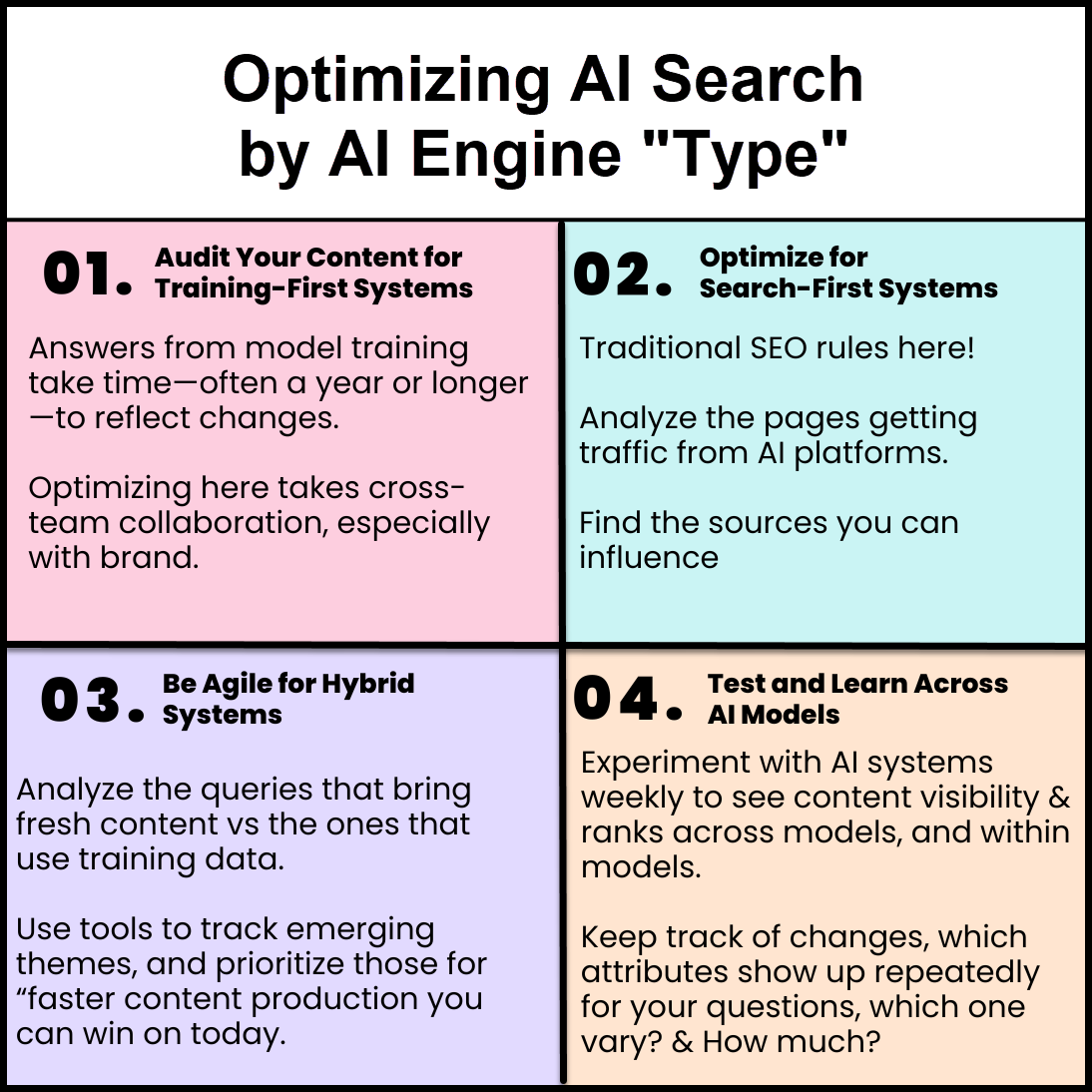
Google’s AI Overviews, Bing Copilot, Perplexity, and ChatGPT’s browsing mode collectively handle billions of queries each month. These generative engines don’t just list web pages; they compile answers using multiple sources and present a unified response. For brands, this means the top organic position isn’t the only prize anymore—appearing as one of the few cited sources in an AI-generated summary can deliver enormous visibility and authority.
AI search optimization acknowledges a shift in user behavior. Users are growing accustomed to asking complex questions and receiving narrative answers without ever scrolling past the first fold. Optimizing for this environment demands that your content be structured, attributed, and semantically rich enough to be chosen by the retrieval model backing the LLM.
Core Components of AI Search Optimization
Effective AI search optimization rests on several interdependent pillars. Missing any one of them can render your content invisible to AI retrievers. The four components you must master are technical accessibility, authority building, content architecture, and entity optimization.
Technical Accessibility for AI Crawlers
- Ensure your site is fully renderable by headless browsers, as many AI search bots rely on dynamic crawling.
- Use clean, well-nested HTML with semantic elements so parsers can easily identify the main content, publication date, and author.
- Implement structured data (Schema.org) for articles, FAQs, products, and organizations to become a known entity in knowledge graphs.
- Maintain fast server response times and avoid blocking essential CSS or JavaScript that might hide key content from AI crawlers.
- Thin content with no unique data: AI models skip pages that simply rephrase what’s already in the training data. Without original research or insight, your page won’t be retrieved.
- Over‑optimizing for keywords at the expense of readability: Keyword stuffing degrades semantic clarity and can hurt both traditional and AI search performance.
- Ignoring structured data: Even if your content is excellent, missing Schema markup prevents the model from recognizing your entity and content type, lowering your citation rate.
- Blocking AI crawlers inadvertently: Some sites block common AI bot user agents while trying to protect content, making them invisible to AI search engines.
- Assuming one‑time optimization is enough: AI models are updated frequently; re‑audit your top pages quarterly to ensure they still reflect the freshest facts and formatting the latests models prefer.
Authority and Trust Signals
AI models heavily weight sources that exhibit consistent authority. This goes beyond traditional PageRank. AI search optimization requires establishing your brand as a primary entity on platforms that LLMs use for training and real-time retrieval, such as Wikipedia, Wikidata, and trusted databases. Co-citation with other high-authority sources and appearance in reputable datasets strengthens your entity vector. Additionally, earning mentions and citations from sites already favored by LLMs improves your chance of being pulled into an answer.
Content Architecture for Machine Reading
AI models prefer content that is declarative, well-segmented, and free of fluff. Each paragraph should contain a standalone factual statement with clear attribution. Use inverted pyramid style: place the definitive answer at the top, followed by supporting context and granular details. Headings must be descriptive and serve as direct questions or answers to potential queries. Tables, lists, and definition-style blocks are favored because they allow the model to extract discrete facts efficiently.
Entity Optimization and Knowledge Graphs
In AI search optimization, you’re not just optimizing a page—you’re teaching the AI what your brand, products, and experts represent as entities. Claim and refine your Google Knowledge Panel, Wikipedia entry, and LinkedIn or Crunchbase profiles with consistent naming, descriptions, and affiliations. Connect your entities using sameAs schema markup across all digital properties. When the AI understands your entity map, it can confidently cite your content when users ask about your niche.
How AI Retrievers Select and Cite Sources

Understanding the retrieval pipeline removes guesswork. Most AI search systems use a two‑stage process: a dense retrieval model scans a curated index for relevant passages, then a ranking model scores them based on relevance, authority, and freshness. The top‑scoring passages are fed into the LLM via the prompt, often truncated to a few hundred tokens each. The model then synthesizes an answer and attributes each factual claim to the source from which it was extracted.
AI search optimization directly influences this pipeline. By crafting content into clear, self‑contained paragraphs that match the latent intent behind search queries, you increase the chance of being retrieved. When those paragraphs also carry strong entity signals and appear on pages with high‑trust indicators, the ranking model elevates them. The result: your text becomes part of the final answer, complete with a citation link that users can click to explore further.
Practical Strategies for AI Search Optimization
Moving from theory to execution, these strategies have proven effective across industries that have been among the first to experience AI‑driven traffic. Each tactic reinforces one or more of the core components listed above.
Create Definitive Source Hubs
AI models favor comprehensive, frequently updated resources that cover a topic exhaustively. Instead of scattering information across many blog posts, build a single authoritative hub page that addresses every facet of a query. Use clear subheadings, a table of contents with anchor links, and include statistics, definitions, and expert commentary. When the AI looks for the most thorough source, your hub page becomes the obvious pick.
Optimize for Facts, Not Just Keywords
Traditional keyword density plays a diminished role. AI search optimization demands that you embed verifiable claims—statistics, dates, names, and specific figures—within your copy. Models are drawn to concrete data points they can cite verbatim. For example, instead of writing “many businesses see a high ROI from SEO,” state “Companies that invest consistently in organic search see an average 13‑to‑1 return on investment over three years.” The specific number makes your content citable.
Leverage Natural Question‑Answer Pairing
Frame your headings as common questions, immediately followed by succinct direct answers. Wrap the answer in a separate paragraph or definition list so the model can extract it without surrounding noise. This mirrors how FAQ structured data works, but even without schema, the clear QA format helps AI retrievers identify the exact snippet to use. Pairing each answer with evidence from a primary study or expert quote further increases citation worthiness.
Strengthen Off‑Page Entity Signals
Your website alone isn’t enough. AI search optimization demands presence in the datasets LLMs use for grounding. Secure a Wikipedia page if your brand meets notability guidelines, get listed on Crunchbase, Wikidata, and industry‑specific reputable directories. Ensure your brand name, description, and relationships are consistent across all platforms. When the AI cross‑references sources to validate facts, this consistency builds trust and boosts your selection probability.
Monitor AI‑Specific Search Performance
Traditional rank trackers don’t yet capture AI search visibility comprehensively. Use specialized tools that can query generative engines and record whether your brand is cited, how often, and in which context. Monitor query logs within your own site search to detect new question patterns that AI users may be asking. Adjust your content based on gaps where AI overviews cite competitors but not you.
Common Mistakes in AI Search Optimization
Avoiding pitfalls is as important as executing best practices. Many well‑meaning teams inadvertently sabotage their AI visibility through outdated habits.
Essential Tools for AI Search Optimization
While the field is young, a toolkit has emerged to help practitioners measure and improve their AI search footprint. Combine these with traditional SEO platforms for a full picture.
| Tool Category | Recommended Tools | Purpose in AI Search Optimization |
|---|---|---|
| AI visibility monitoring | Similarweb AI visibility reports, proprietary dashboards querying AI APIs | Track citation frequency and share of voice in AI‑generated answers |
| Entity management | Google Knowledge Graph API, Wikidata, Schema.org validators | Ensure entity consistency and markup correctness |
| Content gap analysis | Ahrefs, Semrush (for query insights), manual testing with ChatGPT/Perplexity | Identify queries where competitors are cited but you are not |
| Technical crawling | Screaming Frog, Sitebulb | Validate semantic HTML, structured data, and page accessibility for AI crawlers |
The Future of AI Search Optimization
As LLMs evolve, AI search optimization will increasingly intersect with brand authority in the training corpus. Models will prioritize sources they have encountered consistently during pre‑training, making long‑term digital PR and data publication essential. Real‑time personalization may tailor answers based on user location and history, making local entity signals more important. Multimodal A
Brands that adopt a holistic, entity‑centric content strategy today are building a moat that will be hard to erode. AI models learn from repetition and co‑citation; the more your brand appears alongside key topics in high‑quality sources, the more deeply you become embedded in the AI’s knowledge representation. This paradigm shift rewards consistency, factual depth, and genuine expertise over clever keyword tactics.
Frequently Asked Questions
What is AI search optimization and why does it matter?
AI search optimization is the process of making your content the preferred source for AI-powered search engines and large language models. It matters because generative engines now answer a growing share of queries directly, and being cited in those answers is the new front page of search.
How is AI search optimization different from traditional SEO?
While traditional SEO focuses on ranking in the list of blue links, AI search optimization aims to be extracted and cited inside AI-generated responses. It emphasizes entity authority, structured data, and fact-dense content over keyword metrics and backlink volume alone.
Does structured data help with AI search optimization?
Yes, structured data helps AI models understand your content type, entity identity, and the relationships between pieces of information. Schema markup for articles, FAQs, and organizations makes it easier for retrieval systems to extract relevant passages with confidence.
Can small websites compete in AI search optimization?
Small websites can compete by focusing on niche topics where they can demonstrate unique expertise and by building strong entity signals through consistent mentions across reputable platforms. Original research, unique statistics, and clear author authority often outweigh domain size when AI picks sources.
How do I measure success in AI search optimization?
Success is measured through AI-specific visibility metrics: how often your brand appears in AI overviews, the share of citations you receive compared to competitors, and the traffic driven from those citations. You can also track branded search uplift as a proxy for increased AI mentions.
Putting AI Search Optimization into Practice
AI search optimization demands a fundamental rethinking of what it means to create visible content. The brands that will thrive are those that shift from trying to trick ranking algorithms to being the single most reliable, fact‑rich, and well‑structured source on their topic. Every piece of content should answer a question so completely that an AI has no reason to look elsewhere.
Start by auditing your top ten organic pages through the lens of machine readability. Convert vague descriptions into specific, citable facts. Add structured data. Strengthen off‑platform entity signals. Then build a monitoring rhythm to track when and how AI search engines use your content. Over time, these disciplines compound to make your brand a default answer for queries that matter—an outcome no amount of traditional link building can guarantee.
Xem thêm:
- The Ultimate AI SEO Workflow for Ecommerce: Drive More Traffic and Sales
- AI SEO Product Description Optimization: The Complete Playbook for Higher Rankings and Conversions
- AI SEO Outreach Templates: The Complete Guide to Higher Response Rates in 2025
- AI Blog SEO: The Complete Guide to Ranking With Machine Intelligence
- AI Outline Generator: The Complete Guide to Structuring Content in Seconds
Bài viết cùng chủ đề:

AI SEO SEO Automation with Make: The Complete Workflow Guide

AI SEO SEO Automation with Zapier: The Complete Workflow Guide

AI SEO SEO Automation with n8n: The Complete Workflow Guide
AI SEO SEO Automation with Gemini: The Complete Guide to Scaling Organic Growth

AI SEO SEO Automation with Claude: The Complete Guide to Scaling Content in 2025

AI SEO SEO Automation with ChatGPT: The Complete Playbook for 2025

AI SEO & SEO Automation for Affiliate Sites: The 2025 Playbook for Passive Income Growth
AI SEO & SEO Automation for Bloggers: The Complete Guide to Scaling Your Content

AI SEO & SEO Automation for Agencies: The Complete 2025 Playbook

AI SEO and SEO Automation for Ecommerce: The Complete Playbook for 2025

AI SEO & SEO Automation for WordPress: The Complete Playbook for 2025
AI SEO SEO Automation Strategy: The Complete Playbook for 2025

Mastering the AI SEO SEO Automation Process: A Complete Guide to Scaling Organic Growth
AI SEO SEO Automation System: The Complete Guide to Scaling Organic Growth in 2025
AI SEO SEO Automation Platform: The Complete Guide to Scaling Organic Growth in 2025
AI SEO SEO Automation Software: The Complete Guide to Scaling Organic Growth in 2025















