
No products in the cart.
AI SEO Agent: How Autonomous AI Is Reshaping Search Engine Optimization
29
Jul
Jul
An AI SEO agent is no longer a futuristic concept—it is a working reality that transforms how websites climb search rankings. Unlike static checklists or isolated keyword tools, an AI SEO agent interprets goals, scans entire domains, and executes optimizations with minimal human input. It combines large language models, machine learning, and real-time search data to handle everything from keyword clustering to internal linking at scale. For digital teams exhausted by repetitive audits, this technology offloads hours of manual work while surfacing insights that human analysts might overlook. Understanding how these agents function, where they excel, and what limits they carry determines whether they become a competitive advantage or a wasted investment.
What Is an AI SEO Agent? A Complete Definition

An AI SEO agent is a software system that autonomously plans, prioritizes, and performs search optimization tasks. It moves far beyond simple suggestion engines. While a traditional tool might list missing meta descriptions, an AI agent can generate optimized descriptions, evaluate their likely click-through impact, and publish them across hundreds of pages after approval. The key distinction lies in decision-making loops. The agent ingests data from Google Search Console, analytics platforms, and crawl logs, then uses natural language processing to understand what a page aims to achieve. From there, it either takes action directly or queues tasks for review based on confidence thresholds.
These agents often operate as a layer on top of existing SEO platforms. They connect APIs, run scheduled crawls, and maintain a continuous feedback loop. Some function as chatbots where you can type “improve my site speed for mobile” and receive a step-by-step execution plan with automatic fixes. Others run silently in the background, detecting content decay and refreshing stale articles with updated statistics and internal links. The common thread is autonomy paired with contextual understanding—far removed from the rigid rule-based automation of earlier SEO software.
How AI SEO Agents Work: The Core Technology Stack
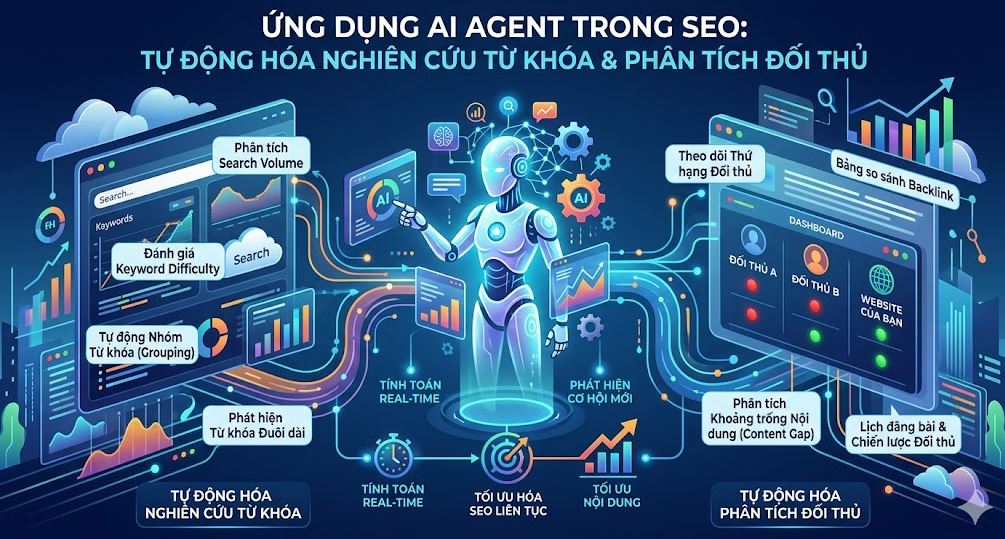
Under the hood, a capable AI SEO agent relies on several interconnected components. First, a data ingestion layer pulls structured and unstructured data from search consoles, ranking monitors, backlink databases, and on-page scrapers. This raw data is fed into a combination of transformer-based language models and domain-specific ranking models. The language model interprets content relevance and semantic gaps, while the ranking model predicts how specific changes might affect positions based on historical patterns and current SERP landscapes.
Decision engines then prioritize actions using a scoring mechanism. Does a product category page need fresh internal links more urgently than a blog post needs updated statistics? The agent balances search volume potential, conversion value, and implementation effort. After executing or queuing an action, it monitors the result. If rankings shift, the agent adjusts its future decisions, learning which interventions yield the strongest impact for that specific domain. This continuous improvement loop separates a true AI SEO agent from static automation scripts.
Key Types of AI SEO Agents Available Today
1. Fully Autonomous SEO Agents
These systems require little daily oversight after initial configuration. They crawl the site, identify problems, and apply fixes—often directly within a CMS. They rewrite title tags, compress images, consolidate duplicate content, and even restructure navigation based on click-through data. Fully autonomous agents suit large e-commerce sites with thousands of URLs where manual management is impossible. However, they demand rigorous guardrails to prevent unintended changes, such as altering page intent or removing content that holds long-tail value.
2. AI-Assisted SEO Copilots
This more common category keeps a human in the driver’s seat. The agent generates recommendations, drafts content briefs, builds topic clusters, and flags technical gaps. The user approves, modifies, or rejects each suggestion. Tools in this bracket often integrate with Google Docs, WordPress, or project management platforms, acting as an intelligent layer that sharpens the strategist’s decisions rather than replacing them. The copilot model reduces risk while still cutting research time by more than half.
3. Specialized AI Modules for Specific SEO Tasks
Not every AI agent aims to run entire campaigns. Some focus on a single high-impact area. You find agents that exclusively handle internal link optimization, analyzing site architecture to suggest and insert links that distribute authority more evenly. Others specialize in content refreshing, detecting pages losing rankings and rewriting sections with newer data. These specialized modules can be plugged into broader workflows, letting teams mix and match capabilities according to budget and needs.
Benefits of Using an AI SEO Agent Over Traditional Methods
- Speed at scale: Auditing 50,000 URLs manually takes weeks. An AI agent completes the same crawl, analysis, and action plan in hours, often with higher accuracy on technical factors.
- Continuous optimization: Instead of quarterly overhauls, the agent monitors ranking shifts daily and reacts immediately to competitor moves or algorithm updates.
- Data synthesis: It connects dots between user behavior metrics, conversion data, and keyword gaps that human teams might miss due to information silos.
- Reduced human error: Consistent tagging, canonicalization, and structured data implementation become rule-driven, eliminating misconfigurations that arise from manual copy-pasting.
- Resource reallocation: Senior SEO specialists spend less time on repetitive audits and more on creative strategy, link-building relationships, and brand positioning.
- Over-optimization and sameness: AI trained on aggregated data may produce mechanically perfect pages that lack the distinctive voice or unique angle search engines increasingly reward.
- Misaligned objectives: If the agent optimizes purely for traffic without conversion awareness, it can attract irrelevant visitors, inflate bounce rates, and hurt long-term authority signals.
- Algorithm blind spots: Agents learn from historical ranking patterns. Sudden, unannounced core updates can break these models until retrained, during which time the agent might double down on tactics that now trigger penalties.
- Data privacy and security: Granting deep CMS access and search console data requires airtight API permissions and careful vendor vetting to avoid exposing proprietary performance data.
- Content authenticity concerns: Google’s guidelines emphasize original, helpful content created for people. If an AI agent generates bulk pages that read like generic summaries, those pages risk being classified as unhelpful and may not rank well.
- Letting the agent run unsupervised on live sites: Even the smartest agent misinterprets context. Always test changes on a staging clone first, especially for site-wide modifications like navigation restructuring or mass redirects.
- Ignoring Google’s E-E-A-T signals: Agents optimized for keyword density may neglect author expertise, factual sourcing, and trust signals. Human editors must verify that AI-written content showcases real experience and authority.
- Using the agent as a sole content creation engine: Bulk AI pages without unique value invite thin-content penalties. Blend agent drafts with original data, expert quotes, and proprietary insights to maintain quality differentiation.
- Failing to update the agent’s knowledge base: Search algorithms and user behavior evolve. If your agent relies on models trained months ago without fresh crawl data, its recommendations will grow stale and potentially harmful.
- Overlooking internal communication: When the agent rewrites a key landing page, the marketing team needs to know the messaging changed. Establish alert flows so all stakeholders stay informed of autonomous changes.
Limitations and Risks When Deploying AI SEO Agents
AI SEO Agent vs. Traditional SEO Tools: A Head-to-Head Comparison
Traditional tools like rank trackers, keyword explorers, and site auditors remain valuable but operate in silos. An AI SEO agent integrates these signals and acts on them. The table below highlights the core differences.
| Feature | Traditional SEO Tool | AI SEO Agent |
|---|---|---|
| Task execution | Reports issues; manual fixes required | Identifies and resolves issues autonomously or with single-click approval |
| Data analysis depth | Structured metrics (volume, difficulty, position) | Structured data plus semantic content analysis, user intent signals, and contextual recommendations |
| Learning ability | Static algorithms, updated periodically | Continuous machine learning loops that adapt to site-specific ranking dynamics |
| Content generation | Keyword lists and topic suggestions | Full article drafts, meta data, schema markup, and internal link suggestions simultaneously |
| Human oversight | Always required | Configurable; full auto-pilot to human-in-the-loop depending on risk tolerance |
| Cost structure | Monthly subscription per seat | Often usage-based or tiered by actions performed, can be higher but delivers greater output |
How to Implement an AI SEO Agent in Your Workflow: A Practical Guide
Introducing an AI agent without a clear process creates chaos. Start by auditing your current SEO bottlenecks. List time-consuming tasks that require high repetition but low creative input—technical audits, title tag updates, reporting, content refreshing. These become the agent’s initial scope. Next, map data access. The agent needs read and write permissions for your CMS, Google Search Console, and analytics accounts. Implement staging environments so you can test changes before they go live, dramatically reducing risk.
Configure goal hierarchies carefully. If your e-commerce site pushes seasonal products, tell the agent to prioritize pages with high margin potential, not just highest search volume. Set ranking thresholds below which the agent should escalate rather than auto-optimize. For content tasks, define your brand’s tone, forbidden topics, and required disclaimers. Many agents allow custom instructions that act as governance boundaries. After deployment, schedule weekly human spot-checks for the first month. Look for patterns: does the agent over-optimize for long-tail terms at the expense of readability? Adjust parameters accordingly.
Integrate the agent with your existing reporting stack. The agent should feed data into your dashboards, not replace them. Track not only keyword positions and clicks but also conversions, time on page, and pages per session. These metrics reveal whether the agent’s efficiency gains translate into genuine user value. Treat the first quarter as a training period. The agent’s performance will improve as it learns which content themes and structural patterns resonate with your audience and search engines.
Common Mistakes When Using an AI SEO Agent and How to Avoid Them
Important Considerations for Long-Term Success with AI SEO
An AI SEO agent works best as a force multiplier, not a standalone substitute for strategy. The most successful implementations pair the agent’s speed with human creativity. Humans define the brand narrative, build genuine editorial relationships, and interpret nuanced user feedback. The agent then scales that vision across thousands of pages consistently. This symbiosis builds a defensible moat: competitors can access similar AI tools, but they cannot replicate the unique combination of original research, community engagement, and editorial standards your team brings.
Stay informed about search engine policies on AI-generated content. Google’s current stance permits AI assistance as long as content remains helpful, people-first, and not designed primarily to manipulate rankings. Transparent labeling—such as noting when AI contributed to research—can even build trust with readers. Avoid fully automated “SEO content factories” that spin AI output without human review. Such practices may work in the short term but collapse under algorithmic scrutiny. Maintaining a human review layer, even if brief, signals quality and drastically reduces risk.
Frequently Asked Questions About AI SEO Agents
What is an AI SEO agent?
An AI SEO agent is an intelligent software system that uses machine learning and natural language processing to plan, execute, and monitor search engine optimization tasks. Unlike basic tools that only report data, an agent can autonomously write metadata, fix technical errors, refresh old content, and adjust internal linking structures based on real-time performance signals.
Can an AI SEO agent fully replace human SEO specialists?
No. AI agents excel at repetitive, data-heavy tasks and reacting to clear patterns, but they lack the strategic vision, brand understanding, and ethical judgment that human experts provide. The most effective setup uses the agent to handle scale and speed while humans direct creative strategy, build relationships for backlinks, and ensure content authenticity aligns with long-term brand values.
Which SEO tasks can an AI agent handle automatically?
Modern AI SEO agents can automate keyword clustering and topic gap analysis, generate optimized title tags and meta descriptions, conduct technical audits and fix broken links or redirect chains, refresh declining content with updated information, create and insert internal links across content clusters, monitor competitor ranking changes, and produce structured data markup. Human approval remains essential for nuanced editorial decisions and high-stakes pages.
Are AI SEO agents compliant with Google’s guidelines?
Yes, when used responsibly. Google’s focus is on the quality and usefulness of the final output, not the tool that created it. As long as the content demonstrates expertise, offers genuine value to readers, and avoids deceptive manipulation, AI-assisted SEO work stays within guidelines. Fully automated content created solely to rank without human review, however, can be considered spam and attract manual actions.
How do I choose the right AI SEO agent for my business?
Start by defining your primary bottleneck. If technical debt plagues a large site, look for agents with strong crawl and fix capabilities. If content freshness is the issue, prioritize agents that specialize in content auditing and rewriting. Evaluate integration depth with your CMS and analytics stack, the transparency of the agent’s decision-making (can you review every planned change?), and the strength of safety guardrails. Request a trial focused on a small, non-critical site section to measure speed, accuracy, and the quality of the output before expanding.
Conclusion: The Future of Search Belongs to AI-Assisted Humans
The rise of the AI SEO agent signals a shift away from manual, tool-by-tool optimization toward intelligent, holistic management of organic search presence. These agents compress weeks of work into hours and reveal patterns impossible for individuals to detect manually. Yet their true power emerges only when guided by experienced professionals who set the ethical boundaries, creative direction, and strategic priorities. Businesses that treat the AI SEO agent as a collaborative team member—leveraging its analytical muscle while preserving human judgment—will build a sustainable, adaptive search strategy. Those who hand over the keys entirely risk generic content and fragile rankings that crumble with the next algorithm update. The agent is ready. The question is whether your team is prepared to lead it.
Xem thêm:
- AI SEO Outreach Automation: The Complete Guide to Scaling Link Building in 2025
- AI SEO Keyword Strategy: The Complete Guide to Future-Proof Search Rankings
- AI SEO LocalBusiness Schema: The Complete Guide to Smarter Local Rankings
- AI SEO Masterclass: The Complete Guide to Dominating Search in 2025
- ChatGPT SEO: The Ultimate Guide to AI-Powered Search Engine Optimization
Bài viết cùng chủ đề:

AI SEO SEO Automation with Make: The Complete Workflow Guide

AI SEO SEO Automation with Zapier: The Complete Workflow Guide

AI SEO SEO Automation with n8n: The Complete Workflow Guide
AI SEO SEO Automation with Gemini: The Complete Guide to Scaling Organic Growth

AI SEO SEO Automation with Claude: The Complete Guide to Scaling Content in 2025

AI SEO SEO Automation with ChatGPT: The Complete Playbook for 2025

AI SEO & SEO Automation for Affiliate Sites: The 2025 Playbook for Passive Income Growth
AI SEO & SEO Automation for Bloggers: The Complete Guide to Scaling Your Content

AI SEO & SEO Automation for Agencies: The Complete 2025 Playbook

AI SEO and SEO Automation for Ecommerce: The Complete Playbook for 2025

AI SEO & SEO Automation for WordPress: The Complete Playbook for 2025
AI SEO SEO Automation Strategy: The Complete Playbook for 2025

Mastering the AI SEO SEO Automation Process: A Complete Guide to Scaling Organic Growth
AI SEO SEO Automation System: The Complete Guide to Scaling Organic Growth in 2025
AI SEO SEO Automation Platform: The Complete Guide to Scaling Organic Growth in 2025
AI SEO SEO Automation Software: The Complete Guide to Scaling Organic Growth in 2025















