
No products in the cart.
AI SEO Checklist for Ecommerce: The Complete 2025 Guide to Automating Product Page Optimization

29
Jul
Jul
Introduction to the AI SEO Revolution in Ecommerce

The ecommerce landscape demands speed, scale, and surgical precision in search engine optimization. An AI SEO checklist for ecommerce acts as a strategic framework that blends artificial intelligence with time‑tested SEO principles, ensuring your product pages, category structures, and content hubs stay ahead of constant algorithm updates. With over 60% of online shopping journeys beginning on a search engine, missing even one critical optimization layer can mean losing revenue to competitors who have automated their workflows.
This checklist moves beyond generic advice by integrating the latest machine‑learning models—from natural language processing for product descriptions to predictive analytics for seasonal keyword trends. Whether you manage a Shopify store with 500 SKUs or a headless enterprise platform with millions of URLs, applying AI‑driven SEO systematically transforms guesswork into measurable growth. In the following sections you will discover actionable categories, practical tool suggestions, and the exact sequence that turns raw data into ranking power.
What Exactly Is an AI SEO Checklist for Ecommerce?
An AI SEO checklist for ecommerce is a structured, repeatable list of tasks where artificial intelligence tools automate or enhance each step of the optimization process. Unlike traditional checklists that rely solely on manual audits and intuition, this version leverages machine learning to crawl, analyze, and recommend changes at a speed impossible for human teams. The checklist covers the full lifecycle of an ecommerce SEO program: crawling and indexing, keyword discovery, on‑page content generation, technical troubleshooting, internal linking, schema markup, and performance monitoring.
The core idea is not to replace human strategists but to offload repetitive, data‑intensive work so that experts can focus on creative differentiation and high‑level strategy. For example, AI can generate 200 unique meta descriptions for a collection drop in minutes while a human editor fine‑tunes the brand voice. The checklist guarantees that no technical detail—from broken canonical tags to missing alt text—escapes attention, creating a safety net for large catalogs.
Why Ecommerce Stores Need a Dedicated AI‑Powered SEO Checklist

Ecommerce sites face unique SEO challenges: thousands of dynamically generated URLs, thin content from faceted navigation, duplicate product variants, seasonal demand spikes, and the constant need to update prices and availability. A manual approach simply cannot keep pace, and even traditional SEO tools often require hours of configuration. An AI‑infused workflow automatically distinguishes between high‑priority pages and low‑value crawl traps, prioritizing fixes that drive revenue.
Moreover, search engines increasingly reward entities, product schemas, and rich results. AI models understand structured data better than rule‑based software, ensuring your product feeds translate into precise markup that triggers price, availability, review stars, and shipping information snippets. Without a dedicated checklist, teams risk applying generic tactics that fail to address the granular requirements of product‑led commerce.
Core Components of an AI SEO Checklist for Ecommerce
A robust AI SEO checklist for ecommerce can be broken into seven interconnected pillars. Each pillar contains specific, AI‑executable steps that feed into the next, creating a virtuous cycle of optimization. The pillars are: crawl management and technical hygiene, intelligent keyword research, content and product description automation, on‑page element generation, AI‑driven internal linking, schema and rich result readiness, and continuous performance analysis. The following table outlines the pillars and the primary AI role within each.
| Checklist Pillar | Primary AI Role | Business Impact |
|---|---|---|
| Technical Crawl & Indexation | Automated log‑file analysis, anomaly detection | Eliminates wasted crawl budget, accelerates indexing new SKUs |
| Keyword Discovery & Clustering | Semantic topic modeling, intent classification | Covers long‑tail demand without manual mapping |
| Product Content Generation | LLM-powered descriptions, FAQ extraction from specs | Scalable unique content, improves conversion rate |
| On‑Page Element Creation | Meta title/description drafts, image alt tag suggestions | Consistent optimization across thousands of URLs |
| Internal Linking & Site Architecture | Graph‑based analysis to suggest authority‑flow links | Strengthens pillar pages, reduces orphan products |
| Structured Data & Rich Results | Schema validation, dynamic product markup generation | Increased SERP visibility via product snippets |
| Performance & Competitor Monitoring | Predictive traffic modeling, ranking volatility alerts | Faster reaction to core updates, protects seasonal peaks |
Step‑by‑Step AI SEO Checklist for Ecommerce
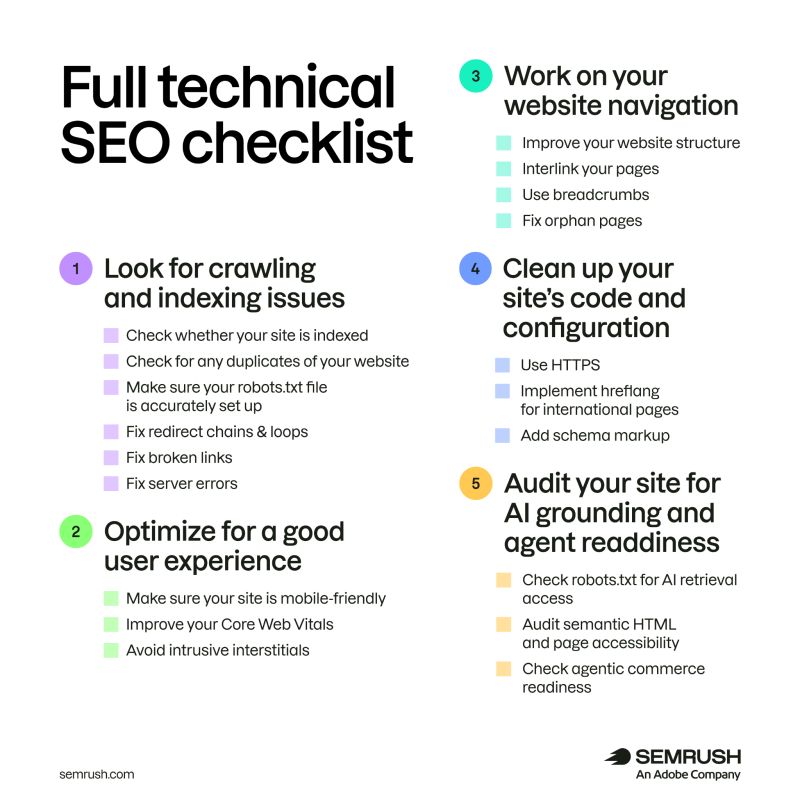
1. Perform an AI‑Augmented Technical Crawl
Begin with an intelligent crawl that mimics how Googlebot processes JavaScript-heavy storefronts. AI‑enhanced crawlers like Botify or DeepCrawl’s application can identify patterns in server responses, rendering delays, and crawl depth anomalies. The checklist action items include: approve a full rendered crawl, feed server log files into an AI log analyzer to detect uncrawled high‑value URLs, and automatically generate a priority fix list ranked by revenue potential. The AI then tags issues such as chain redirects, soft 404s, and infinite loops without manual review.
Pay special attention to faceted navigation parameters. AI models can cluster parameter combinations, analyzing organic traffic data to decide which facets deserve indexation. Configure the tool to output a clean disallow or canonical directive set, which your development team can push live through a bulk API update. This step alone often recovers thousands of dollars in lost organic visits.
2. Uncover Revenue‑Driving Keywords with Predictive Intelligence
Move beyond static keyword volume. AI keyword research tools ingest historical search data, seasonal trends, and even competitor catalog gaps to predict emerging search demands. In your checklist, include a task to run topic models over your entire product catalog, extracting the core entities and modifiers that shoppers blend. For instance, an outdoor gear store might discover that “ultralight 2‑person tent with vestibule” is surging eight weeks before camping season peaks, long before traditional tools signal it.
The AI clusters queries by intent (informational, commercial, transactional) and assigns them to the correct page template: blog content for research‑phase queries, category pages for mid‑funnel terms, and product pages for purchase‑ready keywords. Export these clusters into a structured content brief library that feeds the next phase.
3. Automate Unique, High‑Conversion Product Descriptions
Duplicate manufacturers’ descriptions remain one of the biggest threats to ecommerce SEO. Your AI SEO checklist for ecommerce must enforce the generation of distinctive product copy at scale. Use a fine‑tuned large language model that understands your brand tone, target persona, and compliance rules. Input product attributes, reviews, and user‑generated content snippets; the AI drafts a description that incorporates primary and secondary keywords naturally while highlighting unique selling points.
Include a human‑in‑the‑loop checkpoint: the AI flags confidence scores, and a content editor spot‑checks lower‑scoring outputs. For long‑tail variants (size, color), the model auto‑creates variant‑specific passages, avoiding near‑duplicate content penalties. The checklist also mandates the AI to generate structured FAQ sections for product pages, pulling the most common questions from customer service logs, and formatting them with schema markup in mind.
4. Generate On‑Page SEO Elements with Semantic Precision
With AI, you can produce meta titles, meta descriptions, and header tags that are both engaging and algorithmically robust. Feed the AI the target keyword cluster, the page’s existing content, and a snippet of top‑ranking SERP titles; it generates multiple variations optimized for click‑through rate while respecting pixel width limits. The checklist should verify that each product page has a unique title combining the main keyword, brand name, and a compelling differentiator (e.g., price, free shipping, rating).
For image SEO, AI vision models scan product photos, recognizing objects, textures, and colors to craft descriptive alt text. This reduces the manual overhead to almost zero. Implement the alt text suggestions via a CMS integration, and run a weekly audit to confirm they’ve been applied. The same AI pipeline can also recommend file compression without quality loss, directly feeding into Core Web Vitals improvements.
5. Build a Self‑Optimizing Internal Link Network
Internal linking for large ecommerce sites is painfully resource‑intensive if done manually. AI graph algorithms map the entire site structure, calculate PageRank‑like authority flows, and detect orphaned product pages buried deep in pagination. The checklist step involves activating an AI linking tool that suggests contextual links from blog posts to related products and from best‑seller category pages to complementary accessories.
Implement an automated rule: whenever a new blog post is published, the AI scans its content and inserts links to relevant product and category pages using natural, varied anchor text. Simultaneously, product pages receive auto‑generated “frequently bought together” or “complete the look” sections that serve internal links. The AI monitors click data and refines these connections over time, effectively turning your site architecture into a live organism that strengthens SEO equity distribution.
6. Deploy AI‑Validated Structured Data at Scale
Rich results for product snippets, review stars, stock status, and shipping details significantly improve organic CTR. The checklist demands that every product URL carries JSON‑LD markup generated dynamically by an AI templating engine. The engine escapes thin‑content pitfalls by only populating fields with verified data from the PIM (Product Information Management system) and cross‑references Google’s Merchant Center feed for consistency.
Use the AI to perform a daily schema validation check; it pings Google’s Rich Results Test API and flags discrepancies like missing priceCurrency, incorrect availability, or mismatched SKUs. A dashboard alert triggers if errors exceed a threshold, preventing widespread snippet loss. For winner‑variant URLs, the AI consolidates aggregate ratings across all variants, presenting the correct numberOfReviews and ratingValue without manual stitching.
7. Monitor Performance and Adapt with Predictive Alerts
The final mandatory step is configuring a monitoring layer that watches keyword rankings, organic traffic, conversion rate, and page experience metrics. An AI anomaly‑detection system learns normal seasonal patterns and sends alerts only when deviations are significant—such as a sudden ranking drop on a top‑revenue PLP. The checklist includes a bi‑weekly routine: review the AI’s prioritization of underperforming pages, investigate its root‑cause analysis (e.g., cannibalization, lost backlinks, slow LCP), and assign tasks to the relevant team.
Combine this with competitor content gap analysis. AI scrapes rival ecommerce sites (ethically and within rate limits), compares their top‑ranking category blurbs and blog topics against yours, and proposes content briefs that fill the gaps. This turns the checklist into a living strategy document that reacts to market shifts within hours, not weeks.
Benefits of Using an AI SEO Checklist for Ecommerce
- Massive time savings: Tasks that consumed weeks—like rewriting meta tags for 10,000 SKUs—now complete in an afternoon.
- Scalable uniqueness: AI prevents duplicate content issues while maintaining brand voice, critical for stores that add hundreds of products monthly.
- Surgical prioritization: Revenue‑impact scoring ensures you fix the pages that actually move the needle, not just those with the most errors.
- Proactive adaptation: Predictive keyword models catch trends early, so you rank for “black Friday deals” before competitors even begin optimizing.
- Consistent rich result coverage: Automated schema validation keeps product snippets alive even as Google updates requirements.
- Reduced human error: An AI never forgets to set canonical tags or misses a crawled URL, eliminating costly technical slip‑ups.
- Blindly trusting AI‑generated content without review: Always spot‑check a sample of product pages. Set the AI to flag speculative claims (e.g., “best in class”) unless verified by test results.
- Ignoring crawl budget optimization: AI can identify bloated parameter pages, but you must still instruct your developers to implement the fixes. Balance crawlability with faceted navigation that aids user experience.
- Neglecting mobile‑first performance: Even sophisticated AI SEO tools might not simulate real‑world mobile interaction delays. Integrate CrUX data into your monitoring so the checklist includes Core Web Vitals for actual users.
- Using AI to rewrite instead of enhance: Don’t just feed an old product page into an AI and publish the output. Use the AI to enrich with missing keywords, add entity connections, and integrate UGC signals.
- Forgetting to update the AI model with seasonal training sets: A denim store’s AI must learn the difference between “boyfriend fit” fall searches and “denim shorty shorts” summer spikes. Schedule quarterly model retraining.
- Automating internal links without user intent mapping: Ensure the AI’s contextual links actually help shoppers; irrelevant connections increase bounce rate and dilute topical authority.
Limitations and Risks to Keep on the Radar
An AI SEO checklist for ecommerce is powerful, but not without pitfalls. Over‑reliance on generated content without editorial oversight can produce generic, soulless copy that fails to differentiate. AI models sometimes hallucinate product features or make false claims, introducing legal risks for regulated industries. The checklist must always include a human review gate.
Algorithm updates can penalize content that feels “AI‑written” if it lacks expertise signals. This is why the most successful implementations blend AI with first‑party data—customer reviews, expert insights, and original photography. Another limitation is data latency; AI trained on outdated search patterns may miss a recent viral product category. Regularly refresh training data and keep a feedback loop where human experts correct the AI’s mistakes to continuously improve output quality.
Manual SEO vs. AI‑Assisted SEO: A Quick Comparison for Ecommerce
| Aspect | Manual SEO Workflow | AI‑Assisted SEO Checklist |
|---|---|---|
| Keyword research | Spreadsheets, manual competitor checks | Predictive clustering, intent mapping in hours |
| Product description creation | Copywriters for top SKUs, others duplicated | LLM drafts for all SKUs with brand‑safe customization |
| Technical audits | Quarterly crawls, static reports | Weekly smart crawls with anomaly detection |
| Schema management | Manual coding, frequent breaks | Dynamic generation with real‑time validation |
| Link building suggestions | Guessing based on top sellers | Authority graph analysis pinpoints hidden opportunities |
| Reaction to traffic drops | Reactive, often slow | Proactive alerts with root‑cause hypotheses |
Common Mistakes When Applying AI SEO to Ecommerce (And How to Avoid Them)
Important Notes for Sustaining AI‑Driven SEO Success
Technology evolves swiftly and so must your checklist. Treat it as a living document that receives a full audit every quarter. During these audits, validate that the AI models are still aligned with Google’s latest guidelines—especially regarding AI‑generated content and Helpful Content updates. Document any edge cases where the AI underperforms, and fine‑tune its prompts or switch to a more specialized engine for that task.
Data privacy is non‑negotiable. When using AI to analyze customer‑facing logs or reviews, anonymize personally identifiable information. If you rely on third‑party APIs, ensure they comply with GDPR, CCPA, or other relevant regulations. Finally, never remove the human strategist from the loop. AI accelerates execution, but only an experienced SEO expert can interpret competitive nuance, assess brand risk, and make judgment calls that align with long‑term customer trust.
Frequently Asked Questions About AI SEO Checklist for Ecommerce
Can AI completely automate ecommerce SEO?
Full automation is not advisable. AI excels at repetitive, data‑heavy tasks such as generating product descriptions, auditing technical issues, and clustering keywords. However, strategic decisions—like choosing which category to prioritize during a seasonal push or how to handle a PR crisis that affects backlinks—require human judgment. The strongest approach keeps AI as a force multiplier, automating 80% of the workflow while experts guide the direction and approve sensitive content.
Is AI‑generated product content penalized by Google?
Google does not penalize content solely because it is AI‑generated. The focus is on quality, originality, and helpfulness. If AI content is indistinguishable from thin, mass‑produced spam, it will perform poorly. The AI SEO checklist for ecommerce should include steps for adding unique data points—like integration of authentic customer reviews, expert tips, or behind‑the‑scenes product sourcing stories—so that each page demonstrates first‑hand expertise and trustworthiness beyond what a language model can invent.
How do I pick the right AI tools for my ecommerce SEO checklist?
Map your checklist pillars to specific tool capabilities. For technical crawls, look for AI log analysis features. For content generation, evaluate LLMs that allow fine‑tuning on your existing high‑performing pages. Ensure the tool can export dynamic product markup and provide API access for scale. Start with a pilot on a subset of your catalog, measuring impact on indexation rate, click‑through rate, and time saved before expanding.
What is the best way to AI‑optimize category pages for long‑tail searches?
Use AI to generate category‑level introductory content that semantically includes subtopics related to the products within. For a “running shoes” category, the AI can create a buyer’s guide paragraph that weaves in “stability shoes for overpronation” or “marathon racing flats.” Dynamically inject user‑generated reviews and popular filter combinations as natural language subheadings. The AI monitors search queries that land on the page and suggests content expansions for terms with high impressions but low click‑through rates.
How often should I update my AI SEO checklist?
Review the tactical steps monthly, but perform a complete overhaul every quarter. Search engine updates, new AI model capabilities, and changes in your product catalog all necessitate adjustments. After each major core algorithm update, run a correlation analysis between your checklist’s outputs and ranking fluctuations to identify necessary tweaks. This iterative refinement ensures the checklist remains aligned with real‑world ranking factors.
Conclusion: Making the AI SEO Checklist for Ecommerce a Competitive Moat
An AI SEO checklist for ecommerce is no longer a luxury—it is the backbone of modern ecommerce growth. By systematically applying artificial intelligence across technical health, keyword intelligence, content creation, linking, and performance monitoring, you build a defensible organic channel that compounds over time. The checklist transforms a typically chaotic, reactive SEO effort into a predictable, semi‑automated machine that frees your team to focus on brand storytelling and customer experience.
Implement the steps outlined in this guide one pillar at a time, measure the incremental lift, and refine relentlessly. In an era where every millisecond of page load and every character of a meta description can tilt the revenue equation, letting AI shoulder the heavy operational burden is the clearest path to sustainable ecommerce success.
Xem thêm:
- AI Backlink Analysis: Smarter Link Audits, Stronger Rankings, Faster Growth
- AI SERP Features: The Complete Guide to Understanding and Optimizing for AI-Driven Search Results
- AI SEO vs Surfer SEO: The Complete Guide to AI-Powered Search Optimization
- AI SEO Rich Result Testing: The Complete Guide to Automated SERP Validation
- AI SEO Redirects: The Complete Guide to Smarter Link Management in 2025
Bài viết cùng chủ đề:

AI SEO SEO Automation with Make: The Complete Workflow Guide

AI SEO SEO Automation with Zapier: The Complete Workflow Guide

AI SEO SEO Automation with n8n: The Complete Workflow Guide
AI SEO SEO Automation with Gemini: The Complete Guide to Scaling Organic Growth

AI SEO SEO Automation with Claude: The Complete Guide to Scaling Content in 2025

AI SEO SEO Automation with ChatGPT: The Complete Playbook for 2025

AI SEO & SEO Automation for Affiliate Sites: The 2025 Playbook for Passive Income Growth
AI SEO & SEO Automation for Bloggers: The Complete Guide to Scaling Your Content

AI SEO & SEO Automation for Agencies: The Complete 2025 Playbook

AI SEO and SEO Automation for Ecommerce: The Complete Playbook for 2025

AI SEO & SEO Automation for WordPress: The Complete Playbook for 2025
AI SEO SEO Automation Strategy: The Complete Playbook for 2025

Mastering the AI SEO SEO Automation Process: A Complete Guide to Scaling Organic Growth
AI SEO SEO Automation System: The Complete Guide to Scaling Organic Growth in 2025
AI SEO SEO Automation Platform: The Complete Guide to Scaling Organic Growth in 2025
AI SEO SEO Automation Software: The Complete Guide to Scaling Organic Growth in 2025















