
No products in the cart.
AI SEO Trends 2026: The Strategies That Will Define Search Next Year
29
Jul
Jul
The ground beneath search engine optimization is shifting faster than anyone predicted. By 2026, artificial intelligence will no longer be an optional add‑on – it will be the operating system of search itself. Understanding AI SEO trends 2026 means looking beyond today’s keyword strategies and preparing for a landscape where algorithms interpret intent, generate answers, and even predict demand before a user types a query. This article breaks down the forces reshaping SEO, the tools entering the mainstream, and the concrete actions marketers must take to stay visible and credible.
Search engines are evolving from retrieval engines into reasoning engines. Google’s Search Generative Experience, Bing’s deep integration with GPT, and a wave of standalone AI search engines are already changing how users consume information. In 2026, the winners will be brands that master entity optimization, generative content alignment, and real‑time predictive signals – while avoiding the pitfalls of over‑automation. Let’s explore exactly what is coming.
The Evolution of AI in SEO: From Assistance to Autonomous Decision‑Making
AI’s role in SEO began with simple automations: keyword research tools, content scoring, and rank tracking. By late 2024, large language models were drafting entire content strategies. The jump to 2026 represents a qualitative shift: AI systems will handle not just execution but strategic reasoning. They will allocate budget across topics, predict seasonality with internal data, and adjust hundreds of on‑page signals autonomously. This evolution doesn’t replace the SEO professional – it forces a move into orchestration, ethics, and creative differentiation. The core knowledge of how search works remains invaluable; the medium through which that knowledge is applied is what transforms.
Core AI SEO Trends 2026: The Landscape at a Glance
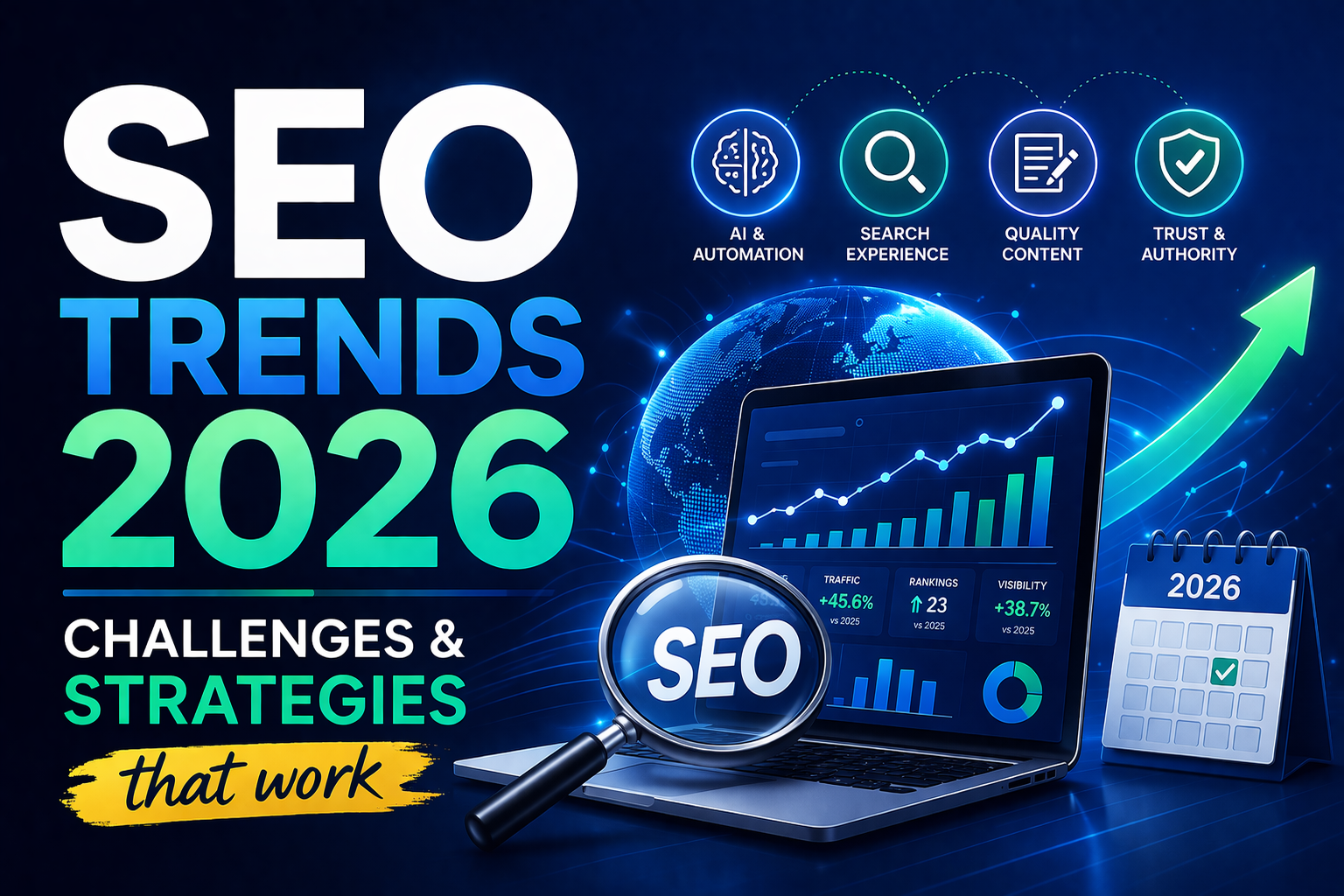
Before diving deep, a snapshot of the trends that matter most: Generative Engine Optimization (GEO), hyper‑personalization, real‑time predictive SEO, multimodal search dominance, AI‑driven link earning, autonomous technical audits, trust‑signal engineering, local AI integration, and entity‑first architecture. Each of these trends interlocks, so treating them as isolated tactics will lead to failure. A cohesive AI SEO strategy 2026 addresses all of them, building a machine‑learning‑ready digital presence that also delights humans.
1. Generative Engine Optimization (GEO) Becomes Non‑Negotiable
Generative Engine Optimization – crafting content that is favored by AI‑powered answer engines – is the most talked‑about shift. In 2026, traditional blue links will share the SERP with AI‑generated snapshots, conversational answers, and dynamic knowledge panels more than ever. GEO means writing with the structures large language models prefer: clear claims, authoritative citations, scannable formatting, and well‑defined entities. It is not about gaming the AI; it is about helping the AI understand your content so fully that it consistently references your brand as the source. Citations, unique statistics, and original research become the new backlinks.
2. Hyper‑Personalized Search Results Driven by AI
Search will look different for every user in 2026. AI models merge location, previous behavior, device context, and even inferred intent to serve tailor‑made results. For SEOs, this means optimizing not just for a keyword but for user clusters. Schema markup that transmits detailed user‑intent signals, dynamic content that adapts to visitor profiles without cloaking, and first‑party data integration become essential. Traditional rank tracking alone becomes misleading; share of voice across personalized SERPs will matter more. Brands that fail to provide a personalized experience will see their content deprioritized by systems that reward relevance at the individual level.
3. AI‑Driven Content Creation and Optimization Matures
The flood of generic AI content will plateau as engines penalize low‑value outputs. In 2026, content created with AI won’t be a differentiator; instead, the quality of human‑AI collaboration will be. Tools that combine company data, editorial guidelines, and domain‑specific language models will produce expert‑level content with minimal iteration. The real trend is AI‑powered content optimization in real time: content that updates itself based on seasonality, news events, or competitor moves without manual republishing. Embedding live data feeds, using adaptive templates, and letting AI rewrite underperforming sections while preserving brand voice becomes standard practice for advanced teams.
4. Real‑Time SEO with Predictive Analytics
Waiting for monthly reports to adjust strategy is already obsolete, and by 2026, the gap between reactive and predictive will be unbridgeable. Predictive analytics tools feed historical search data, social signals, economic indicators, and even weather patterns into machine learning models that forecast demand surges days or weeks before they happen. SEO teams can pre‑optimize content, adjust inventory messaging, and bid on long‑tail queries before competitors notice. This real‑time capability extends to technical SEO: AI monitoring systems will detect crawling issues, page speed degradations, and structured data errors, then automatically generate fixes or roll back problematic deployments. Human oversight remains critical, but the speed of response shifts from hours to milliseconds.
5. Multimodal Search Dominance
Text input will remain important, but voice, image, and video search are no longer side channels. In 2026, advances in computer vision and speech recognition mean a user can snap a photo of a broken appliance part, speak a description, and receive a video answer from a manufacturer’s repair guide – all within one search flow. Optimizing for multimodal search demands a unified entity strategy: an image of a product must be semantically linked to its text description, audio review, and video tutorial. Implementing comprehensive structured data (schema.org types like Product, HowTo, Recipe, VideoObject) and hosting content in high‑resolution, accessible formats becomes a technical foundation, not a nice‑to‑have.
6. AI in Link Building and Digital PR
The manual outreach grind is being replaced by AI‑aided relationship intelligence. Platforms in 2026 will analyze thousands of news sites, journalists’ beat histories, and social media conversations to identify the exact moment a pitch is most likely to land. A The real edge comes from using AI to uncover unlinked brand mentions, predict trending stories where your data can add value, and build authentic connections with niche authority figures. Link building shifts from volume to precision, with trustworthiness metrics heavily scrutinized by search engines.
7. Automated Technical SEO Audits Go Proactive
Technical SEO has always been data‑heavy, and AI thrives in data. By 2026, automated crawlers integrated with AI log‑file analyzers will not only report errors but prescribe fixes, predict the impact on crawl budget, and simulate how a change affects core vital scores before deployment. This “digital twin” approach allows SEOs to test a new site architecture on a staging mirror, let the AI forecast organic traffic changes, and only then push live. The tools will integrate directly into CI/CD pipelines, so every code commit is evaluated for SEO impact. The role of the technical SEO specialist evolves into oversight: designing the rules the AI follows and investigating anomalies the AI flags.
8. E‑E‑A‑T and AI: Engineering Trust Signals in an Automated World
Experience, Expertise, Authoritativeness, and Trustworthiness remain the cornerstone of quality ranking, and AI changes how these are evaluated. In 2026, search engines will use machine learning to verify author credentials, cross‑check factual claims against knowledge graphs, and assess whether user‑generated content on a site aligns with expert consensus. Brands need to surface real‑world proof: author bios with verified credentials, clearly cited sources, demonstration of firsthand experience (photos, case studies, data sets), and transparent editorial policies. A
9. AI and Local SEO: Hyper‑Local Personalization
Local search in 2026 will be powered by AI that understands a neighborhood’s live context: traffic patterns, weather, local events, and even social media sentiment. Optimizing means ensuring your Google Business Profile (or its 2026 equivalent) is not just complete but dynamic – with AI‑generated posts that reflect daily specials, real‑time inventory, or local sponsorships. Voice search queries will be largely local (“best coffee open now with outdoor seating”), so structured data for operating hours, amenities, and real‑time availability must be accurate. AI tools will manage review responses with sentiment‑aware drafts, but again, human empathy must approve every reply.
10. The Shift to Entity‑First SEO Architecture
By 2026, keyword‑centric SEO will be fully secondary to entity‑centric SEO. A search engine’s knowledge graph is the database from which it answers questions, and your website must act as a clear knowledge base. That means every important concept, product, person, and place referenced on your site must be uniquely identified and connected with structured data and internal linking. AI‑powered content management systems will auto‑suggest related entities, build comprehensive topic clusters without manual mapping, and even propose missing content that aligns with your entity footprint. The result is a semantic web of your own content that mirrors the way search engines think.
Practical Application: Building Your 2026 AI SEO Workflow
Translating these trends into action requires a systematic approach. Begin with a thorough content and entity audit. Map every page to a primary entity, verify your schema markup, and identify gaps in your topical authority. Next, implement a scalable AI content system: choose a base model fine‑tuned on your industry’s language, feed it your existing high‑quality content, editorial guidelines, and first‑party customer insights. Use it to generate drafts, but ensure every piece passes through a human editorial layer that adds original anecdotes, expert quotes, and unique data. For technical SEO, pilot a monitoring tool that connects to your dev‑ops pipeline; even a basic automated alert for indexation changes can prevent disasters. In local SEO, start enriching your profile with daily AI‑suggested updates and structured data for all facilities. Finally, set up predictive analytics using free or low‑cost data sources: Google Trends, weather APIs, and your own sales data to forecast content needs for the next quarter.
Integrate AI‑powered SEO tools gradually. Avoid the temptation to replace every process at once. Identify one bottleneck – perhaps keyword research or meta tag generation – where AI can deliver immediate gains. Monitor closely, measure against a control group, and scale what works. Document every prompt, every workflow change, so the team builds institutional knowledge. By mid‑2026, a well‑run hybrid team will handle output that a traditional team of ten cannot match, while producing content that sounds unmistakably human.
Common Mistakes to Avoid When Adopting AI SEO Trends 2026- Deploying AI without a clear editorial workflow. Content generated without human review often contains factual errors, outdated data, or a homogenized tone that search engines will downrank. Always keep a human in the loop for final approval.
- Ignoring structured data. Even the finest AI‑written content will fail to appear in generative snapshots if it lacks the entity markup search engines need to extract it.
- Spamming the web with AI‑generated links. Outreach at scale can quickly become spam. Use AI to identify genuine relationship opportunities, but personalize every communication with a human touch.
- Over‑optimizing for one algorithm version. AI‑driven search engines update continuously. Chasing the latest leak or patent filing leads to fragile tactics. Build a foundation based on user value and entity clarity instead.
- Neglecting page experience and core web vitals. Fast, stable, accessible pages remain a prerequisite. AI can optimize images and scripts, but only if you make page experience a priority from the start.
- Forgetting that search behavior is changing. If your keyword list hasn’t evolved to include conversational queries, visual search terms, and “near me” voice commands, you are already invisible to a growing segment of users.
AI SEO Trends 2026 vs. Traditional SEO: A Quick Comparison
- Deploying AI without a clear editorial workflow. Content generated without human review often contains factual errors, outdated data, or a homogenized tone that search engines will downrank. Always keep a human in the loop for final approval.
- Ignoring structured data. Even the finest AI‑written content will fail to appear in generative snapshots if it lacks the entity markup search engines need to extract it.
- Spamming the web with AI‑generated links. Outreach at scale can quickly become spam. Use AI to identify genuine relationship opportunities, but personalize every communication with a human touch.
- Over‑optimizing for one algorithm version. AI‑driven search engines update continuously. Chasing the latest leak or patent filing leads to fragile tactics. Build a foundation based on user value and entity clarity instead.
- Neglecting page experience and core web vitals. Fast, stable, accessible pages remain a prerequisite. AI can optimize images and scripts, but only if you make page experience a priority from the start.
- Forgetting that search behavior is changing. If your keyword list hasn’t evolved to include conversational queries, visual search terms, and “near me” voice commands, you are already invisible to a growing segment of users.
| Aspect | Traditional SEO (2022–2024) | AI SEO Trends 2026 |
|---|---|---|
| Core Focus | Keyword density, backlinks | Entity authority, generative visibility |
| Content Creation | Mostly human‑written, periodic updates | Human‑AI collaboration, real‑time adaptation |
| Technical Audits | Scheduled crawls, manual fixes | Continuous monitoring, auto‑remediation |
| Rank Tracking | Static keyword positions | Share of voice across personalized SERPs |
| Link Building | Mass outreach, guest posting | AI‑identified relevance, relationship intelligence |
| Search Modalities | Primarily text | Voice, image, video, multimodal |
| User Personalization | Limited to location and device | Deep behavioral, contextual, predictive |
Important Notes: Ethics, Data Privacy, and Long‑Term Sustainability
As AI becomes the engine of SEO, ethical boundaries must be deliberately maintained. Search engines in 2026 will be far better at detecting artificial patterns, including synthetically generated engagement metrics and coordinated link networks. Manipulative AI tactics carry severe penalties and brand damage. Prioritize transparency: if you use AI in content creation, consider disclosing it when appropriate, and always stand behind the accuracy of the information. Data privacy regulations continue to tighten globally; any AI system that scrapes or processes user data must comply with GDPR, CCPA, and new frameworks likely to emerge by 2026. Building a first‑party data asset through consensual interactions is the only sustainable path. Finally, invest in your team’s AI literacy. The most successful SEO departments will blend experienced strategists with data scientists who understand model training, prompt engineering, and output validation.
Frequently Asked Questions (FAQ)
What is the most important AI SEO trend for 2026?
Generative Engine Optimization (GEO) is the single most critical trend. As AI‑generated answers occupy more SERP real estate, brands must optimize content to become the cited source within those snapshots. This requires clear entity markup, authoritative citations, unique data, and scannable formatting that AI models can easily parse and reference.
Will traditional SEO still be relevant in 2026?
Yes, but its scope will change. Foundational technical SEO, user experience, and genuine authority building remain essential. What evolves is the execution layer: keyword research becomes intent research, manual content tweaks become AI‑assisted optimization, and link quantity gives way to trust‑signal quality. Professionals who blend classic SEO wisdom with AI‑powered tools will be in the highest demand.
How can small businesses adapt to AI SEO trends 2026?
Small businesses can start by focusing on local and entity‑first SEO. Claim and fully optimize your business profile with rich structured data, encourage authentic reviews, and create deep, niche content that answers customer questions. Use accessible AI tools for content drafting (always with human review) and free predictive data from Google Trends to anticipate seasonal content needs. The key is building a trustworthy, well‑documented digital presence that AI engines can confidently cite.
Will AI replace SEO professionals in 2026?
No. AI automates repetitive tasks and data analysis, but strategic decision‑making, creative brand storytelling, ethical oversight, and genuine relationship building remain human strengths. The SEO professional of 2026 will be an AI orchestrator and strategist, not a keyboard‑level executor. Adapting quickly to new tools and understanding the limitations of AI models is what will protect and advance careers.
What are the risks of over‑relying on AI for SEO?
Over‑reliance can lead to generic, error‑prone content that damages brand authority. AI can hallucinate facts, miss cultural nuance, and produce content patterns that search engines devalue because they are too similar to other AI‑generated works. The greatest risk is losing the human connection that builds trust. Always pair AI efficiency with strict editorial standards and original insights.
Conclusion: Preparing Your Strategy for AI SEO in 2026
The trends defining AI SEO in 2026 – Generative Engine Optimization, predictive analytics, entity‑first architecture, multimodal search, and automated technical auditing – are not distant forecasts. They are the logical next step of a journey already in motion. Brands that act now, auditing their entities, cleaning their technical foundations, and piloting AI‑assisted workflows, will enjoy a compounding advantage. The future belongs to SEO strategists who embrace AI not as a magic shortcut but as a precision instrument for delivering value. Search engines are getting smarter; your optimization must get smarter still. Start building your intelligent, trust‑centered, data‑informed SEO program today, and 2026 will be the year your brand is discovered exactly when and how your audience needs you.
Xem thêm:
- AI Keyword Generator: Transform Your SEO Strategy with Smart Automation
- AI Site Audit: The Complete Guide to Smarter, Faster Website Analysis for 2025
- How to Optimize for AI Search: A Comprehensive Guide to Generative Engine Optimization
- AI SEO Search Results Analysis: The Complete Guide to Understanding SERP Intelligence
- AI SEO Search Entity Optimization: The Complete Guide to Future-Proof Rankings
Bài viết cùng chủ đề:

AI SEO SEO Automation with Make: The Complete Workflow Guide

AI SEO SEO Automation with Zapier: The Complete Workflow Guide

AI SEO SEO Automation with n8n: The Complete Workflow Guide
AI SEO SEO Automation with Gemini: The Complete Guide to Scaling Organic Growth

AI SEO SEO Automation with Claude: The Complete Guide to Scaling Content in 2025

AI SEO SEO Automation with ChatGPT: The Complete Playbook for 2025

AI SEO & SEO Automation for Affiliate Sites: The 2025 Playbook for Passive Income Growth
AI SEO & SEO Automation for Bloggers: The Complete Guide to Scaling Your Content

AI SEO & SEO Automation for Agencies: The Complete 2025 Playbook

AI SEO and SEO Automation for Ecommerce: The Complete Playbook for 2025

AI SEO & SEO Automation for WordPress: The Complete Playbook for 2025
AI SEO SEO Automation Strategy: The Complete Playbook for 2025

Mastering the AI SEO SEO Automation Process: A Complete Guide to Scaling Organic Growth
AI SEO SEO Automation System: The Complete Guide to Scaling Organic Growth in 2025
AI SEO SEO Automation Platform: The Complete Guide to Scaling Organic Growth in 2025
AI SEO SEO Automation Software: The Complete Guide to Scaling Organic Growth in 2025















