
No products in the cart.
AI SEO Entity Extraction: The Complete Guide to Dominating Search Rankings in 2025
10
Aug
Aug
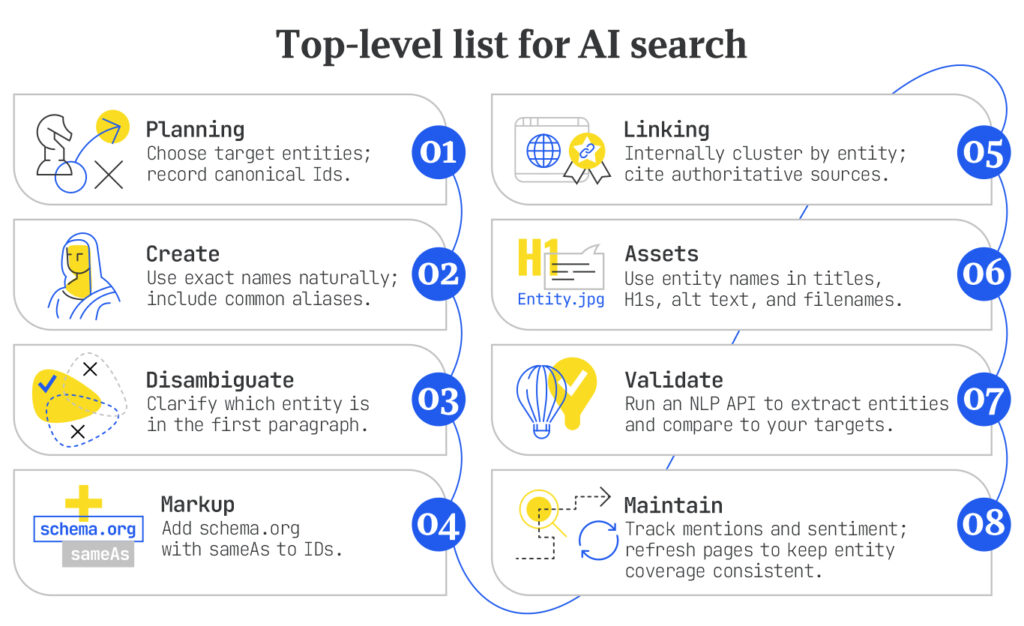
AI SEO entity extraction is transforming how search engines interpret content and how websites achieve visibility. Instead of relying solely on keywords, modern algorithms like Google’s Knowledge Graph use entities—people, places, concepts, and things—to understand context and user intent. This guide explains what entity extraction means for your SEO strategy, how it works, and exactly how to implement it to outperform competitors. You will learn the technical foundations, practical applications, and common pitfalls, ensuring your content aligns perfectly with how AI-driven search engines now operate.
What is AI SEO Entity Extraction?
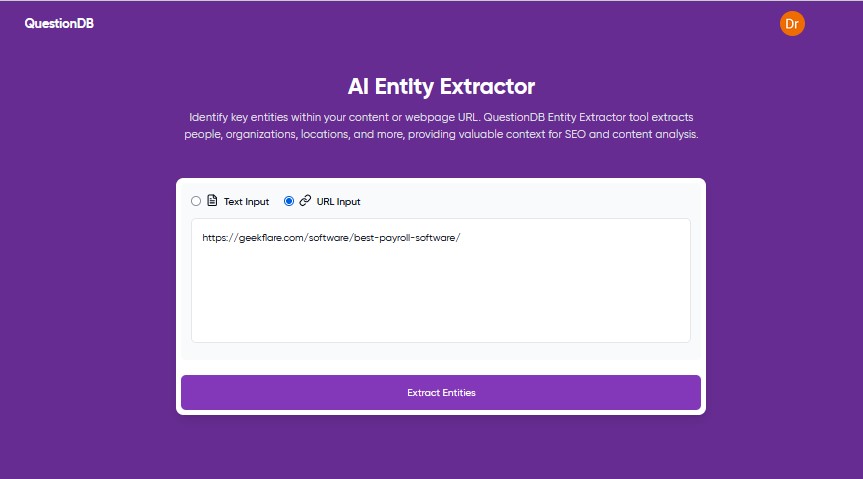
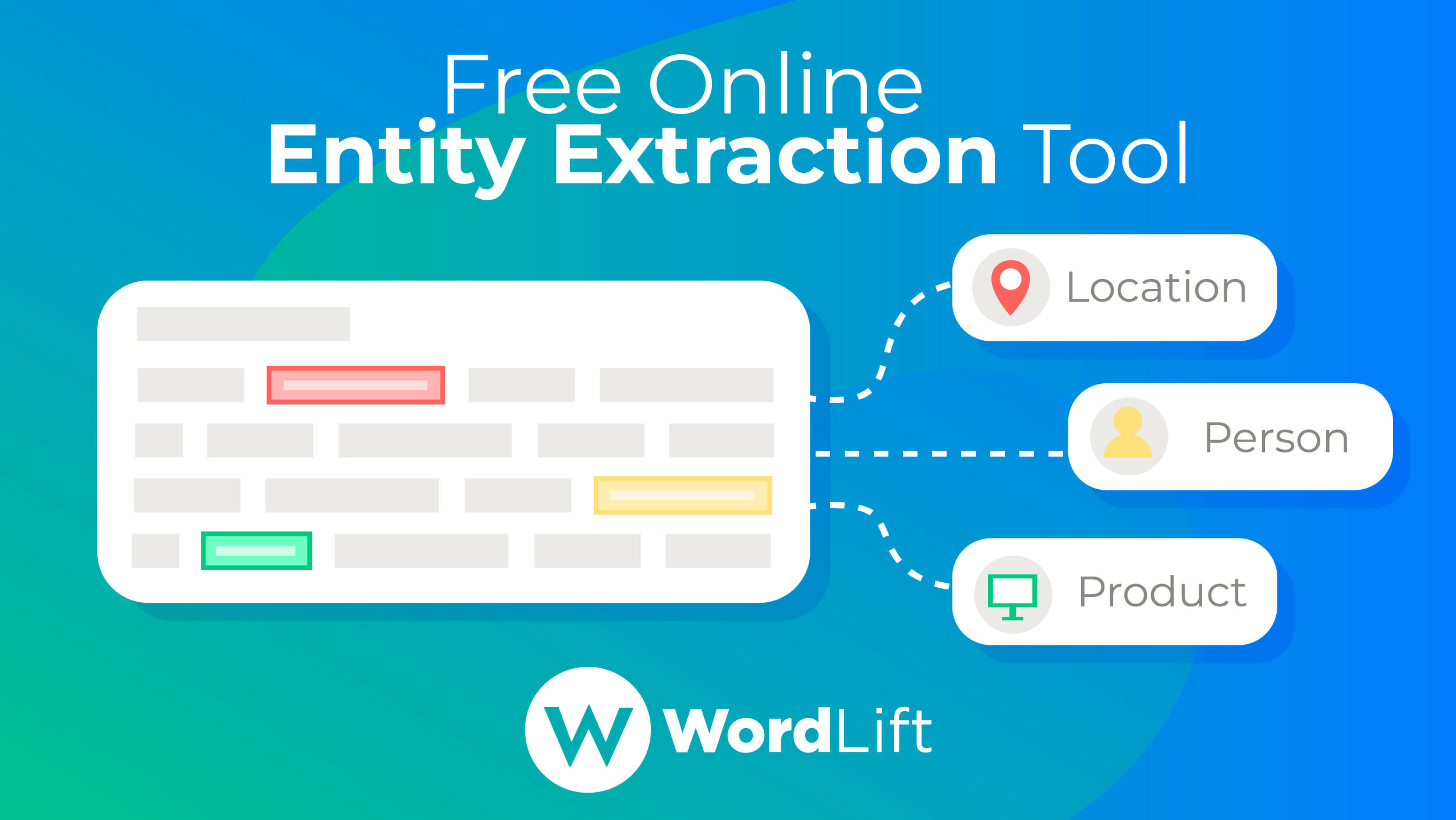
AI SEO entity extraction is the process of using artificial intelligence and natural language processing (NLP) to identify, classify, and extract meaningful entities from unstructured text. An entity is a distinct object or concept, such as a person (Elon Musk), a location (Paris), an organization (NASA), a product (iPhone 15), or an abstract idea (climate change). In the context of search engine optimization, this technology helps search engines move beyond matching exact keyword strings to understanding the semantic relationships between concepts within your content.
Search engines like Google have evolved from keyword-matching systems to semantic search engines. They build massive knowledge graphs that connect entities through relationships. When you perform a search, the algorithm doesn’t just look for pages containing your query words; it looks for pages that demonstrate expertise about the entities involved. AI entity extraction enables this by automatically tagging and linking the key subjects within your text, making it easier for crawlers to categorize your page and match it to relevant queries.
The Difference Between Keywords and Entities
Keywords are literal strings of text. For example, “best running shoes” is a keyword. An entity-based approach would recognize “Nike Pegasus 40,” “ASICS Gel-Kayano,” and “Hoka Clifton 9” as specific product entities, and “cushioning,” “heel drop,” and “pronation support” as related attributes. A keyword-focused article might mention “best running shoes” dozens of times. An entity-optimized article discusses the specific products, their features, and expert opinions, allowing the search engine to infer the page’s relevance to the broader topic without repetitive phrasing.
This distinction matters because entity-based content is more natural, more valuable to readers, and less susceptible to keyword-stuffing penalties. AI SEO entity extraction tools analyze your content to ensure you have covered all relevant entities for a topic, identifying gaps that competitors might have filled.
How AI SEO Entity Extraction Works
Understanding the mechanics of AI entity extraction helps you appreciate its power. The process typically involves several stages of natural language processing.
Named Entity Recognition (NER)
The first step is Named Entity Recognition (NER). This is a subtask of information extraction that identifies and classifies named entities into predefined categories. Common categories include PERSON, ORGANIZATION, LOCATION, DATE, TIME, MONEY, and PERCENT. For instance, in the sentence “Apple released the iPhone 15 in September 2023,” NER would tag “Apple” as an organization, “iPhone 15” as a product, and “September 2023” as a date.
Entity Resolution and Disambiguation
After recognition, the system must resolve ambiguity. The word “Apple” could refer to the fruit or the technology company. Entity resolution uses context to determine the correct meaning. If the surrounding text mentions “iPhone,” “MacBook,” or “Tim Cook,” the system correctly links “Apple” to the company entity. This disambiguation is crucial for building accurate knowledge graph connections.
Relationship Extraction
AI then identifies relationships between entities. In the same sentence, the system recognizes a “released” relationship between Apple and iPhone 15. This creates a triple: (Apple, released, iPhone 15). These triples form the building blocks of knowledge graphs. For SEO, this means your content can explicitly state relationships that search engines can use to answer complex queries, such as “What products did Apple release in 2023?”
Knowledge Graph Integration
Finally, the extracted entities and relationships are matched against existing knowledge graphs. Google’s Knowledge Graph contains billions of facts about entities. When your content mentions an entity that exists in the graph, Google can associate your page with that entity. This association is a strong relevance signal. AI SEO entity extraction tools help you identify which entities from the Knowledge Graph you should target to maximize topical authority.
Why AI SEO Entity Extraction is Critical for Modern Rankings
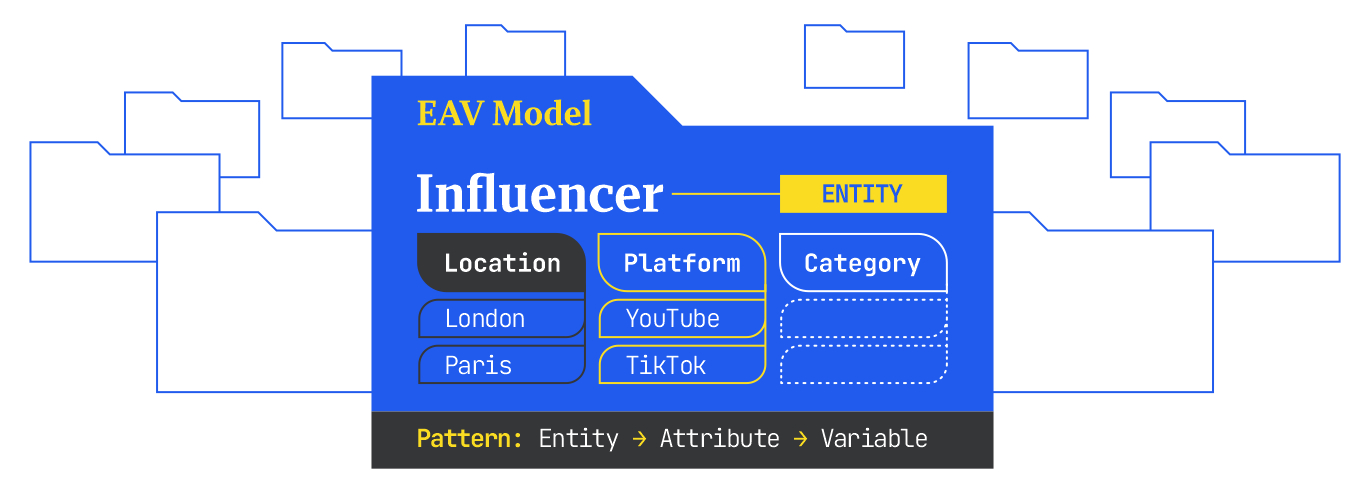
The shift to entity-based indexing has profound implications for your SEO strategy. Relying on traditional keyword density is no longer sufficient.
Improved Search Intent Matching
Search engines are increasingly focused on understanding user intent. When someone searches for “best noise-canceling headphones,” they might be looking for reviews, comparisons, or budget options. By analyzing the entities in your content—specific brands, price ranges, and technical specs—Google can determine if your page satisfies the likely intent. Entity extraction ensures your content covers the full spectrum of related concepts, increasing the chances of matching diverse query variations.
Enhanced Topical Authority
Topical authority is the measure of a website’s expertise on a subject. Search engines assess this by looking at the breadth and depth of entities covered across your site. A website that consistently covers all relevant entities for “digital marketing“—including SEO, content marketing, social media, analytics, and specific tools—is considered more authoritative than one that only discusses one aspect. AI SEO entity extraction helps you map out the entity landscape for your niche and systematically create content that covers it all.
Better Handling of Ambiguous Queries
Many search queries are ambiguous. The word “Jaguar” could refer to the animal, the car brand, or the operating system. Search engines use entity extraction to disambiguate based on your search history and other context. For your content, being clearly associated with specific entities helps search engines understand exactly which “Jaguar” you are talking about, preventing your pages from being misclassified.
Key AI SEO Entity Extraction Tools and Technologies
Several powerful tools leverage AI to perform entity extraction for SEO purposes. These tools analyze your content and provide actionable insights into entity coverage, relevance, and optimization opportunities.
| Tool | Primary Function | Key Features |
|---|---|---|
| Google Cloud Natural Language API | Entity analysis and sentiment | Identifies entities, salience scores, and relationships; integrates with Knowledge Graph |
| Semrush (Content Marketing Platform) | Content optimization | Provides entity recommendations based on top-ranking competitors; analyzes entity density |
| MarketMuse | Content research and optimization | Uses AI to map out entity clusters; scores content against thousands of related topics |
| Clearscope | Content optimization | Generates entity-based keyword recommendations; measures content relevance against SERP leaders |
| Inlinks | Internal linking and entity SEO | Automatically builds entity-based internal links; visualizes entity relationships |
These tools typically provide an entity score, showing how well your content covers the entities that Google associates with your target topic. A high entity score correlates with better rankings because it signals comprehensive coverage to search engines.
Practical Guide: How to Implement AI SEO Entity Extraction
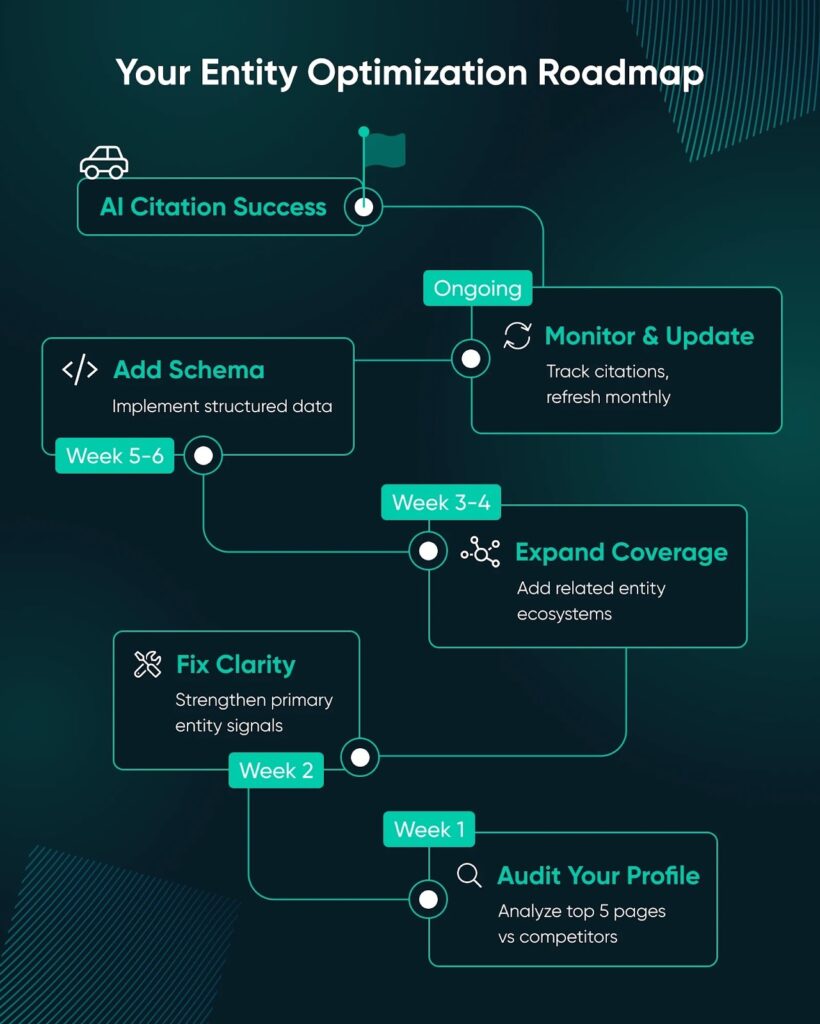
Implementing entity extraction into your SEO workflow requires a systematic approach. Follow these steps to optimize your content for entity-based search algorithms.
Step 1: Perform Entity Research for Your Topic
Before writing, use an AI SEO entity extraction tool to analyze the top 10 ranking pages for your target keyword. The tool will extract the key entities those pages cover. Create a list of these entities, categorizing them into primary entities (the main subject) and secondary entities (related concepts, attributes, and examples). For a page about “AI SEO entity extraction,” primary entities include “artificial intelligence,” “SEO,” and “entity extraction.” Secondary entities might include “Natural Language Processing,” “Knowledge Graph,” “Named Entity Recognition,” and specific tools like “Google Cloud NLP.”
Step 2: Structure Your Content Around Entities
Use your entity list to create a content outline. Each major section of your article should naturally incorporate several related entities. Do not force entities into the text; instead, write naturally about the topic, ensuring you cover the concepts that the entities represent. For example, when discussing how entity extraction works, you will naturally mention “Named Entity Recognition” and “Entity Resolution.” This organic integration is what search engines expect.
Step 3: Use Entities in Key On-Page Elements
Optimize your title tag, meta description, and headings to include your primary entities. The H1 should contain the main keyword and primary entity. H2 and H3 subheadings should incorporate secondary entities where relevant. This helps search engines quickly understand the structure and focus of your content. For instance, an H2 like “How AI SEO Entity Extraction Works” clearly signals the content’s scope.
Step 4: Build Entity-Based Internal Links
Internal linking is a powerful way to reinforce entity relationships. When you mention an entity that you have a dedicated page for, link to that page using the entity name as the anchor text. This creates a web of interconnected pages that search engines can crawl to understand your site’s topical authority. For example, if you have a page about “Natural Language Processing,” link to it from your article on entity extraction when you first mention the term.
Step 5: Leverage Structured Data
Schema markup is a form of structured data that explicitly tells search engines what your content is about. Use schema types like Article, Product, Person, or Organization to provide unambiguous entity signals. JSON-LD format is recommended. This markup helps search engines associate your page with specific entities in the Knowledge Graph, bypassing the need for them to infer it from the text alone.
Step 6: Analyze and Refine with Entity Scores
After publishing, run your content through your chosen entity extraction tool again. Compare your entity score to the top-ranking pages. Identify any high-importance entities you missed and add content to cover them. This iterative process ensures your content remains comprehensive and competitive.
Benefits of Using AI SEO Entity Extraction
The advantages of adopting an entity-based approach to SEO are substantial and measurable.
- Higher Relevance Signals: Content that naturally covers a wide range of related entities is seen as more relevant by search engines, leading to improved rankings for both head terms and long-tail variations.
- Resilience to Algorithm Updates: Entity-based content focuses on user value and semantic depth, which are core principles of Google’s quality guidelines. This approach is less vulnerable to updates that target spammy, keyword-stuffed content.
- Enhanced Featured Snippet Opportunities: Search engines often pull featured snippets from content that clearly defines entities and their relationships. Structured, entity-rich content is more likely to be selected for position zero.
- Improved Content Planning: Entity research reveals content gaps. You can identify entities your competitors cover that you do not, allowing you to create more comprehensive content that outperforms theirs.
- Better Voice Search Optimization: Voice search queries are typically conversational and question-based. Entity-based content that answers specific questions about people, places, and things is better suited for voice search results.
- Consistency is Key: Use the exact same name for an entity throughout your site. Do not alternate between “Google” and “Alphabet” if you mean the same company. Consistency helps search engines link all your content to the correct Knowledge Graph entry.
- Entity Extraction Complements, Not Replaces, Traditional SEO: You still need quality backlinks, fast page speed, and mobile-friendliness. Entity optimization is one part of a holistic SEO strategy.
- Monitor Your Competitors’ Entities: The entity landscape for a topic changes over time. Regularly re-run competitor analysis to see if they have added new entities to their content. Stay ahead by updating your own content.
- User Experience is the Ultimate Goal: Entity optimization should improve the clarity and depth of your content. If it makes your writing worse, you are doing it wrong. Always prioritize the reader.
- Use Google’s Knowledge Graph API: This free API allows you to search for entities and see their relationships. It is an excellent research tool for identifying related entities you might have missed.
Limitations and Challenges of Entity Extraction
While powerful, AI SEO entity extraction is not without its challenges. Understanding these limitations helps you use the technology effectively.
Contextual Nuance and Sarcasm
AI models can struggle with sarcasm, irony, or highly nuanced language. A sentence like “Great, another algorithm update” might be misinterpreted as positive sentiment. While this is more of a sentiment analysis issue, it can affect entity relationship extraction if the context is misunderstood.
Emerging Entities and New Concepts
Knowledge graphs are not always up to date. New products, people, or events may not yet have a Knowledge Graph entry. Your content might mention a brand-new entity that the extraction tool fails to recognize, resulting in a lower entity score despite your content being accurate and valuable.
Language and Translation Issues
Entity extraction models are often trained on English data. For multilingual content, accuracy can drop. Different languages have different grammatical structures and naming conventions, making entity recognition more challenging. A person’s name might be written differently in Japanese or Arabic, and the AI might fail to link them to the correct entity.
Over-Optimization Risk
T If you force too many unrelated entities into your content just to improve your entity score, the text becomes unnatural and unhelpful. Search engines are sophisticated enough to detect this, and it can harm your user experience metrics, which indirectly affects rankings.
Common Mistakes in AI SEO Entity Extraction and How to Avoid Them
Many SEO professionals make avoidable errors when implementing entity-based strategies. Here are the most common pitfalls and their solutions.
Mistake 1: Ignoring Entity Salience
Salience measures how important an entity is to the overall text. Some tools provide a salience score from 0 to 1. A common mistake is treating all entities equally. You should prioritize high-salience entities in your headings and introduction. Low-salience entities can be mentioned once in a supporting paragraph.
Solution: Use tools that provide salience scores. Ensure your primary keyword entity has the highest salience in the document. Place it in the first 100 words and in the H1 tag.
Mistake 2: Keyword Stuffing Disguised as Entities
Some practitioners try to game the system by repeating entity names excessively. This is just a new form of keyword stuffing. Search engines can detect unnatural entity density.
Solution: Focus on semantic coverage. Mention an entity once or twice naturally. Use synonyms, pronouns, and related concepts to maintain readability. The goal is to cover the topic comprehensively, not to repeat the same phrase.
Mistake 3: Neglecting Entity Relationships
Simply listing entities is not enough. Search engines need to understand how the entities relate to each other. If you mention “AI” and “SEO” but never explain how they connect, the extraction is less valuable.
Solution: Write explicit sentences that define relationships. Use verbs like “improves,” “uses,” “depends on,” and “integrates with.” For example, “AI SEO entity extraction uses Natural Language Processing to improve search relevance.” This clearly establishes the relationship between the entities.
Mistake 4: Focusing Only on Text
Entity extraction is not limited to body text. Images, videos, and tables also contain entities. Alt text, file names, and captions are opportunities to reinforce entity signals.
Solution: Optimize your image alt text with relevant entity names. Use descriptive file names. If you have a video, provide a transcript that includes key entities. This provides additional context to search engine crawlers.
Important Notes for a Successful Entity SEO Strategy
To maximize the effectiveness of AI SEO entity extraction, keep these critical points in mind.
Frequently Asked Questions (FAQ)
What is the difference between entity extraction and keyword research?
Keyword research focuses on finding the exact search terms users type into search engines. Entity extraction focuses on identifying the underlying concepts, objects, and people related to a topic. Keywords are strings of text; entities are semantic objects. For example, a keyword might be “cheap flights to Tokyo,” while the entities are “flights,” “Tokyo,” and “cheap.” Entity research provides a deeper understanding of the topic’s context.
How does Google use entities in its ranking algorithm?
Google uses entities to understand the meaning of a query and the content of a page. It connects entities through its Knowledge Graph to establish relationships. When ranking, Google assesses how well a page covers the relevant entities for a query. Pages that demonstrate comprehensive, accurate coverage of the primary and secondary entities are considered more authoritative and relevant, leading to higher rankings.
Can I do AI SEO entity extraction for free?
Yes, there are free options. Google Cloud Natural Language API offers a free tier with a limited number of requests per month. You can also use Google’s Knowledge Graph Search API to explore entities. However, for comprehensive content optimization, paid tools like MarketMuse or Clearscope offer more advanced features, including competitor analysis and entity scoring, which are worth the investment for serious SEO professionals.
How often should I update my content for entity optimization?
You should review your content whenever there are significant changes in your industry or when you notice your rankings dropping. The entity landscape for a topic can shift as new products, technologies, or people emerge. A good practice is to re-run entity analysis on your top-performing pages every six months to ensure they remain comprehensive and up-to-date.
Does entity extraction help with local SEO?
Absolutely. Local SEO relies heavily on entities like business names, addresses, and local landmarks. Ensuring your business name, address, and phone number (NAP) are consistently presented as entities across your website and citations helps search engines associate your business with a specific location. Mentioning nearby entities like “near Central Park” or “close to Times Square” can also help with local relevance.
Conclusion
AI SEO entity extraction represents a fundamental shift in how search engines evaluate content. By moving from keyword matching to semantic understanding, Google and other search engines now reward content that demonstrates deep, contextual knowledge. Implementing an entity-based strategy is no longer optional for serious SEO practitioners; it is a necessity for achieving and maintaining high rankings.
The process involves researching the entity landscape for your topic, structuring your content to naturally cover those entities, using structured data to reinforce signals, and continuously refining your approach based on entity scores. While there are challenges, such as handling emerging entities and avoiding over-optimization, the benefits of improved relevance, enhanced topical authority, and resilience to algorithm updates far outweigh the difficulties.
Start by running entity analysis on your top competitors’ pages. Identify the entities they cover and the gaps in your own content. Use the tools and techniques outlined in this guide to create content that is not only optimized for search engines but also genuinely more informative and valuable for your readers. The future of SEO is semantic, and AI SEO entity extraction is the key to unlocking its potential.
Xem thêm:
- Mastering AI Pillar Pages: The Future of Topic Cluster Architecture in SEO
- AI SEO Organization Schema: The Complete Guide to Structured Data for AI Search
- AI SEO: The Complete Guide to Dominating Search with Artificial Intelligence
- AI SEO Outreach Automation: The Complete Guide to Scaling Link Building in 2025
- AI Search Optimization: The Ultimate Guide to Ranking in LLMs and Generative Engines
Bài viết cùng chủ đề:

AI SEO SEO Automation with Make: The Complete Workflow Guide

AI SEO SEO Automation with Zapier: The Complete Workflow Guide

AI SEO SEO Automation with n8n: The Complete Workflow Guide
AI SEO SEO Automation with Gemini: The Complete Guide to Scaling Organic Growth

AI SEO SEO Automation with Claude: The Complete Guide to Scaling Content in 2025

AI SEO SEO Automation with ChatGPT: The Complete Playbook for 2025

AI SEO & SEO Automation for Affiliate Sites: The 2025 Playbook for Passive Income Growth
AI SEO & SEO Automation for Bloggers: The Complete Guide to Scaling Your Content

AI SEO & SEO Automation for Agencies: The Complete 2025 Playbook

AI SEO and SEO Automation for Ecommerce: The Complete Playbook for 2025

AI SEO & SEO Automation for WordPress: The Complete Playbook for 2025
AI SEO SEO Automation Strategy: The Complete Playbook for 2025

Mastering the AI SEO SEO Automation Process: A Complete Guide to Scaling Organic Growth
AI SEO SEO Automation System: The Complete Guide to Scaling Organic Growth in 2025
AI SEO SEO Automation Platform: The Complete Guide to Scaling Organic Growth in 2025
AI SEO SEO Automation Software: The Complete Guide to Scaling Organic Growth in 2025















