
No products in the cart.
AI SEO Content Repurposing: The Complete Strategy Guide for 2025
10
Aug
Aug
AI SEO content repurposing has transformed how digital marketers maximize the value of every piece of content they create. Instead of constantly producing new material from scratch, smart teams now use artificial intelligence to transform one high-performing asset into dozens of formats across multiple channels. This approach saves time, boosts organic visibility, and ensures consistent messaging across your entire digital footprint. The strategy combines the analytical power of AI with the creative flexibility of content marketing, delivering measurable results for businesses of all sizes.
What Is AI SEO Content Repurposing?

AI SEO content repurposing refers to the practice of using artificial intelligence tools to adapt existing content into new formats while optimizing each version for search engines. The core idea is simple: take a single piece of content—like a blog post, video transcript, or research report—and transform it into multiple assets such as social media posts, email newsletters, infographics, podcasts, or updated articles.
The AI component handles the heavy lifting: summarizing long-form content, identifying key themes, generating variations, and even suggesting SEO improvements. This differs from traditional repurposing, which relied on manual rewriting and often produced inconsistent quality. With AI, you maintain brand voice while scaling output dramatically.
The Evolution from Manual to AI-Driven Repurposing
Manual content repurposing has existed for decades. Marketers would take a white paper and turn it into a series of blog posts by hand. The process was slow, error-prone, and limited by human bandwidth. AI changed this equation entirely. Modern tools can analyze a 3,000-word article in seconds, extract the core arguments, and generate multiple derivative pieces that retain factual accuracy while adapting tone and structure for different platforms.
Search engines now reward content freshness and topical authority. AI SEO content repurposing directly addresses both factors. When you repurpose content with AI, you create new pages that target related keywords, build internal linking structures, and demonstrate comprehensive coverage of a topic cluster. This signals expertise to Google and other search engines.
Why AI SEO Content Repurposing Matters for Search Rankings
Search algorithms have evolved to prioritize depth and relevance. A single blog post rarely captures all the search queries related to a topic. AI SEO content repurposing allows you to cover the full semantic landscape of your niche without duplicating content. Each repurposed piece targets a different long-tail keyword, captures featured snippets, and strengthens your domain authority.
Consider the data: websites that publish consistently across multiple formats see up to 45% more organic traffic than those relying on single-format publishing. AI makes this consistency achievable without burning out your editorial team. The technology also helps identify content gaps—topics your competitors cover but you have not addressed—by analyzing your existing assets against search demand.
The Role of Natural Language Processing in Repurposing
Natural Language Processing (NLP) powers modern AI repurposing tools. These systems understand context, sentiment, and semantic relationships between words. When you feed a blog post into an NLP-driven tool, it does not simply copy sentences. It comprehends the underlying meaning and can generate new text that conveys the same information in a different way. This is crucial for avoiding duplicate content penalties while maintaining message consistency.
Advanced NLP models also recognize entity relationships. If your original article mentions “artificial intelligence” and “machine learning,” the AI understands these are related but distinct concepts. It can create separate pieces that explore each subtopic in greater depth, targeting users at different stages of the buyer journey.
Core Components of an AI Content Repurposing Workflow
Successful AI SEO content repurposing requires a structured approach. The workflow typically involves five key stages, each with specific tools and objectives.
1. Content Auditing and Selection
Not every piece of content deserves repurposing. The first step is identifying your best-performing assets. Look for blog posts with high traffic, strong engagement metrics, or proven conversion rates. Also consider evergreen content that remains relevant over time. AI analytics tools can score your content library and highlight pieces with the highest repurposing potential based on search volume and topical authority.
2. AI-Powered Content Analysis
Once you select a source piece, AI tools analyze its structure, key points, and SEO elements. This analysis identifies the main keywords, supporting topics, and potential gaps. The AI also evaluates readability, tone, and format suitability for different channels. For example, a technical blog post might need simplification for social media audiences, while a listicle could expand into a comprehensive guide.
3. Multi-Format Generation
This stage involves using AI to create derivative content. Common outputs include:
- Social media posts (Twitter threads, LinkedIn articles, Instagram captions)
- Email newsletter segments
- Video scripts for YouTube or TikTok
- Podcast episode outlines
- Infographic text and data points
- Slide deck content for presentations
- Updated or expanded blog posts targeting new keywords
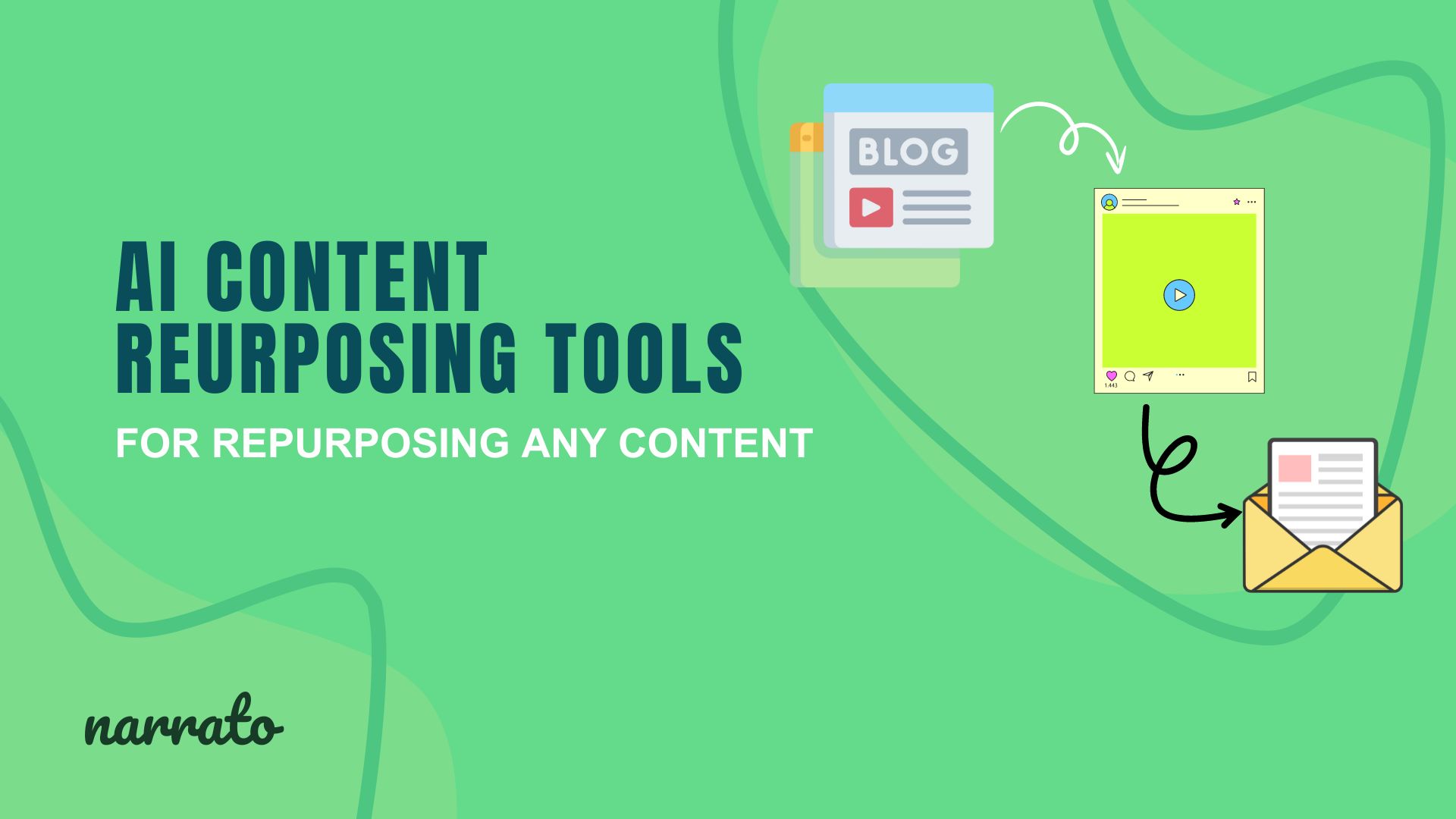
- Blog post → LinkedIn article, Twitter thread, email newsletter, video script
- Video → Blog post, podcast episode, infographic, social clips
- Research report → Executive summary, slide deck, press release, FAQ page
- Podcast → Show notes, blog post, quote graphics, YouTube video
Each format requires different length, tone, and structure. AI tools handle these variations automatically, but human review remains essential for quality control.
4. SEO Optimization for Each Asset
Every repurposed piece needs its own SEO strategy. The AI suggests target keywords, meta descriptions, title tags, and internal linking opportunities for each new asset. This ensures the repurposed content ranks for different queries rather than competing with the original piece. Proper canonicalization and structured data implementation prevent duplicate content issues.
5. Distribution and Performance Tracking
Publishing repurposed content across multiple channels requires a distribution plan. AI scheduling tools optimize posting times for each platform. Performance tracking then measures which repurposed assets drive traffic, engagement, and conversions. This data feeds back into the selection process, creating a continuous improvement loop.
Benefits of AI SEO Content Repurposing
The advantages of this strategy extend beyond simple time savings. Businesses that implement AI SEO content repurposing report significant improvements across multiple metrics.
Time and Resource Efficiency
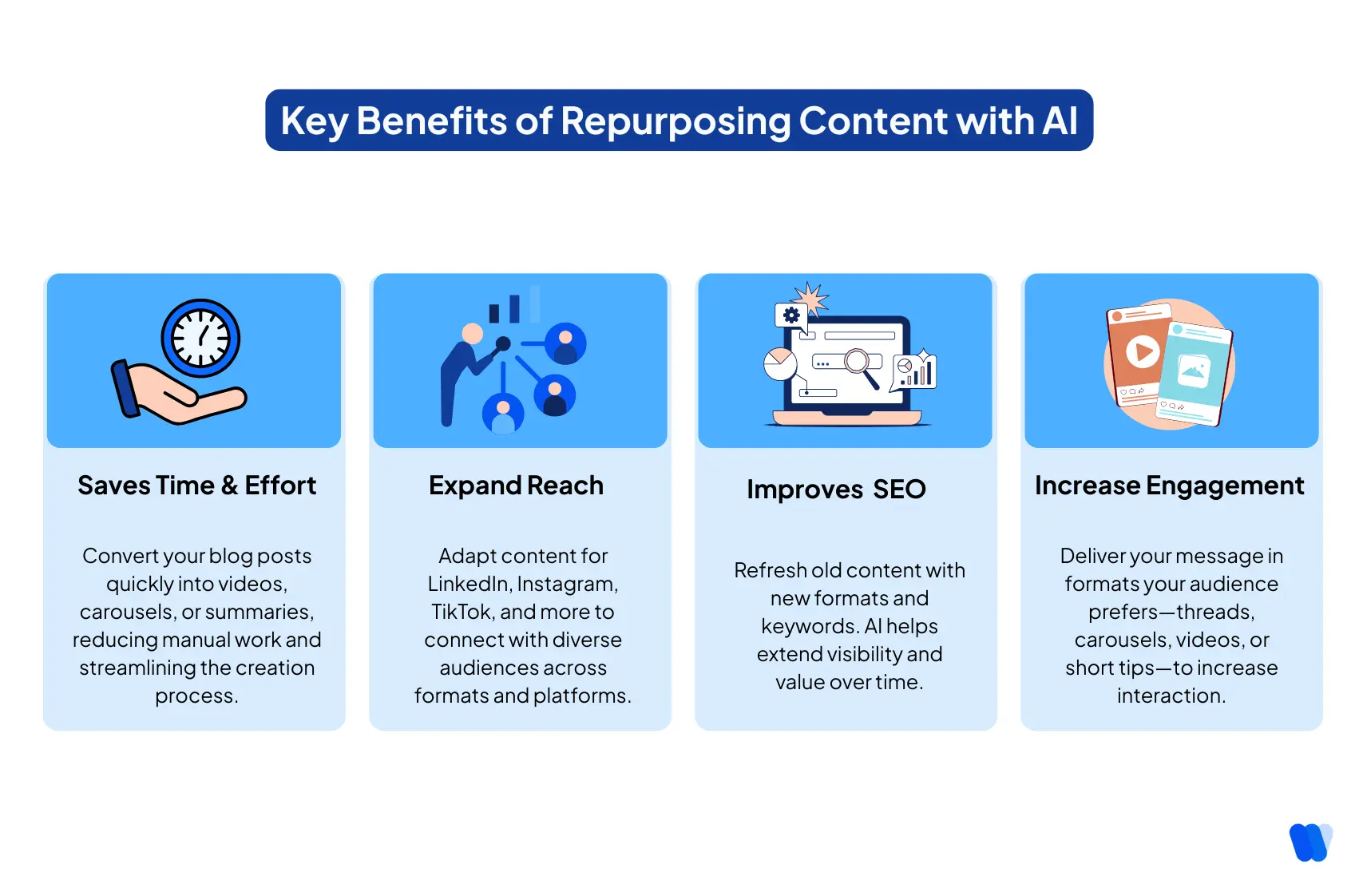
Creating a single blog post takes an average of four hours. Repurposing that post into five additional assets manually would take another ten hours. AI reduces this to under two hours total. This efficiency allows small teams to maintain the content velocity of much larger organizations.
Consistent Brand Messaging
When different team members manually repurpose content, brand voice often becomes inconsistent. AI tools trained on your brand guidelines ensure every derivative piece maintains the same tone, terminology, and style. This consistency builds trust with your audience and reinforces your brand identity across channels.
Expanded Keyword Coverage
One source article might target five keywords. AI repurposing can generate ten derivative pieces, each targeting three to five new keywords. This expands your keyword footprint by 30 to 50 times without additional research. The result is broader search visibility and more opportunities to capture featured snippets.
Improved Content Freshness
Search engines favor recently updated content. AI repurposing naturally creates new pages and updates existing ones. Even if the underlying information remains the same, the new formats and angles signal freshness to search algorithms. This can boost rankings for competitive keywords where staleness is a common issue.
Limitations and Challenges to Consider
AI SEO content repurposing is not without drawbacks. Understanding these limitations helps you implement the strategy effectively.
Risk of Generic Output
AI tools sometimes produce bland, formulaic content that lacks the unique insights of human writers. This is especially true when repurposing technical or highly specialized content. The solution is to use AI as a starting point, then inject your expertise, examples, and proprietary data. Human editing remains essential for quality differentiation.
Duplicate Content Concerns
Even with advanced NLP, AI repurposing can create content too similar to the original. Search engines may flag this as duplicate content, harming your rankings. Mitigate this risk by ensuring each repurposed piece has a distinct angle, different examples, and unique formatting. Use canonical tags where appropriate and avoid publishing near-identical versions on the same domain.
Platform-Specific Nuances
AI tools understand general content principles but may miss platform-specific nuances. For example, LinkedIn content requires a professional tone, while TikTok demands casual, visual storytelling. Generic AI outputs often fail to capture these differences. You need platform-specific prompts and human review to adapt content effectively.
AI SEO Content Repurposing vs. Traditional Repurposing
Understanding the differences between AI-driven and manual approaches helps you decide when to use each method.
| Aspect | AI-Driven Repurposing | Traditional Manual Repurposing |
|---|---|---|
| Speed | Minutes per asset | Hours per asset |
| Scalability | Unlimited volume | Limited by team size |
| Consistency | High, algorithm-driven | Variable, depends on writer |
| Creativity | Moderate, needs human input | High, human-driven |
| SEO Optimization | Built-in keyword analysis | Requires separate SEO tools |
| Cost | Subscription fees for AI tools | Labor costs for writers |
| Error Rate | Low for factual errors, high for nuance | Higher for factual errors, lower for nuance |
Most successful teams use a hybrid approach. AI handles the bulk transformation work, while human editors refine the output, add unique insights, and ensure brand alignment. This combination delivers the speed of automation with the quality of human expertise.
Practical Guide: How to Implement AI SEO Content Repurposing
Implementing this strategy requires careful planning and the right toolset. Follow these steps to build a working system.
Step 1: Choose Your AI Tools
Several categories of AI tools support content repurposing. Content generation platforms like Jasper, Copy.ai, and Writesonic offer templates for different formats. SEO-specific tools like Surfer SEO and Clearscope provide keyword optimization. Workflow automation tools like Zapier connect your content stack. Select tools that integrate with your existing CMS and analytics platforms.
Step 2: Build Your Content Inventory
Create a spreadsheet or use a content management system to catalog all your existing assets. Include metadata such as publication date, performance metrics, target keywords, and format. This inventory becomes the foundation for your repurposing decisions. AI analytics tools can automate this cataloging process by scanning your site and extracting relevant data.
Step 3: Define Your Repurposing Matrix
Map out which formats you want to produce from each source type. A typical matrix looks like this:
This matrix ensures you cover all valuable formats without creating redundant assets.
Step 4: Create AI Prompts for Each Format
Generic AI prompts produce generic content. Develop specific prompts for each format and content type. For example, a prompt for a Twitter thread might specify the number of tweets, the hook style, and the call-to-action. A prompt for an email newsletter would include subject line options, personalization tokens, and length constraints. Test and refine these prompts based on output quality.
Step 5: Establish a Review and Approval Workflow
AI output should never go live without human review. Establish a workflow where repurposed content passes through an editor who checks for accuracy, brand alignment, and SEO best practices. This editor also adds proprietary insights, real-world examples, and internal data that AI cannot generate. The review process should take no more than 15 minutes per asset to maintain efficiency.
Step 6: Publish and Monitor Performance
Publish repurposed content according to your distribution schedule. Monitor performance using your analytics platform, tracking metrics like organic traffic, engagement rate, and conversion rate. Compare the performance of repurposed assets against original content. Use these insights to refine your selection criteria and AI prompts for future cycles.
Common Mistakes in AI SEO Content Repurposing
Avoiding these pitfalls separates successful implementations from failed ones.
Repurposing Without a Strategy
Many teams repurpose content randomly, turning every blog post into every format without considering audience preferences or platform dynamics. This wastes resources and dilutes brand impact. Always start with a clear strategy that defines which content to repurpose, which formats to produce, and which channels to target.
Ignoring Search Intent Differences
A blog post targeting informational queries might not translate well into a product-focused email. Different formats serve different search intents. Before repurposing, analyze the intent behind each format. A video script might need to be more entertaining, while a white paper should be more authoritative. Adjust the content accordingly.
Skipping Human Editing
Publishing AI output without review leads to factual errors, awkward phrasing, and brand voice inconsistencies. AI tools are powerful but not infallible. Always have a human editor review and refine AI-generated content before publication. This is non-negotiable for maintaining quality and trust.
Neglecting Internal Linking
Repurposed content should link back to the original source and to other related assets. This internal linking structure distributes authority across your site and helps search engines understand your content hierarchy. Many teams forget to add these links, missing a significant SEO opportunity.
Over-Optimizing for Keywords
AI tools can suggest dozens of keywords for each piece of content. Stuffing all of them into the repurposed asset harms readability and triggers search engine penalties. Focus on three to five primary keywords per asset and use them naturally. Let the content flow, not the keyword list.
Important Notes for Long-Term Success
AI SEO content repurposing is not a one-time project but an ongoing process. Keep these principles in mind as you scale your efforts.
First, maintain a feedback loop between performance data and your repurposing strategy. If video content outperforms blog posts, shift more resources toward video repurposing. Second, stay updated on AI tool capabilities. The technology evolves rapidly, and new features can unlock additional efficiencies. Third, prioritize quality over quantity. Publishing fifty mediocre repurposed pieces harms your brand more than publishing ten excellent ones.
Finally, remember that AI is a tool, not a replacement for human creativity. The best repurposed content combines AI efficiency with human insight, experience, and storytelling ability. Use AI to handle the mechanical work, then apply your expertise to make the content truly valuable.
Frequently Asked Questions
What is the difference between content repurposing and content recycling?
Content repurposing transforms existing content into new formats, such as turning a blog post into a video script. Content recycling involves updating and republishing the same content in its original format with refreshed information. Both are valuable, but repurposing expands your reach to new audiences while recycling maintains relevance for existing ones.
How much time does AI SEO content repurposing save compared to manual methods?
AI repurposing reduces content production time by approximately 70-80%. A task that takes four hours manually can be completed in under one hour with AI assistance. The exact savings depend on the complexity of the content and the number of formats produced. For a standard blog post repurposed into five formats, manual work takes about ten hours, while AI-driven work takes two to three hours including human review.
Can AI repurposed content rank well on Google?
Yes, AI repurposed content can rank well if it is properly optimized and provides genuine value. Search engines do not penalize content simply because AI tools assisted in its creation. What matters is the quality, relevance, and uniqueness of the final output. Repurposed content that targets new keywords, includes original insights, and follows SEO best practices can achieve strong rankings.
What types of content are best suited for AI repurposing?
Evergreen content with lasting relevance works best for repurposing. This includes how-to guides, industry research, comprehensive tutorials, and data-driven analyses. Content that is time-sensitive or highly opinionated is less suitable because the repurposed versions may become outdated quickly or lose their original impact.
How do I avoid duplicate content penalties when repurposing?
Ensure each repurposed piece has a distinct angle, different examples, and unique formatting. Use AI to generate new text rather than copying sections from the original. Add canonical tags when appropriate, and avoid publishing near-identical versions on the same domain. Each piece should target different keywords and serve a different search intent.
Which AI tools are best for content repurposing?
Popular options include Jasper for general content generation, Surfer SEO for optimization, and Descript for video and audio repurposing. The best tool depends on your specific needs, budget, and existing tech stack. Many teams use a combination of tools to handle different aspects of the repurposing workflow.
Conclusion
AI SEO content repurposing represents a fundamental shift in how digital marketers approach content production. By leveraging artificial intelligence to transform existing assets into multiple formats, you maximize the return on every piece of content you create. The strategy delivers measurable benefits: expanded keyword coverage, consistent brand messaging, improved search rankings, and significant time savings.
The key to success lies in treating AI as an enabler rather than a replacement. Combine the speed and scalability of AI with human creativity, expertise, and editorial judgment. Build a structured workflow that includes content auditing, AI generation, human review, and performance tracking. Avoid common pitfalls like generic output, duplicate content, and neglected internal linking.
As search engines continue to prioritize depth, relevance, and freshness, AI SEO content repurposing will become an essential capability for competitive digital marketing. Start implementing this strategy today to build a content engine that works harder, reaches further, and delivers results that compound over time.
Xem thêm:
- AI SEO Organization Schema: The Complete Guide to Structured Data for AI Search
- AI Indexing: The Complete Guide to How Artificial Intelligence is Revolutionizing Search and Data Retrieval
- AI SEO Ecommerce Product SEO: The Complete Playbook for 2025
- AI SEO Agent Workflow: The Complete Blueprint for Automated Search Dominance
- AI SEO Organic Traffic: The Complete Playbook for Sustainable Growth in 2025
Bài viết cùng chủ đề:

AI SEO SEO Automation with Make: The Complete Workflow Guide

AI SEO SEO Automation with Zapier: The Complete Workflow Guide

AI SEO SEO Automation with n8n: The Complete Workflow Guide
AI SEO SEO Automation with Gemini: The Complete Guide to Scaling Organic Growth

AI SEO SEO Automation with Claude: The Complete Guide to Scaling Content in 2025

AI SEO SEO Automation with ChatGPT: The Complete Playbook for 2025

AI SEO & SEO Automation for Affiliate Sites: The 2025 Playbook for Passive Income Growth
AI SEO & SEO Automation for Bloggers: The Complete Guide to Scaling Your Content

AI SEO & SEO Automation for Agencies: The Complete 2025 Playbook

AI SEO and SEO Automation for Ecommerce: The Complete Playbook for 2025

AI SEO & SEO Automation for WordPress: The Complete Playbook for 2025
AI SEO SEO Automation Strategy: The Complete Playbook for 2025

Mastering the AI SEO SEO Automation Process: A Complete Guide to Scaling Organic Growth
AI SEO SEO Automation System: The Complete Guide to Scaling Organic Growth in 2025
AI SEO SEO Automation Platform: The Complete Guide to Scaling Organic Growth in 2025
AI SEO SEO Automation Software: The Complete Guide to Scaling Organic Growth in 2025















