
No products in the cart.
AI SEO Experiments: Future-Proof Your Search Strategy with Data-Driven Insights
29
Jul
Jul
Search engine optimization has always depended on testing, but the rise of artificial intelligence has completely redefined what’s possible. AI SEO experiments combine machine learning, natural language processing, and automation to test ranking hypotheses at a scale and speed that were unimaginable a few years ago. These experiments are no longer just a curiosity—they are becoming essential for anyone who wants to understand Google’s evolving algorithms, create content that truly serves user intent, and stay ahead of competitors who are still guessing. This in-depth guide walks you through the entire landscape of AI SEO experiments, from conceptual foundations to step-by-step implementation, and reveals how experienced practitioners are using AI to uncover ranking factors that manual testing could never expose.
What Are AI SEO Experiments?
An AI SEO experiment is a structured test that uses artificial intelligence tools and algorithms to evaluate how changes to a website or its content affect search engine visibility. Traditional SEO testing often involves changing a title tag or rewriting a paragraph and then waiting weeks for results. AI accelerates this by generating variants, analyzing patterns in top-ranking pages, predicting outcomes, and even simulating search engine behavior.
At its core, these experiments rely on the same technologies that search engines themselves use: neural networks, deep learning, and semantic analysis. AI can process millions of data points from SERPs, user signals, and on-page elements to isolate which factors move the needle. This isn’t about replacing human creativity; it’s about augmenting decision-making with evidence that manual methods simply can’t produce at scale.
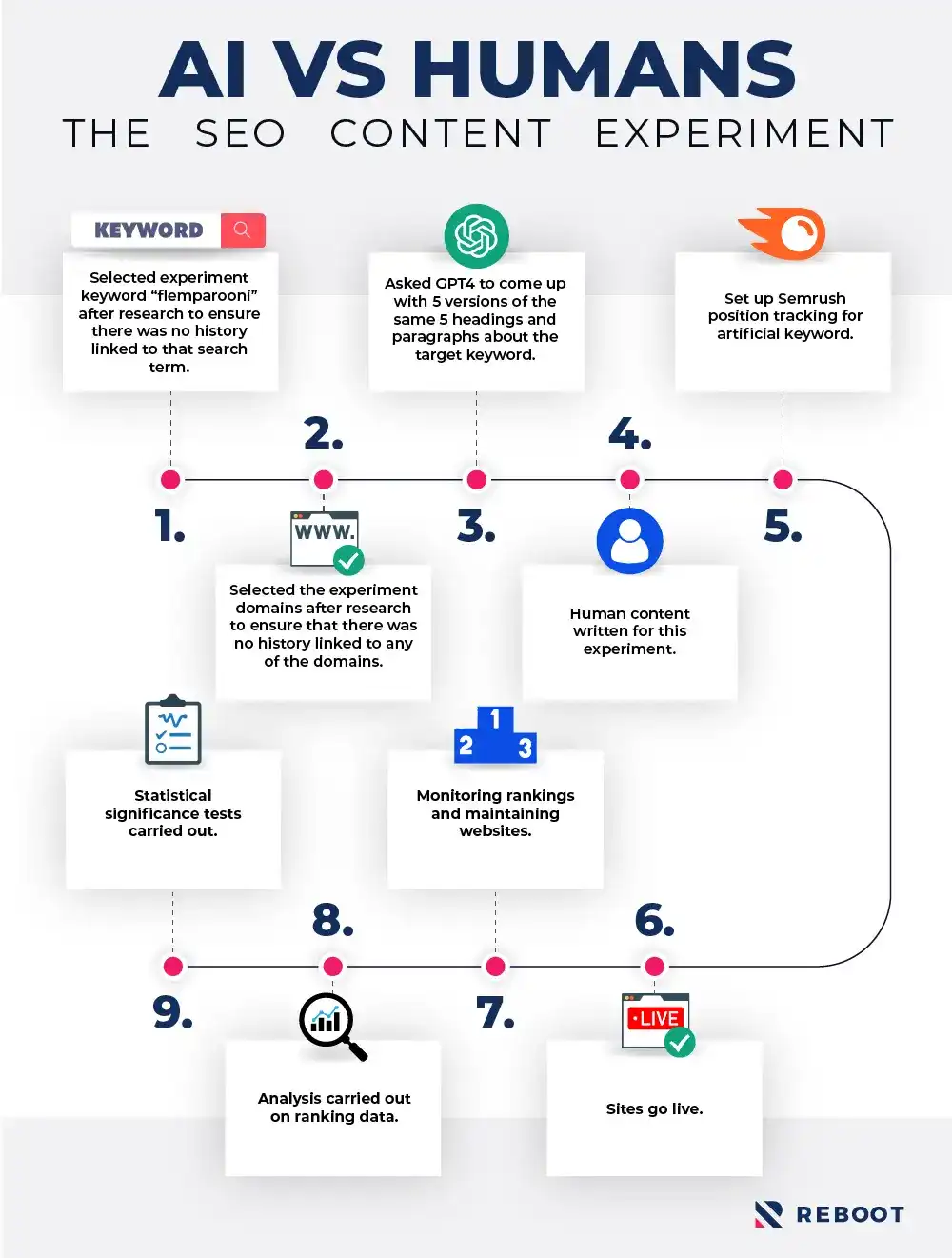
A typical AI SEO experiment might involve feeding thousands of URLs into a language model to extract patterns in headings, content depth, and entity relationships, then correlating those patterns with ranking positions. The goal is always the same: replace assumptions with reproducible data.
The Evolution of SEO Testing: From Guesswork to AI-Driven Precision
SEO testing has gone through three distinct phases. The first was purely intuitive—marketers made changes based on forum tips and anecdotal evidence. The second phase introduced basic A/B testing with split pages, but the sample sizes were small and variables hard to isolate. The third and current phase leverages AI to run multivariate tests across thousands of pages simultaneously, testing dozens of elements at once while controlling for seasonality and algorithm updates.
The shift is profound. Previously, an SEO specialist might test whether adding an FAQ section improved rankings by implementing it on ten pages and waiting two months. Now, an AI SEO experiment can scrape the top twenty results for a keyword cluster, identify that FAQ-rich snippets correlate with position 1-3 in 87% of cases, generate a semantically optimized FAQ block, and even predict the expected traffic lift—all within hours.
This evolution means that experimentation is no longer reserved for large enterprises with dedicated data science teams. Freelancers and small agencies now have access to platforms that can cluster keywords by latent intent, generate content briefs based on SERP entity analysis, and run automated tests that adjust on-page elements dynamically.
Types of AI SEO Experiments
Not all experiments are created equal. Understanding the different categories helps you choose the right approach for your specific challenge. The most impactful types fall into five main buckets.
Content Generation and Optimization Tests
The most widespread AI SEO experiments focus on content. Practitioners test whether AI-generated text can rank, but the smarter tests go much deeper. They compare human-written content augmented by AI outlines against pure AI drafts. They measure how different levels of semantic keyword inclusion affect dwell time and bounce rate. They test variations in readability scores, heading structures, and the inclusion of structured data to see how Google’s systems respond.
A common test involves taking a page that ranks on page two and using an NLP tool to incrementally add contextually relevant entities missing from the top-performing pages. The rankings are then monitored for movement. The pattern that emerges consistently is that AI-identified gap filling yields a statistically significant improvement more often than random content expansion.
Technical SEO Automation Experiments
AI can test technical configurations that would be tedious to handle manually. This includes experiments with internal linking structures—using graph neural networks to identify orphan pages that, when linked from high-authority nodes, see immediate ranking improvements. Other technical experiments involve schema markup variations, where AI generates and tests different JSON-LD templates to see which triggers more rich results in SERPs.
Core Web Vitals experimentation also benefits from AI. Instead of manually tweaking images and scripts, algorithms can predict the performance impact of specific optimizations and automatically deploy the version that balances quality and speed best, monitoring ranking effects in real time.
Backlink and Authority Testing
Building links is still vital, but AI allows for testing the actual authority lift from different types of links. Experiments compare the ranking effect of guest posts on sites with high topical relevance versus high overall domain authority. Machine learning models can predict which link prospects will yield the most organic traffic lift before any outreach is done, then track outcomes to refine future predictions.
Some AI SEO experiments even simulate the effect of cleaning up toxic backlinks by analyzing link graph patterns and the disavow files of similar sites that recovered from penalties. While not a replacement for real-world testing, these simulations help prioritize efforts.
User Experience and Behavioral Signal Tests
With RankBrain and other machine learning components inside Google’s algorithm, user experience signals like click-through rate and dwell time matter immensely. AI-powered experiments can generate dozens of meta description and title tag variations, run multivariate tests on search snippets, and identify the emotional triggers and benefit-driven phrasing that maximize CTR. They go further by correlating on-page engagement patterns (measured via GTM events or tools) with subsequent ranking changes, isolating which UX improvements Google rewards most.
Algorithm Update Impact Simulators
After a core update, many sites lose traffic with no clear reason. Advanced SEOs now build AI models trained on historical update data to simulate the likely ranking shift for any given page under a new algorithmic emphasis. For instance, if an update appears to reward first-hand experience, an experiment can assess whether injecting personal anecdotes and author signals into pages would measurably recover lost positions. These experiments provide a directional compass when the ground shifts under your feet.
Benefits and Limitations of AI-Driven SEO Testing
No methodology is perfect, and being clear-eyed about what AI SEO experiments can and cannot do separates strategic winners from those who chase shiny objects.
Key Benefits
- Speed and scale: Test hundreds of hypotheses simultaneously across entire site sections, not just individual pages.
- Pattern recognition: AI excels at finding subtle correlations between ranking and on-page/off-page factors that humans overlook.
- Bias reduction: Removes confirmation bias by objectively reporting which variants perform, even when results contradict conventional wisdom.
- Predictive capabilities: Forecast traffic changes before implementing a full-scale change, reducing risk.
- Continuous optimization: Models can run perpetually, adapting to algorithm changes in near real time.
- Data dependency: Poor-quality training data or insufficient sample sizes produce misleading conclusions. Garbage in, garbage out.
- Algorithm opacity: Simulating Google perfectly is impossible; experiments can only measure correlated effects, not guaranteed causation.
- Model decay: As search algorithms evolve, AI models that once predicted rankings accurately can become outdated quickly.
- Over-optimization risk: Automatically tuning for current ranking factors can make pages vulnerable when an update shifts priorities.
- Creativity gap: AI can optimize within known boundaries but struggles to originate entirely new content formats that delight users genuinely.
- Testing too many variables at once: If you change headings, meta descriptions, and internal links simultaneously, you cannot attribute the ranking change to any single factor. Stick to isolating one primary variable per experiment.
- Ignoring search intent shifts: A page might lose rankings not because your changes failed, but because the search intent of the keyword evolved. Always verify that the intent profile hasn’t changed since you started.
- Over-relying on automated tools: AI can tell you what correlates with rankings, but it lacks strategic judgment. Blindly applying AI-generated content without human editing often leads to unnatural text that users distrust.
- Using unrepresentative sample sizes: Testing on two pages gives no statistical power. Aim for at least 30 pages in each variant group, and more if your site’s traffic is volatile.
- Neglecting long-term effects: Some tactics produce a short-term ranking boost followed by a crash (often a Google test or initial curiosity click boost). Monitor for at least 60 days before declaring a winner.
- Copying competitors without context: AI might reveal that top pages have a specific element, but if those pages have 10x more domain authority, replicating that element alone will not close the gap.
Notable Limitations
Comparison: Manual SEO Experiments vs. AI-Powered SEO Experiments
Understanding the practical differences between traditional and AI-driven testing helps allocate resources wisely. Most successful programs use a hybrid approach.
| Aspect | Manual SEO Experiments | AI SEO Experiments |
|---|---|---|
| Speed | Weeks to months per test | Hours to days, running many tests in parallel |
| Scalability | Limited to a handful of pages | Thousands of pages tested simultaneously |
| Data Analysis Depth | Surface-level metrics, often spreadsheet-based | Deep semantic, entity, and user signal analysis |
| Predictive Accuracy | Low, based on intuition | Moderate to high, depending on model maturity |
| Cost | Mostly time cost | Tooling and computational cost, but time-efficient |
| Insight Type | Often anecdotal | Statistically significant patterns |
| Risk of Over-Optimization | Lower, changes are deliberate | Higher if auto-pilot is left unchecked |
How to Conduct an AI SEO Experiment: A Practical Step-by-Step Guide
Moving from theory to action requires a clear framework. This guide assumes you have access to an AI-powered SEO platform or the technical ability to work with APIs for language models and data analysis.
Step 1: Define a Precise Hypothesis
Vague goals like “improve SEO” waste resources. Frame your hypothesis as: “If I increase the semantic density of secondary entities related to my target keyword by 15% without increasing keyword stuffing, my page will move from position 8 to top 5 within 30 days.” The hypothesis must be measurable and tied to a specific ranking metric.
Step 2: Gather and Clean SERP Data
Scrape the top 20 results for your focus keywords. Collect on-page elements (title, meta, headings, word count, entity mentions), technical signals (page speed, mobile-friendliness score), and backlink profiles if the tooling allows. The AI model needs this as a baseline. Ensure the data is recent; SERPs shift constantly.
Step 3: Run an AI Analysis for Differential Factors
Use NLP libraries or a dedicated SEO AI tool to identify the exact on-page elements that statistically differentiate position 1-3 from 4-10. Look beyond just keywords—analyze content structure, reading ease, image count, and the presence of specific schema types. The output is a list of potential ranking levers.
Step 4: Generate Test Variants
Create content or technical variants that systematically alter the identified levers. If the analysis shows top pages average 400 words in H2 headings while yours has 150, generate a set of variants with 250, 350, and 450 words in H2s. Use AI content tools to produce these variations quickly while maintaining quality and brand voice.
Step 5: Deploy and Monitor with Statistical Rigor
Implement changes on a controlled set of pages, ensuring you have a holdout group that remains unchanged. Track rankings daily but analyze results using statistical tests (like Bayesian analysis) to determine if movements are significant or just noise. Avoid drawing conclusions too early—search algorithms need time to re-crawl and re-evaluate.
Step 6: Document Results and Iterate
Record exactly what was changed, the measured impact, and any external factors (algorithm updates, seasonal trends). Use these learnings to refine your models. Over time, you build a proprietary knowledge base of what works for your specific niche, which is a compounding competitive advantage.
Common Mistakes in AI SEO Experiments and How to Avoid Them
Even with powerful tools, errors in design or interpretation can derail your efforts. The most frequent pitfalls include:
Key Notes for Long-Term Success with AI SEO Experiments
Building a sustainable experimentation practice requires more than one-off tests. Some crucial principles keep the work effective and ethical.
Always prioritize user value. Any experiment that degrades user experience for a potential ranking gain is a ticking time bomb. Google’s algorithms increasingly detect and penalize manipulation. Design tests that improve content quality, not just trick crawlers.
Combine multiple AI models. One model may be biased, but an ensemble approach—using different NLP tools, prediction engines, and data sources—provides more robust insights. Cross-validate findings.
Maintain a learning repository. The most successful SEO teams treat experiments as organizational knowledge. Document failures as meticulously as successes; both teach invaluable lessons about algorithm behavior.
Stay updated on AI ethics. Using AI to generate content or manipulate rankings carries ethical considerations. Avoid deceptive practices, and transparently disclose AI use where it aligns with your brand values. Search engines are getting better at identifying entirely AI-generated, low-value content.
Human review is non-negotiable. Even the most advanced AI SEO experiment output needs a human to validate factual accuracy, tone, and brand alignment before publication. Automation accelerates, but humans remain the ultimate quality gate.
Frequently Asked Questions About AI SEO Experiments
What exactly is an AI SEO experiment?
An AI SEO experiment is a structured test that uses machine learning and natural language processing to analyze, predict, and measure how changes to a website’s content or technical setup affect search engine rankings and organic traffic. It replaces manual trial-and-error with data-driven hypothesis testing at scale.
Can AI SEO experiments guarantee first-page rankings?
No legitimate experiment can guarantee rankings. AI can identify strong correlations and predict likely outcomes, but every test result is influenced by competition, algorithm updates, and user behavior that no model can fully anticipate. The output is a probability estimate, not a promise.
Do I need to know how to code to run AI SEO experiments?
Not necessarily. Many all-in-one SEO platforms now include built-in AI experiment features that automate data collection, NLP analysis, and variant generation. However, understanding basic Python and APIs allows for more customized and advanced testing.
How long does a typical AI SEO experiment take to show results?
This depends on the domain authority, crawl frequency, and the type of change. Minor on-page edits may start showing ranking shifts within two to four weeks, while larger structural or link-based experiments often require two to three months to yield statistically meaningful data.
What tools are best for conducting AI SEO experiments?
A combination of tools often works best. Platforms like SurferSEO or MarketMuse excel at content optimization experiments, while Google Colab with Python scripts can handle custom SERP analysis. Enterprise solutions like BrightEdge or proprietary in-house models are used by larger organizations. The right stack depends on your budget and the complexity of your hypotheses.
Is it safe to use AI-generated content in these experiments?
Yes, provided the content meets high-quality standards, offers genuine value, and is reviewed by a human editor. Google does not penalize AI content per se—it penalizes unhelpful, spammy content regardless of how it was created. Always ensure your experiments align with Google’s E-E-A-T guidelines.
The Strategic Advantage of Embracing AI SEO Experiments
The landscape of search is being rewritten by AI, and the only way to keep pace is to adopt the same rigorous, data-driven mindset. AI SEO experiments transform optimization from an art into a science, but they require a disciplined approach. Success comes not from which tool you use, but from how clearly you frame your hypotheses, how carefully you isolate variables, and how humbly you accept results that defy your expectations.
Organizations that build a culture of continuous experimentation—using AI as an analytical accelerator—will develop a nuanced, ever-evolving understanding of what truly drives visibility. In an era where algorithm updates can come without warning, this experimental agility is not just a luxury; it is the defining trait of resilient, forward-thinking SEO practitioners. Start small, document everything, and let the data light the path forward.
Xem thêm:
- Mastering AI SEO Prompts: The Ultimate Guide to Supercharging Your Search Strategy
- AI Digital PR: The Ultimate Guide to Automating and Amplifying Your Public Relations Strategy
- AI SEO for Niche Sites: The 2025 Playbook for Dominating Small Markets
- AI SEO Link Juice: The Complete Guide to Automating Authority Transfer in 2025
- AI SEO AI Search Authority: The Complete Guide to Dominating Generative Search
Bài viết cùng chủ đề:

AI SEO SEO Automation with Make: The Complete Workflow Guide

AI SEO SEO Automation with Zapier: The Complete Workflow Guide

AI SEO SEO Automation with n8n: The Complete Workflow Guide
AI SEO SEO Automation with Gemini: The Complete Guide to Scaling Organic Growth

AI SEO SEO Automation with Claude: The Complete Guide to Scaling Content in 2025

AI SEO SEO Automation with ChatGPT: The Complete Playbook for 2025

AI SEO & SEO Automation for Affiliate Sites: The 2025 Playbook for Passive Income Growth
AI SEO & SEO Automation for Bloggers: The Complete Guide to Scaling Your Content

AI SEO & SEO Automation for Agencies: The Complete 2025 Playbook

AI SEO and SEO Automation for Ecommerce: The Complete Playbook for 2025

AI SEO & SEO Automation for WordPress: The Complete Playbook for 2025
AI SEO SEO Automation Strategy: The Complete Playbook for 2025

Mastering the AI SEO SEO Automation Process: A Complete Guide to Scaling Organic Growth
AI SEO SEO Automation System: The Complete Guide to Scaling Organic Growth in 2025
AI SEO SEO Automation Platform: The Complete Guide to Scaling Organic Growth in 2025
AI SEO SEO Automation Software: The Complete Guide to Scaling Organic Growth in 2025















