
No products in the cart.
Mastering AI SEO Prompts: The Ultimate Guide to Supercharging Your Search Strategy
29
Jul
Jul
Artificial intelligence has radically transformed search engine optimization, and at the heart of this shift lies one crucial element: AI SEO prompts. Whether you are an experienced marketer or a small business owner, the way you communicate with AI tools directly determines your rankings, traffic, and conversions. This comprehensive guide unravels everything about crafting powerful AI SEO prompts that yield accurate keyword research, captivating content, and technically flawless site structures. You will learn how to move beyond generic requests and build prompt libraries that function like a full-stack SEO assistant.
What Are AI SEO Prompts?
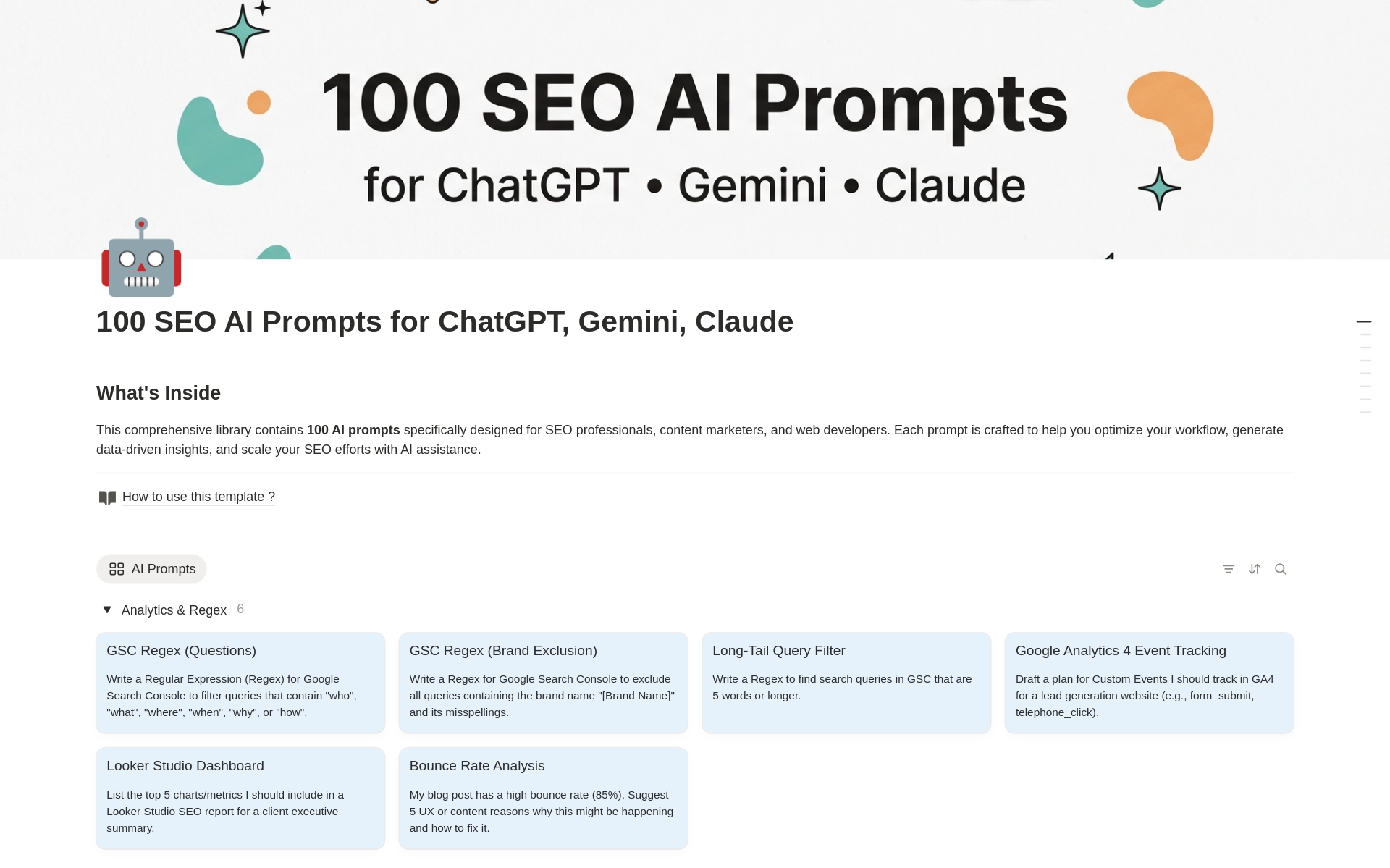
AI SEO prompts are carefully structured instructions given to large language models or generative AI tools to perform search engine optimization tasks. Instead of manually brainstorming topics, analyzing spreadsheets, or writing meta tags from scratch, SEO professionals now use prompts to direct AI toward specific, high-value outputs. The prompt acts as a bridge between human strategic thinking and machine speed, combining context, constraints, and SEO best practices.
These prompts can cover a wide range of activities: generating keyword clusters, drafting on-page content, writing title tags and meta descriptions, creating schema markup, fixing technical SEO issues, or even analyzing competitor strategies. The quality of the output depends almost entirely on how the prompt is written. A vague command like “write an article about running shoes” will produce generic fluff. A detailed AI SEO prompt that includes target keywords, search intent, content structure, tone, and formatting guidelines will deliver ready-to-rank material.
Why AI SEO Prompts Are Reshaping the Industry
Traditional SEO required manual effort across dozens of monotonous tasks. AI SEO prompts compress weeks of work into minutes, but only when the operator understands the underlying principles of both search engines and language models. The prompt must embed ranking signals naturally: E-E-A-T signals, topical authority, semantic relevance, and user engagement. When done right, AI becomes an extension of your expertise rather than a replacement.
The real breakthrough is scalability. A single well-engineered prompt can be reused and tweaked across hundreds of pages, maintaining consistency while leaving room for customization. Agencies and in-house teams now build prompt libraries for local SEO, e-commerce product descriptions, schema generation, and even Python scripts for data analysis. AI SEO prompts have turned SEO from a purely executional discipline into a high-level orchestration role.
Component Breakdown of an Effective AI SEO Prompt

Understanding the anatomy of a prompt is essential before diving into specific applications. While each use case is unique, the strongest prompts share the following structural layers:
- Role assignment: Define who the AI is supposed to be, such as “You are a senior SEO strategist with 10 years of experience in local search.”
- Context and goal: Clearly state the background, target audience, and the exact objective. For example, “We are launching a new dental practice in Austin and need to capture ’emergency dentist’ queries.”
- Input data: Provide primary and secondary keywords, competitor URLs, brand guidelines, and any existing content.
- Output format: Specify headings, tables, HTML tags, character limits for meta descriptions, or JSON-LD structures.
- Constraints and tone: Set boundaries such as “avoid fluff,” “use active voice,” “no mention of competitors,” or “write at an 8th-grade reading level.”
- Examples: Including a sample of the desired output dramatically improves consistency and reduces revision cycles.
- Unmatched speed: Generate weeks of content briefs, metadata, and audits in a single afternoon.
- Consistent brand voice: Tone and style guidelines embedded in prompts keep multi-author output uniform.
- Data-driven ideation: AI can process massive datasets to identify content gaps and trending entities.
- Accessibility: Non-technical team members can produce SEO-optimized drafts without deep keyword knowledge.
- Cost reduction: Scaling content for faceted navigation, local pages, or programmatic SEO becomes economically feasible.
- Hallucinations: AI may fabricate statistics, product specs, or citations if not grounded in provided data.
- Generic outputs: Without strong differentiation prompts, content reads like every other AI-generated article.
- Over-optimization: Models trained to follow SEO instructions can produce keyword-stuffed, unnatural text if constraints are too aggressive.
- Google’s evolving guidelines: Search engines reward helpful, people-first content. Over-reliance on AI without expert review can trigger quality downranks.
- Privacy and copyright: Feeding proprietary data into public AI tools requires careful data governance.
- Prompting without intent clarity: Asking for “an article about credit cards” ignores whether the user wants to compare, apply, or understand hidden fees. Always state the intent.
- Ignoring the target platform: Content for a Google Discover snippet, a YouTube description, and a mobile landing page require different structures and lengths, yet many prompts default to blog format.
- Lack of factual grounding: Not providing specific data points or expert quotes leaves the AI to invent numbers, which damages trustworthiness.
- Treating AI output as final: Skipping human editing is the fastest route to thin content penalties. Every draft needs factual, editorial, and tone review.
- Overcomplicating prompts: A 3-page prompt with contradictory instructions confuses the model and often produces worse results than a focused, clean brief.
Missing even one of these layers often leads to hallucinations or generic content that fails to satisfy user intent. The best SEO practitioners treat prompt engineering as a repeatable science, testing variations and tracking ranking outcomes over time.
Types of AI SEO Prompts and Their Applications
AI SEO prompts can be categorized based on the stage of the SEO funnel they address. Below is a breakdown of the most impactful categories, each with its own optimal structure.
Keyword Research Prompts
Prompting AI for keyword research goes far beyond listing synonyms. Advanced prompts instruct the model to act as a keyword analyst, considering search volume trends, user intent classification, and topical clustering. A typical prompt might look like: “You are a keyword research specialist. Given the seed keyword ‘sustainable yoga mats,’ generate three keyword clusters for informational, commercial, and transactional intent. For each cluster, provide 10 long-tail keywords, estimated search intent, and content type suggestion. Output in a table.” The result is a structured keyword map that aligns directly with content planning.
Content Writing Prompts
Content creation remains the most common application. However, the difference between an AI-generated blog post that ranks and one that stalls lies in the prompt’s ability to embed EEAT signals. Effective AI SEO prompts for content include the target keyword, related entities, desired article outline, internal linking instructions, and tone of voice. For instance, instructing the AI to “include original insights based on our 2025 survey data, cite no external sources, and use short paragraphs” keeps the output unique and engaging. Many professionals also ask the model to write in a specific persona, such as “a certified financial planner who explains things simply.”
Technical SEO Prompts
Many overlook the power of AI for technical tasks. With the right prompt, a language model can generate schema markup, write robots.txt directives, suggest.htaccess rules, or even audit a sample of HTML for structured data errors. A prompt like “You are an SEO technical auditor. Review the following JSON-LD snippet for a local business and point out any missing recommended properties from the Schema.org specification. Then provide the corrected code.” saves hours of manual debugging. AI SEO prompts can also generate valid XML sitemap structures or hreflang tags when fed the correct parameters.
Local SEO Prompts
Local search requires consistency across citations, Google Business Profile optimization, and location-specific content. AI can generate geographic service area pages, localized FAQs, and review response templates. A prompt for local content might include the city, neighborhood, target service, and common questions sourced from People Also Ask boxes. The AI then weaves those elements into a unique page that avoids duplication across multiple locations.
Link Building and Outreach Prompts
Creating personalized outreach emails, guest post pitches, and link bait ideas becomes faster with tailored prompts. A strong prompt will provide the target site’s niche, recent articles, and a legitimate value proposition. The AI can draft emails that feel human and specific, reducing the chance of being marked as spam. Always prompt the model to request a custom snippet or data point from the recipient to show genuine engagement.
Comparison: AI SEO Prompts vs. Manual SEO Execution

| Factor | Manual SEO | AI SEO Prompts (Optimized) |
|---|---|---|
| Speed of research | Hours to days for keyword clustering | Minutes for full intent-based clusters |
| Content output volume | Limited by writer bandwidth | Scalable drafts, human editing still required |
| Consistency | High with strict SOPs, drifts with multiple writers | Extremely consistent when prompt templates are reused |
| Technical accuracy | Relies on developer expertise | Good for standard implementations, needs verification for edge cases |
| Creative differentiation | Strong human storytelling | Mediocre unless guided by detailed examples and unique data |
| Cost efficiency | High labor cost | Dramatically lower per-page cost |
Practical Step-by-Step Guide to Building AI SEO Prompts
Turning theory into actionable results requires a repeatable framework. The following process has been refined through hundreds of campaigns and adapts to any niche.
Step 1: Define the SEO Objective Clearly
Before typing anything, identify whether you need to improve a specific ranking, fill content gaps, or fix a technical issue. Every word in your prompt should tie back to a measurable SEO goal. For example, “increase organic traffic to the product category page by targeting long-tail informational queries that indicate purchase readiness.”
Step 2: Gather All Necessary Assets
Collect the top-performing competitor pages, a list of semantic keywords from tools like Google’s “Related Searches,” user-generated questions from Reddit or Quora, and your internal subject matter expert notes. This real-world data anchors the AI and prevents it from inventing statistics or misinterpreting the topic.
Step 3: Structure the Prompt Using the Component Model
Build the prompt following the role-context-input-format-constraints framework. For an e-commerce blog post, the prompt might start: “Act as a professional copywriter specializing in outdoor gear. We sell ultralight backpacking tents. Using the keyword list and competitor content provided below, write a 1500-word ultimate guide for ‘how to choose a lightweight tent.’ Structure it with an H1, 5 H2s, and bullet points for features. Include our brand name only twice. Tone: authoritative, encouraging, no fluff. Output in clean HTML.”
Step 4: Iterate and Inject EEAT Signals
The first draft will rarely be perfect. Use follow-up prompts to add first-hand experience: “Rewrite the section on tent fabrics to include a personal testing anecdote about seam sealing in heavy rain.” Ask the model to cite your own proprietary data, incorporate author bio snippets, and add consumer trust elements like certifications or warranty highlights. This human-in-the-loop approach elevates the content from obvious AI to expert resource.
Step 5: Validate and Optimize
Run the output through plagiarism checkers, factual verification, and SEO scoring tools. Ensure keyword placement in titles, meta description previews, and opening paragraphs is natural. Check that the response meets the exact formatting requirements, especially if generating schema code. Many SEOs use a separate QA prompt: “Review the following HTML content for SEO best practices. Flag missing image alt tags, keyword stuffing, or thin content sections.”
Advanced Techniques for High-Performance AI SEO Prompts

Once the basics are mastered, deeper strategies unlock elite-level output. Chain-of-thought prompting, for instance, asks the model to reason step by step before producing an answer. For SEO tasks like site architecture planning, a prompt such as “Think through the ideal silo structure for a website about sustainable home improvement, then present it as an indented list” yields more coherent results.
Another technique is negative prompting, where you explicitly forbid certain patterns. “Do not use the words ‘unleash’ or ‘supercharge.’ Avoid passive voice. Do not invent statistics.” This eliminates most AI clichés. Schema-driven prompting instructs the model to output in predefined structures: “Output a JSON-LD schema for a recipe, fill in the name, image, prep time, and ingredients based on the following blog text.” The combination of these methods turns AI SEO prompts into programmable SEO APIs.
Benefits and Limitations of Relying on AI SEO Prompts
Like any tool, prompt-driven SEO delivers dramatic benefits when applied correctly but also carries inherent risks that must be managed.
Key Benefits
Limitations and Risks
Common Mistakes When Writing AI SEO Prompts
Even experienced SEOs fall into predictable traps. Recognizing these pitfalls saves time and protects rankings.
Important Notes for Long-Term Success with AI SEO Prompts
Search engines are increasingly sophisticated at detecting AI patterns. Future-proof your strategy by integrating genuine expertise. Add author bios with real credentials, link to original research, and include video or audio embeds where possible. Prompt your AI to write content that a human expert would feel proud to put their name on. The goal is to use AI SEO prompts to amplify, not simulate, subject matter authority.
Create a prompt library with version control. As algorithms and language models evolve, your prompts need to be updated. Record which prompt variations led to ranking improvements or increased engagement. This library becomes your proprietary SEO asset, far more valuable than one-off outputs.
Finally, always align with Google’s E-E-A-T framework in your prompting. Before sending a prompt, ask yourself: “Would a reasonable person trust the information this prompt will generate?” If the answer is no, inject more context, data, or a request for the AI to acknowledge limitations.
Frequently Asked Questions About AI SEO Prompts
What exactly is an AI SEO prompt?
An AI SEO prompt is a detailed instruction set given to an artificial intelligence tool to perform a search engine optimization task, such as generating keyword clusters, writing content, or creating schema markup. The prompt combines the task goal with context, formatting rules, and SEO constraints to produce actionable, ranking-focused output.
Can AI SEO prompts replace human SEO experts?
No. While AI can drastically accelerate research, drafting, and technical implementation, strategic thinking, creative storytelling, and genuine subject matter expertise still require human judgment. The best results come from SEO experts using AI prompts as a force multiplier, not a full replacement.
How do I prevent AI from generating generic content with SEO prompts?
Provide unique data points, first-person anecdotes, and explicit tone requirements. Use negative prompting to ban overused phrases. Include a sample of your brand’s best-performing content as a style reference. The more specific your input, the less generic the output.
Are there SEO risks if Google detects AI-generated content?
Google assesses content based on helpfulness, not on whether AI assisted in its creation. Content produced by AI SEO prompts that lacks originality, factual accuracy, or user value may be penalized under standard quality guidelines. Thorough human editing and adding genuine expertise eliminate this risk.
What is the ideal length for an AI SEO prompt?
T A keyword research prompt may be concise, while a multi-section pillar page prompt needs extensive structural details. The key is to include all necessary context without burying the primary instruction in noise.
Can I use the same AI SEO prompt for different websites?
Prompts can be templated, but they must be adapted for each site’s brand voice, audience, and niche. Using identical prompts across unrelated sites will produce similar content footprints, risking duplicate or thin content issues. Always customize the input data and tone constraints.
Conclusion
Mastering AI SEO prompts is no longer optional for competitive digital marketers; it is the core competency that separates scalable, high-impact teams from those stuck in manual bottlenecks. The difference between a prompt that yields ranking content and one that generates noise lies in strategic depth. By encoding SEO expertise into every prompt layer—role, context, intent, formatting, and factual anchors—you transform a generalist AI into a specialized, reliable SEO partner. Remember that technology evolves, but the fundamental principles of helpful content, trust, and user-focused experience remain constant. Build your prompt library, refine it continuously, and always keep human expertise at the center of your automation.
Xem thêm:
- AI SEO Redirect Chains: The Complete Guide to Automated Redirect Management
- AI SEO Customer Acquisition: The Complete Playbook for Sustainable Growth in 2025
- AI SEO Entity Keywords: The Complete Guide to Future-Proof Search Rankings
- AI Translation SEO: Mastering Multilingual Content for Global Search Dominance
- AI SEO Entity Optimization: The Complete Guide to Future-Proof Rankings
Bài viết cùng chủ đề:

AI SEO SEO Automation with Make: The Complete Workflow Guide

AI SEO SEO Automation with Zapier: The Complete Workflow Guide

AI SEO SEO Automation with n8n: The Complete Workflow Guide
AI SEO SEO Automation with Gemini: The Complete Guide to Scaling Organic Growth

AI SEO SEO Automation with Claude: The Complete Guide to Scaling Content in 2025

AI SEO SEO Automation with ChatGPT: The Complete Playbook for 2025

AI SEO & SEO Automation for Affiliate Sites: The 2025 Playbook for Passive Income Growth
AI SEO & SEO Automation for Bloggers: The Complete Guide to Scaling Your Content

AI SEO & SEO Automation for Agencies: The Complete 2025 Playbook

AI SEO and SEO Automation for Ecommerce: The Complete Playbook for 2025

AI SEO & SEO Automation for WordPress: The Complete Playbook for 2025
AI SEO SEO Automation Strategy: The Complete Playbook for 2025

Mastering the AI SEO SEO Automation Process: A Complete Guide to Scaling Organic Growth
AI SEO SEO Automation System: The Complete Guide to Scaling Organic Growth in 2025
AI SEO SEO Automation Platform: The Complete Guide to Scaling Organic Growth in 2025
AI SEO SEO Automation Software: The Complete Guide to Scaling Organic Growth in 2025















