
No products in the cart.
AI SEO for Nonprofits: The Complete Guide to Boosting Visibility and Donations

31
Jul
Jul
Nonprofit organizations face a unique digital challenge. They must compete for attention, donations, and volunteers, often with limited marketing budgets and small teams. Traditional SEO requires constant content creation, technical audits, and link building—tasks that can overwhelm any mission-driven staff. This is where AI SEO for nonprofits changes the game. By leveraging artificial intelligence, organizations can automate research, optimize content at scale, and understand donor intent with unprecedented precision. This guide explores how nonprofits can harness AI to rank higher, attract the right audience, and turn search traffic into meaningful action, all while staying true to their mission.
What Is AI SEO for Nonprofits?

AI SEO for nonprofits refers to the strategic use of artificial intelligence tools and machine learning algorithms to improve a nonprofit’s search engine rankings and organic visibility. Unlike traditional SEO, which relies heavily on manual keyword research and content optimization, AI SEO automates and enhances these processes. It analyzes vast amounts of search data, predicts user behavior, and generates insights that help nonprofits target the exact queries their potential donors and beneficiaries are using.
The core difference lies in efficiency and depth. A human SEO specialist might analyze a few hundred keywords in a week. An AI tool can analyze millions of search queries, identify semantic relationships, and suggest content gaps in minutes. For a nonprofit with limited resources, this speed translates directly into more time spent on the mission and less on spreadsheets.
AI also excels at understanding search intent. It can differentiate between someone searching for “homeless shelter near me” (immediate need) and “how to donate to homeless shelters” (donation intent). This allows nonprofits to create content that matches each stage of the supporter journey, from awareness to action.
Why Nonprofits Need AI-Powered SEO Now More Than Ever
The digital landscape for nonprofits has become fiercely competitive. According to recent industry data, the number of nonprofit organizations has grown steadily, while online attention spans have shortened. Generic content no longer cuts it. Search engines like Google now prioritize helpful, authoritative content that demonstrates experience and trustworthiness. This aligns perfectly with the E-E-A-T framework, but meeting these standards manually is resource-intensive.
AI levels the playing field. A small nonprofit with a two-person communications team can now produce SEO-optimized content that rivals larger organizations. AI tools can analyze competitor strategies, identify high-value topics, and even draft initial content outlines. This capability is not about replacing human creativity but about amplifying it. The nonprofit’s unique voice and mission remain central, while AI handles the heavy lifting of technical optimization.
Furthermore, donor behavior has shifted. People research causes online before giving. They read reviews, check impact reports, and compare organizations. If a nonprofit’s website does not appear in search results for relevant queries, it simply does not exist in the donor’s consideration set. AI SEO ensures that the organization is visible at the exact moment of decision-making.
Core Components of an AI-Driven SEO Strategy for Nonprofits
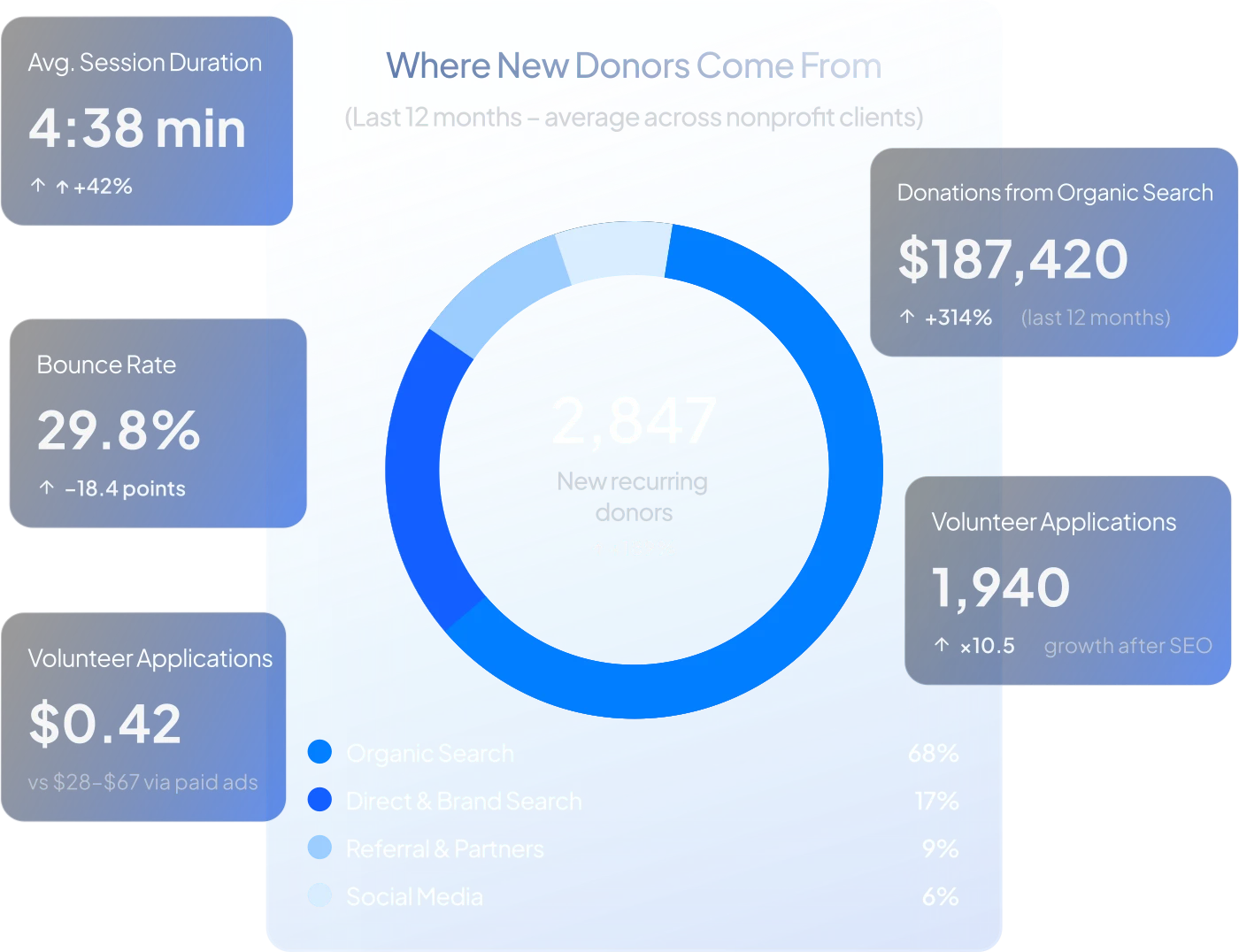
Implementing AI SEO for nonprofits is not a single action but a multi-layered strategy. Understanding the core components helps organizations build a sustainable system that delivers long-term results.
1. AI-Powered Keyword and Topic Research
Traditional keyword research often focuses on high-volume terms like “charity” or “donate,” which are too broad and competitive. AI tools like SEMrush, Ahrefs, and specialized platforms like Clearscope or Surfer SEO analyze search engine results pages (SERPs) to find gaps. They identify long-tail keywords with lower competition but high conversion potential. For example, instead of “animal rescue,” an AI tool might suggest “how to start a rabbit rescue in Texas” or “senior dog adoption costs.” These specific queries attract users who are further along in their decision-making process.
AI also clusters keywords by topic. This helps nonprofits create pillar pages and supporting articles that establish topical authority. Search engines reward websites that comprehensively cover a subject. If a nonprofit focuses on clean water initiatives, AI can map out all related subtopics: water filtration methods, impact statistics, volunteer opportunities, and donation options. This creates a content ecosystem that signals expertise to Google.
2. Content Optimization and Generation
AI writing assistants, such as Jasper, Copy.ai, or ChatGPT, can generate drafts, headlines, and meta descriptions. However, the real power lies in optimization. Tools like Surfer SEO analyze the top-ranking pages for a keyword and provide a detailed brief. This includes recommended word count, heading structure, image count, and semantic keywords to include. The nonprofit’s writer can then create content that meets these criteria while infusing it with real stories and data from the field.
This process ensures that content is not only readable but also structurally aligned with what search engines expect. For example, if all top-ranking pages for “food bank volunteer” include a section on “what to expect on your first shift,” the AI tool will flag this as a necessary component. The nonprofit can then provide authentic, first-hand information about their specific volunteer experience, which adds a layer of trust that generic content lacks.
3. Technical SEO Audits and Monitoring
Technical issues like slow page speed, broken links, and poor mobile responsiveness can severely hurt rankings. AI-powered crawlers can audit an entire website in minutes, identifying issues that would take a human days to find. Tools like Sitebulb or Screaming Frog use machine learning to prioritize issues based on their impact on rankings and user experience.
For nonprofits, this is particularly valuable because websites are often built by volunteers or on a tight budget. The site may have outdated plugins, missing alt text, or duplicate content. AI audits provide a clear, prioritized action list. The organization can then fix the most critical issues first, ensuring that their valuable content is not hidden from search engines due to technical errors.
4. User Experience and Intent Analysis
Google’s algorithm increasingly focuses on user engagement metrics like dwell time, bounce rate, and click-through rate. AI tools analyze how users interact with a website and predict what changes will improve these metrics. For example, an AI heatmap tool can show that users are clicking on a non-clickable element, indicating a desired feature. Or it might reveal that a donation page has a high exit rate, suggesting a confusing layout.
By understanding user intent, nonprofits can structure their websites to guide visitors toward action. A visitor searching for “annual report” has a different intent than one searching for “donate now.” AI helps create distinct pathways for each. The report seeker gets a clean PDF download page, while the donor gets a streamlined, emotionally compelling giving page with multiple payment options.
Practical Applications: How to Implement AI SEO in Your Nonprofit
Knowing the components is one thing; implementing them is another.
Step 1: Audit Your Current Digital Footprint
Start with a comprehensive AI-powered audit. Use tools like Google Search Console (which now includes some AI insights) and a dedicated crawler. Identify your current top-performing pages, your keyword rankings, and any technical errors. This baseline will help you measure progress. Also, analyze your competitors. What keywords are they ranking for that you are not? What content gaps exist?
Step 2: Define Your Core Topics and Donor Personas
List the main program areas of your nonprofit. For each area, define the primary audience: donors, volunteers, beneficiaries, or journalists. Use AI tools to generate a list of questions these personas might ask. Tools like AnswerThePublic or AlsoAsked provide visual maps of these questions. This becomes your content roadmap.
Step 3: Create a Content Production Workflow
Develop a workflow that combines AI efficiency with human authenticity. Use AI to generate outlines and first drafts. Then, have a human editor rewrite and enrich the content with real stories, quotes from staff, and specific data from your programs. Always fact-check AI-generated statistics. Never publish AI content without human review, as it can contain subtle inaccuracies or a generic tone that damages trust.
Step 4: Optimize for Local and Voice Search
Many nonprofits serve specific geographic areas. AI SEO helps optimize for local search by ensuring your Google Business Profile is complete and your content includes local landmarks and phrases. Voice search is also growing. People ask, “Where can I donate clothes near me?” or “What animal shelters need volunteers?” AI tools can help you identify these conversational queries and structure your content to answer them directly, increasing your chances of appearing in featured snippets.
Step 5: Measure, Learn, and Iterate
AI is not a set-and-forget solution. Use analytics tools to track which content drives traffic, conversions, and donations. AI can analyze this data and suggest adjustments. For example, it might find that blog posts with personal stories have a 50% higher conversion rate than those with just statistics. Use this insight to adjust your content strategy. Continuous iteration is the key to staying ahead in SEO.
Benefits of AI SEO for Nonprofits
The advantages of adopting AI SEO are tangible and measurable. Here are the primary benefits that organizations can expect.
- Cost Efficiency: AI tools reduce the need for expensive external SEO agencies. Many tools offer nonprofit discounts or free tiers, making them accessible even with minimal budgets.
- Time Savings: Automating research and technical audits frees up staff time for mission-critical work, such as fundraising and program delivery.
- Scalability: AI allows a small team to manage a large content calendar. You can produce more high-quality content without sacrificing quality.
- Improved Donor Targeting: By understanding search intent, you attract visitors who are genuinely interested in your cause, leading to higher conversion rates.
- Competitive Advantage: Many nonprofits are still relying on outdated SEO methods. Early adopters of AI gain a significant edge in search rankings.
- Data-Driven Decisions: AI provides actionable insights based on real data, not guesswork. This reduces the risk of investing time in strategies that do not work.
Limitations and Ethical Considerations
While AI is powerful, it is not a magic bullet. Nonprofits must be aware of its limitations to use it responsibly.
Lack of Human Empathy: AI cannot replicate the emotional depth of a personal story from a beneficiary. Over-reliance on AI-generated content can make your website sound robotic and insincere. The human touch is essential for building trust with donors.
Data Privacy Concerns: AI tools collect vast amounts of data. Nonprofits must ensure they comply with GDPR and other privacy regulations when using AI for audience analysis. Transparency with your supporters about data usage is critical.
Potential for Inaccuracy: AI models can generate plausible-sounding but incorrect information. Always verify statistics, quotes, and program details before publishing. A factual error can severely damage a nonprofit’s credibility.
Algorithm Bias: AI models are trained on existing data, which may contain biases. This could lead to content that unintentionally excludes certain demographics. Regularly review your content to ensure it is inclusive and representative of the community you serve.
Comparison: Traditional SEO vs. AI SEO for Nonprofits

To fully appreciate the shift, it helps to compare the two approaches side-by-side.
| Aspect | Traditional SEO | AI SEO |
|---|---|---|
| Keyword Research | Manual, time-consuming, limited to obvious terms | Automated, analyzes millions of queries, finds long-tail opportunities |
| Content Creation | Slow, relies on individual writer’s knowledge | AI-assisted drafting and optimization, faster production |
| Technical Audits | Manual crawling, requires technical expertise | Automated crawlers, prioritized issue lists |
| Data Analysis | Historical data, reactive | Predictive analytics, real-time insights |
| Cost | High agency fees or dedicated hires | Lower cost, scalable subscriptions |
| Personalization | Limited to basic segmentation | Deep intent analysis, dynamic content suggestions |
While traditional SEO still has a place, the efficiency and depth of AI make it the superior choice for resource-constrained nonprofits.
Common Mistakes to Avoid When Using AI for SEO
Many nonprofits jump into AI SEO without a clear strategy, leading to wasted effort and poor results. Here are the most common pitfalls and how to avoid them.
Mistake 1: Publishing Unedited AI Content
This is the fastest way to lose credibility. AI-generated text often lacks nuance and can contain factual errors. Always have a human editor review, rewrite, and fact-check every piece of content before it goes live. Inject your organization’s unique voice and real-world experiences.
Mistake 2: Ignoring Search Intent
Creating content for keywords that do not match user intent is futile. If you write a detailed report on water scarcity but your target keyword is “donate to water charity,” you will not convert visitors. Use AI to understand the “why” behind the search query and tailor your content accordingly.
Mistake 3: Neglecting Technical SEO
AI content is useless if search engines cannot crawl your site. Ensure your site is fast, mobile-friendly, and has a clear structure. Use AI audit tools regularly to catch issues early.
Mistake 4: Focusing Only on Volume
Publishing dozens of low-quality AI articles will not help. Google’s algorithms are sophisticated enough to detect thin content. Focus on creating comprehensive, authoritative resources that genuinely help your audience. One excellent 2,000-word guide is worth more than ten 300-word blurbs.
Mistake 5: Overlooking the Human Story
Donors give to people, not algorithms. While AI helps you get found, your mission’s story is what converts a visitor into a supporter. Balance AI-optimized content with powerful storytelling, authentic photos, and videos from the field.
Important Notes for Nonprofit Leaders
Adopting AI SEO is a strategic decision that requires buy-in from leadership. Here are some key considerations to keep in mind.
Start Small: You do not need to overhaul your entire digital strategy overnight. Start with one program area or one type of content. Learn what works, then expand.
Invest in Training: Your team needs to understand how to use AI tools effectively. Invest in training or choose user-friendly platforms with good customer support. Many tools offer webinars and tutorials specifically for beginners.
Maintain Transparency: Be open with your supporters about how you use AI. If you use AI to draft content, it is good practice to have a human thoroughly edit it. Transparency builds trust, which is the foundation of donor relationships.
Focus on E-E-A-T: Google’s quality rater guidelines emphasize Experience, Expertise, Authoritativeness, and Trustworthiness. AI can help you optimize for these factors, but the actual experience and expertise must come from your organization. Showcase your staff, your on-the-ground work, and your measurable impact.
Integrate with Other Channels: SEO does not work in a silo. Your AI-optimized content should be promoted on social media, in email newsletters, and through partnerships. Use AI to repurpose content into different formats, such as turning a blog post into a short video script or an infographic.
Frequently Asked Questions (FAQ)
What is the best AI SEO tool for a nonprofit with a small budget?
Several tools offer free tiers or nonprofit discounts. Google Search Console is essential and free. For keyword research, Google Keyword Planner is free. For content optimization, consider the free versions of tools like AnswerThePublic or the limited free plan of Surfer SEO. For AI writing assistance, ChatGPT has a free tier that is useful for brainstorming and outlining. Always check if a tool has a specific nonprofit program, as many do.
Can AI replace my nonprofit’s content writer?
No, AI should not replace human writers. It should augment their work. AI can handle research, generate outlines, and suggest headlines, but a human writer is essential for injecting emotion, verifying facts, and maintaining your organization’s unique voice. The best results come from a collaboration between AI and human creativity.
How long does it take to see results from AI SEO?
SEO is a long-term strategy. While AI speeds up the process, it typically takes 3 to 6 months to see significant improvements in rankings and organic traffic. This timeline depends on the competitiveness of your keywords, the current state of your website, and the consistency of your efforts. Patience and persistence are key.
Is AI SEO safe for nonprofit websites?
Yes, when used correctly. The main risks are publishing inaccurate information and creating low-quality content that violates Google’s spam policies. To stay safe, always have a human review AI output, fact-check all data, and focus on creating genuinely helpful content. Avoid using AI to generate mass-produced, low-value pages solely for ranking purposes.
How does AI help with donor retention through SEO?
AI SEO helps attract the right donors in the first place, which is the first step in retention. By targeting specific intents, you attract supporters who are genuinely aligned with your mission. Additionally, AI can help you create a resource center on your website with valuable content for existing donors, such as impact reports and volunteer guides. This keeps them engaged and informed, increasing their likelihood of donating again.
Conclusion
AI SEO for nonprofits is not just a trend; it is a fundamental shift in how organizations can achieve digital visibility. By automating tedious tasks, providing deep insights into donor behavior, and enabling content production at scale, AI empowers even the smallest teams to compete effectively. The key is to use AI as a tool to enhance human effort, not replace it. The most successful nonprofits will be those that combine the analytical power of AI with the irreplaceable power of human storytelling and genuine impact. Start small, focus on your mission, and let AI help the world find you. The donors, volunteers, and communities you serve are searching for solutions right now. Make sure your organization is the one they find.
Xem thêm:
- AI SEO Content Editing: The Complete Guide to Smarter, Faster Optimization
- AI SEO Semantic Content Analysis: The Complete Guide to Smarter Rankings
- AI SEO SEO Automation with Gemini: The Complete Guide to Scaling Organic Growth
- AI SEO Attribution: The Complete Guide to Measuring What Actually Drives Rankings
- AI SEO Citation Building: The Complete Guide to Automated Local Search Dominance
Bài viết cùng chủ đề:

AI SEO SEO Automation with Make: The Complete Workflow Guide

AI SEO SEO Automation with Zapier: The Complete Workflow Guide

AI SEO SEO Automation with n8n: The Complete Workflow Guide
AI SEO SEO Automation with Gemini: The Complete Guide to Scaling Organic Growth

AI SEO SEO Automation with Claude: The Complete Guide to Scaling Content in 2025

AI SEO SEO Automation with ChatGPT: The Complete Playbook for 2025

AI SEO & SEO Automation for Affiliate Sites: The 2025 Playbook for Passive Income Growth
AI SEO & SEO Automation for Bloggers: The Complete Guide to Scaling Your Content

AI SEO & SEO Automation for Agencies: The Complete 2025 Playbook

AI SEO and SEO Automation for Ecommerce: The Complete Playbook for 2025

AI SEO & SEO Automation for WordPress: The Complete Playbook for 2025
AI SEO SEO Automation Strategy: The Complete Playbook for 2025

Mastering the AI SEO SEO Automation Process: A Complete Guide to Scaling Organic Growth
AI SEO SEO Automation System: The Complete Guide to Scaling Organic Growth in 2025
AI SEO SEO Automation Platform: The Complete Guide to Scaling Organic Growth in 2025
AI SEO SEO Automation Software: The Complete Guide to Scaling Organic Growth in 2025















