
No products in the cart.
AI SEO for Small Business: The Complete Guide to Smarter Rankings on a Budget
29
Jul
Jul
For a small business owner, few marketing channels deliver the consistent, long‑term returns of organic search. The problem is that traditional SEO demands dozens of hours a month—hours you simply don’t have. AI SEO for small business changes that equation. It uses machine learning and natural language processing to automate research, content planning, on‑page optimisation, and performance tracking, cutting the manual workload by half or more while keeping a human‑led strategy at the core. Whether you run a local bakery, an e‑commerce niche store, or a service‑based consultancy, AI tools can help you compete against larger players without hiring a full‑time SEO specialist.
The real advantage of AI‑driven search optimisation is speed, but the smarter play is precision. Algorithms trained on vast datasets can spot ranking gaps your eyes would miss and suggest content angles that align with search intent within seconds. This guide walks you through every stage of integrating AI into your small business SEO—from choosing the right tools to avoiding the most common traps—so you can attract more qualified traffic without wasting your budget.
What Is AI SEO for Small Business?
AI SEO is the application of artificial intelligence technologies—primarily large language models, predictive analytics, and computer vision—to the core activities of search engine optimisation. For a small business, this means using software that can understand Google’s ranking signals, analyse competitor pages, generate content outlines, and even write optimised meta tags, all while learning from the data you feed it.
Instead of manually sifting through keyword tools and spreadsheets, a small business owner can connect an AI platform to their website, enter a few seed keywords, and receive a prioritised list of low‑competition, high‑intent phrases complete with content briefs. The AI then monitors performance, flagging pages that are losing traction or keywords that have moved into striking distance of page one. This turns SEO from a reactive guessing game into a proactive, data‑driven system.
Why Small Businesses Need AI-Powered SEO Right Now
Consumer search behaviour has become more conversational, localised, and intent‑rich. Google’s algorithms, including the Helpful Content System and multiple core updates, increasingly reward sites that demonstrate genuine expertise and satisfy user needs quickly. Small businesses that stay manual often cannot react fast enough. AI steps in to bridge that gap.
- Search volume volatility: Trends shift within days; AI can detect emerging queries before traditional tools pick them up.
- Resource constraints: Most small businesses cannot afford a full‑time SEO manager. AI automates the repetitive parts, freeing your time for strategic thinking and customer interactions.
- Local competition: Neighbouring businesses are already using AI for local SEO tasks like managing Google Business Profiles and generating location‑specific landing pages.
- Publishing AI content without editing: Google’s algorithms are getting better at identifying formulaic AI prose. Always add unique observations, local details, and brand voice. A bakery’s blog about sourdough should mention the specific oven brand, the flour mill they source from, and the starter’s history.
- Ignoring search intent nuances: AI can mislabel a commercial query as informational. Always manually verify the top 10 results for a target keyword before committing. If the SERP shows product pages, a blog post won’t rank.
- Neglecting local citations and NAP consistency: AI local tools can detect inconsistency, but you still need a human to verify corrections across dozens of directories. Set a calendar reminder to audit this quarterly.
- Over‑optimising anchor text: AI link‑building suggestions often recommend exact‑match anchors. Too many of those trigger Penguin‑style filters. Maintain a natural mix of branded, naked URL, and partial‑match anchors.
- Buying into hype without measuring: Track specific KPIs from day one—organic clicks, keyword rankings for target terms, conversion rate from organic traffic. If an AI tool doesn’t move those needles within three months, re‑evaluate.
- Forgetting about Core Web Vitals: AI content might be perfect, but if your page loads in 5 seconds, users will bounce. Let the AI’s technical audit feed directly into your development queue.
Core Components of AI SEO for Small Business
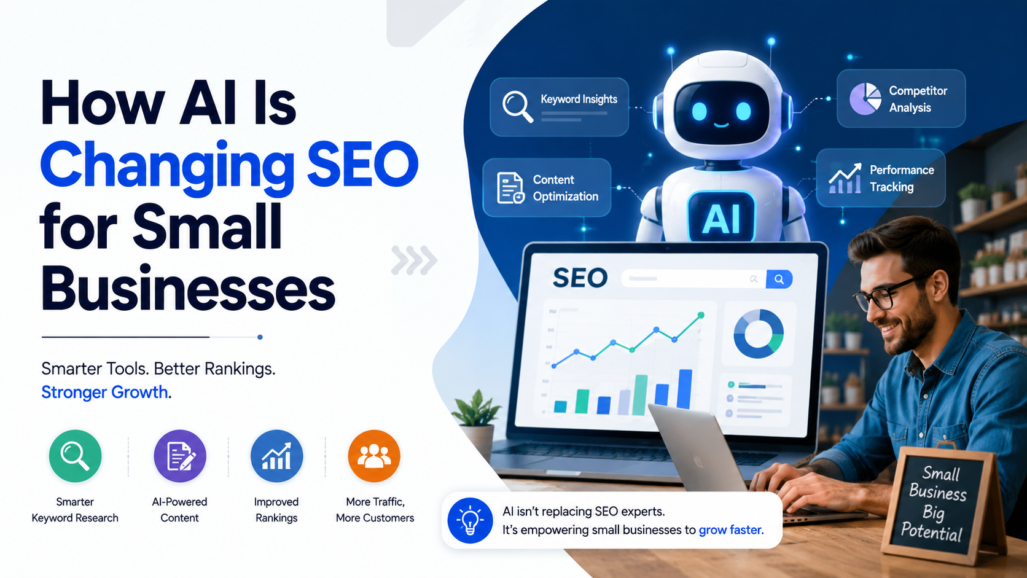
A well‑rounded AI SEO strategy touches every pillar of modern optimisation. The technology isn’t a single magic button, but a suite of capabilities that can be assembled like building blocks.
1. AI‑Driven Keyword Research and Intent Analysis
Traditional keyword tools show volume and difficulty. AI tools go further; they cluster keywords by search intent, reveal question‑based queries that voice searchers use, and predict the likelihood of conversion. A local plumber, for example, might discover that “emergency drain unblock cost” has a transactional intent far more valuable than the informational “how to unclog a drain”, even though the latter has higher volume. The AI automatically groups topics into pillar pages and supporting content, building a semantic silo that search engines love.
2. Automated Content Briefs and First Drafts
Most small business owners freeze when staring at a blank WordPress editor. AI‑powered content assistants (often integrated with SEO platforms) generate a full brief: recommended word count, headings, questions to answer, internal links, and even a rough draft. The output still requires human editing to inject brand voice and personal experience, but the structural heavy lifting is done. This alone can cut content creation time by up to 70%.
3. On‑Page Optimisation at Scale
AI can audit every page of your site simultaneously, checking for missing title tag modifiers, suboptimal header hierarchy, thin content, and cannibalisation issues. It then suggests exact changes—like adding a location modifier to a title or expanding a section with a schema‑friendly FAQ—and can even implement them if you grant the right permissions. For e‑commerce stores with hundreds of product pages, this is transformative.
4. Technical SEO Automation
Crawling errors, slow Core Web Vitals, broken links, and mobile‑usability glitches are all detectable by AI. Modern platforms prioritise fixes based on business impact, telling you that fixing a slow server response time on your checkout page matters more than a minor duplicate meta description on a blog tag archive. Automated monitoring catches issues before they tank rankings.
5. AI for Local SEO and Google Business Profile
For any small business with a physical presence, local AI SEO is a game‑changer. Tools can scan Google Business Profile insights, suggest review response templates that naturally include keywords, detect NAP inconsistencies across directories, and even predict which new “near me” search variations are growing in your area. Some platforms now automate the creation of hyper‑local landing pages for each service suburb, a tactic that would be impossibly time‑consuming manually.
6. Predictive Analytics and Performance Insights
Rather than looking backward at last month’s traffic, AI forecasting models estimate future ranking changes based on detected algorithm shifts, competitor movements, and seasonal trends. This allows a small business to allocate content investment toward pages that are likely to surge in the next quarter, not those that already passed their peak.
Benefits and Limitations of AI SEO for Small Businesses
No technology is a silver bullet, and AI SEO tools come with clear trade‑offs. Understanding both sides of the coin ensures you implement them strategically.
| Benefits | Limitations |
|---|---|
| Dramatically reduces time spent on repetitive tasks like keyword mapping and meta tag writing. | AI‑generated content can feel generic if not heavily edited; Google values original human perspective. |
| Uncovers hidden keyword opportunities that manual brainstorming would miss. | Over‑reliance on data can stifle creative risk‑taking and brand differentiation. |
| Enables smaller teams to produce content at a velocity that competes with much larger organisations. | Many tools have subscription costs that, while lower than an agency, still require ROI justification. |
| Provides real‑time technical auditing, catching issues within hours rather than monthly manual checks. | AI may misinterpret nuanced brand tone or cultural references, leading to awkward copy if left unmonitored. |
| Improves local visibility through automated citation building and review management. | Google’s guidelines caution against purely automated content; human review is essential to avoid manual penalties. |
AI SEO vs Traditional SEO: A Quick Comparison for Small Business Owners
| Factor | Traditional Manual SEO | AI SEO for Small Business |
|---|---|---|
| Time investment per month | 40–80 hours for a serious campaign | 10–20 hours, mostly for strategy and editing |
| Keyword discovery | Spreadsheets, manual tool queries | Automated clustering and intent prediction |
| Content output | 1–2 well‑researched articles per week | 4–6 AI‑assisted drafts/week, refined by human |
| Technical audit frequency | Monthly or quarterly | Continuous real‑time monitoring |
| Cost footprint | Higher (agency or full‑time salary) | Moderate tool subscription, lower labour cost |
| Risk of generic content | Low (human‑crafted) | Medium‑high without careful human oversight |
How to Implement AI SEO for Your Small Business: A Step‑by‑Step Guide
Jumping into AI tools without a plan leads to chaotic execution. Follow this phased roadmap to fold AI into your existing marketing routine without disruption.
Step 1: Select the Right AI SEO Stack for Your Needs
Small businesses shouldn’t buy an enterprise‑grade platform. Look for tools that bundle multiple functions—keyword research, content optimisation, and technical auditing—under one dashboard. For most local businesses, a stack that includes All‑in‑one platforms like Surfer SEO, Semrush with AI assistants, or Rank Math PRO with AI credits works well. Pair it with a dedicated local SEO tool like BrightLocal or Local Viking if you serve a geographic area. Always start with a free trial and map it to one specific campaign before committing.
Step 2: Run a Full AI‑Powered Site Audit
Connect the tool to your website and let it crawl every page. Pay attention to the prioritised fix list. Common low‑hanging fruit includes missing image alt text, slow page load times on mobile, and orphan pages (pages with no internal links). Address technical faults first because they undermine all other efforts.
Step 3: Build a Keyword Universe with AI Clustering
Seed the tool with 5–10 core terms that describe your business. The A For a small accountancy firm, seed terms like “small business tax accountant” might reveal clusters around “quarterly BAS lodgement”, “single touch payroll setup”, and “tax planning for sole traders”. Export this clusters as your content roadmap.
Step 4: Create AI‑Assisted Content That Ranks
For each cluster pillar, generate a content brief. Use the AI to draft a first version, but then invest 30–45 minutes per article to add personal anecdotes, client stories, local references, and original data. Insert high‑quality images and embed relevant internal links. Ensure the article passes AI detection and E‑E‑A‑T scrutiny by including the author’s credentials and publishing a genuine “about the author” section.
Step 5: Optimise Existing Pages with AI Recommendations
Run your top 20 pages through the on‑page optimiser. The A Implement changes one page at a time and track ranking movements for two weeks before moving to the next batch. This prevents accidental damage from over‑optimisation.
Step 6: Automate Local SEO Tasks
For brick‑and‑mortar businesses, set up automated review generation and monitoring. Use AI to detect new “near me” queries in Google Search Console and quickly create a supporting blog post or FAQ. Ensure your Google Business Profile posts are scheduled with AI‑suggested content that includes geo‑modified terms.
Step 7: Monitor, Learn, and Adjust
AI dashboards show you which pieces of content are gaining impressions, which keywords are climbing, and where competitors are overtaking you. Schedule a 30‑minute weekly review. Use the AI’s forecasting to decide where to direct your next content sprint. The loop is: automate measurement, apply human insight, then automate implementation again.
Common Mistakes When Using AI SEO for Small Business (and How to Avoid Them)
Even the best tools can lead to poor outcomes if you treat them as an autopilot. Small business owners who avoid these pitfalls see far greater ROI.
Important Notes on AI SEO Ethics and Google Guidelines
Google has been clear: using AI to generate content is not against its guidelines as long as it is not used to manipulate rankings with low‑value, spun articles. The “Helpful Content” update rewards people‑first content, meaning AI can be involved in the process, but a human must be the final gatekeeper. Small businesses should err on the side of transparency—mention when AI assists content creation in your editorial policy if it fits your brand. More importantly, always demonstrate first‑hand experience. A local gym owner can have AI outline a blog post about fitness routines, but the final version must include real client success stories, in‑gym photos, and certifications displayed. That genuine experience signal is what separates an AI‑assisted page from a purely generated one.
Data privacy is another crucial aspect. Many AI SEO tools require access to your Google Search Console and analytics. Vet the vendor’s data handling policies. For small businesses in regulated industries like legal or healthcare, ensure the AI doesn’t inadvertently generate claims that could breach advertising standards—always have a qualified professional review final content.
Frequently Asked Questions About AI SEO for Small Business
Is AI SEO suitable for a completely new website with no authority?
Absolutely. In fact, AI is extremely powerful for new sites because it can rapidly map out a full content silo structure and identify low‑competition keywords that a new domain can realistically rank for. The AI cannot build backlinks, but it can surface link‑worthy content ideas and ensure your on‑page foundation is flawless from day one. Combine it with a smart link‑building outreach strategy for faster traction.
How much does AI SEO cost for a small business?
Entry‑level AI‑infused SEO platforms start around $30–$100 per month. More comprehensive suites with dedicated AI content writers and local SEO modules range from $150 to $300 per month. This is significantly cheaper than a junior SEO specialist’s salary, making it accessible for solopreneurs and micro‑businesses. Many tools offer a free tier for very small websites.
Can Google detect AI‑written content and penalise my site?
Google does not penalise content simply because it was created with AI assistance. Penalties arise when the content is spammy, duplicated, lacks depth, or is published solely to manipulate search results. The key is to treat AI output as a draft that you heavily revise. Add original research, personal anecdotes, and expert quotes. A page that genuinely helps a user will not be downgraded based on its origin tool.
What’s the one AI SEO task that brings the fastest results?
Optimising existing pages that already rank on page two or three. AI tools excel at pinpointing exactly which on‑page elements are holding a page back—often a missing keyword in the title or a section that doesn’t satisfy the user’s next logical question. A dozen small tweaks across 10 underperforming pages can lift traffic by 20–40% within weeks, without waiting for new content to be indexed.
Do I still need to build backlinks if I use AI SEO?
Yes. AI can identify backlink gaps, suggest guest post topics, and even draft outreach emails, but the actual relationship building and link acquisition remain human‑driven. Think of AI as the research assistant that tells you exactly which sites to target, but you still need to pick up the phone or send a personalised email to secure the link. High‑quality backlinks remain a critical ranking signal.
Can AI help with voice search optimisation for my small business?
Absolutely. Voice queries tend to be longer, more conversational, and heavily question‑based. AI can scrape “People also ask” boxes and autocomplete suggestions to generate a list of natural‑language questions your customers ask. You can then build dedicated FAQ pages or blog posts that answer these questions concisely, increasing your chances of appearing in voice search results and featured snippets.
Conclusion
AI SEO for small business is no longer an experimental luxury—it is a practical equaliser that can transform how you compete in organic search. By automating the time‑consuming groundwork—keyword discovery, technical audits, content briefs, and local listing management—you free up mental bandwidth to focus on what algorithms cannot replicate: genuine industry experience, customer empathy, and creative storytelling. The businesses that will win the next wave of search are those that treat AI as a tireless analyst, not a replacement for human judgement. Start with a defined pilot project, measure relentlessly, and always add your unique fingerprint to every piece of content. With that disciplined approach, AI SEO becomes the most cost‑effective growth lever a small business can pull.
Xem thêm:
- AI SEO Semantic Architecture: The Complete Blueprint for Modern Search Dominance
- AI SEO Quality Score: The Complete Guide to Scoring Higher in 2025
- AI Keyword Research: The New Standard for Search Intent Discovery and Content Strategy
- AI SEO Search Intent Mapping: The Complete Guide to Ranking in 2025
- AI SEO for WooCommerce: Automate, Optimize, and Scale Your Store Traffic
Bài viết cùng chủ đề:

AI SEO SEO Automation with Make: The Complete Workflow Guide

AI SEO SEO Automation with Zapier: The Complete Workflow Guide

AI SEO SEO Automation with n8n: The Complete Workflow Guide
AI SEO SEO Automation with Gemini: The Complete Guide to Scaling Organic Growth

AI SEO SEO Automation with Claude: The Complete Guide to Scaling Content in 2025

AI SEO SEO Automation with ChatGPT: The Complete Playbook for 2025

AI SEO & SEO Automation for Affiliate Sites: The 2025 Playbook for Passive Income Growth
AI SEO & SEO Automation for Bloggers: The Complete Guide to Scaling Your Content

AI SEO & SEO Automation for Agencies: The Complete 2025 Playbook

AI SEO and SEO Automation for Ecommerce: The Complete Playbook for 2025

AI SEO & SEO Automation for WordPress: The Complete Playbook for 2025
AI SEO SEO Automation Strategy: The Complete Playbook for 2025

Mastering the AI SEO SEO Automation Process: A Complete Guide to Scaling Organic Growth
AI SEO SEO Automation System: The Complete Guide to Scaling Organic Growth in 2025
AI SEO SEO Automation Platform: The Complete Guide to Scaling Organic Growth in 2025
AI SEO SEO Automation Software: The Complete Guide to Scaling Organic Growth in 2025















